

Deep Contextualized Word Representations
Open accessThe DOI matches its Crossref record; 71 of the 71 references it cites were found in a registry or an index; 10 of the 21 sources its claims cite were checked for support.
Abstract
Matthew E. Peters, Mark Neumann, Mohit Iyyer, Matt Gardner, Christopher Clark, Kenton Lee, Luke Zettlemoyer. Proceedings of the 2018 Conference of the North American Chapter of the Association for Computational Linguistics: Human Language Technologies, Volume 1 (Long Papers). 2018.
Overview
CoChat Summary
TL;DR
ELMo introduces deep contextualized word representations computed as task-specific linear combinations of internal states from a pretrained two-layer bidirectional LSTM language model. Adding ELMo to existing models improves the state of the art across six NLP benchmarks, with relative error reductions up to 20%.
Key findings
- ELMo improved every considered task: SQuAD F1 81.1→85.8 (4.7 absolute, 24.9% relative), SNLI 88.0→88.7 ± 0.17 (0.7 / 5.8%), SRL 81.4→84.6 (3.2 / 17.2%), Coref 67.2→70.4 (3.2 / 9.8%), NER 90.15→92.22 ± 0.10 (2.06 / 21%), and SST-5 51.4→54.7 ± 0.5 (3.3 / 6.8%).
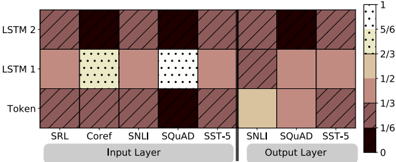
- Using all biLM layers outperforms using only the top layer: for SQuAD, the last biLM layer improves development F1 by 3.9% over baseline, averaging all layers adds another 0.3%, and learned layer weights add another 0.2%.
- Intrinsic evaluations show layer-specific information: biLM top-layer WSD F1 is 69.0 versus 67.4 for the first layer, while POS tagging accuracy is higher at the first layer (97.3) than the top layer (96.8).
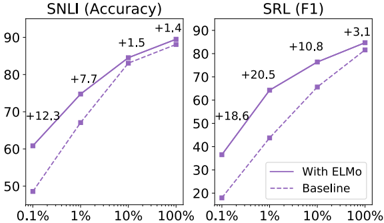
- ELMo increases sample efficiency: the SRL model reaches maximum development F1 after 486 epochs without ELMo, but with ELMo exceeds the baseline maximum at epoch 10, a 98% relative decrease in updates; ELMo with 1% of the training set performs about the same as the baseline with 10%.
Methods
- ELMo is built on a pretrained biLM with two biLSTM layers, 4096 units, 512-dimensional projections, and a residual connection; the context-insensitive type representation uses 2048 character n-gram convolutional filters, two highway layers, and a linear projection to 512 dimensions. The biLM was trained for 10 epochs on the 1B Word Benchmark (approximately 30 million sentences), with average forward/backward perplexity 39.7.
- For downstream tasks, the biLM weights are frozen; all layer representations are recorded, and the task model learns a softmax-normalized linear combination of them. ELMo is concatenated with token embeddings and sometimes also added at the output of the task biRNN, with dropout and sometimes L2 regularization on ELMo weights.
- Evaluation covers six benchmarks—SQuAD, SNLI, SRL, coreference resolution, NER, and SST-5—plus intrinsic WSD on SemCor and POS tagging on PTB.
Limitations
- The paper states no limitations section; no limitations are stated in the paper.
- Evident from the text: evaluation is limited to six benchmark NLP tasks and intrinsic WSD/POS tagging; no other languages or domains are tested.
- Evident from the text: the method depends on a large-scale pretrained biLM and task-specific layer weighting; the paper notes balancing language model perplexity with model size and computational requirements for downstream tasks.
Model-written summary. Check it against the paper before relying on it.
Integrity signals
Registry
Cites
Statistics
Figures
Verification
Claims the paper makes
8 Valid · 3 Not valid · 6 Not checked · 73 Own results and interpretations
Every source the paper cites for this claim was checked and supports it.
In the paper
“For tasks where direct comparisons are possible, ELMo outperforms CoVe (McCann et al., 2017), which computes contextualized representations using a neural machine translation encoder.”
§ Deep contextualized word representations > 1 Introduction
What the sources say
- Supportedcites McCann et al., 2017 matched to “Learned in Translation: Contextualized Word Vectors” (2017) source
The citation identifies CoVe and its method, not the citing authors’ comparison with ELMo. The Abstract (p. 1) describes CoVe as contextualized word vectors produced using an encoder trained for machine translation; Section 4 (p. 4) identifies the encoder’s outputs as context vectors. (LLM, conf=0.90)
plainstates a cause- Asserted: passes — The authors put it forward as true.
- Checkable: passes — It can be checked against evidence.
- Load-bearing: unclear — It is unclear whether the paper’s conclusions depend on it.
- Based: passes — The paper gives a reason why it holds.
- Supported
Every source the paper cites for this claim was checked and supports it.
In the paper
“Unlike most widely used word embeddings (Pennington et al., 2014), ELMo word representations are functions of the entire input sentence, as described in this section.”
§ Deep contextualized word representations > 3 ELMo: Embeddings from Language Models
What the sources say
- Supportedcites Pennington et al., 2014 matched to “Glove: Global Vectors for Word Representation” (2014) source
The citation is offered as an example of the static word embeddings contrasted with ELMo, and our copy of GloVe fits that identification: the Introduction (p. 1) states that semantic vector space models 'represent each word with a real-valued vector' used as features across applications, and the abstract/Introduction describe GloVe as a model that 'trains on global word-word co-occurrence counts' to produce a fixed word vector space (with released trained vectors), i.e. one context-independent vector per word rather than a function of the input sentence. Nothing in our copy makes GloVe representations sentence-dependent, so the contrast the citing sentence draws holds for this source. (LLM, conf=0.85)
plainstates a cause- Asserted: passes — The authors put it forward as true.
- Checkable: passes — It can be checked against evidence.
- Load-bearing: passes — The paper’s conclusions depend on it.
- Based: passes — The paper gives a reason why it holds.
- Supported
The cited sources support only part of this claim — read each source’s verdict below.
In the paper
“However, unlike WSD, accuracies using the first biLM layer are higher than the top layer, consistent with results from deep biL-STMs in multi-task training (Søgaard and Goldberg, 2016;Hashimoto et al., 2017) and MT (Belinkov et al., 2017).”
§ Deep contextualized word representations > POS tagging
What the sources say
- Partly supportedcites Søgaard and Goldberg, 2016 matched to “Deep multi-task learning with low level tasks supervised at lower layers” (2016) sourceExperimental — accuracy not yet measured
Our copy of Søgaard & Goldberg (2016) supports the general direction of the claim: the Experiments and Results section states that 'POS supervision at the lower layer is consistently better than standard MTL' (POS feeding off the inner/1st layer, higher-level task off the outer/3rd), and the Introduction frames the main contribution as 'better performance by having POS task supervision at a lower layer' with supervision of all tasks at the outermost level being 'often suboptimal'. But the accuracy gain the paper reports and quantifies is for the higher-level tasks (CHUNKS F1, CCG supertagging) plus a Rademacher-complexity analysis; no passage in our copy states that POS tagging accuracy itself is higher from the first layer than from the top layer. So the 'lower layer beats top layer' part is supported while the specific attribution to POS-tagging accuracy is not stated in the text we hold. (LLM, conf=0.68)
- Partly supportedcites Hashimoto et al., 2017 matched to “A Joint Many-Task Model: Growing a Neural Network for Multiple NLP Tasks” (2017) sourceExperimental — accuracy not yet measured
Section 2.2 assigns POS tagging to the first bi-LSTM layer, and Section 6 says the model can be used as a POS tagger with only that layer. The paper does not compare POS accuracies from its first and top layers, so it supports the lower-layer connection but not the claimed accuracy advantage. (LLM, conf=0.82)
- Supportedcites Belinkov et al., 2017 matched to “What do Neural Machine Translation Models Learn about Morphology?” (2017) source
The citation is offered for the MT comparison, not as evidence that Belinkov et al. studied biLMs. Section 4.2 reports that first-layer NMT encoder representations outperform second-layer representations on POS tagging, matching the cited comparison. (LLM, conf=0.92)
plainstates an association- Asserted: passes — The authors put it forward as true.
- Checkable: passes — It can be checked against evidence.
- Load-bearing: passes — The paper’s conclusions depend on it.
- Based: passes — The paper gives a reason why it holds.
- Partly supported
The cited sources support only part of this claim — read each source’s verdict below.
In the paper
“The increase of 4.7% with ELMo is also significantly larger then the 1.8% improvement from adding CoVe to a baseline model (McCann et al., 2017).”
§ Deep contextualized word representations > 4 Evaluation
What the sources say
- Partly supportedcites McCann et al., 2017 matched to “Learned in Translation: Contextualized Word Vectors” (2017) sourceExperimental — accuracy not yet measured
The SQuAD results (p. 8, Table 3) support that adding CoVe improved validation performance, but they do not show a 1.8% gain: the listed scores differ by 5.9 points in exact match and 4.3 points in F1. The paper does not compare that gain with ELMo or establish that the difference is significant. (LLM, conf=0.84)
plain- Asserted: passes — The authors put it forward as true.
- Checkable: passes — It can be checked against evidence.
- Load-bearing: passes — The paper’s conclusions depend on it.
- Based: passes — The paper gives a reason why it holds.
- Partly supported
The cited sources support only part of this claim — read each source’s verdict below.
In the paper
“This is competitive with a state-of-the-art WSD-specific supervised model using hand crafted features (Iacobacci et al., 2016) and a task specific biLSTM that is also trained with auxiliary coarse-grained semantic labels and POS tags (Raganato et al., 2017a).”
§ Deep contextualized word representations > 5.3 What information is captured by the biLM's representations?
What the sources say
- Supportedcites Iacobacci et al., 2016 matched to “Embeddings for Word Sense Disambiguation: An Evaluation Study” (2016) source
The Iacobacci et al. citation attaches to the supervised WSD model using hand-crafted features, not to the biLSTM attributed to Raganato et al. Section 4.1 describes the supervised IMS system and its standard POS, context-word, and collocation features; the Conclusions call the standard-feature system state-of-the-art. Page numbers are not supplied in our copy's passages. (LLM, conf=0.92)
- Not matchedcites Raganato et al., 2017a
More than one paper fits this citation.
plain- Asserted: passes — The authors put it forward as true.
- Checkable: passes — It can be checked against evidence.
- Load-bearing: passes — The paper’s conclusions depend on it.
- Based: passes — The paper gives a reason why it holds.
- Supported
51 more claims
Create a free account to see all 90 claims and to verify the 6 references still open.
- It may state two separate claims as one. 23
- Probably not a substantial claim. 13
Claims other papers make about this one
Each is checked against this paper’s own text: does it say what the citing paper says it does?
The source backs part of the claim, not all of it — or backs it for a different population, condition or comparison.
In the citing paper
“In stark contrast, our approach harnesses the potential of Large Language Models (LLMs), particularly their underlying transformer architecture. This modern method enables a more nuanced and contextually aware extraction of meanings at both the word and sentence levels”
From ChatGPT and Deepseek: Can They Predict the Stock Market and Macroeconomy? (2025) · cites this paper as Peters et al., 2018
Experimental — accuracy not yet measuredThe source backs part of the claim, not all of it — or backs it for a different population, condition or comparison.
In the citing paper
“This structure can capture intricate word features, such as synonyms and polysemy, across different linguistic contexts.”
From A Survey of Deep Learning-Based Multimodal Emotion Recognition: Speech, Text, and Face (2023) · cites this paper as [62]
Experimental — accuracy not yet measuredThe source backs part of the claim, not all of it — or backs it for a different population, condition or comparison.
In the citing paper
“we can utilize the technique of fine-tuning pre-trained language models32–35 with family-specific sequences to further improve ProGen’s ability to capture the distribution of local sequence neighborhoods corresponding to the protein family.”
From Large language models generate functional protein sequences across diverse families (2023) · cites this paper as [32]
Experimental — accuracy not yet measuredThe source backs part of the claim, not all of it — or backs it for a different population, condition or comparison.
In the citing paper
“These practical applications of language technology are increasingly reliant on approaches based on trained Large Language Models (LLMs) [23, 41, 104, 111], whereby models are first exposed to as large and varied a collection of language data as possible with the aim of extracting 'general' properties of a language of interest.”
From Data Governance in the Age of Large-Scale Data-Driven Language Technology (2022) · cites this paper as [104]
Experimental — accuracy not yet measuredThe source backs part of the claim, not all of it — or backs it for a different population, condition or comparison.
In the citing paper
“Preliminary work that applied the transfer learning paradigm of pre-training and fine-tuning all of the model's parameters to NLP problems used a causal language modeling objective for pre-training (Dai and Le, 2015; Peters et al., 2018; Radford et al., 2018; Howard and Ruder, 2018).”
From Exploring the Limits of Transfer Learning with a Unified Text-to-Text Transformer (2019) · cites this paper as Peters et al., 2018
Experimental — accuracy not yet measured
17 more claims about this paper
Create a free account to see every claim other papers make about this one.
Self-check
Percentages, sums and reported differences re-computed from the paper’s own numbers.
Each contradiction between two passages listed here was confirmed by an independent check.
Rated minor: it would not touch a result — a value no result rests on, a p-value that stays on the same side of the significance level, or a conflict that is clerical, resolved elsewhere in the paper, or outside its own findings.
In the paper
§ Deep contextualized word representations > 5.6 Contextual vs. sub-word information
“Table 7 summarizes the results for SQuAD, SNLI and SNLI.”
§ Deep contextualized word representations > 6 Conclusion
“Table: 7 Table 7 : Development set ablation analysis for SQuAD, SNLI and SRL comparing different choices for the context-independent type representation and contextual representation.”
Rated minor: it would not touch a result — a value no result rests on, a p-value that stays on the same side of the significance level, or a conflict that is clerical, resolved elsewhere in the paper, or outside its own findings.
In the paper
§ Deep contextualized word representations > 4 Evaluation
“with relative error reductions ranging from 6 -20% over strong base models.”
§ Deep contextualized word representations > 4 Evaluation
“After adding ELMo to the baseline model, test set F 1 improved by 4.7% from 81.1% to 85.8%, a 24.9% relative error reduction over the baseline”
Citations
Cites
Hochreiter, S., & Schmidhuber, J. (1997) · Neural Computation · doi:10.1162/neco.1997.9.8.1735 · Cited by 102,318 · cited 2×
“, 2016) uses a bidirectional Long Short Term Memory (LSTM; Hochreiter and Schmidhuber, 1997) to encode the context around a pivot word.”
MethodAdam: A Method for Stochastic Optimization
Kingma, D. P., & Ba, J. (2014) · arXiv · doi:10.48550/arxiv.1412.6980 · Cited by 98,946
Glove: Global Vectors for Word Representation
Pennington, J., Socher, R., & Manning, C. (2014) · Proceedings of the 2014 Conference on Empirical Methods in Natural Language Processing (EMNLP) · doi:10.3115/v1/d14-1162 · Cited by 34,071
(2014) · Cited by 33,419
Distributed Representations of Words and Phrases and their Compositionality
Mikolov, T., Sutskever, I., Chen, K., Corrado, G., & Dean, J. (2013) · arXiv · doi:10.48550/arxiv.1310.4546 · Cited by 24,533 · cited 3×
“Due to their ability to capture syntactic and semantic information of words from large scale unlabeled text, pretrained word vectors (Turian et al., 2010; Mikolov et al., 2013; Pennington et al., 2014) are a standard component of most state-ofthe-art NLP architectures, including for question answering (Liu et al.”
BackgroundEnriching Word Vectors with Subword Information
Bojanowski, P., Grave, E., Joulin, A., & Mikolov, T. (2017) · Transactions of the Association for Computational Linguistics · doi:10.1162/tacl_a_00051 · Cited by 9,645 · cited 2×
“Previously proposed methods overcome some of the shortcomings of traditional word vectors by either enriching them with subword information (e.g., Wieting et al., 2016; Bojanowski et al., 2017) or learning separate vectors for each word sense (e.”
MethodBuilding a Large Annotated Corpus of English: The Penn Treebank
Marcus, M. (1993) · doi:10.21236/ada273556 · Cited by 7,405
On the Properties of Neural Machine Translation: Encoder–Decoder Approaches
Cho, K., van Merrienboer, B., Bahdanau, D., & Bengio, Y. (2014) · Proceedings of SSST-8, Eighth Workshop on Syntax, Semantics and Structure in Statistical Translation · doi:10.3115/v1/w14-4012 · Cited by 7,099
Recursive Deep Models for Semantic Compositionality Over a Sentiment Treebank
Socher, R., Perelygin, A., Wu, J., Chuang, J., Manning, C. D., Ng, A., & Potts, C. (2013) · Proceedings of the 2013 Conference on Empirical Methods in Natural Language Processing · doi:10.18653/v1/d13-1170 · Cited by 6,878
SQuAD: 100,000+ Questions for Machine Comprehension of Text
Rajpurkar, P., Zhang, J., Lopyrev, K., & Liang, P. (2016) · Proceedings of the 2016 Conference on Empirical Methods in Natural Language Processing · doi:10.18653/v1/d16-1264 · Cited by 6,208 · cited 2×
“Question answering The Stanford Question Answering Dataset (SQuAD) (Rajpurkar et al., 2016) contains 100K+ crowd sourced question-answer pairs where the answer is a span in a given Wikipedia paragraph.”
Background
Research works printed but not linked: 4
- [2]2. Yonatan Belinkov, Nadir Durrani, Fahim Dalvi, Has- san Sajjad, and James R. Glass. 2017. What do neu- ral machine translation models learn about morphol- ogy? In ACL.
- [4]4. Samuel R. Bowman, Gabor Angeli, Christopher Potts, and Christopher D. Manning. 2015. A large an- notated corpus for learning natural language infer- ence. In Proceedings of the 2015 Conference on Empirical Methods in Natural Language Processing (EMNLP). Association for Computational Linguis- tics.
- [36]36. Tomas Mikolov, Ilya Sutskever, Kai Chen, Greg S Cor- rado, and Jeff Dean. 2013. Distributed representa- tions of words and phrases and their compositional- ity. In NIPS.
- [48]48. Prajit Ramachandran, Peter Liu, and Quoc Le. 2017. Improving sequence to sequence learning with unla- beled data. In EMNLP.
Cited by
Items 8,101–8,200 of 12,015
Better, Faster, Stronger Sequence Tagging Constituent Parsers
Vilares, D., Abdou, M., & Søgaard, A. (2019) · Conference of the North American Chapter of the Association for Computational Linguistics: Human Language Technologies (NAACL-HLT) · doi:10.18653/v1/n19-1341 · Cited by 30
Temporal and Aspectual Entailment
Kober, T., de Vroe, S. B., & Steedman, M. J. (2019) · International Conference on Computational Semantics (IWCS) · doi:10.18653/v1/w19-0409 · Cited by 22
Word Pair Convolutional Model for Happy Moment Classification.
Saxon, M., Bhandari, S., Ruskin, L., & Honda, G. (2019) · National Conference on Artificial Intelligence · Cited by 3
Towards language-agnostic alignment of product titles and descriptions: a neural approach
Stein, D., Shterionov, D., & Way, A. (2019) · International World Wide Web Conference (WWW) · doi:10.1145/3308560.3316602 · Cited by 3
AGRR 2019: Corpus for Gapping Resolution in Russian
Ponomareva, M., Droganova, K., Smurov, I., & Shavrina, T. (2019) · Workshop on Balto-Slavic Natural Language Processing (BSNLP) · doi:10.18653/v1/w19-3705 · Cited by 3
Encouraging Paragraph Embeddings to Remember Sentence Identity Improves Classification
Vu, T., & Iyyer, M. (2019) · Proceedings of the conference - Association for Computational Linguistics. Meeting · doi:10.18653/v1/p19-1638 · Cited by 3
Self-citationLiu, Z., Goel, S., Raghuprasad, M. Y., & Muresan, S. (2019) · International Workshop on Semantic Evaluation (SemEval) · doi:10.18653/v1/s19-2194 · Cited by 5
Uppsala University and Gavagai at CLEF eRISK : Comparing Word Embedding Models
Fano, E., Jussi Karlgren, C., & Nivre, J. (2019) · Cross-Language Evaluation Forum · Cited by 3
Projecting named entity recognizers without annotated or parallel corpora
Hou, J., Koppatz, M., Quecedo, J. M. H., & Yangarber, R. (2019) · DSpace repository (University of Tartu) · Cited by 3
Mapping Lexical Knowledge to Distributed Models for Ontology Concept Invention
Vimercati, M., Bianchi, F., Soto, M., & Palmonari, M. (2019) · Lecture notes in computer science · doi:10.1007/978-3-030-35166-3_40 · Cited by 4
TILM: Neural Language Models with Evolving Topical Influence
Santu, S. K. K., Veeramachaneni, K. K., & Zhai, C. (2019) · Conference on Computational Natural Language Learning · doi:10.18653/v1/k19-1073 · Cited by 3
Exploring Graph-Algebraic CCG Combinators for Syntactic-Semantic AMR Parsing
Beschke, S. (2019) · doi:10.26615/978-954-452-056-4_014 · Cited by 3
Improving Disease Named Entity Recognition for Clinical Trial Matching
Khan, M. A. A. H., Dimitrova, N., Shamsuzzaman, M., Hasan, S. A., Sorower, M. S., Liu, J., Datla, V. V., Milosevic, M., Mankovich, G., & van Ommering, R. (2019) · IEEE International Conference on Bioinformatics and Biomedicine (BIBM) · doi:10.1109/bibm47256.2019.8983421 · Cited by 6
Transformer based Chinese Sentiment Classification
Zhu, Z., Zhou, Y., & Xu, S. (2019) · International Conference on Computational Intelligence and Intelligent Systems (CIIS) · doi:10.1145/3372422.3372438 · Cited by 3
Towards Robust Neural Machine Reading Comprehension via Question Paraphrases
Li, Y., Li, H., & Liu, J. (2019) · International Conference on Asian Language Processing · doi:10.1109/ialp48816.2019.9037673 · Cited by 3
Semi-Supervised Sentence Classification Based on User Polarity in the Social Scenarios
Ma, B., Sun, H., Wang, J., Qi, Q., & Liao, J. (2020) · IEEE International Conference on Acoustics Speech and Signal Processing · doi:10.1109/icassp40776.2020.9053774 · Cited by 3
Entropy-Based Approach for the Detection of Changes in Arabic Newspapers’ Content
Bernikova, O. A., Granichin, O. N., Lemberg, D., et al. (2020) · Entropy · doi:10.3390/e22040441 · Cited by 3
Laville, M., Bouhandi, M., Morin, E., & Langlais, P. (2020) · Lecture notes in computer science · doi:10.1007/978-3-030-47358-7_36 · Cited by 3
Is Language Modeling Enough? Evaluating Effective Embedding Combinations
Schneider, R., Oberhauser, T., Grundmann, P., Gers, F. A., Löser, A., & Staab, S. (2020) · ePrints Soton (University of Southampton) · Cited by 3
Embedding Space Correlation as a Measure of Domain Similarity
Beyer, A., Kauermann, G., & Schütze, H. (2020) · Language Resources and Evaluation · Cited by 3
Subword-Level Chinese Text Classification Method Based on BERT
李, 思. (2020) · Computer Science and Application · doi:10.12677/csa.2020.106112 · Cited by 4
Extremely Low-Resource Text Simplification with Pre-trained Transformer Language Model
Maruyama, T., & Yamamoto, K. (2020) · International Journal of Asian Language Processing · doi:10.1142/s2717554520500010 · Cited by 3
You Don’t Have Time to Read This: An Exploration of Document Reading Time Prediction
Weller, O., Hildebrandt, J., Reznik, I., Challis, C., Tass, E. S., Snell, Q. O., & Seppi, K. D. (2020) · Proceedings of the conference - Association for Computational Linguistics. Meeting · doi:10.18653/v1/2020.acl-main.162 · Cited by 3
Chemical and Textual Embeddings for Drug Repurposing
Nordon, G., Gottlieb, L., & Radinsky, K. (2020) · Proceedings of the AAAI Conference on Artificial Intelligence · doi:10.1609/aaai.v34i08.7046 · Cited by 5
Contextual representation of self-disclosure and supportiveness in short text
Akiti, C., Rajtmajer, S. M., & Squicciarini, A. (2020) · National Conference on Artificial Intelligence · Cited by 3
CS-NET at SemEval-2020 Task 4: Siamese BERT for ComVE
Dash, S. R., Routray, S., Varshney, P., & Modi, A. (2020) · International Workshop on Semantic Evaluation (SemEval) · doi:10.18653/v1/2020.semeval-1.61 · Cited by 4
Predicting Fans’ FIFA World Cup Team Preference from Tweets
Rabbi, M. F., Mukta, M. S. H., Jenia, T. N., & Islam, A. K. M. N. (2020) · Lecture notes of the Institute for Computer Sciences, Social Informatics and Telecommunications Engineering · doi:10.1007/978-3-030-52856-0_22 · Cited by 3
Effects of Architecture and Training on Embedding Geometry and Feature Discriminability in BERT
Podkorytov, M., Biś, D., Cai, J., Amirizirtol, K., & Liu, X. (2020) · International Joint Conference on Neural Networks (IJCNN) · doi:10.1109/ijcnn48605.2020.9206645 · Cited by 7
Word Graph Network: Understanding Obscure Sentences on Social Media for Violation Comment Detection
Ma, D., Liu, H., & Song, D. (2020) · Lecture notes in computer science · doi:10.1007/978-3-030-60450-9_58 · Cited by 3
Abstractive Summarization via Discourse Relation and Graph Convolutional Networks
Wei, W., Wang, H., & Wang, Z. (2020) · Lecture notes in computer science · doi:10.1007/978-3-030-60457-8_27 · Cited by 4
Multi-hop Reading Comprehension Incorporating Sentence-Based Reasoning
Huo, L., Ge, B., & Zhao, X. H. (2020) · Lecture notes in computer science · doi:10.1007/978-3-030-60259-8_40 · Cited by 4
A Short-Patterning of the Texts Attributed to Al Ghazali: A “Twitter Look” at the Problem
Volkovich, Z. (2020) · Mathematics · doi:10.3390/math8111937 · Cited by 3
Meta-context Transformers for Domain-Specific Response Generation
Kar, D., Samanta, S., & Azad, A. P. (2021) · Lecture notes in computer science · doi:10.1007/978-3-030-75768-7_23 · Cited by 3
Patra, B., Fufa, C., Bhattacharya, P., & Lee, C. (2020) · Conference on Empirical Methods in Natural Language Processing (EMNLP) · doi:10.18653/v1/2020.emnlp-main.678 · Cited by 3
Analysing Word Representation from the Input and Output Embeddings in Neural Network Language Models
Derby, S., Miller, P. C., & Devereux, B. J. (2020) · Conference on Computational Natural Language Learning · doi:10.18653/v1/2020.conll-1.36 · Cited by 6
Controlling the Imprint of Passivization and Negation in Contextualized Representations
Çelikkanat, H., Virpioja, S., Tiedemann, J., & Apidianaki, M. (2020) · BlackboxNLP Workshop on Analyzing and Interpreting Neural Networks for NLP · doi:10.18653/v1/2020.blackboxnlp-1.13 · Cited by 8
Multitask Learning for Cross-Lingual Transfer of Broad-coverage Semantic Dependencies
Aminian, M., Rasooli, M. S., & Diab, M. (2020) · Conference on Empirical Methods in Natural Language Processing (EMNLP) · doi:10.18653/v1/2020.emnlp-main.663 · Cited by 4
Ghannay, S., Servan, C., & Rosset, S. (2020) · International Conference on Computational Linguistics · doi:10.18653/v1/2020.coling-main.245 · Cited by 3
Multi-sense Language Modelling
Lekkas, A., Schneider–Kamp, P., & Augenstein, I. (2022) · doi:10.18653/v1/2022.distcurate-1.2 · Cited by 3
TALES: Test Set of Portuguese Lexical-Semantic Relations for Assessing Word Embeddings
Oliveira, H. G., Sousa, T., & Alves, A. (2020) · European Conference on Artificial Intelligence · Cited by 3
Deep Inside-outside Recursive Autoencoder with All-span Objective
Hong, R., Cai, J., & Tu, K. (2020) · International Conference on Computational Linguistics · doi:10.18653/v1/2020.coling-main.322 · Cited by 3
Adversarial Domain Adaptation for Crisis Data Classification on Social Media
Chen, Q., Wang, W., Huang, K., De, S., & Coenen, F. (2020) · IEEE International Conference on Internet of Things (iThings) and IEEE Green Computing and Communications (GreenCom) and IEEE Cyber, Physical and Social Computing (CPSCom) and IEEE Smart Data (SmartData) · doi:10.1109/ithings-greencom-cpscom-smartdata-cybermatics50389.2020.00061 · Cited by 4
LMVE at SemEval-2020 Task 4: Commonsense Validation and Explanation Using Pretraining Language Model
Liu, S., Guo, Y. H., Li, B., & Ren, F. (2020) · International Workshop on Semantic Evaluation (SemEval) · doi:10.18653/v1/2020.semeval-1.70 · Cited by 3
MaP: A Matrix-based Prediction Approach to Improve Span Extraction in Machine Reading Comprehension
Luo, H., Shi, Y., Gong, M., Shou, L., & Li, T. (2020) · Conference of the Asia-Pacific Chapter of the Association for Computational Linguistics and the International Joint Conference on Natural Language Processing (AACL-IJCNLP) · doi:10.18653/v1/2020.aacl-main.69 · Cited by 5
Tomasulo, J., Wang, J., & Zhang, X. (2020) · International Workshop on Semantic Evaluation (SemEval) · doi:10.18653/v1/2020.semeval-1.110 · Cited by 3
Martinkovic, M., Pecar, S., & Šimko, M. (2020) · International Workshop on Semantic Evaluation (SemEval) · doi:10.18653/v1/2020.semeval-1.232 · Cited by 3
UnihanLM: Coarse-to-Fine Chinese-Japanese Language Model Pretraining with the Unihan Database
Xu, C., Ge, T., Li, C., & Wei, F. (2020) · Conference of the Asia-Pacific Chapter of the Association for Computational Linguistics and the International Joint Conference on Natural Language Processing (AACL-IJCNLP) · doi:10.18653/v1/2020.aacl-main.24 · Cited by 5
Data Selection for Bilingual Lexicon Induction from Specialized Comparable Corpora
Laville, M., Hazem, A., Morin, E., & Langlais, P. (2020) · International Conference on Computational Linguistics · doi:10.18653/v1/2020.coling-main.527 · Cited by 3
Kanani, C. S., Saha, S., & Bhattacharyya, P. (2020) · International Workshop on Semantic Evaluation (SemEval) · doi:10.18653/v1/2020.semeval-1.214 · Cited by 3
Mongolian Questions Classification in the Law Domain
Wang, G., Bao, F., & Wang, W. (2020) · International Conference on Asian Language Processing · doi:10.1109/ialp51396.2020.9310455 · Cited by 3
Frerich, K., Bukowski, M., Geisler, S., & Farkas, R. (2021) · Applied Sciences · doi:10.3390/app11020690 · Cited by 4
Tebbifakhr, A., Negri, M., & Turchi, M. (2020) · International Conference on Computational Linguistics · Cited by 7
Coloring the Black Box: What Synesthesia Tells Us about Character Embeddings
Kann, K., & Monsalve‐Mercado, M. M. (2021) · Conference of the European Chapter of the Association for Computational Linguistics · doi:10.18653/v1/2021.eacl-main.230 · Cited by 4
Comparing Knowledge-Intensive and Data-Intensive Models for English Resource Semantic Parsing
Cao, J., Lin, Z. J., Sun, W., & Wan, X. (2021) · Computational Linguistics · doi:10.1162/coli_a_00395 · Cited by 8
Changing the Geometry of Representations: α-Embeddings for NLP Tasks
Volpi, R., Thakur, U., & Malagò, L. (2021) · Entropy · doi:10.3390/e23030287 · Cited by 5
Concept Identification of Directly and Indirectly Related Mentions Referring to Groups of Persons
Zhukova, A., Hamborg, F., Donnay, K., & Gipp, B. (2021) · Lecture notes in computer science · doi:10.1007/978-3-030-71292-1_40 · Cited by 3
Project Reporting Management System with AI based Assistive Features for Text Summarization
Tan, J. B. B., Chen, Q., & Yeo, C. K. (2021) · International Journal of Machine Learning and Computing · doi:10.18178/ijmlc.2021.11.1.1009 · Cited by 3
Modeling Human Mental States with an Entity-based Narrative Graph
Lee, I.-T., Pacheco, M. L., & Goldwasser, D. (2021) · Conference of the North American Chapter of the Association for Computational Linguistics: Human Language Technologies (NAACL-HLT) · doi:10.18653/v1/2021.naacl-main.391 · Cited by 8
Is “hot pizza” Positive or Negative? Mining Target-aware Sentiment Lexicons
Zhou, J., Wu, Y., Sun, C., & He, L. (2021) · Conference of the European Chapter of the Association for Computational Linguistics · doi:10.18653/v1/2021.eacl-main.49 · Cited by 3
Benchmarking Pre-trained Language Models for Multilingual NER: TraSpaS at the BSNLP2021 Shared Task
Šuppa, M., & Jariabka, O. (2021) · Cited by 3
Toward Development of A.D.A. – Advanced Distributed Assistant
Scattone, F. F., Rosa, T. D. O., Santo, G. F. D. E., Elmadjian, C., Ferreira, R. C., Moura, S., Andrade, A., Omena, L. A. D., Vicente, A., Marques, F. D. S., et al. (2020) · Simpósio em Sistemas Computacionais de Alto Desempenho (SSCAD) · doi:10.5753/wscad.2020.14070 · Cited by 3
Unsupervised Learning of Explainable Parse Trees for Improved Generalisation
Sahay, A., Maheshwari, A., Kumar, R., Ramakrishnan, G., Hanawal, M. K., & Arya, K. (2021) · International Joint Conference on Neural Networks (IJCNN) · doi:10.1109/ijcnn52387.2021.9533448 · Cited by 3
Biodiversity in NLP: modelling lexical meaning with the Fruit Fly Algorithm
Preissner, S., & Herbelot, A. (2020) · Italian Journal of Computational Linguistics · doi:10.4000/ijcol.609 · Cited by 4
Automatic Methods for Detecting Cultural Bias in Social Media (Based on Telegram’s Dialogs)
Zherebtsova, Y. A., Chizhik, A. V., & Садохин, А. П. (2021) · Vestnik NSU Series Linguistics and Intercultural Communication · doi:10.25205/1818-7935-2021-19-2-54-72 · Cited by 3
Exploring Cross-Lingual Transfer Learning with Unsupervised Machine Translation
Wang, C., Gaspers, J., Thi, Q. N., & Jiang, H. (2021) · Findings of the Association for Computational Linguistics: ACL (Findings of ACL) · doi:10.18653/v1/2021.findings-acl.177 · Cited by 4
Entity Enhancement for Implicit Discourse Relation Classification in the Biomedical Domain
Shi, W. Y., & Demberg, V. (2021) · doi:10.18653/v1/2021.acl-short.116 · Cited by 5
YoungSheldon at SemEval-2021 Task 7: Fine-tuning Is All You Need
Sharma, M., Kandasamy, I., & Vasantha, W. B. (2021) · International Workshop on Semantic Evaluation · doi:10.18653/v1/2021.semeval-1.161 · Cited by 4
Re-entry Prediction for Online Conversations via Self-Supervised Learning
Wang, L., Zeng, X., Huang, H., Wong, K., & Jiang, D. (2021) · Findings of the Association for Computational Linguistics: EMNLP (Findings of EMNLP) · doi:10.18653/v1/2021.findings-emnlp.183 · Cited by 4
Enhancing Question Generation with Commonsense Knowledge
Jia, X., Wang, H. E., Yin, D., & Wu, Y. (2021) · Lecture notes in computer science · doi:10.1007/978-3-030-84186-7_10 · Cited by 10
Adversarial Constraint Evaluation on Biomedical Text Mining
Wang, Y., & Zhang, H. (2021) · Lecture notes in computer science · doi:10.1007/978-3-030-82153-1_21 · Cited by 3
Contextualized Knowledge Base Sense Embeddings in Word Sense Disambiguation
Saeidi, M., Milios, E., & Zeh, N. (2021) · Lecture notes in computer science · doi:10.1007/978-3-030-86159-9_12 · Cited by 3
TSIA team at FakeDeS 2021: Fake News Detection in Spanish Using Multi-Model Ensemble Learning.
Guan, Z. (2021) · IberLEF@SEPLN · Cited by 3
Age Estimates from Name Characters
Liou, J.-S., Hsiao, C.-Y., Chow, L.-Y., Huang, Y.-H., & Chen, Y.-S. (2021) · Applied Sciences · doi:10.3390/app11209611 · Cited by 3
Incorporate Lexicon into Self-training: A Distantly Supervised Chinese Medical NER
Gan, Z., Li, Z., Zhang, B., Wan, J., Chen, Y., Liu, K., Zhao, J., Shi, Y., & Liu, S. (2021) · Lecture notes in computer science · doi:10.1007/978-3-030-88480-2_27 · Cited by 3
Fine and Coarse Granular Argument Classification before Clustering
Dumani, L., Wiesenfeldt, T., & Schenkel, R. (2021) · ACM International Conference on Information and Knowledge Management (CIKM) · doi:10.1145/3459637.3482431 · Cited by 8
Analisis Metode Representasi Teks Untuk Deteksi Interelasi Kitab Hadis: Systematic Literature Review
Ariyanto, A. D. P., Fatichah, C., & Arifin, A. Z. (2021) · Jurnal RESTI (Rekayasa Sistem dan Teknologi Informasi) · doi:10.29207/resti.v5i5.3499 · Cited by 11
A Model Fusion Approach for Goods Information Inspection in Dual-Platform E-Commerce Systems
Liu, Y., Zhao, Z., Jiang, T., Wang, Y., Wu, S., & Zhe, W. (2021) · IEEE International Conference on Emerging Technologies and Factory Automation (ETFA) · doi:10.1109/etfa45728.2021.9613493 · Cited by 5
Le, A. P., Pham, T. V., Le, T.-V., & Huynh, D. V. (2021) · IEEE International Conference on Machine Learning and Applied Network Technologies (ICMLANT) · doi:10.1109/icmlant53170.2021.9690554 · Cited by 3
Syntax-Informed Question Answering with Heterogeneous Graph Transformer
Zhu, F., Tan, L. Y., Ng, S.-K., & Bressan, S. (2022) · Lecture notes in computer science · doi:10.1007/978-3-031-12423-5_2 · Cited by 3
Flow-Adapter Architecture for Unsupervised Machine Translation
Liu, Y., Jabbar, H., & Schuetze, H. (2022) · Proceedings of the conference - Association for Computational Linguistics. Meeting · doi:10.18653/v1/2022.acl-long.89 · Cited by 9
Duan, R., Yang, X., Wang, Q., & Zhao, Y. (2021) · 2021 2nd International Conference on Electronics, Communications and Information Technology (CECIT) · doi:10.1109/cecit53797.2021.00028 · Cited by 3
An Unsupervised Way to Understand Artifact Generating Internal Units in Generative Neural Networks
Jeong, H., Han, J., & Choi, J. (2022) · Proceedings of the AAAI Conference on Artificial Intelligence · doi:10.1609/aaai.v36i1.19989 · Cited by 5
Visual Semantic Planning for Service Robot via Natural Language Instructions
Wang, K., Zhang, Y., Jiang, C., Luo, J., Xueke, Y., & Chen, S. (2021) · China Automation Congress (CAC) · doi:10.1109/cac53003.2021.9728603 · Cited by 4
Kebe, G. Y., Richards, L. E., Raff, E., Ferraro, F., & Matuszek, C. (2022) · Proceedings of the AAAI Conference on Artificial Intelligence · doi:10.1609/aaai.v36i10.21335 · Cited by 7
Named Entity Linking on Handwritten Document Images
Tüselmann, O., & Fink, G. A. (2022) · Lecture notes in computer science · doi:10.1007/978-3-031-06555-2_14 · Cited by 4
NER4ID at SemEval-2022 Task 2: Named Entity Recognition for Idiomaticity Detection
Tedeschi, S., & Roberto Navigli, A. (2022) · International Workshop on Semantic Evaluation (SemEval) · doi:10.18653/v1/2022.semeval-1.25 · Cited by 3
Liu, K., Wang, J., & Zhang, X. (2022) · International Workshop on Semantic Evaluation (SemEval) · doi:10.18653/v1/2022.semeval-1.26 · Cited by 6
Improving sequence labeling with labeled clue sentences
Wang, Q., Wen, Z., Ding, K., Zhao, Q., Yang, M., Yu, X., & Xu, R. (2022) · Knowledge-Based Systems · doi:10.1016/j.knosys.2022.109828 · Cited by 3
CRSAtt: By Capturing Relational Span and Using Attention for Relation Classification
Shao, C., Li, M., Li, G., Zhou, M., & Han, D. (2022) · Applied Sciences · doi:10.3390/app122111068 · Cited by 3
Are Male Candidates Better than Females? Debiasing BERT Resume Retrieval System
Zhang, S., Li, P., & Cai, Z. (2022) · Conference proceedings/Conference proceedings - IEEE International Conference on Systems, Man, and Cybernetics · doi:10.1109/smc53654.2022.9945184 · Cited by 5
d'Obrenan, C. V. D. B., Galliano, F., Minton, J., Botev, V., & Wu, R. (2023) · Journal of Interdisciplinary Methodologies and Issues in Sciences · doi:10.46298/jimis.9388 · Cited by 3
Emotion Detection on Indonesian Tweets Using CNN and Contextualized Word Embedding
Heldiansyah, M. F., & Winarko, E. (2022) · International Conference on Data and Software Engineering · doi:10.1109/icodse56892.2022.9972229 · Cited by 4
General Cross-Architecture Distillation of Pretrained Language Models into Matrix Embeddings
Galke, L. P. A., Cuber, I., Meyer, C., Nölscher, H. F., Sonderecker, A., & Scherp, A. (2022) · International Joint Conference on Neural Networks (IJCNN) · doi:10.1109/ijcnn55064.2022.9892144 · Cited by 3
Recall, Expand, and Multi-Candidate Cross-Encode: Fast and Accurate Ultra-Fine Entity Typing
Jiang, C., Hui, W., Jiang, Y., Wang, X., Xie, P., & Tu, K. (2023) · Proceedings of the conference - Association for Computational Linguistics. Meeting · doi:10.18653/v1/2023.acl-long.648 · Cited by 4
Real-World Compositional Generalization with Disentangled Sequence-to-Sequence Learning
Zheng, H. R., & Lapata, M. (2023) · Findings of the Association for Computational Linguistics: ACL (Findings of ACL) · doi:10.18653/v1/2023.findings-acl.108 · Cited by 9
Probing Physical Reasoning with Counter-Commonsense Context
Kondo, K., Sugawara, S., & Aizawa, A. (2023) · Proceedings of the conference - Association for Computational Linguistics. Meeting · doi:10.18653/v1/2023.acl-short.53 · Cited by 10
Wei, Y.-C., & King, M. (2023) · International Workshop on Semantic Evaluation (SemEval) · doi:10.18653/v1/2023.semeval-1.55 · Cited by 3
Probing with Noise: Unpicking the Warp and Weft of Embeddings
Klubička, F., & Kelleher, J. D. (2022) · BlackboxNLP Workshop on Analyzing and Interpreting Neural Networks for NLP (BlackboxNLP) · doi:10.18653/v1/2022.blackboxnlp-1.34 · Cited by 6
An Empirical Study on Finding Spans
Gu, W., Zheng, B., Chen, Y., Chen, T., & Durme, B. V. (2022) · Conference on Empirical Methods in Natural Language Processing (EMNLP) · doi:10.18653/v1/2022.emnlp-main.264 · Cited by 5
Sliding-Bert: Striding Towards Conversational Machine Comprehension in Long Contex
Zhang, L., Wang, W., Yu, K., Huang, J., Lyu, Q., Xue, H., & Hetang, C. (2023) · Advances in Artificial Intelligence and Machine Learning · doi:10.54364/aaiml.2023.1178 · Cited by 7
Metadata
- Authors
- Peters, M., Neumann, M., Iyyer, M., Gardner, M., Clark, C., Lee, K., & Zettlemoyer, L.
- Affiliations
- Allen Institute for Artificial Intelligence (US)
- University of Washington (US)
- Venue
- Proceedings of the 2018 Conference of the North American Chapter of the Association for Computational Linguistics: Human Language Technologies, Volume 1 (Long Papers)
- Published
- 2018
- Pages
- 2227-2237
- OpenAlex
- W2787560479
- Semantic Scholar
- 3febb2bed8865945e7fddc99efd791887bb7e14f
- Cited by
- 11,983
- References
- 53
- Citations by year
- 2026: 193 · 2025: 554 · 2024: 783 · 2023: 1395 · 2022: 1667 · 2021: 2573 · 2020: 2552 · 2019: 1977 · 2018: 284
- FWCI
- 754.67
- Type
- conference paper
- Language
- en
- Open access
- hybrid
- doi.org
- Licence
- cc-by
- Locations
- Conference of the North American Chapter of the Association for Computational Linguistics: Human Language Technologies (NAACL-HLT) (publishedVersion, cc-by)
- arXiv (Cornell University) (submittedVersion)
- arXiv (Cornell University)
- Topics
- Physical Sciences › Computer Science › Artificial Intelligence › Topic Modeling
- Physical Sciences › Computer Science › Artificial Intelligence › Natural Language Processing Techniques
- Physical Sciences › Computer Science › Artificial Intelligence › Sentiment Analysis and Opinion Mining
- Keywords
- contextualized word representations, word embeddings, word sense disambiguation
About these checks
Registry, retraction, Cites and statistics results are computed, not judged, with one exception: a printed reference that no index lists is read once by a model before it counts as a citation error. Claims are extracted by a model and kept only when their quote appears verbatim in the text; each cited source is then checked, with a model’s help, for whether it says what the claim relies on. Those verdicts can be wrong — read the claim’s quote and the cited source before relying on one.
The claim verdicts this report counts are experimental: their accuracy is not yet measured.
A language model drew the claims from the paper on 2026-10-23, under version 3 of the claim definition (model deepseek-v4.1-flash, prompt extract-v3).
A second model labelled each claim on 2026-10-23 (model jev-1.13-20260917, definition revision gold-guideline-v0.2).
Cited sources are checked with a language model’s help (gpt-6-sol and qwen3.8-omni-flash).
Statistics and arithmetic are recomputed, not judged.
Confidence bands are shown only for fields calibrated on our annotated test set. None is calibrated yet, so no band is shown.
What counts as a claim ›How we measure confidence ›How we check this ›
Are you an author, or do you see a problem with this page? Request a review
Data sources
Bibliographic data: Semantic Scholar, OpenAlex, Crossref.
Contains information from the Semantic Scholar Academic Graph Datasets, made available under the ODC Attribution License (ODC-BY 1.0).
Semantic Scholar’s data is described in: Kinney, R., et al. (2023). The Semantic Scholar Open Data Platform. arXiv:2301.10140.
