

What makes a good conversation? How controllable attributes affect human judgments
Open accessThe DOI matches its Crossref record; 42 of the 44 references it cites were found in a registry or an index.
Abstract
Abigail See, Stephen Roller, Douwe Kiela, Jason Weston. Proceedings of the 2019 Conference of the North American Chapter of the Association for Computational Linguistics: Human Language Technologies, Volume 1 (Long and Short Papers). 2019.
Overview
The claims and statistics of this paper haven’t been checked yet.
Free: it reads the open-access text and checks the first 5 claims that cite a source we can check. Create a free account to check every claim.
Integrity signals
Registry
Cites
Statistics
Figures

Verification
Claims the paper makes
The claims and statistics of this paper haven’t been checked yet.
Free: it reads the open-access text and checks the first 5 claims that cite a source we can check. Create a free account to check every claim.
Claims other papers make about this one
Each is checked against this paper’s own text: does it say what the citing paper says it does?
The cited source says what the claim attributes to it.
In the citing paper
“And there are clear programming parallels to factors such as specificity and repetition that have been identified to affect human judgements of conversation quality [10].”
From Productivity Assessment of Neural Code Completion (2022) · cites this paper as [10]
Self-check
Percentages, sums and reported differences re-computed from the paper’s own numbers.
The self-check needs the paper’s full text.
Citations
Cites
Glove: Global Vectors for Word Representation
Pennington, J., Socher, R., & Manning, C. (2014) · Proceedings of the 2014 Conference on Empirical Methods in Natural Language Processing (EMNLP) · doi:10.3115/v1/d14-1162 · Cited by 34,071
Zhu, Y., Kiros, R., Zemel, R., Salakhutdinov, R., Urtasun, R., Torralba, A., & Fidler, S. (2015) · 2015 IEEE International Conference on Computer Vision (ICCV) · doi:10.1109/iccv.2015.11 · Cited by 2,264
Zhu, Y., Kiros, R., Zemel, R., Salakhutdinov, R., Urtasun, R., Torralba, A., & Fidler, S. (2015) · arXiv · doi:10.48550/arxiv.1506.06724 · Cited by 2,264
A Diversity-Promoting Objective Function for Neural Conversation Models
Li, J., Galley, M., Brockett, C., Gao, J., & Dolan, B. (2016) · Proceedings of the 2016 Conference of the North American Chapter of the Association for Computational Linguistics: Human Language Technologies · doi:10.18653/v1/n16-1014 · Cited by 1,926 · cited 1×
“Other works do use human evaluations (Vinyals and Le, 2015; Venkatesh et al., 2017; Li et al., 2016b,a; Zhang et al., 2018b; Di-nan et al., 2018), typically reporting just one type of judgment (either quality or appropriateness) either using a Likert scale or pairwise comparisons.”
MethodLiu, C.-W., Lowe, R., Serban, I., Noseworthy, M., Charlin, L., & Pineau, J. (2016) · Proceedings of the 2016 Conference on Empirical Methods in Natural Language Processing · doi:10.18653/v1/d16-1230 · Cited by 1,228
Personalizing Dialogue Agents: I have a dog, do you have pets too?
Zhang, S., Dinan, E., Urbanek, J., Szlam, A., Kiela, D., & Weston, J. (2018) · Proceedings of the 56th Annual Meeting of the Association for Computational Linguistics (Volume 1: Long Papers) · doi:10.18653/v1/p18-1205 · Cited by 1,177 · cited 4×
“Conducting experiments on the PersonaChat task (Zhang et al., 2018b), we obtain significantly higher engaging-ness scores than the baseline by optimizing con-trol of repetition, specificity and question-asking over multiple turns.”
BackgroundMethodInfluentialSelf-citation(2017) · International Conference on Learning Representations · Cited by 1,075
Adversarial Learning for Neural Dialogue Generation
Li, J., Monroe, W., Shi, T., Jean, S., Ritter, A., & Jurafsky, D. (2017) · Proceedings of the 2017 Conference on Empirical Methods in Natural Language Processing · doi:10.18653/v1/d17-1230 · Cited by 873 · cited 3×
“There are more recent attempts to find better automatic approaches, such as adversarial evaluation (Li et al., 2017b) and learning a scoring model (Lowe et al., 2017), but their value is still unclear.”
BackgroundA Network-based End-to-End Trainable Task-oriented Dialogue System
Wen, T.-H., Vandyke, D., Mrkšić, N., Gasic, M., Rojas Barahona, L. M., Su, P.-H., Ultes, S., & Young, S. (2017) · Proceedings of the 15th Conference of the European Chapter of the Association for Computational Linguistics: Volume 1, Long Papers · doi:10.18653/v1/e17-1042 · Cited by 778
The Ubuntu Dialogue Corpus: A Large Dataset for Research in Unstructured Multi-Turn Dialogue Systems
Lowe, R., Pow, N., Serban, I., & Pineau, J. (2015) · Proceedings of the 16th Annual Meeting of the Special Interest Group on Discourse and Dialogue · doi:10.18653/v1/w15-4640 · Cited by 748 · cited 1×
“Nevertheless, a number of studies only use automated metrics, with no human study at all (Lowe et al., 2015; Serban et al., 2016b; Parthasarathi and Pineau, 2018).”
Background
Research works printed but not linked: 5
- Jiwei Li, Will Monroe, Alan Ritter, Dan Jurafsky, Michel Galley, and Jianfeng Gao. 2016b. Deep reinforcement learning for dialogue generation. In Proceedings of the 2016 Conference on Em- pirical Methods in Natural Language Process- ing, pages 1192-1202, Austin, Texas. Associa- tion for Computational Linguistics.
- Iulian Vlad Serban, Ryan Lowe, Laurent Charlin, and Joelle Pineau. 2016a. Generative deep neu- ral networks for dialogue: A short review. Ad- vances in Neural Information Processing Sys- tems workshop on Learning Methods for Dia- logue.
- Iulian Vlad Serban, Alessandro Sordoni, Yoshua Bengio, Aaron C Courville, and Joelle Pineau. 2016b. Building end-to-end dialogue systems using generative hierarchical neural network models. In AAAI, volume 16, pages 3776-3784.
- Anu Venkatesh, Chandra Khatri, Ashwin Ram, Fenfei Guo, Raefer Gabriel, Ashish Nagar, Ro- hit Prasad, Ming Cheng, Behnam Hedayatnia, Angeliki Metallinou, et al. 2017. On evaluat- ing and comparing conversational agents. Ad- vances in Neural Information Processing Sys- tems, Conversational AI Workshop.
- Oriol Vinyals and Quoc Le. 2015. A neural con- versational model. In Proceedings of the 31st International Conference on Machine Learning, Deep Learning Workshop, Lille, France.
Cited by
Items 101–200 of 281
Leftover Lunch: Advantage-based Offline Reinforcement Learning for Language Models
Baheti, A., Lu, X., Brahman, F., Bras, R. J. L., Sap, M., & Riedl, M. O. (2024) · International Conference on Learning Representations · doi:10.48550/arxiv.2305.14718 · Cited by 21
“The task is to learn a chatbot from Reddit comment-response pairs 15 that is fluent, safe, engaging, exciting, and human-like (See et al., 2019).”
BackgroundTask-specific Objectives of Pre-trained Language Models for Dialogue AdaptationPreprint
Li, J., Zhang, Z., Zhao, H., Zhou, X., & Zhou, X. (2020) · arXiv (Cornell University) · Cited by 24
Hierarchical Reinforcement Learning for Open-Domain Dialog
Saleh, A., Jaques, N., Ghandeharioun, A., Shen, J. H., & Picard, R. W. (2020) · AAAI Publications (The Association for the Advancement of Artificial Intelligence (AAAI)) · doi:10.1609/aaai.v34i05.6400 · Cited by 40
Training Social Skills in Virtual Reality Machine Learning as a Process of Co-Creation
Neundlinger, K., Mühlegger, M., Kriglstein, S., Layer-Wagner, T., & Regal, G. (2022) · Lecture notes in networks and systems · doi:10.1007/978-3-030-93780-5_10 · Cited by 18
HyLECA: A Framework for Developing Hybrid Long-term Engaging Controlled Conversational Agents
Başar, E., Balaji, D., He, L., Hendrickx, I., Krahmer, E., de Bruijn, G., & Bosse, T. (2023) · ACM Conference on Conversational User Interfaces (CUI) · doi:10.1145/3571884.3604404 · Cited by 22
“Issues like inadequate specificity in conversations can be disliked by humans, potentially weakening user engagement [12].”
BackgroundFietta, V., Rizzi, S., Luca, C. D., Gios, L., Pavesi, M. C., Gabrielli, S., Monaro, M., & Forti, S. (2024) · JMIR Human Factors · doi:10.2196/64614 · Cited by 21
“Another function of this method was to identify any ambiguities or misinterpretations that might emerge during interactions with the chatbot [35].”
Speaking and listening to inter-brain relationships
Pérez, A., & Davis, M. H. (2022) · Cortex · doi:10.1016/j.cortex.2022.12.002 · Cited by 20
Interview: Large-scale Modeling of Media Dialog with Discourse Patterns and Knowledge Grounding
Majumder, B. P., Li, S. X., Ni, J., & McAuley, J. (2020) · Conference on Empirical Methods in Natural Language Processing (EMNLP) · doi:10.18653/v1/2020.emnlp-main.653 · Cited by 38
“To assess this, we adopt the Normalized Inverse Document Frequency (See et al., 2019) to measure vocabulary specificity via word rarity.”
InfluentialAssessing Open-Ended Human-Computer Collaboration Systems: Applying a Hallmarks Approach
Kozierok, R., Aberdeen, J. S., Clark, C., Garay, C. D., Goodman, B. A., Korves, T. M., Hirschman, L., McDermott, P. L., & Peterson, M. (2021) · Frontiers in Artificial Intelligence · doi:10.3389/frai.2021.670009 · Cited by 22
“…a survey of several concurrently developed methods for the evaluation of multimodal dialogue systems (Venkatesh et al., 2018; Wei and Landay, 2018; See et al., 2019; Amershi et al., 2019; Malchanau et al., 2019) that did not factor into the development of the Hallmarks but have commonalities with…”
BackgroundInfluentialFineD-Eval: Fine-grained Automatic Dialogue-Level Evaluation
Zhang, C., D’Haro, L. F., Zhang, Q., Friedrichs, T., & Li, H. (2022) · Conference on Empirical Methods in Natural Language Processing (EMNLP) · doi:10.18653/v1/2022.emnlp-main.220 · Cited by 28
Automated Interactive Domain-Specific Conversational Agents that Understand Human Dialogs
Zeng, Y., Rajasekharan, A., Padalkar, P., Basu, K., Arias, J., & Gupta, G. (2023) · Lecture notes in computer science · doi:10.1007/978-3-031-52038-9_13 · Cited by 33
Ye, G., Zhao, H., Zhang, Z., & Jiang, Z. (2024) · Information Processing & Management · doi:10.1016/j.ipm.2024.104035 · Cited by 16
The Dialog Must Go On: Improving Visual Dialog via Generative Self-Training
Kang, G.-C., Kim, S., Kim, J.-H., Kwak, D., & Zhang, B. (2023) · IEEE Computer Society Conference on Computer Vision and Pattern Recognition/Proceedings - IEEE Computer Society Conference on Computer Vision and Pattern Recognition/Proceedings · doi:10.1109/cvpr52729.2023.00652 · Cited by 22
“On the other hand, neural dialogue generation considers many different aspects: specificity, responserelatedness [66], interestingness [50], and diversity [41].”
BackgroundA Taxonomy of Empathetic Questions in Social Dialogs
Svikhnushina, E., Voinea, I., Welivita, A., & Pu, P. (2022) · Proceedings of the conference - Association for Computational Linguistics. Meeting · doi:10.18653/v1/2022.acl-long.211 · Cited by 15
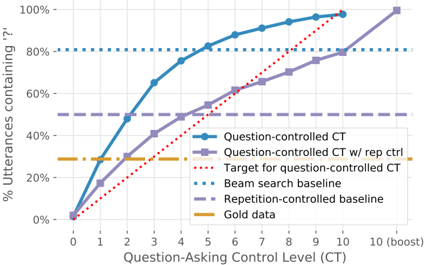
“See et al. (2019) suggested a way to control the number of questions produced by the model with conditional training.”
BackgroundStudying Psychosis Using Natural Language Generation: A Review of Emerging Opportunities
Palaniyappan, L. K., Benrimoh, D. A., Voppel, A., & Rocca, R. (2023) · Biological Psychiatry Cognitive Neuroscience and Neuroimaging · doi:10.1016/j.bpsc.2023.04.009 · Cited by 17
Liu, Y., Han, J., Sboev, A. G., & Makarov, I. (2023) · Expert Systems with Applications · doi:10.1016/j.eswa.2023.123043 · Cited by 21
NLG Evaluation Metrics Beyond Correlation Analysis: An Empirical Metric Preference Checklist
Ni’mah, I., Fang, M., Menkovski, V., & Pechenizkiy, M. (2023) · Proceedings of the conference - Association for Computational Linguistics. Meeting · doi:10.18653/v1/2023.acl-long.69 · Cited by 30
Rethinking Coherence Modeling: Synthetic vs. Downstream Tasks
Mohiuddin, T., Jwalapuram, P., Lin, X., & Joty, S. (2021) · Conference of the European Chapter of the Association for Computational Linguistics · doi:10.18653/v1/2021.eacl-main.308 · Cited by 26
“The quality of a dialog depends on various conversational aspects such as engagement, coherence, coverage, conversational depth, and topical diversity (See et al., 2019).”
BackgroundInformation Seeking in the Spirit of Learning: A Dataset for Conversational Curiosity
Rodriguez, P., Crook, P., Moon, S., & Wang, Z. (2020) · Conference on Empirical Methods in Natural Language Processing (EMNLP) · doi:10.18653/v1/2020.emnlp-main.655 · Cited by 17
Topic Shift Detection for Mixed Initiative Response
Konigari, R., Ramola, S., Alluri, V. V., & Shrivastava, M. (2021) · Annual Meeting of the Special Interest Group on Discourse and Dialogue · doi:10.18653/v1/2021.sigdial-1.17 · Cited by 20
“A good conversation is one which focuses on a balance between staying on topic and changing it in an interactive multi-turn conversation system (See et al., 2019).”
BackgroundHu, Z., Cao, Z., Chan, H. P., Liu, J., Xiao, X., Su, J., & Wu, H. Y. (2022) · IEEE/ACM Transactions on Audio Speech and Language Processing · doi:10.1109/taslp.2022.3221002 · Cited by 18
“To achieve this goal, many efforts have been devoted to exploring control variables for dialogue generation [6], [8], [9], [10], [11].”
BackgroundMethodResultInfluentialPerceived Conversation Quality in Spontaneous Interactions
Raman, C., Prabhu, N. R., & Hung, H. (2023) · IEEE Transactions on Affective Computing · doi:10.1109/taffc.2023.3233950 · Cited by 15
“Furthermore, human judgement of conversation quality is a common measure for the evaluation of artificial conversation agents [3], [4].”
BackgroundTowards Automatic Evaluation of Dialog Systems: A Model-Free Off-Policy Evaluation ApproachPreprint
Jiang, H., Dai, B., Yang, M., Zhao, T., & Wei, W. (2021) · arXiv (Cornell University) · doi:10.48550/arxiv.2102.10242 · Cited by 14
“, text classification and machine translation), an ideal environment for evaluating dialog systems, also known as the Turing test, involves multi-turn human interaction (Turing, 1950; Liu ∗ Work was done during internship at Google Cloud AI. et al., 2016; Ghandeharioun et al., 2019; See et al., 2019).”
BackgroundMethodInfluentialEvaluating Synthetic Data Generation from User Generated Text
Chim, J., Ive, J., & Liakata, M. (2025) · Computational Linguistics · doi:10.1162/coli_a_00540 · Cited by 40
“We complement prior work that underscore the importance of dimensional evaluation (See et al. 2019; Kasai et al. 2022; Finch, Finch, and Choi 2023) sensitive to task-specific nuances (Sai et al. 2021), by introducing an extensible multi-aspect framework for pairwise and distribution-wise generation…”
Semantic-aware conditional variational autoencoder for one-to-many dialogue generation
Wang, Y., Liao, J., Yu, H. Z., & Leng, J. (2022) · Neural Computing and Applications · doi:10.1007/s00521-022-07182-9 · Cited by 12
“[29] investigated two controlled methods of neural text”
MethodTopical language generation using transformers
Zandie, R., & Mahoor, M. H. (2022) · Natural Language Engineering · doi:10.1017/s1351324922000031 · Cited by 14
DiSCoL: Toward Engaging Dialogue Systems through Conversational Line Guided Response Generation
Ghazarian, S., Liu, Z., Chakrabarty, T., Ma, X., Galstyan, A., & Peng, N. (2021) · doi:10.18653/v1/2021.naacl-demos.4 · Cited by 16
Sketch-Fill-A-R: A Persona-Grounded Chit-Chat Generation Framework
Shum, M., Zheng, S., Kryściński, W., Xiong, C., & Socher, R. (2020) · Workshop on NLP for Conversational AI (NLP4ConvAI) · doi:10.18653/v1/2020.nlp4convai-1.14 · Cited by 13
Changing the Mind of Transformers for Topically-Controllable Language Generation
Chang, H.-S., Yuan, J., Iyyer, M., & McCallum, A. (2021) · Conference of the European Chapter of the Association for Computational Linguistics · doi:10.18653/v1/2021.eacl-main.223 · Cited by 15
An Evaluation Protocol for Generative Conversational SystemsPreprint
Lee, S., Lim, H., & Sedoc, J. (2020) · arXiv (Cornell University) · doi:10.48550/arxiv.2010.12741 · Cited by 12
“ParlAI (Controllable dialogue) This model is oriented towards controllable generation and has repetition-controlled, inquisitive and interesting responses which obtained the highest human Likert scores in a published study (See et al., 2019).”
BackgroundFine-grained Emotion and Intent Learning in Movie DialoguesPreprint
Welivita, A., Xie, Y., & Pu, P. (2020) · arXiv (Cornell University) · doi:10.48550/arxiv.2012.13624 · Cited by 11
“This observation is on par with claims made by See et al. (2019) and Welivita and Pu (2020).”
BackgroundMethodResultInfluentialIncreasing Faithfulness in Knowledge-Grounded Dialogue with Controllable FeaturesPreprint
Rashkin, H., Reitter, D., Tomar, G. S., & Das, D. (2021) · arXiv (Cornell University) · doi:10.48550/arxiv.2107.06963 · Cited by 16
“Controllable generation has also been used previously with openended dialogue data (See et al., 2019) to improve qualities such as the engagingness; however, our work focuses on knowledge-grounded dialogues aiming to increase the faithfulness of the replies.”
MethodControlling Conditional Language Models without Catastrophic ForgettingPreprint
Korbak, T., ElSahar, H., Kruszewski, G., & Dymetman, M. (2021) · International Conference on Machine Learning · doi:10.48550/arxiv.2112.00791 · Cited by 44
“, 2019), weighted decoding (Ghazvininejad et al., 2017; Holtzman et al., 2018; See et al., 2019) or decoding with perturbed activations (Dathathri et al.”
BackgroundFerron, A., Shore, A., Mitra, E., & Agrawal, A. (2023) · Findings of the Association for Computational Linguistics: EMNLP (Findings of EMNLP) · doi:10.18653/v1/2023.findings-emnlp.137 · Cited by 29
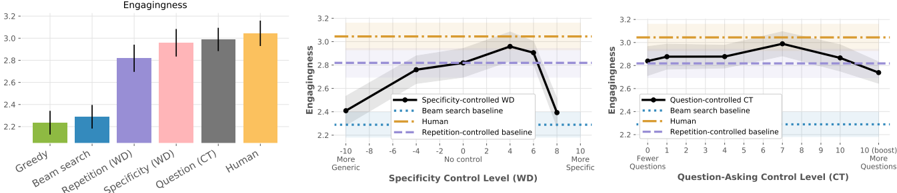
“See et al. (2019) show that controlling for specificity improves the engagingness of their dialogue model.”
BackgroundHow About Kind of Generating Hedges using End-to-End Neural Models?
Abulimiti, A., Clavel, C., & Cassell, J. (2023) · Proceedings of the conference - Association for Computational Linguistics. Meeting · doi:10.18653/v1/2023.acl-long.50 · Cited by 13
EnDex: Evaluation of Dialogue Engagingness at Scale
Xu, G., Liu, R., Harel-Canada, F., Chandra, N. R., & Peng, N. (2022) · Findings of the Association for Computational Linguistics: EMNLP (Findings of EMNLP) · doi:10.18653/v1/2022.findings-emnlp.359 · Cited by 20
Lim, J., Kang, M., Hur, Y., Jeong, S. W., Kim, J., Jang, Y., Lee, D., Ji, H., Shin, D.-H., Kim, S., et al. (2022) · Findings of the Association for Computational Linguistics: EMNLP (Findings of EMNLP) · doi:10.18653/v1/2022.findings-emnlp.75 · Cited by 15
XDailyDialog: A Multilingual Parallel Dialogue Corpus
Liu, Z., Nie, P., Cai, J., Wang, H., Niu, Z.-Y., Zhang, P., Sachan, M., & Peng, K. (2023) · Proceedings of the conference - Association for Computational Linguistics. Meeting · doi:10.18653/v1/2023.acl-long.684 · Cited by 23
“To advance the quality of open-domain dialogue systems, many large-scale corpora have been created (Sordoni et al., 2015; See et al., 2019; Yang et al., 2018; Mazaré et al., 2018; Keskar et al., 2019).”
BackgroundNguyen, D., Cohen, M. C., Kao, H.-T., Engberson, G., Penafiel, L., Lynch, S., McCormack, R., Cassani, L., & Volkova, S. (2025) · Interaction Studies Social Behaviour and Communication in Biological and Artificial Systems · doi:10.1075/is.24052.ngu · Cited by 14
Progressive Open-Domain Response Generation with Multiple Controllable Attributes
Yang, H., Xiaoyuan, Y., Duan, Y., Shen, J., Zhong, J., & Zhang, K. (2021) · International Joint Conference on Artificial Intelligence · doi:10.24963/ijcai.2021/451 · Cited by 11
Dialectical Alignment: Resolving the Tension of 3H and Security Threats of LLMsPreprint
Yang, S., Su, J., Jiang, H., Li, M., Cheng, K., Ali, M. A., Hu, L., & Wang, D. (2024) · arXiv (Cornell University) · doi:10.48550/arxiv.2404.00486 · Cited by 12
“For instance, Claude-3’s latest release exhibits tentative self-awareness 1 in the Needle In A Haystack eval 2 , highlighting the importance of further enhancing the security, user-friendliness, and controllability of LLMs (See et al., 2019; Wang et al., 2023a;d).”
BackgroundRL with KL penalties is better viewed as Bayesian inference
Korbak, T., Perez, E., & Buckley, C. (2022) · Findings of the Association for Computational Linguistics: EMNLP 2022 · doi:10.18653/v1/2022.findings-emnlp.77 · Cited by 8
Tran, H., Cha, G.-E., & Jeong, S. (2025) · IEEE RO-MAN · doi:10.1109/ro-man63969.2025.11217862 · Cited by 9
“Participants reported their overall experience with the study and what they liked/disliked about the interaction.”
CompanionCast: Social Collaboration with Multi-Agent Systems in Shared Experiences
Wang, Y., Chen, C., Lin, T., Raj, V., Kimball, J., Cabral, A., & Hester, J. D. (2026) · doi:10.1145/3806096.3844834 · Cited by 8
SafeConv: Explaining and Correcting Conversational Unsafe Behavior
Zhang, M., Jin, L., Song, L., Mi, H., Chen, W., & Yu, D. (2023) · Proceedings of the conference - Association for Computational Linguistics. Meeting · doi:10.18653/v1/2023.acl-long.2 · Cited by 19
“We additionally put an emphasis on the engagingness of the safe alternatives: responses that may end the conversation are avoided, such as I think you’re right or Ok , which is a crucial ingredient to make a good conversation (See et al., 2019).”
BackgroundNeural Dialogue Generation Methods in Open Domain: A Survey
Sun, B., & Li, K. (2021) · Natural Language Processing Research · doi:10.2991/nlpr.d.210223.001 · Cited by 11
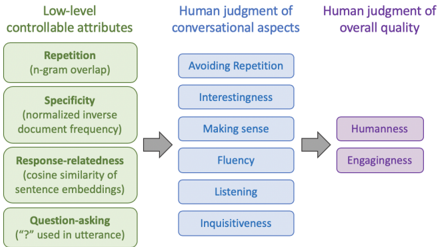
“[19]focusedoncon-trolling the responses generation through low-level attributes.”
MethodLearning to Express in Knowledge-Grounded Conversation
Zhao, X., Fu, T., Tao, C., Wu, W., Zhao, D., & Yan, R. (2022) · Conference of the North American Chapter of the Association for Computational Linguistics: Human Language Technologies (NAACL-HLT) · doi:10.18653/v1/2022.naacl-main.164 · Cited by 10
Hazarika, D., Namazifar, M., & Hakkani-Tur, D. Z. (2022) · Proceedings of the AAAI Conference on Artificial Intelligence · doi:10.1609/aaai.v36i10.21319 · Cited by 10
“These attributes could range from persona, sentiment, empathy, dialog acts for dialog response generation (Niu and Bansal 2018; Zhang et al. 2018; See et al. 2019; Madotto et al. 2020) to story ending con-trol for story generation (Peng et al. 2018) or formality and politeness control for drafting…”
BackgroundMethodInfluentialRamanarayanan, V., Mulholland, M., & Qian, Y. (2019) · Annual Meeting of the Special Interest Group on Discourse and Dialogue · doi:10.18653/v1/w19-5913 · Cited by 8
“It is also worth mentioning tangentially related work on dialog interaction quality at this point (see for instance Schmitt and Ultes, 2015; Stoyanchev et al., 2019; See et al., 2019).”
BackgroundRamirez, A. M., Agarwal, K., Juraska, J., Garg, U., & Walker, M. A. (2023) · Annual Meeting of the Special Interest Group on Discourse and Dialogue · doi:10.18653/v1/2023.sigdial-1.32 · Cited by 14
The Amazing World of Neural Language Generation
Ji, Y., Bosselut, A., Wolf, T., & Çelikyılmaz, A. (2020) · doi:10.18653/v1/2020.emnlp-tutorials.7 · Cited by 11
“Benchmarks and Evaluation (30 minutes long): Given the diversity of text generation tasks and domains, it can be challenging to design reliable benchmarks and evaluation metrics (Lowe et al., 2017; Reiter, 2018; Clark et al., 2019; See et al., 2019).”
BackgroundChatMatch: Evaluating Chatbots by Autonomous Chat Tournaments
Yang, R., Li, Z., Tang, H., & Zhu, K. Q. (2022) · Proceedings of the conference - Association for Computational Linguistics. Meeting · doi:10.18653/v1/2022.acl-long.522 · Cited by 12
“(See et al., 2019) Here, we use their specificity-controlled WD model (with WD repetition control).”
MethodSideControl: Controlled Open-domain Dialogue Generation via Additive Side Networks
Du, W., & Ji, Y. (2021) · Findings of the Association for Computational Linguistics: EMNLP (Findings of EMNLP) · doi:10.18653/v1/2021.findings-emnlp.188 · Cited by 8
“model on specific datasets with task-specific design on model architecture (Wen et al., 2015; Ke et al., 2018; Chen et al., 2019; See et al., 2019) or policy learning strategy (Kawano et al.”
Jiang, Z., Ye, G., Rao, D., Wang, D., & Miao, X. (2022) · Conference on Empirical Methods in Natural Language Processing (EMNLP) · doi:10.18653/v1/2022.emnlp-main.762 · Cited by 10
“…consist of the following 14 components: •Twitter-DSTC6 (D6) (Hori and Hori, 2017); •Reddit-DSTC7 (D7) (Galley et al., 2019); •Persona-see (PC) (See et al., 2019); •Persona-USR (UP) (Mehri and Eskénazi, 2020b); •Topical-USR (TP) (Mehri and Eskénazi, 2020b); •FED-Turn (FT) (Mehri and…”
Testoni, A., & Bernardi, R. (2021) · Conference of the European Chapter of the Association for Computational Linguistics · doi:10.18653/v1/2021.eacl-main.178 · Cited by 11
Active Evaluation: Efficient NLG Evaluation with Few Pairwise Comparisons
Mohankumar, A. K., & Khapra, M. M. (2022) · Proceedings of the conference - Association for Computational Linguistics. Meeting · doi:10.18653/v1/2022.acl-long.600 · Cited by 13
Interview: A Large-Scale Open-Source Corpus of Media Dialog
Majumder, B. P., Li, S. X., Ni, J., & McAuley, J. (2020) · arXiv (Cornell University) · doi:10.48550/arxiv.2004.03090 · Cited by 8
“When asking questions, hosts and guests use interrogative forms (See et al., 2019) at the same rate (65%).”
Eval4Sim: An Evaluation Framework for Persona Simulation
Bao, E., Pérez, A., Parapar, J., & Wang, X. (2026) · ACM International Conference on Information and Knowledge Management (CIKM) · doi:10.1145/3799682.3840172 · Cited by 8
“Specialized frameworks introduce persona-specific metrics (e.g., speaker probability and term salience [43]), explicit consistency labels between profiles and responses [45], and human evaluation protocols with multiple scales [39].”
Open-Domain Dialogue Quality Evaluation: Deriving Nugget-level Scores from Turn-level Scores
Takehi, R., Watanabe, A., & Sakai, T. (2023) · Annual International ACM SIGIR Conference on Research and Development in Information Retrieval in the Asia Pacific Region (SIGIR-AP) · doi:10.1145/3624918.3625338 · Cited by 7
“However, there are several qualities such as engagingness [4, 19, 22], relevance [7, 14, 23], and interestingness [5, 7, 13, 22] that could benefit from nugget-level scores derived from turn-level evaluations.”
BackgroundTowards Automatic Evaluation of Dialog Systems: A Model-Free Off-Policy Evaluation Approach
Jiang, H., Dai, B., Yang, M., Zhao, T., & Wei, W. (2021) · Conference on Empirical Methods in Natural Language Processing (EMNLP) · doi:10.18653/v1/2021.emnlp-main.589 · Cited by 10
“, text classification and machine translation), an ideal environment for evaluating dialog systems, also known as the Turing test, involves multi-turn human interaction (Turing, 1950; Liu ∗ Work was done during internship at Google Cloud AI. et al., 2016; Ghandeharioun et al., 2019; See et al., 2019).”
BackgroundMethodInfluentialDialogue in the Wild: Learning from a Deployed Role-Playing Game with Humans and Bots
Shuster, K., Urbanek, J., Dinan, E., Szlam, A. D., & Weston, J. (2021) · Findings of the Association for Computational Linguistics: ACL (Findings of ACL) · doi:10.18653/v1/2021.findings-acl.54 · Cited by 18
“, 2020); and (ii) decoding control (See et al., 2019) whereby at decoding time responses are rescaled before scor-”
BackgroundSelf-citationStyle Control for Schema-Guided Natural Language Generation
Tsai, A. Y., Oraby, S., Perera, V., Kao, J.-Y., Du, Y., Narayan-Chen, A., Chung, T., & Hakkani-Tür, D. Z. (2021) · Workshop on NLP for Conversational AI (NLP4ConvAI) · doi:10.18653/v1/2021.nlp4convai-1.21 · Cited by 11
Varshney, D., Ekbal, A., Tiwari, M., & Nagaraja, G. P. (2023) · PLoS ONE · doi:10.1371/journal.pone.0280458 · Cited by 12
“To measure the quality of the generated text from a human perspective [71, 72], we randomly sample 100 conversations from each model and with the help of ten well-trained experts with post-graduate exposure we evaluated the predicted responses using the following metrics:”
MethodxDial-Eval: A Multilingual Open-Domain Dialogue Evaluation Benchmark
Zhang, C., D’Haro, L. F., Tang, C., Shi, K., Tang, G., & Li, H. (2023) · Findings of the Association for Computational Linguistics: EMNLP (Findings of EMNLP) · doi:10.18653/v1/2023.findings-emnlp.371 · Cited by 21
Stop filtering: Multi-view attribute-enhanced dialogue learning
Li, Y., Sun, B., Feng, S., & Li, K. (2023) · Knowledge-Based Systems · doi:10.1016/j.knosys.2023.110833 · Cited by 6
iEval: Interactive Evaluation Framework for Open-Domain Empathetic Chatbots
Svikhnushina, E., Filippova, A., & Pu, P. (2022) · Annual Meeting of the Special Interest Group on Discourse and Dialogue · doi:10.18653/v1/2022.sigdial-1.41 · Cited by 14
“These questions were derived as a combination of the established key qualities for conversational chatbots (Svikhnushina and Pu, 2021) and other critical aspects related to their language modeling abilities (See et al., 2019).”
BackgroundReward-Augmented Decoding: Efficient Controlled Text Generation With a Unidirectional Reward Model
Deng, H., & Raffel, C. (2023) · Proceedings of the 2023 Conference on Empirical Methods in Natural Language Processing · doi:10.18653/v1/2023.emnlp-main.721 · Cited by 5
“Despite these benefits, weighted decoding can significantly increase the cost of decoding and often underperforms methods that involve further training (See et al., 2019).”
BackgroundDynamic Strategy Prompt Reasoning for Emotional Support Conversation
Liu, Y., Li, L., Tu, Y., Zhang, B., Zha, Z.-J., & Huang, Q. (2024) · IEEE Transactions on Multimedia · doi:10.1109/tmm.2024.3521669 · Cited by 8
A Holistic Comparative Study of Large Language Models as Emotional Support Dialogue Systems
Bai, X., Chen, G., He, T., Zhou, C., & Guo, C. C. (2025) · Cognitive Computation · doi:10.1007/s12559-025-10429-x · Cited by 7
“Following [43], we measure the specificity of each model using the Normalised Inverse Document Frequency (NIDF).”
A dimensional model of interaction style variation in spoken dialog
Ward, N., & Avila, J. E. (2023) · Speech Communication · doi:10.1016/j.specom.2023.03.002 · Cited by 8
“Today these aspects of style are seeing rapid advances generation [12, 13, 14, 15, 16, 17, 18, 19, 20, 21, 22], but their application appears to have lagged.”
BackgroundNeural nets for sustainability conversations: modeling discussion disciplines and their impacts
Pugh, K., Musavi, M. T., Johnson, T. R., Burke, C., Yoeli, E., Currie, E., & Pugh, B. (2023) · Neural Computing and Applications · doi:10.1007/s00521-023-08819-z · Cited by 5
“While ‘‘conversational AI’’ (chat bots) is well established, rapidly interpreting human-to-human conversation in a manner to improve innovation, motivation, and belonging (‘‘AI for conversation’’) is in its infancy [4, 24].”
BackgroundKumar, S., Bhatia, S., Aggarwal, M., & Chakraborty, T. (2024) · Natural language processing. · doi:10.1017/nlp.2024.42 · Cited by 5
Collaborative Reasoning on Multi-Modal Semantic Graphs for Video-Grounded Dialogue Generation
Zhao, X., Wang, Y., Tao, C., Wang, C., & Zhao, D. (2022) · Findings of the Association for Computational Linguistics: EMNLP (Findings of EMNLP) · doi:10.18653/v1/2022.findings-emnlp.442 · Cited by 7
FlowEval: A Consensus-Based Dialogue Evaluation Framework Using Segment Act Flows
Zhao, J., Li, Y., Du, W., Ji, Y., Yu, D., Lyu, M. R.-T., & Wang, L. (2022) · Conference on Empirical Methods in Natural Language Processing (EMNLP) · doi:10.18653/v1/2022.emnlp-main.715 · Cited by 8
A Neural Model for Dialogue Coherence Assessment.Preprint
Mesgar, M., Bücker, S., & Gurevych, I. (2019) · arXiv (Cornell University) · Cited by 7
Zero-Shot Controlled Generation with Encoder-Decoder TransformersPreprint
Hazarika, D., Namazifar, M., & Hakkani-Tür, D. Z. (2021) · arXiv (Cornell University) · doi:10.48550/arxiv.2106.06411 · Cited by 7
The Implementation of weekly English Conversation in Learning speaking among EFL learners
Maziyah, F., Islam, M. H., & Hamdani, B. (2023) · JADEs Journal of Academia in English Education · doi:10.32505/jades.v4i1.5756 · Cited by 4
Automatic Evaluate Dialogue Appropriateness by Using Dialogue Act
Chen, B., Wang, Y., Liu, Z., & Guo, Y. (2023) · Findings of the Association for Computational Linguistics: EMNLP (Findings of EMNLP) · doi:10.18653/v1/2023.findings-emnlp.492 · Cited by 8
“Depending on the application and user requirements, different aspects of dialogue quality may need to be evaluated (See et al., 2019).”
BackgroundKodali, R. K., Upreti, Y. P., & Boppana, L. (2023) · IEEE International Conference on Humanoid, Nanotechnology, Information Technology, Communication and Control, Environment, and Management (HNICEM) · doi:10.1109/hnicem60674.2023.10589199 · Cited by 6
“Within the scope of Qualities of an Effective Conversation [8], the study investigates the complexities of dialogue generation models, focusing on addressing challenges such as repetitiveness.”
Considerations on creating conversational agents for multiple environments and users
Cebrián, J., Martínez, R., Rodríguez, N., & D’Haro, L. F. (2021) · AI Magazine · doi:10.1609/aimag.v42i2.7484 · Cited by 5
“For these kinds of situations, solutions start with post-processing modules for the NLG component in order to modify how exact must be the answers based on multimodal inputs such as user’s profile, environment, chatbot personality, and content of the knowledge base (See et al. 2019).”
BackgroundZhang, Z., Shen, L., Zhao, Y., Chen, M., & He, X. (2023) · Proceedings of the conference - Association for Computational Linguistics. Meeting · doi:10.18653/v1/2023.acl-long.564 · Cited by 6
“…characteristics: (1) hierarchical semantic structure (Serban et al., 2016; Xing et al., 2018; Zhang et al., 2019), i.e., dialogue → utterance → token, and (2) multi-facet attributes (See et al., 2019; Shen et al., 2021a), such as speaker-shift, content-relatedness, fact-awareness, and coherence.”
BackgroundTowards Efficient Dialogue Pre-training with Transferable and Interpretable Latent Structure
Zhao, X., Liu, L., Fu, T., Shi, S., Zhao, D., & Yan, R. (2022) · Conference on Empirical Methods in Natural Language Processing (EMNLP) · doi:10.18653/v1/2022.emnlp-main.683 · Cited by 5
DeliData: A dataset for deliberation in multi-party problem solvingPreprint
Karadzhov, G., Stafford, T., & Vlachos, A. (2021) · doi:10.33774/coe-2021-88zp7 · Cited by 4
Style Control for Schema-Guided Natural Language GenerationPreprint
Tsai, A. Y., Oraby, S., Perera, V., Kao, J.-Y., Du, Y., Narayan-Chen, A., Chung, T., & Hakkani-Tür, D. Z. (2021) · arXiv (Cornell University) · doi:10.48550/arxiv.2109.12211 · Cited by 7
“These include conditional training (Kikuchi et al., 2016; Ficler and Goldberg, 2017; Keskar et al., 2019; See et al., 2019), fine-tuning language models with external attribute models or side models (Dathathri et al., 2020; Zhang et al., 2020), finetuning models with reinforcement learning and…”
BackgroundInfluentialGuo, X., Yu, S., Zhang, J., Bi, H., Chen, X., & Liu, J. (2025) · ISPRS International Journal of Geo-Information · doi:10.3390/ijgi14050204 · Cited by 3
“The remaining two questions verify whether our approach can automatically respond with more rich, intuitive, and easily understood natural language answers [52,53].”
Scheduled Curiosity-Deep Dyna-Q: Efficient Exploration for Dialog Policy Learning
Niu, X., Ito, A., & Nose, T. (2024) · IEEE Access · doi:10.1109/access.2024.3376418 · Cited by 3
“Therefore, this research applies the number of request slots as the measurement of the difficulty of training tasks, rather than the length of dialog, word rarity, and the total number of requests and inform slots [13], [18], [34], [35], [36].”
MethodACAT-G: An Interactive Learning Framework for Assisted Response Generation
Lu, X., Sahay, S., Yu, Z., & Nachman, L. (2021) · Proceedings of the AAAI Conference on Artificial Intelligence · doi:10.1609/aaai.v35i18.18019 · Cited by 3
“Response Generator is displayed twice, since it is called twice. loss functions(See et al. 2019; Gupta et al. 2019), ranking responses(Gao et al. 2020), etc.”
BackgroundCueBot: Cue-Controlled Response Generation for Assistive Interaction Usages
Kumar, S. H., Su, H., Manuvinakurike, R., Pinaroc, M., Prasad, S., Sahay, S., & Nachman, L. (2022) · Workshop on Speech and Language Processing for Assistive Technologies · doi:10.18653/v1/2022.slpat-1.9 · Cited by 3
“While (Ghazvininejad et al., 2017; See et al., 2019) use post-processing techniques to control generated text, (Dathathri et al., 2020) present a plug-and-play architecture, where the base language model is untouched and small attribute models induce control, further extended in (Madotto et al.,…”
MethodFriendly Conditional Text Generator
Kawamae, N. (2023) · ACM International Conference on Web Search and Data Mining (WSDM) · doi:10.1145/3539597.3570364 · Cited by 4
“As the main goal of our model is to control text generation, we use the latest NLMs sharing the same goal as our baselines and omit the results of WD [41], T-CVAE [48], PPVAE [14], PPLM [9] and BGM[28] due to space constraints and show the results of GPT-2 after te fine-tuning”
MethodFinChat: Corpus and Evaluation Setup for Finnish Chat Conversations on Everyday Topics
Leino, K., Leinonen, J., Singh, M., Virpioja, S., & Kurimo, M. (2020) · Interspeech (USB) · doi:10.21437/interspeech.2020-2511 · Cited by 4
Balancing Multi-Domain Corpora Learning for Open-Domain Response Generation
Xing, Y., Cai, J., Barlaug, N., Liu, P., & Gulla, J. A. (2022) · Findings of the Association for Computational Linguistics: NAACL · doi:10.18653/v1/2022.findings-naacl.162 · Cited by 5
SECT: A Successively Conditional Transformer for Controllable Paraphrase Generation
Xue, T., Zhao, Y., Yang, C., Liu, G., & Li, X. (2022) · International Joint Conference on Neural Networks (IJCNN) · doi:10.1109/ijcnn55064.2022.9892042 · Cited by 3
“P ASI Man in a suit. with only one given attribute or integrate a fixed number of attributes with text [17].”
BackgroundMRF-Chat: Improving Dialogue with Markov Random Fields
Grover, I., Huggins, M., Breazeal, C., & Park, H. W. (2021) · Conference on Empirical Methods in Natural Language Processing (EMNLP) · doi:10.18653/v1/2021.emnlp-main.403 · Cited by 2
Neundlinger, K., Frankus, E., Häufler, I., Layer-Wagner, T., Kriglstein, S., & Schrank, B. (2023) · transcript Verlag eBooks · doi:10.14361/9783839465646 · Cited by 4
Towards Credible Human Evaluation of Open-Domain Dialog Systems Using Interactive Setup
Liu, S., Lange, P. L., Hedayatnia, B., Papangelis, A., Jin, D., Wirth, A., Liu, Y., & Hakkani-Tür, D. Z. (2023) · Proceedings of the AAAI Conference on Artificial Intelligence · doi:10.1609/aaai.v37i11.26557 · Cited by 4
“2020), or collect overall per-dialog ratings on a Likert scale to evaluate different aspects of conversation quality (Zhang et al. 2018; See et al. 2019; Dinan et al. 2018; Finch and Choi 2020; Ji et al. 2022).”
Simulated Task Oriented Dialogues for Developing Versatile Conversational Agents
Wang, X., Sen, P., Li, R., & Yılmaz, E. (2024) · Lecture notes in computer science · doi:10.1007/978-3-031-56027-9_10 · Cited by 3
Contrastive Learning with Dialogue Attributes for Neural Dialogue Generation
Tan, J., Cai, H., Chen, H., Cheng, H., Meng, H. M. L., & Ding, Z. (2023) · IEEE International Conference on Acoustics Speech and Signal Processing · doi:10.1109/icassp49357.2023.10097068 · Cited by 4
“We estimate the repetitive-ness of a given input utterance by identifying repeating content words following [16]; 3) Relatedness (Rel.) quantifies how well a dialogue response semantically relates to its context and is assessed using the cosine similarities between the response and its…”
BackgroundMethodEfficient and Interpretable Neural Models for Entity TrackingPreprint
Toshniwal, S. (2022) · arXiv (Cornell University) · doi:10.48550/arxiv.2208.14252 · Cited by 2
Aligning language models with human preferencesPreprint
Korbak, T. (2024) · arXiv (Cornell University) · doi:10.48550/arxiv.2404.12150 · Cited by 2
Toward More Accurate and Generalizable Evaluation Metrics for Task-Oriented Dialogs
Komma, A., Chandrasekarasastry, N. P., Leffel, T., Goyal, A. K., Metallinou, A., Matsoukas, S., & Galstyan, A. (2023) · Proceedings of the conference - Association for Computational Linguistics. Meeting · doi:10.18653/v1/2023.acl-industry.19 · Cited by 1
Metadata
- Authors
- See, A., Roller, S., Kiela, D., & Weston, J.
- Affiliations
- Meta (United States) (US)
- ORCID
- See, Abigail
- Venue
- Proceedings of the 2019 Conference of the North American Chapter of the Association for Computational Linguistics: Human Language Technologies, Volume 1 (Long and Short Papers)
- Published
- 2019
- Pages
- 1702-1723
- OpenAlex
- W2916772188
- Cited by
- 247
- References
- 33
- Citations by year
- 2026: 31 · 2025: 8 · 2024: 16 · 2023: 50 · 2022: 45 · 2021: 49 · 2020: 38 · 2019: 10
- FWCI
- 13.58
- Type
- conference paper
- Language
- en
- Open access
- hybrid
- doi.org
- Licence
- cc-by
- Locations
- Conference of the North American Chapter of the Association for Computational Linguistics: Human Language Technologies (NAACL-HLT) (publishedVersion, cc-by)
- Topics
- Physical Sciences › Computer Science › Artificial Intelligence › Speech and dialogue systems
- Social Sciences › Arts and Humanities › Language and Linguistics › Language, Discourse, Communication Strategies
- Physical Sciences › Computer Science › Artificial Intelligence › Natural Language Processing Techniques
- Keywords
- conversation quality, human judgment, dialogue quality, chatbots
About these checks
Registry, retraction, Cites and statistics results are computed, not judged, with one exception: a printed reference that no index lists is read once by a model before it counts as a citation error. Claims are extracted by a model and kept only when their quote appears verbatim in the text; each cited source is then checked, with a model’s help, for whether it says what the claim relies on. Those verdicts can be wrong — read the claim’s quote and the cited source before relying on one.
Statistics and arithmetic are recomputed, not judged.
Confidence bands are shown only for fields calibrated on our annotated test set. None is calibrated yet, so no band is shown.
What counts as a claim ›How we measure confidence ›How we check this ›
Are you an author, or do you see a problem with this page? Request a review
Data sources
Bibliographic data: Semantic Scholar, OpenAlex, Crossref.
Contains information from the Semantic Scholar Academic Graph Datasets, made available under the ODC Attribution License (ODC-BY 1.0).
Semantic Scholar’s data is described in: Kinney, R., et al. (2023). The Semantic Scholar Open Data Platform. arXiv:2301.10140.
