

The DOI matches its Crossref record; 3 of the 3 references it cites were found in a registry or an index.
Towards an Automatic Turing Test: Learning to Evaluate Dialogue Responses
Open accessAbstract
Ryan Lowe, Michael Noseworthy, Iulian Vlad Serban, Nicolas Angelard-Gontier, Yoshua Bengio, Joelle Pineau. Proceedings of the 55th Annual Meeting of the Association for Computational Linguistics (Volume 1: Long Papers). 2017.
Overview
The claims and statistics of this paper haven’t been checked yet.
Run the check — free, no account needed. It reads the open-access text and checks the sources it cites.
Integrity signals
Registry
Cites
Statistics
Figures

Verification
Claims the paper makes
The claims and statistics of this paper haven’t been checked yet.
Run the check — free, no account needed. It reads the open-access text and checks the sources it cites.
Claims other papers make about this one
Each is checked against this paper’s own text: does it say what the citing paper says it does?
The cited source says what the claim attributes to it.
In the citing paper
“Supervised assessment methods learn to predict human-like evaluation scores (Lowe et al., 2017), but they require a significant annotation effort for achieving training data.”
From Q2: : Evaluating Factual Consistency in Knowledge-Grounded Dialogues via Question Generation and Question Answering (2021) · cites this paper as Lowe et al., 2017
The cited source says what the claim attributes to it.
In the citing paper
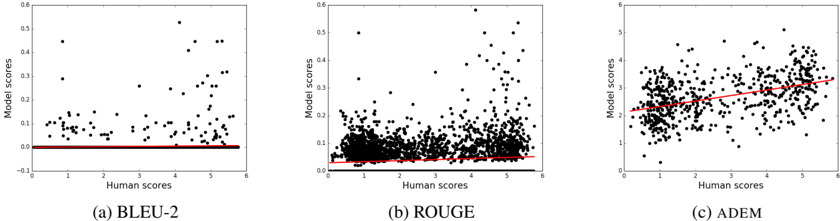
“Standard token-matching metrics, such as BLEU (Papineni et al., 2002) or METEOR (Banerjee and Lavie, 2005) in machine translation, or ROUGE (Lin, 2004) in summarization, were shown to have weak or no correlation with human judgements for dialogue (Liu et al., 2016;Lowe et al., 2017).”
From Q2: : Evaluating Factual Consistency in Knowledge-Grounded Dialogues via Question Generation and Question Answering (2021) · cites this paper as Lowe et al., 2017
Self-check
Percentages, sums and reported differences re-computed from the paper’s own numbers.
The self-check needs the paper’s full text.
Citations
Cites
The publisher hasn’t deposited this paper’s reference list.
Research works printed but not linked: 42
- Joshua Albrecht and Rebecca Hwa. 2007. Regression for sentence-level mt evaluation with pseudo refer- ences. In ACL.
- Ron Artstein, Sudeep Gandhe, Jillian Gerten, Anton Leuski, and David Traum. 2009. Semi-formal eval- uation of conversational characters. In Languages: From Formal to Natural, Springer, pages 22-35.
- Jimmy Lei Ba, Jamie Ryan Kiros, and Geoffrey E Hin- ton. 2016. Layer normalization. arXiv preprint arXiv:1607.06450 . · arXiv
- Yoshua Bengio, Patrice Simard, and Paolo Frasconi. 1994. Learning long-term dependencies with gradi- ent descent is difficult. IEEE transactions on neural networks 5(2):157-166.
- Chris Callison-Burch, Philipp Koehn, Christof Monz, and Omar F Zaidan. 2011. Findings of the 2011 workshop on statistical machine translation. In Pro- ceedings of the Sixth Workshop on Statistical Ma- chine Translation. Association for Computational Linguistics, pages 22-64.
- Tim Cooijmans, Nicolas Ballas, César Laurent, and Aaron Courville. 2016. Recurrent batch normaliza- tion. arXiv preprint arXiv:1603.09025 . · arXiv
- David DeVault, Anton Leuski, and Kenji Sagae. 2011. Toward learning and evaluation of dialogue policies with text examples. In Proceedings of the SIG- DIAL 2011 Conference. Association for Computa- tional Linguistics, pages 39-48.
- Bhuwan Dhingra, Zhong Zhou, Dylan Fitzpatrick, Michael Muehl, and William W Cohen. 2016. Tweet2vec: Character-based distributed repre- sentations for social media. arXiv preprint arXiv:1605.03481 . · arXiv
- Harrison Edwards and Amos Storkey. 2016. Censoring representations with an adversary. ICLR .
- Salah El Hihi and Yoshua Bengio. 1995. Hierarchical recurrent neural networks for long-term dependen- cies. In NIPS. Citeseer, volume 400, page 409.
- Philip Gage. 1994. A new algorithm for data compres- sion. The C Users Journal 12(2):23-38.
- Michel Galley, Chris Brockett, Alessandro Sordoni, Yangfeng Ji, Michael Auli, Chris Quirk, Mar- garet Mitchell, Jianfeng Gao, and Bill Dolan. 2015. deltableu: A discriminative metric for generation tasks with intrinsically diverse targets. arXiv preprint arXiv:1506.06863 . · arXiv
- Sudeep Gandhe and David Traum. 2016. A semi- automated evaluation metric for dialogue model coherence. In Situated Dialog in Speech-Based Human-Computer Interaction, Springer, pages 217- 225.
- Rohit Gupta, Constantin Orasan, and Josef van Gen- abith. 2015. Reval: A simple and effective machine translation evaluation metric based on recurrent neu- ral networks. In Proceedings of the 2015 Confer- ence on Empirical Methods in Natural Language Processing (EMNLP).
- Ryuichiro Higashinaka, Toyomi Meguro, Kenji Ima- mura, Hiroaki Sugiyama, Toshiro Makino, and Yoshihiro Matsuo. 2014. Evaluating coherence in open domain conversational systems. In INTER- SPEECH. pages 130-134.
- Sergey Ioffe and Christian Szegedy. 2015. Batch nor- malization: Accelerating deep network training by reducing internal covariate shift. arXiv preprint arXiv:1502.03167 . · arXiv
- Anjuli Kannan, Karol Kurach, Sujith Ravi, Tobias Kaufmann, Andrew Tomkins, Balint Miklos, Greg Corrado, László Lukács, Marina Ganea, Peter Young, et al. 2016. Smart reply: Automated re- sponse suggestion for email. In Proceedings of the ACM SIGKDD Conference on Knowledge Discovery and Data Mining (KDD). volume 36, pages 495- 503.
- Anjuli Kannan and Oriol Vinyals. 2017. Adversar- ial evaluation of dialogue models. arXiv preprint arXiv:1701.08198 . · arXiv
- Diederik Kingma and Jimmy Ba. 2014. Adam: A method for stochastic optimization. arXiv preprint arXiv:1412.6980 . · arXiv
- Jiwei Li, Michel Galley, Chris Brockett, Jianfeng Gao, and Bill Dolan. 2015. A diversity-promoting objec- tive function for neural conversation models. arXiv preprint arXiv:1510.03055 . · arXiv
- Jiwei Li, Michel Galley, Chris Brockett, Jianfeng Gao, and Bill Dolan. 2016a. A persona-based neural con- versation model. arXiv preprint arXiv:1603.06155 . · arXiv
- Jiwei Li, Will Monroe, and Dan Jurafsky. 2017. Learn- ing to decode for future success. arXiv preprint arXiv:1701.06549 . · arXiv
- Jiwei Li, Will Monroe, Alan Ritter, and Dan Jurafsky. 2016b. Deep reinforcement learning for dialogue generation. arXiv preprint arXiv:1606.01541 . · arXiv
- Chia-Wei Liu, Ryan Lowe, Iulian V Serban, Michael Noseworthy, Laurent Charlin, and Joelle Pineau. 2016. How not to evaluate your dialogue system: An empirical study of unsupervised evaluation met- rics for dialogue response generation. arXiv preprint arXiv:1603.08023 . · arXiv
- Ryan Lowe, Nissan Pow, Iulian Serban, and Joelle Pineau. 2015. The ubuntu dialogue corpus: A large dataset for research in unstructured multi-turn dia- logue systems. arXiv preprint arXiv:1506.08909 . · arXiv
- Matouš Machácek and Ondrej Bojar. 2014. Results of the wmt14 metrics shared task. In Proceedings of the Ninth Workshop on Statistical Machine Transla- tion. Citeseer, pages 293-301.
- Sebastian Möller, Roman Englert, Klaus-Peter Engel- brecht, Verena Vanessa Hafner, Anthony Jameson, Antti Oulasvirta, Alexander Raake, and Norbert Re- ithinger. 2006. Memo: towards automatic usability evaluation of spoken dialogue services by user error simulations. In INTERSPEECH.
- Kishore Papineni, Salim Roukos, Todd Ward, and Wei- Jing Zhu. 2002. Bleu: a method for automatic eval- uation of machine translation. In Proceedings of the 40th annual meeting on association for compu- tational linguistics. Association for Computational Linguistics, pages 311-318.
- Karl Pearson. 1901. Principal components analysis. The London, Edinburgh and Dublin Philosophical Magazine and Journal 6(2):566.
- Alan Ritter, Colin Cherry, and William B Dolan. 2011. Data-driven response generation in social media. In Proceedings of the conference on empirical meth- ods in natural language processing. Association for Computational Linguistics, pages 583-593.
- Iulian Vlad Serban, Alessandro Sordoni, Yoshua Ben- gio, Aaron Courville, and Joelle Pineau. 2016a. Building end-to-end dialogue systems using gener- ative hierarchical neural network models. In AAAI. pages 3776-3784.
- Iulian Vlad Serban, Alessandro Sordoni, Ryan Lowe, Laurent Charlin, Joelle Pineau, Aaron Courville, and Yoshua Bengio. 2016b. A hierarchical latent variable encoder-decoder model for generating dia- logues. arXiv preprint arXiv:1605.06069 . · arXiv
- Lifeng Shang, Zhengdong Lu, and Hang Li. 2015. Neu- ral responding machine for short-text conversation. arXiv preprint arXiv:1503.02364 . · arXiv
- Lifeng Shang, Tetsuya Sakai, Zhengdong Lu, Hang Li, Ryuichiro Higashinaka, and Yusuke Miyao. 2016. Overview of the ntcir-12 short text conversation task. Proceedings of NTCIR-12 pages 473-484.
- Alessandro Sordoni, Yoshua Bengio, Hossein Vahabi, Christina Lioma, Jakob Grue Simonsen, and Jian- Yun Nie. 2015a. A hierarchical recurrent encoder- decoder for generative context-aware query sugges- tion. In Proceedings of the 24th ACM International on Conference on Information and Knowledge Man- agement. ACM, pages 553-562.
- Alessandro Sordoni, Michel Galley, Michael Auli, Chris Brockett, Yangfeng Ji, Margaret Mitchell, Jian-Yun Nie, Jianfeng Gao, and Bill Dolan. 2015b. A neural network approach to context-sensitive gen- eration of conversational responses. arXiv preprint arXiv:1506.06714 . · arXiv
- Miloš Stanojevic, Amir Kamran, Philipp Koehn, and Ondrej Bojar. 2015. Results of the wmt15 metrics shared task. In Proceedings of the Tenth Workshop on Statistical Machine Translation. pages 256-273.
- Alan M Turing. 1950. Computing machinery and intel- ligence. Mind 59(236):433-460.
- Oriol Vinyals and Quoc Le. 2015. A neural conversa- tional model. arXiv preprint arXiv:1506.05869 . · arXiv
- Marilyn A Walker, Diane J Litman, Candace A Kamm, and Alicia Abella. 1997. Paradise: A framework for evaluating spoken dialogue agents. In Proceedings of the eighth conference on European chapter of the Association for Computational Linguistics. Associa- tion for Computational Linguistics, pages 271-280.
- J. Weizenbaum. 1966. ELIZAa computer program for the study of natural language communication be- tween man and machine. Communications of the ACM 9(1):36-45.
- Yang Xiang, Yaoyun Zhang, Xiaoqiang Zhou, Xiao- long Wang, and Yang Qin. 2014. Problematic situa- tion analysis and automatic recognition for chi-nese online conversational system. Proc. CLP pages 43- 51.
Cited by
Sorted by citations
Items 201–300 of 341
Automatic Scoring for Translations Based on Language Models
Wu, D., Wang, M., & Li, X. (2022) · Computational Intelligence and Neuroscience · doi:10.1155/2022/2171206 · Cited by 7
Evolving Cybersecurity Challenges in the Age of AI-Powered Chatbots: A Comprehensive Review
Costa, A., & Mateus-Coelho, N. (2024) · IFIP advances in information and communication technology · doi:10.1007/978-3-031-63851-0_15 · Cited by 7
Treating Dialogue Quality Evaluation as an Anomaly Detection Problem
Nedelchev, R., Usbeck, R., & Lehmann, J. (2020) · Publikationsdatenbank der Fraunhofer-Gesellschaft (Fraunhofer-Gesellschaft) · Cited by 6
Towards Automatic Evaluation of Dialog Systems: A Model-Free Off-Policy Evaluation Approach
Jiang, H., Dai, B., Yang, M., Zhao, T., & Wei, W. (2021) · Conference on Empirical Methods in Natural Language Processing (EMNLP) · doi:10.18653/v1/2021.emnlp-main.589 · Cited by 6
On the Pragmatics of the Turing Test
Jacquet, B., Jamet, F., & Baratgin, J. (2021) · International Conference on Information and Digital Technologies (IDT) · doi:10.1109/idt52577.2021.9497570 · Cited by 10
GRTr: Generative-Retrieval Transformers for Data-Efficient Dialogue Domain Adaptation
Shalyminov, I., Sordoni, A., Atkinson, A., & Schulz, H. (2021) · IEEE/ACM Transactions on Audio Speech and Language Processing · doi:10.1109/taslp.2021.3074779 · Cited by 12
LEGOEval: An Open-Source Toolkit for Dialogue System Evaluation via Crowdsourcing
Li, Y., Arnold, J., Yan, F., Shi, W., & Yu, Z. (2021) · Annual Meeting of the Association for Computational Linguistics: System Demonstrations (ACL Demo) · doi:10.18653/v1/2021.acl-demo.38 · Cited by 6
Proceedings of the First Workshop on NLP for Conversational AI
(2019) · doi:10.18653/v1/w19-41 · Cited by 7
Modeling Dialogues with Hashcode Representations: A Nonparametric Approach
Garg, S., Rish, I., Cecchi, G., Goyal, P., Ghazarian, S., Gao, S., Steeg, G. V., & Galstyan, A. (2020) · Proceedings of the AAAI Conference on Artificial Intelligence · doi:10.1609/aaai.v34i04.5813 · Cited by 4
Recent Advances in Chatbot Algorithms, Techniques, and Technologies
Caldarini, G., & Jaf, S. (2023) · Advances in web technologies and engineering book series · doi:10.4018/978-1-6684-6234-8.ch011 · Cited by 6
Testoni, A., & Raffaella Bernardi, B. (2021) · Conference of the European Chapter of the Association for Computational Linguistics · doi:10.18653/v1/2021.eacl-main.178 · Cited by 5
Conversational natural language processing for automated customer support services
Kaur, A., & Singh, A. (2023) · AIP conference proceedings · doi:10.1063/5.0100875 · Cited by 5
Dialogues Are Not Just Text: Modeling Cognition for Dialogue Coherence Evaluation
Li, X., Su, J., Yang, Y., Gao, Z., Duan, X., & Guan, Y. (2024) · Proceedings of the AAAI Conference on Artificial Intelligence · doi:10.1609/aaai.v38i17.29819 · Cited by 5
Survey of evaluation methods for dialogue systems}{Survey of evaluation methods for dialogue systems
Zhang, W., ZHANG, Y., & Liu, T. (2017) · Scientia Sinica Informationis · doi:10.1360/n112017-00125 · Cited by 5
Lü, L., He, Z., Zhou, X., & Yu, D. (2019) · arXiv (Cornell University) · doi:10.48550/arxiv.1912.04664 · Cited by 5
Eskénazi, M., & Zhao, T. (2020) · arXiv (Cornell University) · doi:10.48550/arxiv.2006.06026 · Cited by 7
Parthasarathi, P., Pineau, J., & Chandar, S. (2020) · arXiv (Cornell University) · doi:10.48550/arxiv.2008.10427 · Cited by 6
Self-citationAn Evaluation Protocol for Generative Conversational SystemsPreprint
Lee, S., Lim, H., & Sedoc, J. (2020) · arXiv (Cornell University) · doi:10.48550/arxiv.2010.12741 · Cited by 11
Explaining Dialogue Evaluation Metrics using Adversarial Behavioral Analysis
Khalid, B., & Lee, S. (2022) · Conference of the North American Chapter of the Association for Computational Linguistics: Human Language Technologies (NAACL-HLT) · doi:10.18653/v1/2022.naacl-main.430 · Cited by 5
Sen2Pro: A Probabilistic Perspective to Sentence Embedding from Pre-trained Language Model
Shen, L., Jiang, H., Liu, L., & Shi, S. (2023) · Workshop on Representation Learning for NLP (RepL4NLP) · doi:10.18653/v1/2023.repl4nlp-1.26 · Cited by 6
QualityAdapt: an Automatic Dialogue Quality Estimation Framework
Mendonca, J., Lavie, A., & Trancoso, I. M. (2022) · Annual Meeting of the Special Interest Group on Discourse and Dialogue · doi:10.18653/v1/2022.sigdial-1.9 · Cited by 4
de Wit, J. (2024) · Lecture notes in computer science · doi:10.1007/978-3-031-54975-5_5 · Cited by 4
BLEU Neighbors: A Reference-less Approach to Automatic Evaluation
Ethayarajh, K., & Sadigh, D. (2020) · Workshop on Evaluation and Comparison of NLP Systems (Eval4NLP) · doi:10.18653/v1/2020.eval4nlp-1.5 · Cited by 5
Jiang, M. T.-J., Wu, S.-H., Chen, Y., Gu, Z.-X., Chiang, C.-J., Wu, Y.-C., Huang, Y., Chiu, C.-H., Shaw, S.-R., & Day, M.-Y. (2020) · IEEE/ACM International Conference on Advances in Social Networks Analysis and Mining (ASONAM) · doi:10.1109/asonam49781.2020.9381329 · Cited by 4
Empathy and Persona of English vs. Arabic Chatbots: A Survey and Future Directions
Hamad, O., Hamdi, A., & Shaban, K. B. (2022) · Lecture notes in computer science · doi:10.1007/978-3-031-16270-1_43 · Cited by 4
StoryER: Automatic Story Evaluation via Ranking, Rating and Reasoning
Chen, H., Vo, D. M., Takamura, H., Miyao, Y., & Nakayama, H. (2022) · Conference on Empirical Methods in Natural Language Processing (EMNLP) · doi:10.18653/v1/2022.emnlp-main.114 · Cited by 8
Dialogizer: Context-aware Conversational-QA Dataset Generation from Textual Sources
Hwang, Y., Kim, Y., Bae, H., Lee, H., Bang, J., & Jung, K. (2023) · Conference on Empirical Methods in Natural Language Processing (EMNLP) · doi:10.18653/v1/2023.emnlp-main.545 · Cited by 7
Conversation Initiation by Diverse News Contents Introduction
Akasaki, S., & Kaji, N. (2019) · Conference of the North American Chapter of the Association for Computational Linguistics: Human Language Technologies (NAACL-HLT) · doi:10.18653/v1/n19-1400 · Cited by 4
AvgOut: A Simple Output-Probability Measure to Eliminate Dull Responses
Niu, T., & Bansal, M. (2020) · Proceedings of the AAAI Conference on Artificial Intelligence · doi:10.1609/aaai.v34i05.6378 · Cited by 3
Gârbacea, C., Carton, S., Yan, S., & Mei, Q. (2019) · arXiv (Cornell University) · doi:10.48550/arxiv.1901.00398 · Cited by 4
A Review on Dyadic Conversation Visualizations - Purposes, Data, Lens of AnalysisPreprint
Kim, J. Y., Calvo, R. A., Yacef, K., & Enfield, N. J. (2019) · arXiv (Cornell University) · doi:10.48550/arxiv.1905.00653 · Cited by 4
Generating More Interesting Responses in Neural Conversation Models with Distributional ConstraintsPreprint
Baheti, A., Ritter, A., Li, J., & Dolan, B. (2018) · arXiv (Cornell University) · doi:10.48550/arxiv.1809.01215 · Cited by 4
Towards a Better Metric for Evaluating Question Generation SystemsPreprint
Nema, P., & Khapra, M. M. (2018) · arXiv (Cornell University) · doi:10.48550/arxiv.1808.10192 · Cited by 4
Counterfactual Story Reasoning and GenerationPreprint
Qin, L., Bosselut, A., Holtzman, A., Bhagavatula, C., Clark, E., & Choi, Y. (2019) · arXiv (Cornell University) · doi:10.48550/arxiv.1909.04076 · Cited by 27
Approximating Human Judgment of Generated Image QualityPreprint
Kolchinski, Y. A., Zhou, S., Zhao, S., Gordon, M., & Ermon, S. (2019) · arXiv (Cornell University) · doi:10.48550/arxiv.1912.12121 · Cited by 7
Hybrid Generative-Retrieval Transformers for Dialogue Domain AdaptationPreprint
Shalyminov, I., Sordoni, A., Atkinson, A., & Schulz, H. (2020) · arXiv (Cornell University) · doi:10.48550/arxiv.2003.01680 · Cited by 4
Retrieval-based Goal-Oriented Dialogue GenerationPreprint
González, A. V., Augenstein, I., & Søgaard, A. (2019) · arXiv (Cornell University) · doi:10.48550/arxiv.1909.13717 · Cited by 4
FFAEval: Evaluating Dialogue System via Free-For-All Ranking
Ma, Z., Yao, Z., Zhang, J., Yu, J., Zhang, X., Li, J., & Tang, J. (2023) · Findings of the Association for Computational Linguistics: EMNLP (Findings of EMNLP) · doi:10.18653/v1/2023.findings-emnlp.1049 · Cited by 2
Emotion and Intention Detection in a Large Language Model
Castro, E., Calvo, H., & Kolesnikova, O. (2025) · Mathematics · doi:10.3390/math13233768 · Cited by 3
Berlot-Attwell, I., & Rudzicz, F. (2022) · Workshop on NLP for Conversational AI (NLP4ConvAI) · doi:10.18653/v1/2022.nlp4convai-1.14 · Cited by 4
Reviewing chatbot algorithms: methods for intelligent dialogue systems
Lavlu, M. T. H., Hassan, A., Akhtar, S., Labiba, S. B., & Mustafa, H. A. (2025) · Human-Intelligent Systems Integration · doi:10.1007/s42454-025-00074-y · Cited by 3
Answer Relevance Score (ARS): Novel Evaluation Metric for Question Answering System
Gupta, T., & Kumar, E. (2023) · International Conference on Advances in Computation, Communication and Information Technology (ICAICCIT) · doi:10.1109/icaiccit60255.2023.10466080 · Cited by 3
SSA: A More Humanized Automatic Evaluation Method for Open Dialogue Generation
Zhan, Z., Hou, Z., Yang, Q., Zhao, J., Zhang, Y., & Hu, C. (2019) · International Joint Conference on Neural Networks (IJCNN) · doi:10.1109/ijcnn.2019.8851960 · Cited by 3
Chierici, A., Habash, N. Y., & Bicec, M. (2020) · Language Resources and Evaluation · Cited by 3
Predicting User Engagement Status for Online Evaluation of Intelligent Assistants
Meng, R., Yue, Z., & Glass, A. (2021) · Lecture notes in computer science · doi:10.1007/978-3-030-72113-8_29 · Cited by 5
Trainable Ranking Models to Evaluate the Semantic Accuracy of Data-to-Text Neural Generator
Garneau, N., & Lamontagne, L. (2021) · Workshop on Evaluation and Comparison of NLP Systems (Eval4NLP) · doi:10.18653/v1/2021.eval4nlp-1.6 · Cited by 3
Optimizing Interactive Systems with Data-Driven Objectives
Li, Z. (2019) · International Joint Conference on Artificial Intelligence · doi:10.24963/ijcai.2019/912 · Cited by 3
Non-goal oriented dialogue agents: state of the art, dataset, and evaluation
Mehndiratta, A., & Asawa, K. (2020) · Artificial Intelligence Review · doi:10.1007/s10462-020-09848-z · Cited by 4
Developing an Intelligent Personal Tutor to Support EFL Learning
Du, Y., Su, X., & Jiang, Y. (2020) · International Conference on Computer Science and Application Engineering (CSAE) · doi:10.1145/3424978.3425035 · Cited by 3
Sang, J., Zhao, X., Zhang, J., & Lin, Z. (2022) · ACM International Conference on Multimedia (ACM MM) · doi:10.1145/3503161.3549200 · Cited by 3
A Manually Annotated Chinese Corpus for Non-task-oriented Dialogue SystemsPreprint
Li, J., Song, Y., Zhang, H., & Shi, S. (2018) · arXiv (Cornell University) · doi:10.48550/arxiv.1805.05542 · Cited by 3
How to Evaluate Your Dialogue Models: A Review of ApproachesPreprint
Li, X., Wu, W., Qin, L., & Yin, Q. (2021) · arXiv (Cornell University) · doi:10.48550/arxiv.2108.01369 · Cited by 6
Hwang, Y., Kang, D., & Bak, J. (2025) · Engineering Applications of Artificial Intelligence · doi:10.1016/j.engappai.2025.110609 · Cited by 2
Dial-M: A Masking-based Framework for Dialogue Evaluation
Dey, S., & Desarkar, M. S. (2023) · Annual Meeting of the Special Interest Group on Discourse and Dialogue · doi:10.18653/v1/2023.sigdial-1.7 · Cited by 3
Stylistically User-specific Response Generation
Fikri, A., Takamura, H., & Okumura, M. (2021) · Journal of Natural Language Processing · doi:10.5715/jnlp.28.1116 · Cited by 2
Towards Credible Human Evaluation of Open-Domain Dialog Systems Using Interactive Setup
Liu, S., Lange, P. L., Hedayatnia, B., Papangelis, A., Jin, D., Wirth, A., Liu, Y., & Hakkani-Tür, D. Z. (2023) · Proceedings of the AAAI Conference on Artificial Intelligence · doi:10.1609/aaai.v37i11.26557 · Cited by 2
Utilizing Crowdsourced Asynchronous Chat for Efficient Collection of Dialogue Dataset
Ikeda, K., & Hoashi, K. (2018) · Proceedings of the AAAI Conference on Human Computation and Crowdsourcing · doi:10.1609/hcomp.v6i1.13321 · Cited by 2
DEnsity: Open-domain Dialogue Evaluation Metric using Density Estimation
Park, C., Lee, S., Rim, D. J., & Choo, J. (2023) · Findings of the Association for Computational Linguistics: ACL (Findings of ACL) · doi:10.18653/v1/2023.findings-acl.896 · Cited by 5
Kath, H., Lüers, B., Gouvêa, T. S., & Sonntag, D. (2023) · Lecture notes in computer science · doi:10.1007/978-3-031-42608-7_9 · Cited by 3
WeaSuL: Weakly Supervised Dialogue Policy Learning: Reward Estimation for Multi-turn Dialogue
Khandelwal, A. (2021) · International Conference on Natural Language Generation · doi:10.18653/v1/2021.inlg-1.8 · Cited by 2
Overview of the NLPCC 2019 Shared Task: Open Domain Conversation Evaluation
Shan, Y., Cui, A., Tan, L., & Xiong, K. (2019) · Lecture notes in computer science · doi:10.1007/978-3-030-32236-6_76 · Cited by 2
FinChat: Corpus and Evaluation Setup for Finnish Chat Conversations on Everyday Topics
Leino, K., Leinonen, J., Singh, M., Virpioja, S., & Kurimo, M. (2020) · Interspeech (USB) · doi:10.21437/interspeech.2020-2511 · Cited by 2
Gao, J. Y., Bi, W., Xu, R., & Shi, S. (2021) · Findings of the Association for Computational Linguistics: ACL (Findings of ACL) · doi:10.18653/v1/2021.findings-acl.220 · Cited by 2
Contextual Topic Modeling For Dialog SystemsPreprint
Khatri, C., Goel, R., Hedayatnia, B., Metanillou, A., Venkatesh, A., Gabriel, R., & Mandal, A. (2018) · arXiv (Cornell University) · doi:10.48550/arxiv.1810.08135 · Cited by 2
TIGEr: Text-to-Image Grounding for Image Caption EvaluationPreprint
Jiang, M., Huang, Q., Zhang, L., Wang, X. E., Zhang, P., Gan, Z., Diesner, J., & Gao, J. (2019) · arXiv (Cornell University) · doi:10.48550/arxiv.1909.02050 · Cited by 18
An Adversarially-Learned Turing Test for Dialog Generation ModelsPreprint
Gao, X., Zhang, Y., Galley, M., & Dolan, B. (2021) · arXiv (Cornell University) · doi:10.48550/arxiv.2104.08231 · Cited by 4
LEGOEval: An Open-Source Toolkit for Dialogue System Evaluation via CrowdsourcingPreprint
Li, Y., Arnold, J., Yan, F., Shi, W., & Yu, Z. (2021) · arXiv (Cornell University) · doi:10.48550/arxiv.2105.01992 · Cited by 2
OpenMEVA: A Benchmark for Evaluating Open-ended Story Generation MetricsPreprint
Guan, J., Zhang, Z., Feng, Z., Liu, Z., Ding, W., Mao, X., Fan, C., & Huang, M. (2021) · arXiv (Cornell University) · doi:10.48550/arxiv.2105.08920 · Cited by 2
Benign Adversarial Attack: Tricking Algorithm for Goodness.Preprint
Zhao, X., Zhang, J., Lin, Z., & Sang, J. (2021) · arXiv (Cornell University) · Cited by 2
A Review of Dialogue Systems: From Trained Monkeys to Stochastic ParrotsPreprint
Patlan, A. S., Tripathi, S., & Korde, S. (2021) · arXiv (Cornell University) · doi:10.48550/arxiv.2111.01414 · Cited by 10
Open Questions for Next Generation Chatbots
Ye, W., & Li, Q. (2020) · IEEE/ACM Symposium on Edge Computing (SEC) · doi:10.1109/sec50012.2020.00050 · Cited by 1
Intelligent Agents and Dialog Systems
Bickmore, T., & Wallace, B. (2022) · Cognitive informatics in biomedicine and healthcare · doi:10.1007/978-3-031-09108-7_9 · Cited by 1
BERT-Based Dialogue Evaluation Methods with RUBER Framework
Htar, K. T., Wang, Y., Wu, J., Hattori, G., & Thida, A. (2021) · Advances in intelligent systems and computing · doi:10.1007/978-3-030-73113-7_12 · Cited by 1
A framework for interactive, autonomous and semantic dialogue generation in games
Davies, R. J., Dewell, N., & Harvey, C. (2021) · BCU Open Access Repository (Birmingham City University) · Cited by 1
Dialogue Response Evaluation Model with Conversational Feature Sensitive Negative Sampling
Kang, D., & Bak, J. (2023) · IEEE International Conference on Big Data and Smart Computing (BigComp) · doi:10.1109/bigcomp57234.2023.00038 · Cited by 1
Gao, Y., Piovano, E., Soliman, T., Moniruzzaman, M., Kumar, A., Bradford, M., & Nandi, S. (2023) · ACM International Conference on Information and Knowledge Management (CIKM) · doi:10.1145/3583780.3615493 · Cited by 1
MERCY: Multiple Response Ranking Concurrently in Realistic Open-Domain Conversational Systems
Ghazarian, S., Hedayatnia, B., Jin, D., Liu, S., Peng, N., Liu, Y., & Hakkani-Tür, D. Z. (2023) · Annual Meeting of the Special Interest Group on Discourse and Dialogue · doi:10.18653/v1/2023.sigdial-1.58 · Cited by 1
Automatic Evaluate Dialogue Appropriateness by Using Dialogue Act
Chen, B., Wang, Y., Liu, Z., & Guo, Y. (2023) · Findings of the Association for Computational Linguistics: EMNLP (Findings of EMNLP) · doi:10.18653/v1/2023.findings-emnlp.492 · Cited by 4
Analysis of Emotions in Speech Acts for Chatbots: An Overview and a Model Proposal
Castro, E., Calvo, H., Kolesnikova, O., & Castro, C. (2023) · IEEE Symposium Series on Computational Intelligence (SSCI) · doi:10.1109/ssci52147.2023.10371792 · Cited by 1
Harth, J. (2024) · Computers in Human Behavior Artificial Humans · doi:10.1016/j.chbah.2024.100063 · Cited by 1
Extricating from GroundTruth: An Unpaired Learning Based Evaluation Metric for Image Captioning
Zhao, Z., Sun, Y.-L., Wang, N.-X., & Tian, W.-D. (2020) · International Joint Conference on Neural Networks (IJCNN) · doi:10.1109/ijcnn48605.2020.9206632 · Cited by 1
AI AND CLOUD BASED SMART FARM ASSIST IN KANNADA FOR COCONUT FARMERS
Gadiyar, H. M. T., Thyagaraju, G. S., Poornima, P., Hebbar, R., Sanjana, K., & Sanjana, S. (2020) · International Journal of Engineering Applied Sciences and Technology · doi:10.33564/ijeast.2020.v05i04.058 · Cited by 1
Parthasarathi, P., Pineau, J., & Chandar, S. (2021) · Annual Meeting of the Special Interest Group on Discourse and Dialogue · doi:10.18653/v1/2021.sigdial-1.50 · Cited by 1
Self-citationGarg, S., Rish, I., Cecchi, G., Goyal, P., Ghazarian, S., Gao, S., Steeg, G. V., & Galstyan, A. (2018) · arXiv (Cornell University) · doi:10.48550/arxiv.1804.10188 · Cited by 1
Addressee and Response Selection for Multilingual ConversationPreprint
Sato, M., Ouchi, H., & Tsuboi, Y. (2018) · arXiv (Cornell University) · doi:10.48550/arxiv.1808.03915 · Cited by 1
Infogain-Driven Dialogue Modeling with Hashcode RepresentationsPreprint
Garg, S., Rish, I., Cecchi, G., Ghazarian, S., Goyal, P., Gao, S., Steeg, G. V., & Galstyan, A. (2018) · arXiv (Cornell University) · Cited by 1
Evaluating Dialogue Generation Systems via Response SelectionPreprint
Sato, S., Akama, R., Ouchi, H., Suzuki, J., & Inui, K. (2020) · arXiv (Cornell University) · doi:10.48550/arxiv.2004.14302 · Cited by 1
Question classification via machine learning techniques
Ho, M. K. (2020) · doi:10.32657/10356/145449 · Cited by 1
Problem Learning: Towards the Free Will of MachinesPreprint
Zhang, Y. (2021) · arXiv (Cornell University) · doi:10.48550/arxiv.2109.00177 · Cited by 2
Commonsense-Focused Dialogues for Response Generation: An Empirical StudyPreprint
Zhou, P., Gopalakrishnan, K., Hedayatnia, B., Kim, S., Pujara, J., Ren, X., Liu, Y., & Hakkani-Tür, D. Z. (2021) · arXiv (Cornell University) · doi:10.48550/arxiv.2109.06427 · Cited by 9
Reinforcement learning for dialogue systems optimization with user adaptation
Carrara, N. (2019) · theses.fr (ABES) · doi:10.70675/84c4f883z5773z48d6zba77z4c53329fb3e4 · Cited by 1
Next utterance ranking based on context response similarity
Boussaha, B. E. A., Hernández, N., Jacquin, C., & Morin, E. (2018) · HAL
Evaluation of Methods for Data-Driven Tools that Empower Mental Health Professionals
DeMasi, O. (2019) · eScholarship (California Digital Library)
Responsive and Self-Expressive Dialogue Generation
Chikai, K., Takayama, J., & Arase, Y. (2019) · Workshop on NLP for Conversational AI (NLP4ConvAI) · doi:10.18653/v1/w19-4116
Diversifying Topic-Coherent Response Generation for Natural Multi-turn ConversationsPreprint
Hu, F., Liu, W., Mian, A. S., & Li, L. (2019) · arXiv (Cornell University) · doi:10.48550/arxiv.1910.11161
Learning Data-Driven Objectives to Optimize Interactive SystemsPreprint
Li, Z., Kiseleva, J., Agarwal, A., & de Rijke, M. (2018) · arXiv (Cornell University) · doi:10.48550/arxiv.1802.06306 · Cited by 3
Recent Advances and Challenges in Design of Non-goal-Oriented Dialogue Systems
Mehndiratta, A., & Asawa, K. (2019) · Lecture notes in computer science · doi:10.1007/978-3-030-37188-3_3
Building A User-Centric and Content-Driven SocialbotPreprint
Fang, H. (2020) · arXiv (Cornell University) · doi:10.48550/arxiv.2005.02623 · Cited by 1
Sequential Sentence Matching Network for Multi-turn Response Selection in Retrieval-based ChatbotsPreprint
Xiong, C., Liu, C., Xu, Z., Jiang, J., & Ye, J. (2020) · arXiv (Cornell University) · doi:10.48550/arxiv.2005.07923
Metadata
- Authors
- Lowe, R., Noseworthy, M., Serban, I. V., Angelard-Gontier, N., Bengio, Y., & Pineau, J.
- Affiliations
- McGill University (CA)
- Canadian Institute for Advanced Research (CA)
- ORCID
- Bengio, Yoshua
- Venue
- Proceedings of the 55th Annual Meeting of the Association for Computational Linguistics (Volume 1: Long Papers)
- Published
- 2017
- Pages
- 1116-1126
- ISSN
- 0736-587X (ISSN-L)
- OpenAlex
- W2741333084
- Cited by
- 341
- References
- 0
- Citations by year
- 2026: 6 · 2025: 11 · 2024: 10 · 2023: 35 · 2022: 34 · 2021: 61 · 2020: 69 · 2019: 58 · 2018: 47 · 2017: 10
- FWCI
- 22.95
- Type
- conference paper
- Language
- en
- Open access
- hybrid
- doi.org
- Licence
- cc-by
- Locations
- Proceedings of the conference - Association for Computational Linguistics. Meeting (publishedVersion, cc-by)
- arXiv (Cornell University) (submittedVersion)
- arXiv (Cornell University)
- International Conference on Learning Representations
- Funders
- Samsung
- Topics
- Physical Sciences › Computer Science › Artificial Intelligence › Speech and dialogue systems
- Physical Sciences › Computer Science › Artificial Intelligence › Natural Language Processing Techniques
- Physical Sciences › Computer Science › Artificial Intelligence › Topic Modeling
- Keywords
- Turing test, automated assessment, chatbots, human-computer dialogue, natural language understanding
About these checks
Registry, retraction, Cites and statistics results are computed, not judged, with one exception: a printed reference that no index lists is read once by a model before it counts as a citation error. Claims are extracted by a model and kept only when their quote appears verbatim in the text; each cited source is then checked, with a model’s help, for whether it says what the claim relies on. Those verdicts can be wrong — read the claim’s quote and the cited source before relying on one.
Statistics and arithmetic are recomputed, not judged.
Confidence bands are shown only for fields calibrated on our annotated test set. None is calibrated yet, so no band is shown.
What counts as a claim ›How we measure confidence ›How we check this ›
Are you an author, or do you see a problem with this page? Request a review
