

The DOI matches its Crossref record; 2 of the 2 references it cites were found in a registry or an index.
Neural-based Context Representation Learning for Dialog Act Classification
Open accessAbstract
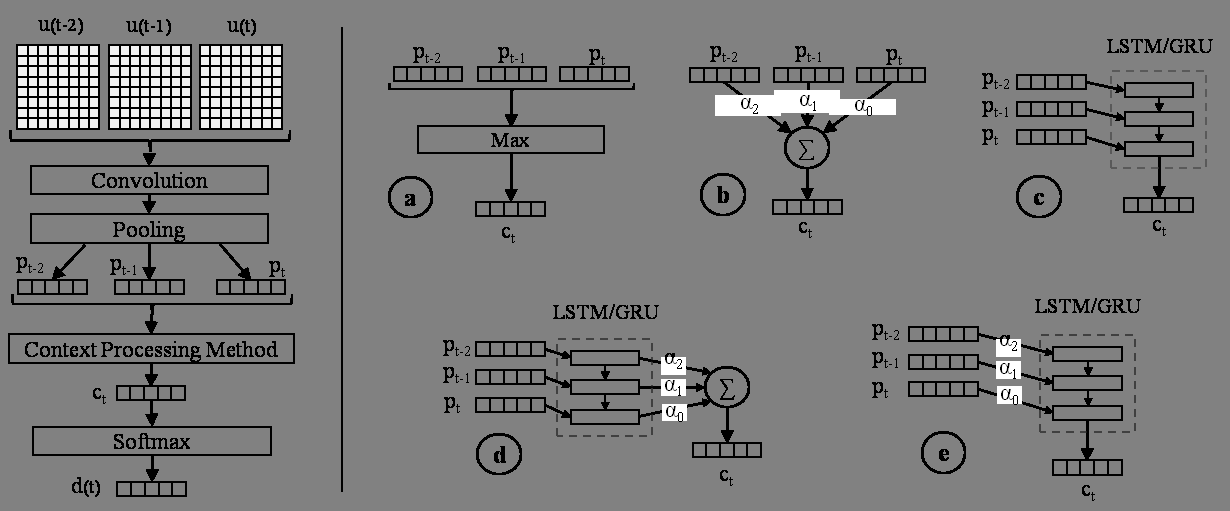
We explore context representation learning methods in neural-based models for dialog act classification.We propose and compare extensively different methods which combine recurrent neural network architectures and attention mechanisms (AMs) at different context levels.Our experimental results on two benchmark datasets show consistent improvements compared to the models without contextual information and reveal that the most suitable AM in the architecture depends on the nature of the dataset.
Overview
The claims and statistics of this paper haven’t been checked yet.
Run the check — free, no account needed. It reads the open-access text and checks the sources it cites.
Integrity signals
Registry
Cites
Statistics
Figures
Verification
Claims the paper makes
The claims and statistics of this paper haven’t been checked yet.
Run the check — free, no account needed. It reads the open-access text and checks the sources it cites.
Claims other papers make about this one
Each is checked against this paper’s own text: does it say what the citing paper says it does?
The cited source says what the claim attributes to it.
In the citing paper
“A generalization of this, that moves beyond task-specific dialogue systems, is to classify speech and feedback as dialogue acts instead (Liu and Lane, 2017; Ortega and Vu, 2017).”
From Modeling Feedback in Interaction With Conversational Agents—A Review (2022) · cites this paper as Ortega and Vu, 2017
Self-check
Percentages, sums and reported differences re-computed from the paper’s own numbers.
The self-check needs the paper’s full text.
Citations
Cites
Hochreiter, S., & Schmidhuber, J. (1997) · Neural Computation · doi:10.1162/neco.1997.9.8.1735 · Cited by 102,318
SWITCHBOARD: telephone speech corpus for research and development
Godfrey, J. J., Holliman, E. C., & McDaniel, J. (1992) · [Proceedings] ICASSP-92: 1992 IEEE International Conference on Acoustics, Speech, and Signal Processing · doi:10.1109/icassp.1992.225858 · Cited by 2,134 · cited 2×
“• SwDA : Switchboard Dialog Act Corpus (Godfrey et al., 1992; Jurafsky et al., 1997), a dialog corpus of 2-speaker conversations .”
Background
Research works printed but not linked: 26
- Heike Adel and Hinrich Schütze. 2017. Explor- ing different dimensions of attention for uncer- tainty detection. In Proceedings of the 15th Conference of the European Chapter of the As- sociation for Computational Linguistics: Vol- ume 1, Long Papers. Association for Computa- tional Linguistics, Valencia, Spain, pages 22-34. http://www.aclweb.org/anthology/E17-1003.
- Jeremy Ang, Yang Liu, and Elizabeth Shriberg. 2005. Automatic dialog act segmentation and classifica- tion in multiparty meetings. In in Proc. IEEE Int. Conf. on Acoustics, Speech and Signal Processing (ICASSP. pages 1061-1064.
- Dzmitry Bahdanau, Kyunghyun Cho, and Yoshua Bengio. 2014. Neural machine translation by jointly learning to align and translate. CoRR abs/1409.0473. http://arxiv.org/abs/1409.0473. · arXiv
- KyungHyun Cho, Bart van Merrienboer, Dzmitry Bahdanau, and Yoshua Bengio. 2014. On the properties of neural machine translation: Encoder-decoder approaches. CoRR abs/1409.1259. http://arxiv.org/abs/1409.1259. · arXiv
- Jan Chorowski, Dzmitry Bahdanau, Dmitriy Serdyuk, KyungHyun Cho, and Yoshua Bengio. 2015. Attention-based models for speech recognition. CoRR abs/1506.07503. http://arxiv.org/abs/1506.07503. · arXiv
- Junyoung Chung, C ¸aglar Gülc ¸ehre, KyungHyun Cho, and Yoshua Bengio. 2014. Empirical evaluation of gated recurrent neural networks on sequence modeling. CoRR abs/1412.3555. http://arxiv.org/abs/1412.3555. · arXiv
- David Golub and Xiaodong He. 2016. Character- level question answering with attention. CoRR abs/1604.00727. http://arxiv.org/abs/1604.00727. · arXiv
- M. Henderson, M. Gai, B. Thomson, P. Tsiakoulis, K. Yu, and S. Young. 2012. Discriminative spoken language understanding using word con- fusion networks. In 2012 IEEE Spoken Lan- guage Technology Workshop (SLT). pages 176-181. https://doi.org/10.1109/SLT.2012.6424218. · DOI
- Adam Janin, Don Baron, Jane Edwards, Dan Ellis, David Gelbart, Nelson Morgan, Barbara Peskin, Thilo Pfau, Elizabeth Shriberg, Andreas Stolcke, and Chuck Wooters. 2003. The icsi meeting corpus. pages 364-367.
- Gang Ji and Jeff Bilmes. 2006. Backoff model training using partially observed data: Applica- tion to dialog act tagging. In Proceedings of the Main Conference on Human Language Technol- ogy Conference of the North American Chapter of the Association of Computational Linguistics. As- sociation for Computational Linguistics, Strouds- burg, PA, USA, HLT-NAACL '06, pages 280-287. https://doi.org/10.3115/1220835.1220871. · DOI
- Yangfeng Ji, Gholamreza Haffari, and Jacob Eisen- stein. 2016. A latent variable recurrent neural net- work for discourse relation language models. CoRR abs/1603.01913. http://arxiv.org/abs/1603.01913. · arXiv
- Nal Kalchbrenner and Phil Blunsom. 2013. Re- current convolutional neural networks for dis- course compositionality. CoRR abs/1306.3584. http://arxiv.org/abs/1306.3584. · arXiv
- Yoon Kim. 2014. Convolutional neural networks for sentence classification. CoRR abs/1408.5882. http://arxiv.org/abs/1408.5882. · arXiv
- Ji Young Lee and Franck Dernoncourt. 2016. Sequen- tial short-text classification with recurrent and con- volutional neural networks. CoRR abs/1603.03827. http://arxiv.org/abs/1603.03827. · arXiv
- Tomas Mikolov, Ilya Sutskever, Kai Chen, Greg Corrado, and Jeffrey Dean. 2013. Distributed representations of words and phrases and their compositionality. CoRR abs/1310.4546. http://arxiv.org/abs/1310.4546. · arXiv
- B. T. Polyak and A. B. Juditsky. 1992. Accel- eration of stochastic approximation by averag- ing. SIAM J. Control Optim. 30(4):838-855. https://doi.org/10.1137/0330046. · DOI · Paper page
- Eugénio Ribeiro, Ricardo Ribeiro, and David Mar- tins de Matos. 2015. The influence of context on dialogue act recognition. CoRR abs/1506.00839. http://arxiv.org/abs/1506.00839. · arXiv
- Tim Rocktäschel, Edward Grefenstette, Karl Moritz Hermann, Tomás Kociský, and Phil Blun- som. 2015. Reasoning about entailment with neural attention. CoRR abs/1509.06664. http://arxiv.org/abs/1509.06664. · arXiv
- Alexander M. Rush, Sumit Chopra, and Jason We- ston. 2015. A neural attention model for abstrac- tive sentence summarization. In Lluís Màrquez, Chris Callison-Burch, Jian Su, Daniele Pighin, and Yuval Marton, editors, Proceedings of the 2015 Conference on Empirical Methods in Natu- ral Language Processing, EMNLP 2015, Lisbon, Portugal, September 17-21, 2015. The Associa- tion for Computational Linguistics, pages 379-389. http://aclweb.org/anthology/D/D15/D15-1044.pdf.
- Sheng-syun Shen and Hung-yi Lee. 2016. Neural at- tention models for sequence classification: Anal- ysis and application to key term extraction and dialogue act detection. CoRR abs/1604.00077. http://arxiv.org/abs/1604.00077. · arXiv
- Elizabeth Shriberg, Raj Dhillon, Sonali Bhagat, Jeremy Ang, and Hannah Carvey. 2004. The icsi meet- ing recorder dialog act (mrda) corpus. In Michael Strube and Candy Sidner, editors, Proceedings of the 5th SIGdial Workshop on Discourse and Dia- logue. Association for Computational Linguistics, Cambridge, Massachusetts, USA, pages 97-100. http://www.aclweb.org/anthology/W04-2319.
- Andreas Stolcke, Noah Coccaro, Rebecca Bates, Paul Taylor, Carol Van Ess-Dykema, Klaus Ries, Eliz- abeth Shriberg, Daniel Jurafsky, Rachel Martin, and Marie Meteer. 2000. Dialogue act modeling for automatic tagging and recognition of conversa- tional speech. Comput. Linguist. 26(3):339-373. https://doi.org/10.1162/089120100561737. · DOI
- Zichao Yang, Diyi Yang, Chris Dyer, Xiaodong He, Alexander J. Smola, and Eduard H. Hovy. 2016. Hi- erarchical attention networks for document classifi- cation. In HLT-NAACL.
- Wenpeng Yin, Hinrich Schütze, Bing Xiang, and Bowen Zhou. 2015. ABCNN: attention- based convolutional neural network for mod- eling sentence pairs. CoRR abs/1512.05193. http://arxiv.org/abs/1512.05193. · arXiv
- Ye Zhang and Byron C. Wallace. 2015. A sen- sitivity analysis of (and practitioners' guide to) convolutional neural networks for sen- tence classification. CoRR abs/1510.03820. http://arxiv.org/abs/1510.03820. · arXiv
- Matthias Zimmermann. 2009. Joint segmentation and classification of dialog acts using conditional ran- dom fields. In INTERSPEECH. pages 864-867.
Cited by
Sorted by citations
Modeling Feedback in Interaction With Conversational Agents—A Review
Axelsson, A., Buschmeier, H., & Skantze, G. (2022) · Frontiers in Computer Science · doi:10.3389/fcomp.2022.744574 · Cited by 45
Metadata
- Authors
- Ortega, D., & Vu, N. T.
- Affiliations
- University of Stuttgart (DE)
- ORCID
- Vu, Ngoc Thang
- Venue
- Proceedings of the 18th Annual SIGdial Meeting on Discourse and Dialogue
- Published
- 2017
- Pages
- 247-252
- OpenAlex
- W2744378813
- Cited by
- 41
- References
- 2
- Citations by year
- 2026: 1 · 2025: 2 · 2024: 2 · 2023: 8 · 2022: 4 · 2021: 6 · 2020: 4 · 2019: 5 · 2018: 9
- FWCI
- 1.98
- Type
- conference paper
- Language
- en
- Open access
- hybrid
- doi.org
- Licence
- cc-by
- Locations
- Annual Meeting of the Special Interest Group on Discourse and Dialogue (publishedVersion, cc-by)
- arXiv (Cornell University) (submittedVersion)
- arXiv (Cornell University)
- Topics
- Physical Sciences › Computer Science › Artificial Intelligence › Speech and dialogue systems
- Physical Sciences › Computer Science › Artificial Intelligence › Topic Modeling
- Physical Sciences › Computer Science › Artificial Intelligence › Speech Recognition and Synthesis
- Keywords
- dialogue act classification, attention mechanism, recurrent neural networks, contextual information, dialogue understanding
About these checks
Registry, retraction, Cites and statistics results are computed, not judged, with one exception: a printed reference that no index lists is read once by a model before it counts as a citation error. Claims are extracted by a model and kept only when their quote appears verbatim in the text; each cited source is then checked, with a model’s help, for whether it says what the claim relies on. Those verdicts can be wrong — read the claim’s quote and the cited source before relying on one.
Statistics and arithmetic are recomputed, not judged.
Confidence bands are shown only for fields calibrated on our annotated test set. None is calibrated yet, so no band is shown.
What counts as a claim ›How we measure confidence ›How we check this ›
Are you an author, or do you see a problem with this page? Request a review
