

Emo2Vec: Learning Generalized Emotion Representation by Multi-task Training
Open accessThe DOI matches its Crossref record; 43 of the 45 references it cites were found in a registry or an index.
Abstract
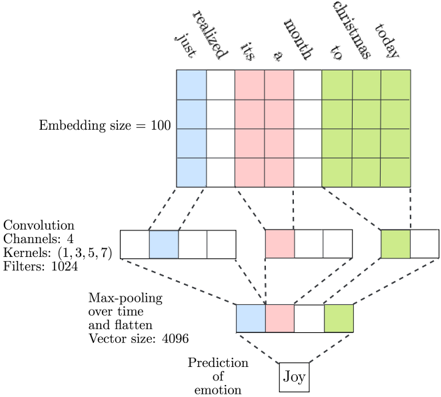
In this paper, we propose Emo2Vec which encodes emotional semantics into vectors.We train Emo2Vec by multi-task learning six different emotion-related tasks, including emotion/sentiment analysis, sarcasm classification, stress detection, abusive language classification, insult detection, and personality recognition.Our evaluation of Emo2Vec shows that it outperforms existing affect-related representations, such as Sentiment-Specific Word Embedding and DeepMoji embeddings with much smaller training corpora.When concatenated with GloVe, Emo2Vec achieves competitive performances to state-of-the-art results on several tasks using a simple logistic regression classifier.
Overview
The claims and statistics of this paper haven’t been checked yet.
Free: it reads the open-access text and checks the first 5 claims that cite a source we can check. Create a free account to check every claim.
Integrity signals
Registry
Cites
Statistics
Figures
Verification
Claims the paper makes
The claims and statistics of this paper haven’t been checked yet.
Free: it reads the open-access text and checks the first 5 claims that cite a source we can check. Create a free account to check every claim.
Claims other papers make about this one
Each is checked against this paper’s own text: does it say what the citing paper says it does?
The cited source says what the claim attributes to it.
In the citing paper
“Experiments revealed that Emo2Vec surpasses conventional word embedding techniques in numerous emotion-driven tasks.”
From A Survey of Deep Learning-Based Multimodal Emotion Recognition: Speech, Text, and Face (2023) · cites this paper as [65]
The cited source says what the claim attributes to it.
In the citing paper
“Xu et al. [65] unveiled Emo2Vec, embedding emotional semantics into fixed-size vector representations at the word level.”
From A Survey of Deep Learning-Based Multimodal Emotion Recognition: Speech, Text, and Face (2023) · cites this paper as [65]
Self-check
Percentages, sums and reported differences re-computed from the paper’s own numbers.
The self-check needs the paper’s full text.
Citations
Cites
Gradient-based learning applied to document recognition
Lecun, Y., Bottou, L., Bengio, Y., & Haffner, P. (1998) · Proceedings of the IEEE · doi:10.1109/5.726791 · Cited by 58,805 · cited 8×
“Compared with CNN embedding : Emo2Vec works better than CNN embedding on 14/18 datasets, giving 2.6% absolute accuracy improvement for the sentiment task and 1.6% absolute f1-score improvement on the other tasks.”
MethodInfluentialGlove: Global Vectors for Word Representation
Pennington, J., Socher, R., & Manning, C. (2014) · Proceedings of the 2014 Conference on Empirical Methods in Natural Language Processing (EMNLP) · doi:10.3115/v1/d14-1162 · Cited by 34,071 · cited 1×
“Recent work on word representation has been focusing on embedding syntactic and semantic information into fixed-sized vectors (Mikolov et al., 2013; Pennington et al., 2014) based on the distributional hypothesis, and have proven to be useful in many natural language tasks (Collobert et al., 2011).”
BackgroundDistributed Representations of Words and Phrases and their Compositionality
Mikolov, T., Sutskever, I., Chen, K., Corrado, G., & Dean, J. (2013) · arXiv · doi:10.48550/arxiv.1310.4546 · Cited by 24,533 · cited 1×
“Recent work on word representation has been focusing on embedding syntactic and semantic information into fixed-sized vectors (Mikolov et al., 2013; Pennington et al., 2014) based on the distributional hypothesis, and have proven to be useful in many natural language tasks (Collobert et al., 2011).”
Background(2010) · International Conference on Machine Learning · Cited by 13,995
Recursive Deep Models for Semantic Compositionality Over a Sentiment Treebank
Socher, R., Perelygin, A., Wu, J., Chuang, J., Manning, C. D., Ng, A., & Potts, C. (2013) · Proceedings of the 2013 Conference on Empirical Methods in Natural Language Processing · doi:10.18653/v1/d13-1170 · Cited by 6,878 · cited 2×
“(1,2) SST-fine and SST-binary (Socher et al., 2013) (3) OpeNER (Agerri et al., 2013) (Staiano and Guerini, 2014).”
BackgroundNatural Language Processing (almost) from Scratch
Collobert, R., Weston, J., Bottou, L., Karlen, M., Kavukcuoglu, K., & Kuksa, P. P. (2011) · arXiv (Cornell University) · doi:10.48550/arxiv.1103.0398 · Cited by 4,962 · cited 1×
“Recent work on word representation has been focusing on embedding syntactic and semantic information into fixed-sized vectors (Mikolov et al., 2013; Pennington et al., 2014) based on the distributional hypothesis, and have proven to be useful in many natural language tasks (Collobert et al., 2011).”
BackgroundA Convolutional Neural Network for Modelling Sentences
Kalchbrenner, N., Grefenstette, E., & Blunsom, P. (2014) · Proceedings of the 52nd Annual Meeting of the Association for Computational Linguistics (Volume 1: Long Papers) · doi:10.3115/v1/p14-1062 · Cited by 3,601
NLTK: the Natural Language Toolkit
Loper, E., & Bird, S. (2002) · Proceedings of the ACL-02 Workshop on Effective tools and methodologies for teaching natural language processing and computational linguistics - · doi:10.3115/1118108.1118117 · Cited by 3,218
Emotion knowledge: further exploration of a prototype approach
Shaver, P., Schwartz, J., Kirson, D., & O'Connor, C. (1987) · Journal of Personality and Social Psychology · doi:10.1037/0022-3514.52.6.1061 · Cited by 3,072 · cited 1×
“More tweets between January and October 2017 are additionally added using the Twitter Firehose API by us-ing the hashtags based on the hierarchy mentioned in Shaver et al. (1987).”
MethodAttention-based LSTM for Aspect-level Sentiment Classification
Wang, Y., Huang, M., zhu, X., & Zhao, L. (2016) · Proceedings of the 2016 Conference on Empirical Methods in Natural Language Processing · doi:10.18653/v1/d16-1058 · Cited by 2,450 · cited 1×
“Aspect-based sentiment (Chen et al., 2017; Wang et al., 2016) is also a hot topic where researchers care more about the sentiment towards a certain target.”
Background
Research works printed but not linked: 4
- [14]14. Mohit Iyyer, Varun Manjunatha, Jordan Boyd-Graber, and Hal Daumé III. 2015. Deep unordered com- position rivals syntactic methods for text classifica- tion. In Proceedings of the 53rd Annual Meeting of the Association for Computational Linguistics and the 7th International Joint Conference on Natural Language Processing (Volume 1: Long Papers), vol- ume 1, pages 1681-1691.
- [18]18. Tomas Mikolov, Ilya Sutskever, Kai Chen, Greg S. Cor- rado, and Jeff Dean. 2013. Distributed representa- tions of words and phrases and their compositional- ity. In Advances in neural information processing systems, pages 3111-3119.
- [22]22. James W Pennebaker and Laura A King. 1999. Lin- guistic styles: Language use as an individual differ- ence. Journal of personality and social psychology, 77(6):1296.
- [41]41. Amir Zadeh, Minghai Chen, Soujanya Poria, Erik Cambria, and Louis-Philippe Morency. 2017. Ten- sor fusion network for multimodal sentiment analy- sis. In Proceedings of the 2017 Conference on Em- pirical Methods in Natural Language Processing, pages 1103-1114.
Cited by
Towards Empathetic Open-domain Conversation Models: A New Benchmark and Dataset
Rashkin, H., Smith, E. M., Li, M., & Boureau, Y.-L. (2019) · Proceedings of the 57th Annual Meeting of the Association for Computational Linguistics · doi:10.18653/v1/p19-1534 · Cited by 771
“…wide breadth of research in distributional representation approaches for many emotion classification tasks (Duppada et al., 2018; Park et al., 2018; Xu et al., 2018; Mohammad et al., 2018) that build on deep networks pretrained on large-scale weakly-labelled data such as emo-jis (Felbo et al.,…”
BackgroundZhang, S., Yang, Y., Chen, C., Zhang, X., Leng, Q., & Zhao, X. (2024) · Expert Systems with Applications · doi:10.1016/j.eswa.2023.121692 · Cited by 251
Semantic-Emotion Neural Network for Emotion Recognition From Text
Batbaatar, E., Li, M., & Ryu, K. H. (2019) · IEEE Access · doi:10.1109/access.2019.2934529 · Cited by 246
“Recently, some emotion embeddings are proposed for solving this issue and achieved better performance in emotion-related tasks [16]–[19].”
BackgroundMoEL: Mixture of Empathetic Listeners
Lin, Z., Madotto, A., Shin, J., Xu, P., & Fung, P. (2019) · Proceedings of the 2019 Conference on Empirical Methods in Natural Language Processing and the 9th International Joint Conference on Natural Language Processing (EMNLP-IJCNLP) · doi:10.18653/v1/d19-1012 · Cited by 213
“However, only fewer works focus on emotion (Winata et al., 2017, 2019; Xu et al., 2018; Fan et al., 2018a,c,b; Lee et al., 2019) and empathy in the context of dialogues systems (Bertero et al., 2016; Chatterjee et al., 2019a,b; Shin et al., 2019).”
BackgroundSelf-citationA Survey of Deep Learning-Based Multimodal Emotion Recognition: Speech, Text, and Face
Lian, H., Lu, C., Li, S., Zhao, Y., Tang, C., & Zong, Y. (2023) · Entropy · doi:10.3390/e25101440 · Cited by 224
“Following this, Xu et al. [65] unveiled Emo2Vec, embedding emotional semantics into fixed-size vector representations at the word level.”
MethodNeural Approaches to Conversational AI
Gao, J., Galley, M., & Li, L. (2019) · Foundations and Trends® in Information Retrieval · doi:10.1561/1500000074 · Cited by 209
A Survey of Textual Emotion Recognition and Its Challenges
Deng, J., & Ren, F. (2023) · IEEE Transactions on Affective Computing · doi:10.1109/taffc.2021.3053275 · Cited by 186
“To learn generalized emotion representation, Emo2Vec is proposed in [72] to encode emotional semantics into vectors.”
BackgroundA survey on deep learning for textual emotion analysis in social networks
Peng, S., Cao, L., Zhou, Y., Ouyang, Z., Yang, A., Li, X., Jia, W., & Yu, S. (2022) · Digital Communications and Networks · doi:10.1016/j.dcan.2021.10.003 · Cited by 179
Dreaddit: A Reddit Dataset for Stress Analysis in Social Media
Turcan, E., & McKeown, K. (2019) · Proceedings of the Tenth International Workshop on Health Text Mining and Information Analysis (LOUHI 2019) · doi:10.18653/v1/d19-6213 · Cited by 145
“…Neural Network (GRNN) (Cho et al., 2014) and Convolutional Neural Network (CNN) (as designed in Kim (2014)) with parallel filters of size 2 and 3, as these have been shown to be effective in the literature on emotion detection in text (e.g., Xu et al. (2018); Abdul-Mageed and Ungar (2017)).”
BackgroundText-Based Emotion Recognition Using Deep Learning Approach
Bharti, S. K., Varadhaganapathy, S., Gupta, R. K., Shukla, P. K., Bouye, M., Hinga, S. K., & Mahmoud, A. (2022) · Computational Intelligence and Neuroscience · doi:10.1155/2022/2645381 · Cited by 219
“Xu et al. [8] P. Xu et al. [12] has proposed an Emo2Vec method that encodes emotional semantics into vector form. have trained Emo2Vec on a multitask learning framework by using smaller and larger datasets (smaller datasets such as ISEAR, WASSA, and Olympic).”
MethodAll-in-One: Emotion, Sentiment and Intensity Prediction Using a Multi-Task Ensemble Framework
Akhtar, M. S., Ghosal, D., Ekbal, A., Bhattacharyya, P., & Kurohashi, S. (2019) · IEEE Transactions on Affective Computing · doi:10.1109/taffc.2019.2926724 · Cited by 138
“[31] proposed an emotion-aware embeddings (Emo2Vec) that encodes the emotional semantics into vector through the application of multi-task learning.”
BackgroundNeural Approaches to Conversational AI
Gao, J., Galley, M., & Li, L. (2019) · now publishers, Inc. eBooks · doi:10.1561/9781680835533 · Cited by 107
A BERT based dual-channel explainable text emotion recognition system
Kumar, P., & Raman, B. (2022) · Neural Networks · doi:10.1016/j.neunet.2022.03.017 · Cited by 120
Deng, J., & Ren, F. (2020) · IEEE Transactions on Affective Computing · doi:10.1109/taffc.2020.3034215 · Cited by 95
“To achieve robust emotion feature representation, Emo2Vec is trained in [33] to encode emotional semantics by multi-task learning six different emotion-related tasks.”
BackgroundOn the evaluation and combination of state-of-the-art features in Twitter sentiment analysis
Carvalho, J., & Plastino, A. (2020) · Artificial Intelligence Review · doi:10.1007/s10462-020-09895-6 · Cited by 102
Zero-shot Cross-lingual Dialogue Systems with Transferable Latent Variables
Liu, Z., Shin, J., Xu, Y., Winata, G. I., Xu, P., Madotto, A., & Fung, P. (2019) · Conference on Empirical Methods in Natural Language Processing (EMNLP) · doi:10.18653/v1/d19-1129 · Cited by 67
“Cross-lingual transfer learning which acts as one of the low-resource topics (Gu et al., 2018; Lee et al., 2019; Liu et al., 2019; Xu et al., 2018) has attracted more and more people recently, followed by the rapid development of cross-lingual word embeddings.”
BackgroundSelf-citationEmotion-Infused Models for Explainable Psychological Stress Detection
Turcan, E., Muresan, S., & McKeown, K. R. (2021) · Conference of the North American Chapter of the Association for Computational Linguistics: Human Language Technologies (NAACL-HLT) · doi:10.18653/v1/2021.naacl-main.230 · Cited by 69
“…al., 2019; Kiperwasser and Ballesteros, 2018; Liu et al., 2019); we are especially interested in instances where it has improved semantic and emotion-related tasks, such as Xu et al. (2018), who perform emotion detection with a suite of secondary semantic tasks including personality classification.”
BackgroundMuMu: Cooperative Multitask Learning-Based Guided Multimodal Fusion
Islam, M. M., & Iqbal, T. (2022) · Proceedings of the AAAI Conference on Artificial Intelligence · doi:10.1609/aaai.v36i1.19988 · Cited by 70
“Additionally, multitask models have been used to learn shared representations (Ruder 2017; Xu et al. 2018; Zhou et al. 2020b; Achille et al. 2019; Zamir et al. 2018).”
MethodMulti-Task Learning and Adapted Knowledge Models for Emotion-Cause Extraction
Turcan, E., Wang, S., Anubhai, R., Bhattacharjee, K., Al-Onaizan, Y., & Muresan, S. (2021) · Findings of the Association for Computational Linguistics: ACL (Findings of ACL) · doi:10.18653/v1/2021.findings-acl.348 · Cited by 50
HappyBot: Generating Empathetic Dialogue Responses by Improving User Experience Look-aheadPreprint
Shin, J., Xu, P., Madotto, A., & Fung, P. (2019) · arXiv (Cornell University) · Cited by 46
Self-citationClickbait? Sensational Headline Generation with Auto-tuned Reinforcement Learning
Xu, P., Wu, C.-S., Madotto, A., & Fung, P. (2019) · Conference on Empirical Methods in Natural Language Processing (EMNLP) · doi:10.18653/v1/d19-1303 · Cited by 49
Self-citationSurvey of deep emotion recognition in dynamic data using facial, speech and textual cues
Zhang, T., & Tan, Z. (2024) · Multimedia Tools and Applications · doi:10.1007/s11042-023-17944-9 · Cited by 46
Sent2Vec: A New Sentence Embedding Representation With Sentimental Semantic
Moghadasi, M. N., & Zhuang, Y. (2020) · IEEE International Conference on Big Data (BigData) · doi:10.1109/bigdata50022.2020.9378337 · Cited by 50
“Emo2vec [18] is a word-level representation that encodes emotional semantics into fixed-sized, real-valued vectors.”
BackgroundA Comprehensive Analysis of Preprocessing for Word Representation Learning in Affective Tasks
Babanejad, N., Agrawal, A., An, A., & Papagelis, M. (2020) · Proceedings of the conference - Association for Computational Linguistics. Meeting · doi:10.18653/v1/2020.acl-main.514 · Cited by 39
“, 2014), representing emotion with vectors using a multi-task training framework (Xu et al., 2018) and generating affective word embeddings (Felbo et al.”
MethodCAiRE_HKUST at SemEval-2019 Task 3: Hierarchical Attention for Dialogue Emotion Classification
Winata, G. I., Madotto, A., Lin, Z., Shin, J., Xu, Y., Xu, P., & Fung, P. (2019) · International Workshop on Semantic Evaluation (SemEval) · doi:10.18653/v1/s19-2021 · Cited by 35
“The most naive first step would be to recognize emotion from a given flattened sequence, which has been researched extensively despite the very abstract nature of emotion (Socher et al., 2013; Felbo et al., 2017a; McCann et al., 2017; Xu et al., 2018; Chatterjee et al., 2019a).”
BackgroundInfluentialSelf-citationEmoGraph: Capturing Emotion Correlations using Graph NetworksPreprint
Xu, P., Liu, Z., Winata, G. I., Lin, Z., & Fung, P. (2020) · arXiv (Cornell University) · doi:10.48550/arxiv.2008.09378 · Cited by 36
“Park et al. (2018); Fung et al.; Xu et al. (2018) encoded emotion information into word representations and demonstrated improvements over emotion classification tasks.”
BackgroundSelf-citationA transformer based multi task learning approach to multimodal hate speech detection
Kapil, P., & Ekbal, A. (2025) · Natural Language Processing Journal · doi:10.1016/j.nlp.2025.100133 · Cited by 39
CAiRE: An Empathetic Neural ChatbotPreprint
Lin, Z., Xu, P., Winata, G. I., Siddique, F. B., Liu, Z., Shin, J., & Fung, P. (2019) · arXiv (Cornell University) · doi:10.48550/arxiv.1907.12108 · Cited by 49
Self-citationBarreto, S., Moura, R., Carvalho, J., Paes, A., & Plastino, A. (2022) · Data Mining and Knowledge Discovery · doi:10.1007/s10618-022-00853-0 · Cited by 48
“SSWE [51] 50 137K Feed-forward network Twitter (10M tweets) Emo2Vec [58] 100 1.”
BackgroundMethodInfluentialHierarchical Meta-Embeddings for Code-Switching Named Entity Recognition
Winata, G. I., Lin, Z., Shin, J., Liu, Z., & Fung, P. (2019) · Conference on Empirical Methods in Natural Language Processing (EMNLP) · doi:10.18653/v1/d19-1360 · Cited by 17
“Embeddings Previous works have extensively explored different representations such as word (Mikolov et al., 2013; Pennington et al., 2014; Grave et al., 2018; Xu et al., 2018), subword (Sennrich et al.”
Self-citationDistributed Representations of Emotion Categories in Emotion Space
Wang, X., & Zong, C. (2021) · doi:10.18653/v1/2021.acl-long.184 · Cited by 21
“To encode emotional information into word embedding, sentiment embedding and emotion(al) embedding have been proposed (Tang et al., 2014; Yu et al., 2017; Xu et al., 2018).”
MethodPredicting emotions in online social networks: challenges and opportunities
Alqahtani, G., & Alothaim, A. (2022) · Multimedia Tools and Applications · doi:10.1007/s11042-022-12345-w · Cited by 18
“[150] GloVe and encodes emotional semantics into vectors (Emo2Vec).”
BackgroundDevelopment of Context-Based Sentiment Classification for Intelligent Stock Market Prediction
Smatov, N., Калашников, Р., & Kartbayev, A. Z. (2024) · Big Data and Cognitive Computing · doi:10.3390/bdcc8060051 · Cited by 24
“The advancements by the authors of [16–18] further addressed the complexities introduced by Twitter’s ever-changing language, showcasing the significance of these developments in tackling the nuances of social media text analysis.”
BackgroundRepresentation Learning for Emotion Recognition from Smartphone Keyboard Interactions
Ghosh, S., Goenka, S., Ganguly, N., Mitra, B., & De, P. (2019) · International Conference on Affective Computing and Intelligent Interaction and workshops · doi:10.1109/acii.2019.8925518 · Cited by 14
“Some of the recent works on emotion detection based on other modalities, such as facial expressions, and speech characteristics, showed that automatic feature extraction can be as effective as feature engineering [10], [11].”
BackgroundHuang, L., Eiden, A. L., He, L., Annan, A., Wang, S., Wang, J., Manion, F. J., Wang, X., Du, J., & Yao, L. (2024) · JMIR Medical Informatics · doi:10.2196/57164 · Cited by 17
Sentiment Diffusion in Online Social Networks: A Survey from the Computational Perspective
Han, X., Xu, M., Deng, X., & Wang, B. (2025) · ACM Computing Surveys · doi:10.1145/3736750 · Cited by 19
“…and named entity recognition tasks ELMo [137] SQuAD 10 Significantly improve the state of the art across six challenging NLP problems Emo2Vec [191] ISEAR, WASSA 11 Has competitive performances to state-of-the-art results on several tasks WDE-CNN [202] User-product-reviewgraph 12 Effective…”
Incorporating external knowledge for text matching model
Jiang, K., Jin, G., Zhang, Z., Cui, R., & Zhao, Y. (2024) · Computer Speech & Language · doi:10.1016/j.csl.2024.101638 · Cited by 12
Artificial intelligence techniques for human-machine interaction
Mukhtar, H. (2024) · Elsevier eBooks · doi:10.1016/b978-0-443-29150-0.00010-x · Cited by 14
Cháves-Villota, A., Jiménez-Martín, A., Jojoa, M., Bahillo, A., & García-Domínguez, J. J. (2025) · Computer Speech & Language · doi:10.1016/j.csl.2025.101873 · Cited by 15
MTVRep: A movie and TV show reputation system based on fine-grained sentiment and semantic analysis
Benlahbib, A., & Nfaoui, E. H. (2021) · International Journal of Power Electronics and Drive Systems/International Journal of Electrical and Computer Engineering · doi:10.11591/ijece.v11i2.pp1613-1626 · Cited by 12
“[16] proposed Emo2Vec which are word-level representations that encode emotional semantics into fixed-sized, real-valued vectors.”
BackgroundLi, W., Hua, Y., Zhou, P., Zhou, L., Xu, X., & Yang, J. (2025) · Journal of Medical Internet Research · doi:10.2196/63755 · Cited by 14
Learning Sentiment-Enhanced Word Representations by Fusing External Hybrid Sentiment Knowledge
Li, Y., Lin, Z., Lin, Y., Yin, J., & Chang, L. (2023) · Cognitive Computation · doi:10.1007/s12559-023-10164-1 · Cited by 8
“We choose some generalized emotion representation learning models without pre-training, such as SGloVe [1] and Emo2Vec [41].”
MethodBruyne, L. D., Clercq, O. D., & Hoste, V. (2021) · Electronics · doi:10.3390/electronics10212643 · Cited by 8
“Although there are not many studies that perform transfer learning with multiple emotion frameworks, there are various studies that employ multitask learning by jointly training emotion detection with sentiment analysis [16,17] or other related tasks [18].”
BackgroundTowards Label-Agnostic Emotion Embeddings
Buechel, S., Modersohn, L., & Hahn, U. (2021) · Conference on Empirical Methods in Natural Language Processing (EMNLP) · doi:10.18653/v1/2021.emnlp-main.728 · Cited by 16
“Similarly, Xu et al. (2018) learn word embeddings that are particularly rich in affective information by sharing an embedding layer between models for different emotion-related tasks.”
BackgroundESTeR: Combining Word Co-occurrences and Word Associations for Unsupervised Emotion Detection
Gollapalli, S. D., Rozenshtein, P., & Ng, S.-K. (2020) · Findings of the Association for Computational Linguistics: EMNLP (Findings of EMNLP) · doi:10.18653/v1/2020.findings-emnlp.93 · Cited by 10
“For the first set of baselines, we directly use the recent emotion-enriched word embeddings from ewe-uni300 (Agrawal et al., 2018), emo2vec100 1 (Xu et al., 2018), and ssweu50 2 (Tang et al., 2014) to represent sentence and emotion vectors.”
BackgroundMethodInfluentialMoEL: Mixture of Empathetic ListenersPreprint
Lin, Z., Madotto, A., Shin, J., Xu, P., & Fung, P. (2019) · arXiv (Cornell University) · doi:10.48550/arxiv.1908.07687 · Cited by 7
“However, only fewer works focus on emotion (Winata et al., 2017, 2019; Xu et al., 2018; Fan et al., 2018a,c,b; Lee et al., 2019) and empathy in the context of dialogues systems (Bertero et al., 2016; Chatterjee et al., 2019a,b; Shin et al., 2019).”
BackgroundSelf-citationEmpBot: A T5-based Empathetic Chatbot focusing on SentimentsPreprint
Zaranis, E., Paraskevopoulos, G., Katsamanis, A., & Potamianos, A. (2021) · arXiv (Cornell University) · doi:10.48550/arxiv.2111.00310 · Cited by 20
“tion (Fan et al., 2018b; Xu et al., 2018; Winata et al., 2017, 2019) and empathy in dialogue systems (Bertero et al.”
BackgroundGraph-enhanced implicit aspect-level sentiment analysis based on multi-prompt fusion
Li, X., Wang, X., Yao, C., & Yang, L. (2025) · Scientific Reports · doi:10.1038/s41598-025-02609-4 · Cited by 9
Simplified Approach for Predicting Emotions of Multi-Turn Textual Utterances
Vickneswaran, J., Navanesan, P., Vijayaratnam, V., & Thayasivam, U. (2020) · International Conference on Advances in ICT for Emerging Regions · doi:10.1109/icter51097.2020.9325442 · Cited by 6
“Hierarchical Attention for Dialogue Emotion Classification [7] is a model that uses the combination of many word embedding models such as GloVe [4], ELMo [8], BERT [9], Emo2Vec [10], DeepMoji [11], and Emoji2Vec [12].”
MethodFeelingBlue: A Corpus for Understanding the Emotional Connotation of Color in Context
Ananthram, A., Winn, O., & Muresan, S. (2023) · Transactions of the Association for Computational Linguistics · doi:10.1162/tacl_a_00540 · Cited by 12
Deep Emotion Recognition using Facial, Speech and Textual Cues: A SurveyPreprint
Zhang, T., & Tan, Z. (2021) · TechRxiv · doi:10.36227/techrxiv.15184302.v2 · Cited by 9
Dreaddit: A Reddit Dataset for Stress Analysis in Social MediaPreprint
Turcan, E., & McKeown, K. R. (2019) · arXiv (Cornell University) · doi:10.48550/arxiv.1911.00133 · Cited by 86
“…Neural Network (GRNN) (Cho et al., 2014) and Convolutional Neural Network (CNN) (as designed in Kim (2014)) with parallel filters of size 2 and 3, as these have been shown to be effective in the literature on emotion detection in text (e.g., Xu et al. (2018); Abdul-Mageed and Ungar (2017)).”
BackgroundBarreto, S., Moura, R., Carvalho, J., Paes, A., & Plastino, A. (2021) · arXiv (Cornell University) · doi:10.48550/arxiv.2105.14373 · Cited by 5
“SSWE [51] 50 137K Feed-forward network Twitter (10M tweets) Emo2Vec [58] 100 1.”
BackgroundMethodInfluentialNagaraj, P., & Das, B. (2021) · Advances in intelligent systems and computing · doi:10.1007/978-981-16-5157-1_9 · Cited by 5
Zhang, W. (2022) · Wireless Communications and Mobile Computing · doi:10.1155/2022/7691586 · Cited by 4
“[55] proposed Emo2Vec, which encodes sentiment semantics as a word-level representation of fixed-size real-valued vectors, and used a multitask learning approach to train Emo2Vec on six different emotionrelated tasks [56].”
MethodIslam, M. M., Gladstone, A., & Iqbal, T. (2023) · Proceedings of the AAAI Conference on Artificial Intelligence · doi:10.1609/aaai.v37i1.25177 · Cited by 11
“The aim of designing these models is two-fold: maximizing shared representations among the tasks and compressing the size of models by maximizing shared learnable parameters across tasks (Ruder 2017; Xu et al. 2018; Zhou et al. 2020b; Achille et al. 2019; Zamir et al. 2018).”
BackgroundEnhancing emotion detection in software engineering using a residual multi-embedding fusion network
Mahouachi, R. (2025) · Journal of Systems and Software · doi:10.1016/j.jss.2025.112651 · Cited by 4
Emotion and Intensity Prediction Using Hybrid Multi-Task BERT_BiLSTM Deep Learning Model
Parmar, M., & Tiwari, A. (2025) · Arabian Journal for Science and Engineering · doi:10.1007/s13369-025-10144-7 · Cited by 6
Neural Networks and Emotions: A Deep Learning Perspective
Madhura, M., Meghana, S., Varshitha, V., Kodipalli, A., & Rao, T. (2024) · IEEE International Conference for Convergence in Technology (I2CT) · doi:10.1109/i2ct61223.2024.10544003 · Cited by 5
“The accompanying line plots, detailed in Figures 8 and 9, showcased the training and validation loss as well as accuracy curves.”
ResultModality-Transferable Emotion Embeddings for Low-Resource Multimodal Emotion RecognitionPreprint
Dai, W., Liu, Z., Yu, T., & Fung, P. (2020) · arXiv (Cornell University) · doi:10.48550/arxiv.2009.09629 · Cited by 8
“For example, incorporate semantic emotion information (Xu et al., 2018) to the original word embeddings.”
BackgroundSelf-citationDeep Emotion Recognition using Facial, Speech and Textual Cues: A SurveyPreprint
Zhang, T., & Tan, Z. (2021) · TechRxiv · doi:10.36227/techrxiv.15184302 · Cited by 4
Buechel, S., & Hahn, U. (2025) · IEEE Transactions on Affective Computing · doi:10.1109/taffc.2025.3635686 · Cited by 6
Efficient Emotion-Aware Iconic Gesture Prediction for Robot Co-Speech
Montiel-Vázquez, E. C., Cruz, C. A., Gkikas, S., Kassiotis, T., Giannakakis, G. A., & Gómez, R. (2026) · International Conference in Electronic Engineering & Information Technology (EEITE) · doi:10.1109/eeite69609.2026.11679713 · Cited by 3
“The text is encoded with SBERT [24], while word-level embeddings are obtained using emo2vec [25].”
Block-segmentation vectors for arousal prediction using semi-supervised learning
Odaka, Y., & Kaneiwa, K. (2023) · Applied Soft Computing · doi:10.1016/j.asoc.2023.110327 · Cited by 3
Developing a Novel Method for Emotion Detection through Natural Language Processing
Lalitha, V. L., & Anguraj, D. K. (2024) · Data & Metadata · doi:10.56294/dm2024.222 · Cited by 3
EVOLUTIONARY COMBINATORIAL OPTIMIZATION FOR WORD EMBEDDING (ECOWE) IN SENTIMENT CLASSIFICATION
Gunasegaran, T., & Cheah, Y. (2019) · Malaysian Journal of Computer Science · doi:10.22452/mjcs.sp2019no3.3 · Cited by 2
Learning to memorize in neural task-oriented dialogue systems
Wu, C.-S. (2019) · doi:10.14711/thesis-991012730762803412 · Cited by 3
Self-citationPriyadarshini, M. A., & Mohan, A. K. (2025) · International Journal of Systems Assurance Engineering and Management · doi:10.1007/s13198-025-02977-0 · Cited by 1
Modeling a Novel Approach for Emotion Recognition Using Learning and Natural Language Processing
Lakshmi Lalitha, V., & Anguraj, D. K. (2024) · ACM Transactions on Asian and Low-Resource Language Information Processing · doi:10.1145/3641851 · Cited by 1
“According to China’s Internet Public Opinion Index’s 2011 Annual Report [ 13 ], “the total number of themes, there are more than 80% negative events.””
BackgroundCAML Model for Computational Linguistics
Chaudhuri, P. P., Dutta, A., Choudhury, S. P., Chowdhury, D. R., & Hazari, R. (2025) · Springer eBooks · doi:10.1007/978-981-96-1501-8_6 · Cited by 1
Semantics with Feeling: Emotions for Abstract Embedding, Affect for Concrete Grounding
Moro, D., Caracas, G., McNeill, D., & Kennington, C. (2020) · Scholar Works (Boise State University) · Cited by 1
Clickbait? Sensational Headline Generation with Auto-tuned Reinforcement LearningPreprint
Xu, P., Wu, C.-S., Madotto, A., & Fung, P. (2019) · arXiv (Cornell University) · doi:10.48550/arxiv.1909.03582 · Cited by 15
Self-citationConSSED at SemEval-2019 Task 3: Configurable Semantic and Sentiment Emotion Detector
Poświata, R. (2019) · International Workshop on Semantic Evaluation (SemEval) · doi:10.18653/v1/s19-2027 · Cited by 1
Hierarchical Meta-Embeddings for Code-Switching Named Entity RecognitionPreprint
Winata, G. I., Lin, Z., Shin, J., Liu, Z., & Fung, P. (2019) · arXiv (Cornell University) · doi:10.48550/arxiv.1909.08504
“Embeddings Previous works have extensively explored different representations such as word (Mikolov et al., 2013; Pennington et al., 2014; Grave et al., 2018; Xu et al., 2018), subword (Sennrich et al.”
Self-citationZero-shot Cross-lingual Dialogue Systems with Transferable Latent VariablesPreprint
Liu, Z., Shin, J., Xu, Y., Winata, G. I., Xu, P., Madotto, A., & Fung, P. (2019) · arXiv (Cornell University) · doi:10.48550/arxiv.1911.04081 · Cited by 4
“Cross-lingual transfer learning which acts as one of the low-resource topics (Gu et al., 2018; Lee et al., 2019; Liu et al., 2019; Xu et al., 2018) has attracted more and more people recently, followed by the rapid development of cross-lingual word embeddings.”
BackgroundSelf-citationEncoding Sememe and Context Information into Sentence Representation for Implicit Sentiment Analysis
Qiu, Q., & Qiu, J. (2021) · Lecture notes on data engineering and communications technologies · doi:10.1007/978-3-030-80472-5_35
Taming the beast : learning to control neural conversational models
Madotto, A. (2021) · doi:10.14711/thesis-991012980222103412 · Cited by 1
Self-citationSustainable multimodal human assessment and emotion recognition system
Lalitha, Y. S., Gayatri, Y., Inti, L. B., Sheetal, S. R., Shirisha, P., Shnain, A. H., Joshi, R., & Dutt, A. (2025) · AIP conference proceedings · doi:10.1063/5.0266409
Sing, B., & Rahman, M. (2025) · IEEE International Conference on Quantum Photonics, Artificial Intelligence & Networking (QPAIN) · doi:10.1109/qpain66474.2025.11171754
“In other languages, such as English and German, some researchers have developed nostalgia classifiers using classical machine learning models like Na¨ıve Bayes and Support Vector Machines, as well as deep learning techniques [3], [4].”
Wang, Q., Li, Z., Song, Y., Chen, H., Kang, J., Lian, J., Li, J., Li, Y., & Li, X. (2026) · IEEE International Conference on Acoustics Speech and Signal Processing · doi:10.1109/icassp55912.2026.11463671 · Cited by 1
A Survey of Multimodal Emotion Recognition Systems for Visually Impaired
Ingale, S., Dhanaraj, R. K., & Al-Khasawneh, M. A. (2026) · Lecture notes in networks and systems · doi:10.1007/978-3-032-18913-4_7
Alam, F., Kamal, A., Meraj, M., Fazil, M., Kamal, A., Khan, S., Faridi, S., Sejwal, V. K., Qamar, S., & Almakki, R. (2026) · Scientific Reports · doi:10.1038/s41598-026-72542-7
“It operates as three parallel networks, and each receives the corresponding embedding vectors from SSWE, the shared embedding, and Emo2Vec.”
Influential
Metadata
- Authors
- Xu, P., Madotto, A., Wu, C.-S., Park, J. H., & Fung, P.
- Affiliations
- Hong Kong University of Science and Technology (HK)
- Venue
- Proceedings of the 9th Workshop on Computational Approaches to Subjectivity, Sentiment and Social Media Analysis
- Published
- 2018
- Pages
- 292-298
- OpenAlex
- W2891424355
- Cited by
- 83
- References
- 45
- Citations by year
- 2026: 4 · 2025: 12 · 2024: 8 · 2023: 6 · 2022: 6 · 2021: 15 · 2020: 9 · 2019: 23
- FWCI
- 4.78
- Type
- conference paper
- Language
- en
- Open access
- hybrid
- doi.org
- Licence
- cc-by
- Locations
- Workshop on Computational Approaches to Subjectivity, Sentiment and Social Media Analysis (WASSA) (publishedVersion, cc-by)
- Funders
- Hong Kong University of Science and Technology
- Topics
- Physical Sciences › Computer Science › Artificial Intelligence › Sentiment Analysis and Opinion Mining
- Physical Sciences › Computer Science › Artificial Intelligence › Emotion and Mood Recognition
- Physical Sciences › Computer Science › Artificial Intelligence › Topic Modeling
- Keywords
- emotion representation, multi-task learning, emotion analysis, sentiment analysis, sarcasm detection, stress detection, offensive language detection, personality recognition
About these checks
Registry, retraction, Cites and statistics results are computed, not judged, with one exception: a printed reference that no index lists is read once by a model before it counts as a citation error. Claims are extracted by a model and kept only when their quote appears verbatim in the text; each cited source is then checked, with a model’s help, for whether it says what the claim relies on. Those verdicts can be wrong — read the claim’s quote and the cited source before relying on one.
Statistics and arithmetic are recomputed, not judged.
Confidence bands are shown only for fields calibrated on our annotated test set. None is calibrated yet, so no band is shown.
What counts as a claim ›How we measure confidence ›How we check this ›
Are you an author, or do you see a problem with this page? Request a review
Data sources
Bibliographic data: Semantic Scholar, OpenAlex, Crossref.
Contains information from the Semantic Scholar Academic Graph Datasets, made available under the ODC Attribution License (ODC-BY 1.0).
Semantic Scholar’s data is described in: Kinney, R., et al. (2023). The Semantic Scholar Open Data Platform. arXiv:2301.10140.
