

The DOI matches its Crossref record; 6 of the 6 references it cites were found in a registry or an index; none of the 13 sources its claims cite is checked for support yet.
John Chrysostom’s Tale on How Michael Vanquished Satanael – a Bogomil text?
Open accessAbstract
The study is an attempt at a comparative analysis of two pseudo-canonical texts: the Slavic Homily of John Chrysostom on How Michael Vanquished Satanael (in two versions) and the Greek Λόγος τοῠ ἀρχηστρατήγου Μιχαήλ, ὃταν ἐπῆρεν τήν στολήν (BHG 1288n). Both texts, very close to each other in terms of the plot, relate an ancient angelomachia between a heavenly emissary and a demiurge expelled from the angelic hierarchy. When examined against the background of dualistic heterodox doctrines on the one hand, and compared to other medieval cultural texts (be they liturgical, iconographical or folkloric) on the other, these works enable insight into how heterodox and pseudo-canonical texts functioned and were disseminated in the medieval Byzantine-Slavic cultural sphere. The Slavic Homily… is not genetically related to its Greek counterpart, which is only preserved in a lat, 16th century copy. Rather, it was composed before the 13th century on the basis of another, non-extant model with a content similar to the pseudo-canonical Greek Homily… It is probable to a certain degree that the emergence of the Slavic work is connected with the growing interest in the cult of Archangel Michael in the First Bulgarian Empire, especially in the Diocese of Ohrid. Certain Gnostic ideas related to dualistic cosmology, as well as cosmogony, angelology and anthropology spread from the Judeo-Christian world to Byzantine literature and culture. Having undergone a number of transformations in the neo-Manichean communities of the Byzantine Empire and Bulgaria, they formed the basis for medieval dualistic cosmogony, as well as angelology and anthropology. Circulated both orally and in written form, beliefs concerning the invisible God, Archangel Michael as a ‘second God’ and the soul’s journey to Paradise became so widespread that they are not only found in heretic texts, but also cited almost verbatim in anti-heretic treatises. The content and later textual modifications of the Slavic Homily… cast a doubt on the hypothesis concerning its Bogomil origin. Furthermore, it cannot be determined to what extent works such as the Homily… were made use of by (moderate?) Bogomil communities. Even before the 14th century, the text underwent the processes of liturgization and folklorization, as proven by the presence of liturgical quotations (absent from the Greek text), the visualization of the story in sacred space as well as the aetiological legends about Archangel Michael’s fight against the Devil. The existence of ancient Gnostic ideas in the beliefs propagated by neo-Manichean Balkan heretic teachings, as well as their widespread presence in “high” and “low” texts originating in medieval communities call for a more cautious evaluation of the mutual antagonisms between them. This raises the problem of a wider look at medieval culture, in fact a syncretic phenomenon, where the distinction between the canonical, the pseudo-canonical, the heretic and the folkloric is not always clear-cut.
Overview
CoChat Summary
TL;DR
The paper compares two Slavic versions of the *Tale of John Chrysostom on How Michael Vanquished Satanael* with the Greek *Λόγος τοῦ ἀρχηστρατήγου Μιχαήλ* and argues that the Slavic work is not genetically related to the extant Greek text but was composed before the 13th century from a non-extant model. It concludes that the Slavic *Tale*’s Bogomil origin is doubtful, since the text underwent later “liturgization” and “folklorization” and its dualist elements belong to a broader transmission of older Gnostic and Neo-Manichaean ideas rather than an original Bogomil theology.
Key findings
- The Slavic *Tale* survives in five known copies in two versions: the older version is represented by the Savina monastery manuscript (?) and ЦИАИ no. 1161; the newer by Nikoljac monastery no. 82, the Punčo Codex, and ЦИАИ no. 232. The older texts are Serbian-recension Old Church Slavic; the newer come close to Bulgarian.
- The Greek text is preserved in Vat. Gr. 1190a, dated 1542, and is structurally close to the Slavic versions, but the paper rejects Afinogenova’s claim that the Greek is a translation of the Slavic; it suggests the Slavic *Tale* was translated/compiled in Bulgaria or Serbia no later than the end of the 12th or first decades of the 13th century from an unknown Byzantine work.
- Liturgical quotations from John Chrysostom’s anaphora appear in the Slavic *Tale* but are absent from the Greek text; the paper interprets this as evidence of later “liturgization” of the Slavic text, making it suitable for liturgical use, possibly for the Synaxis of the spiritual powers.
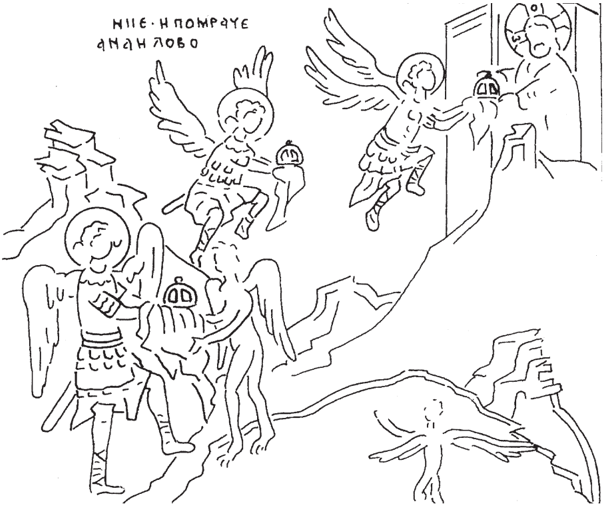
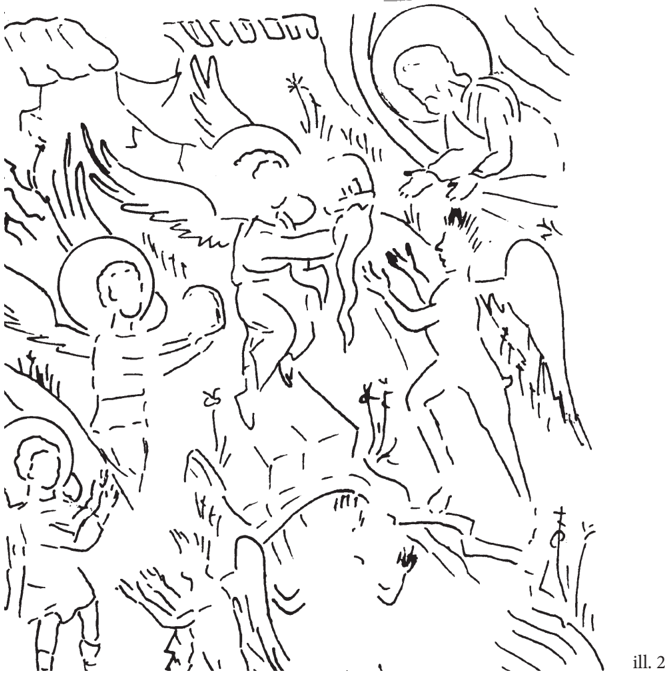
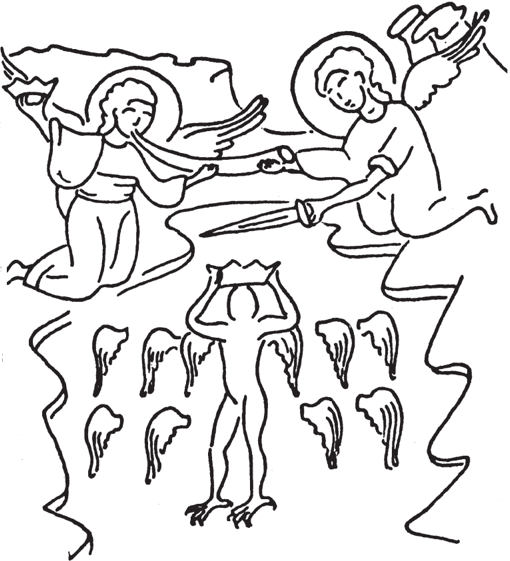
- The plot was visualized in sacred art, e.g. the St. Archangel Michael Church in Lesnovo, completed by 1349, and later icons from Skopje (1626) and Sarajevo (1723); folklore legends also process the motif of Satanael stealing God’s insignia, often replacing the robe, wreath, and sceptre with the sun or keys to hell.
Methods
- Comparative and typological analysis of two pseudo-canonical texts: the Slavic *Homily of John Chrysostom on How Michael Vanquished Satanael* in two versions and the Greek *Λόγος τοῦ ἀρχηστρατήγου Μιχαήλ* (BHG 1288n).
- The Slavic versions are based on editions by A. Miltenova and T. Jovanović, using ЦИАИ no. 1161, Nikoljac no. 82, the Punčo Codex, and ЦИАИ no. 232; the Greek text follows O. Afinogenova’s edition of Vat. Gr. 1190a.
- The analysis situates the texts against Judeo-Gnostic tradition, Byzantine-Slavic heretic, pseudo-canonical, and heresiological literature, and compares them with liturgical, iconographical, and folkloric material.
Limitations
- The paper states that the study does not aspire to completeness and that doubts about the time and place of the Slavic translation/compilation remain to be clarified.
- It notes that the small number of extant copies makes it impossible to determine exactly when before the 14th century the Slavic text was completed, and that the Greek text is preserved only in a late 16th-century copy.
- The paper also states that there is no unquestionable evidence proving the work stems from a heretic environment and that it cannot be determined to what extent works such as the *Tale* were used by (moderate?) Bogomil communities; the text itself is fragmentary in places, with missing passages in the compared versions.
Model-written summary. Check it against the paper before relying on it.
Integrity signals
Registry
Cites
Statistics
Figures
Verification
Claims the paper makes
0 Valid · 15 Not valid · 19 Not checked · 98 Own results and interpretations
None of the sources cited for this claim have been checked yet.
In the paper
“One of the oldest Byzantine works, the letter of monk Euthymius of Acmonia against the dualist heresy of the Fundagiagites (Bogomils from Asia Minor) is constructed as an account of what the right-believing monk has heard from a certain heretic 63 .”
plain- Asserted: passes — The authors put it forward as true.
- Checkable: passes — It can be checked against evidence.
- Load-bearing: unclear — It is unclear whether the paper’s conclusions depend on it.
- Based: passes — The paper gives a reason why it holds.
A result the paper reports from its own data — it cites no other source for it, so there is none to check. The quote shows it is in the paper.
In the paper
“Nevertheless, if we juxtapose the Byzantine Tale . . .with the Slavic versions, it turns out that the liturgical quotes are absent from the Greek text .”
plain- Asserted: passes — The authors put it forward as true.
- Checkable: passes — It can be checked against evidence.
- Load-bearing: passes — The paper’s conclusions depend on it.
- Based: passes — The paper gives a reason why it holds.
None of the sources cited for this claim have been checked yet.
In the paper
“Still, the Greek Tale . . .includes a passage which indubitably preserves traces of the ancient Gnostic faith in the good God, the God 'from outside' , in opposition to the demiurge”
boostedstates an association- Asserted: passes — The authors put it forward as true.
- Checkable: passes — It can be checked against evidence.
- Load-bearing: passes — The paper’s conclusions depend on it.
- Based: passes — The paper gives a reason why it holds.
A result the paper reports from its own data — it cites no other source for it, so there is none to check. The quote shows it is in the paper.
In the paper
“The same quotation recurs in heretic and pseudo-canonical texts .”
plainstates an association- Asserted: passes — The authors put it forward as true.
- Checkable: passes — It can be checked against evidence.
- Load-bearing: unclear — It is unclear whether the paper’s conclusions depend on it.
- Based: passes — The paper gives a reason why it holds.
A result the paper states — it cites no source for it, so there is none to check. The quote shows it is in the paper.
In the paper
“The phrase appears in a similar context in the Old Testament apocryphon called On The Sea of Tiberias 57 , in the Slavic 58 and Greek 59 Palaea, as well as in later copies of pseudo-canonical works treating on cosmogony 60 .”
hedgedstates an association- Asserted: passes — The authors put it forward as true.
- Checkable: passes — It can be checked against evidence.
- Load-bearing: unclear — It is unclear whether the paper’s conclusions depend on it.
- Based: passes — The paper gives a reason why it holds.
23 more claims
Create a free account to see all 132 claims and every source verdict.
- Probably not a substantial claim. 90
- It may state two separate claims as one. 48
- The quote only partly states this claim. 2
Self-check
Percentages, sums and reported differences re-computed from the paper’s own numbers.
Each contradiction between two passages listed here was confirmed by an independent check.
Rated minor: it would not touch a result — a value no result rests on, a p-value that stays on the same side of the significance level, or a conflict that is clerical, resolved elsewhere in the paper, or outside its own findings.
In the paper
§ Abstract
“the Serbian scholar chooses the text of ЦИАИ no .1116”
§ Abstract
“The so-called first version, as found in the codex ЦИАИ no .1161”
Rated minor: it would not touch a result — a value no result rests on, a p-value that stays on the same side of the significance level, or a conflict that is clerical, resolved elsewhere in the paper, or outside its own findings.
In the paper
§ VII. Final remarks.
“which is only preserved in a lat, 16 th century copy”
§ Abstract
“a Greek codex of mixed content, dating back to 1542”
Citations
Cites
Gnosis: The Nature and History of Gnosticism
Rudolph, K. (1983) · Cited by 234
Le De daemonibus du Pseudo-Psellos
Gautier, P. (1980) · Revue des études byzantines · doi:10.3406/rebyz.1980.2106 · Cited by 88
Quispel, G. (1951) · Cited by 49
Werke des Patriarchen von Bulgarien Euthymius (1375-1393).
Tărnovski, E., & Bălgarski, P. (1901) · Cited by 8
Barry, J. (1983) · Cited by 2
(1949) · Endocrinology · doi:10.1210/endo-44-5-485 · Cited by 1
Research works printed but not linked: 6
- Dlaczego ludzie nie mają płaskich stóp, trans. M. Lewińska, [in:] Apokryfy i legendy starotestamentowe Słowian południowych, ed. G. Minczew, M. Skowronek, Kraków 2006, p. 233.
- Irenaeus, Adversus haereses, [in:] Five Books of S. Irenaeus, Bishop of Lyons, Against Heresies, ed. J. Parker, Oxford 1872.
- Jak Święty Archanioł ukradł diabłu słońce, trans. A. Kawecka, [in:] Apokryfy i legendy starotestamentowe Słowian południowych, ed. G. Minczew, M. Skowronek, Kraków 2006, p. 232.
- O tym, jak Pan Bóg i diabeł dzielili świat, trans. A. Kawecka, [in:] Apokryfy i legendy starotestamentowe Słowian południowych, ed. G. Minczew, M. Skowronek, Kraków 2006, p. 228.
- Tajemna księga, czyli Zapytania Jana zadane w wieczerniku Królowi niebieskiemu, trans. A. Sarwa, [in:] A. Sarwa, Tajemna księga katarów, Sandomierz 2006.
- Widzenie, które miał Święty Izajasz prorok, syn Amosa, trans. I. Petrov, [in:] Apokryfy i legendy starotestamentowe Słowian południowych, ed. G. Minczew, M. Skowronek, Kraków 2006, p. 53–61.
Cited by
Medieval Christian Dualist Perceptions and Conceptions of Biblical Paradise
Stoyanov, Y. (2013) · Studia Ceranea · doi:10.18778/2084-140x.03.11 · Cited by 5
Cosmogonies and mythopoesis in the Balkans and beyond
Geller, F. B. (2014) · Slavia Meridionalis · doi:10.11649/sm.2014.005 · Cited by 2
Eastern Elements in Cathar Doctrines – an Argument for the Traditional Interpretation of Catharism
Czarnecki, P. (2024) · Studia Ceranea Journal of the Waldemar Ceran Research Centre for the History and Culture of the Mediterranean Area and South-East Europe · doi:10.18778/2084-140x.14.30 · Cited by 1
Imaging Evil in the First Chapters of Genesis: Texts behind the Images in Eastern Orthodox Art
Kuyumdzhieva, M. (2016) · Studia Ceranea Journal of the Waldemar Ceran Research Centre for the History and Culture of the Mediterranean Area and South-East Europe · doi:10.18778/2084-140x.06.19 · Cited by 1
Сведения о дуалистических ересях и языческих верованиях в "Шестодневе" Иоанна Экзарха
Минчев, Г., Сковронек, М., & Петров, И. Н. (2014) · Studia Ceranea Journal of the Waldemar Ceran Research Centre for the History and Culture of the Mediterranean Area and South-East Europe · doi:10.18778/2084-140x.04.07
Polska bibliografia antyku chrześcijańskiego 2011-2012
Figiel, J. (2012) · Vox Patrum · doi:10.31743/vp.4094
An Introduction to a Comparative Theological Approach Towards Zigabenus’ Account on Bogomilism
Kokoudev, P. S. (2026) · Disputatio philosophica · doi:10.32701/dp.27.1.5
Metadata
- Authors
- Minczew, G., & Majer, M.
- Affiliations
- University of Łódź (PL)
- Venue
- Studia Ceranea
- Published
- 2011-12-30
- Volume
- 1
- Pages
- 23-54
- ISSN
- 2084-140X (ISSN-L)
- 2449-8378
- OpenAlex
- W137064831
- Cited by
- 7
- References
- 6
- Citations by year
- 2026: 1 · 2024: 1 · 2016: 1 · 2014: 2 · 2013: 1 · 2012: 1
- FWCI
- 18.05
- Type
- journal article
- Language
- en
- Open access
- diamond
- doi.org
- Licence
- Locations
- Studia Ceranea Journal of the Waldemar Ceran Research Centre for the History and Culture of the Mediterranean Area and South-East Europe (publishedVersion, cc-by-nc-nd)
- DOAJ (DOAJ: Directory of Open Access Journals) (submittedVersion, cc-by-sa)
- University of Lodz Repository (University of Łódź) (submittedVersion, cc-by-nc-nd)
- Topics
- Social Sciences › Arts and Humanities › Classics › Byzantine Studies and History
- Social Sciences › Arts and Humanities › Religious studies › Historical, Religious, and Philosophical Studies
- Social Sciences › Arts and Humanities › History › Medieval Literature and History
- Keywords
- John Chrysostom, Bogomils, Gnosticism, dualism, Archangel Michael, First Bulgarian Empire, textual transmission, textual variants, cosmogony, angelology
About these checks
Registry, retraction, Cites and statistics results are computed, not judged, with one exception: a printed reference that no index lists is read once by a model before it counts as a citation error. Claims are extracted by a model and kept only when their quote appears verbatim in the text; each cited source is then checked, with a model’s help, for whether it says what the claim relies on. Those verdicts can be wrong — read the claim’s quote and the cited source before relying on one.
A language model drew the claims from the paper on 2026-11-10, under version 3 of the claim definition (model deepseek-v4.1-flash, prompt extract-v3).
A second model labelled each claim on 2026-11-10 (model jev-1.13-20260917, definition revision gold-guideline-v0.2).
Statistics and arithmetic are recomputed, not judged.
Confidence bands are shown only for fields calibrated on our annotated test set. None is calibrated yet, so no band is shown.
What counts as a claim ›How we measure confidence ›How we check this ›
Are you an author, or do you see a problem with this page? Request a review
Data sources
Bibliographic data: Semantic Scholar, OpenAlex, Crossref.
Contains information from the Semantic Scholar Academic Graph Datasets, made available under the ODC Attribution License (ODC-BY 1.0).
Semantic Scholar’s data is described in: Kinney, R., et al. (2023). The Semantic Scholar Open Data Platform. arXiv:2301.10140.
