

The DOI matches its Crossref record; 77 of the 79 references it cites were found in a registry or an index.
Managing uncertainty in climate-driven ecological models to inform adaptation to climate change
Open accessAbstract
The impacts of climate change on forest ecosystems are likely to require changes in forest planning and natural resource management. Changes in tree growth, disturbance extent and intensity, and eventually species distributions are expected. In natural resource management and planning, ecosystem models are typically used to provide a “best estimate” about how forests might work in the future and thus guide decision-making. Ecosystem models can be used to develop forest management strategies that anticipate these changes, but limited experience with models and model output is a challenge for managers in thinking about how to address potential effects of climate change. What do decision makers need to know about climate models, ecological models used for impacts assessments, and the uncertainty in model projections in order to use model output in strategies for adaptation to climate change? We present approaches for understanding and reducing the uncertainty associated with modeling the effects of climate change on ecosystems, focusing on multi-model approaches to clarify the strengths and limits of projections and minimize vulnerability to undesirable consequences of climate change. Scientific uncertainties about changes in climate or projections of their impacts on resources do not present fundamental barriers to management and adaptation to climate change. Instead, many of these uncertainties can be controlled by characterizing their effects on models and future projections from those models. There is uncertainty in decision making that does not derive just from the complex interaction of climate and ecosystem models, but in how modeling is integrated with other aspects of the decision environment such as choice of objectives, monitoring, and approach to assessment. Adaptive management provides a hedge against uncertainty, such that climate and ecosystem models can inform decision making.
Overview
The claims and statistics of this paper haven’t been checked yet.
Run the check — free, no account needed. It reads the open-access text and checks the sources it cites.
Integrity signals
Registry
Cites
Statistics
Figures

Verification
Claims the paper makes
The claims and statistics of this paper haven’t been checked yet.
Run the check — free, no account needed. It reads the open-access text and checks the sources it cites.
Claims other papers make about this one
Each is checked against this paper’s own text: does it say what the citing paper says it does?
In the citing paper
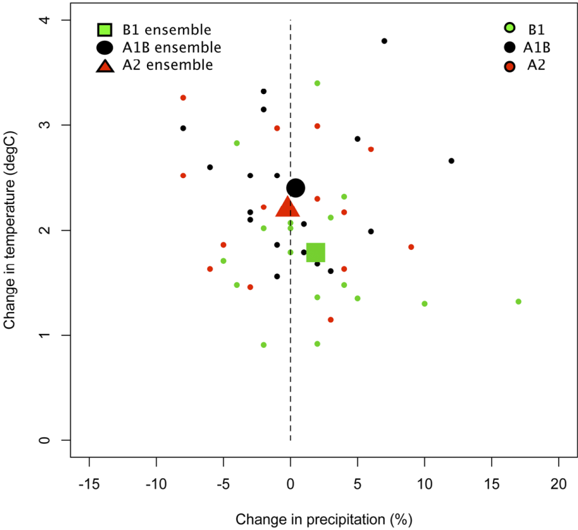
“These uncertainties are due to inherent differences among GCMs (Meehl et al. 2007, Littell et al. 2011), illustrated in our climate agreement maps, and are a key motivation for global multi-model ensemble analyses such as those presented here.”
From Climate change and disruptions to global fire activity (2012) · cites this paper as Littell et al. 2011
Self-check
Percentages, sums and reported differences re-computed from the paper’s own numbers.
The self-check needs the paper’s full text.
Citations
Cites
Predicting species distribution: offering more than simple habitat models.
Guisan, A., & Thuiller, W. (2005) · Ecology Letters · doi:10.1111/j.1461-0248.2005.00792.x · Cited by 6,844
Special report on emissions scenarios
Nakićenović, N., Alcamo, J., Davis, G. R., de Vries, B. J. M., Fenhann, J. V., Gaffin, S., Gregory, K., Grübler, A., Jung, T. Y., Kram, T., et al. (2000) · Cited by 6,089
Stationarity Is Dead: Whither Water Management?
Milly, P. C. D., Betancourt, J. L., Falkenmark, M., Hirsch, R. M., Kundzewicz, Z. W., Lettenmaier, D. P., & Stouffer, R. J. (2008) · Science · doi:10.1126/science.1151915 · Cited by 4,563
THE WCRP CMIP3 Multimodel Dataset: A New Era in Climate Change Research
Meehl, G., Covey, C., Delworth, T., Latif, M., Mcavaney, B., Mitchell, J., Stouffer, R., & Taylor, K. E. (2007) · Bulletin of the American Meteorological Society · doi:10.1175/bams-88-9-1383 · Cited by 2,831
The art of modelling range-shifting species: The art of modelling range-shifting species
Elith, J., Kearney, M., & Phillips, S. (2010) · Methods in Ecology and Evolution · doi:10.1111/j.2041-210x.2010.00036.x · Cited by 2,813
Crämer, W., Bondeau, A., Woodward, F. I., Prentice, I. C., Betts, R., Brovkin, V. A., Cox, P. M., Fisher, V. A., Foley, J. A., Friend, A. D., et al. (2001) · Global Change Biology · doi:10.1046/j.1365-2486.2001.00383.x · Cited by 2,023
CLIMATE CHANGE AND FORESTS OF THE FUTURE: MANAGING IN THE FACE OF UNCERTAINTY
Millar, C. I., Stephenson, N. L., & Stephens, S. L. (2007) · Ecological Applications · doi:10.1890/06-1715.1 · Cited by 2,009
Hydrologic Implications of Dynamical and Statistical Approaches to Downscaling Climate Model Outputs
Wood, A. W., Leung, L.-Y. R., Sridhar, V., & Lettenmaier, D. P. (2004) · Climatic Change · doi:10.1023/b:clim.0000013685.99609.9e · Cited by 1,889
Does global change increase the success of biological invaders?
Dukes, J. S., & Mooney, H. A. (1999) · Trends in Ecology & Evolution · doi:10.1016/s0169-5347(98)01554-7 · Cited by 1,629
Some Ecological Consequences of a Computer Model of Forest Growth
Botkin, D. B., Janak, J. F., & Wallis, J. R. (1972) · Journal of Ecology · doi:10.2307/2258570 · Cited by 1,356
Research works printed but not linked: 1
- 10.1023/A:1008011916649 · DOI
Cited by
Sorted by citations
Climate change and disruptions to global fire activity
Moritz, M. A., Parisien, M.-A., Batllori, E., Krawchuk, M. A., Van Dorn, J., Ganz, D. J., & Hayhoe, K. (2012) · Ecosphere · doi:10.1890/es11-00345.1 · Cited by 959
Wind as a natural disturbance agent in forests: a synthesis
Mitchell, S. J. (2012) · Forestry An International Journal of Forest Research · doi:10.1093/forestry/cps058 · Cited by 503
Dantzer, B., Fletcher, Q. E., Boonstra, R., & Sheriff, M. J. (2014) · Conservation Physiology · doi:10.1093/conphys/cou023 · Cited by 467
Process-based models are required to manage ecological systems in a changing world
Cuddington, K., Fortin, M., Gerber, L., Hastings, A., Liebhold, A. M., O'Connor, M., & Ray, C. (2013) · Ecosphere · doi:10.1890/es12-00178.1 · Cited by 255
Migrate or evolve: options for plant pathogens under climate change
Chakraborty, S. (2013) · Global Change Biology · doi:10.1111/gcb.12205 · Cited by 188
Metadata
- Authors
- Littell, J. S., McKenzie, D., Kerns, B. K., Cushman, S., & Shaw, C. G.
- Affiliations
- University of Washington (US)
- US Forest Service (US)
- Corresponding author
- Littell, Jeremy S.
- Venue
- Ecosphere
- Publisher
- Wiley
- Published
- 2011-09
- Volume
- 2
- Issue
- 9
- Pages
- art102
- ISSN
- 2150-8925 (ISSN-L)
- OpenAlex
- W2021343386
- Cited by
- 138
- References
- 79
- Citations by year
- 2026: 5 · 2025: 8 · 2024: 2 · 2023: 1 · 2022: 6 · 2021: 7 · 2020: 8 · 2019: 13 · 2018: 11 · 2017: 13 · 2016: 9 · 2015: 9 · 2014: 18 · 2013: 17 · 2012: 11
- FWCI
- 12.58
- Type
- journal article
- Language
- en
- Open access
- gold
- doi.org
- Locations
- Ecosphere (publishedVersion, cc-by)
- Funders
- Joint Institute for the Study of the Atmosphere and Ocean (NA17RJ1232)
- National Oceanic and Atmospheric Administration (NA17RJ1232)
- Western Wildland Environmental Threat Assessment Center
- Topics
- Life Sciences › Agricultural and Biological Sciences › Forestry › Forest Management and Policy
- Physical Sciences › Environmental Science › Global and Planetary Change › Plant Water Relations and Carbon Dynamics
- Life Sciences › Agricultural and Biological Sciences › Forestry › Forest ecology and management
- Keywords
- climate change adaptation, forests, ecosystem models, uncertainty reduction, multi-model approach, adaptive management, forest management planning, natural resource management, climate change projections, decision making under uncertainty, tree growth, disturbance, species distribution
About these checks
Registry, retraction, Cites and statistics results are computed, not judged, with one exception: a printed reference that no index lists is read once by a model before it counts as a citation error. Claims are extracted by a model and kept only when their quote appears verbatim in the text; each cited source is then checked, with a model’s help, for whether it says what the claim relies on. Those verdicts can be wrong — read the claim’s quote and the cited source before relying on one.
Statistics and arithmetic are recomputed, not judged.
Confidence bands are shown only for fields calibrated on our annotated test set. None is calibrated yet, so no band is shown.
What counts as a claim ›How we measure confidence ›How we check this ›
Are you an author, or do you see a problem with this page? Request a review
