

The DOI matches its Crossref record; 49 of the 50 references it cites were found in a registry or an index; none of the 25 sources its claims cite is checked for support yet.
Efficacy of bio-optimized extracts of turmeric and essential fennel oil on the quality of life in patients with irritable bowel syndrome
Open accessAbstract
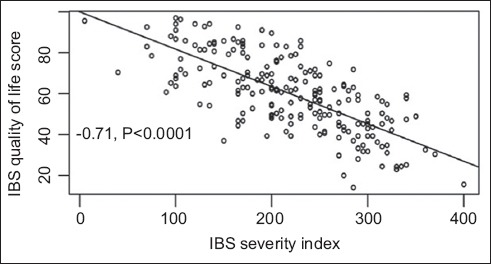
BACKGROUND: The use of herbal products to treat irritable bowel syndrome (IBS), a disease that frequently affects the quality of life (QoL), is still under evaluation. This open pilot study assessed the efficacy of bio-optimized extracts of turmeric and essential fennel oil (Enterofytol®) in IBS patients. METHODS: A total of 211 patients (14% diarrhea-predominant, IBS-D; 24% constipation-predominant, IBS-C; 62% mixed, IBS-M) were enrolled by general practitioners and completed questionnaires measuring symptom severity and QoL before and after Enterofytol®, two capsules b.i.d. for one month, followed by two capsules q.d. for another month. RESULTS: IBS severity index and QoL were inversely related. A significant reduction in the severity index and an improvement in QoL were evident following treatment in all IBS subgroups. IBS-D patients showed the worst clinical picture at entry, with the highest IBS severity index and the lowest QoL score, compared with IBS-C and IBS-M subtypes. IBS-D patients, however, also showed the most pronounced response to therapy, considering both scores. The improvement in the IBS severity index was independent of age and sex. CONCLUSIONS: Results from this "real-life" study show that the combination of turmeric and essential fennel oil over two months improves both symptoms and QoL in IBS patients, irrespectively of age, sex, initial severity of symptoms and IBS-subtypes, suggesting a potential role for the natural treatment of IBS.
Overview
CoChat Summary
TL;DR
In this open, real-life pilot study of 211 IBS patients, two months of bio-optimized turmeric extract plus essential fennel oil (Enterofytol®) was associated with significant reductions in IBS severity and improvements in quality of life. Benefits were seen across IBS subtypes and were independent of age and sex.
Key findings
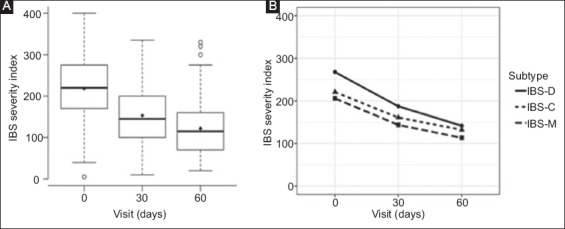
- IBS severity index fell by 29±23% after 30 days and by a further 17±35% by 60 days (P<0.0001); QoL improved by a mean 31±40% over 60 days.
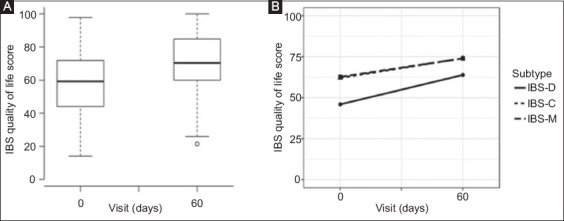
- IBS-D patients had the worst baseline picture—highest severity index (268±69.0 vs 221±62.3 IBS-C and 206±72.6 IBS-M; P<0.0001) and lowest QoL (46.0±21.5 vs 62.2±17.2 and 62.7±17.0; P<0.0001)—but showed the greatest QoL increase (70.4±70.9% vs 24.5±26.5% and 25.3±29.6%; P<0.0001).
- Abdominal pain locations dropped from 2.2±1.5 at baseline to 1.6±1.3 at 30 days and 1.2±1.1 at 60 days (P<0.0001); maximum weekly evacuations fell from 20±14 to 15±10 and 14±9, and minimum evacuations from 7.6±7.1 to 6.6±5.2 and 5.9±3.5 (P<0.0001).
- No adverse events were reported, and improvements in IBS severity index were independent of age and sex.
Methods
- Observational, prospective, non-controlled, non-randomized pilot study conducted in general practice between October 2015 and August 2016; 70 GPs enrolled 211 patients fulfilling Rome III criteria for IBS (14% IBS-D, 24% IBS-C, 62% IBS-M).
- Patients received Enterofytol® (bio-optimized turmeric extract standardized to 42 mg curcumin and 25 mg fennel essential oil/trans-anethole), two capsules b.i.d. before meals for 30 days, then two capsules q.d. for another 30 days; assessments at baseline, 30 and 60 days used IBS severity index (0–400), IBS QoL (0–100), intestinal habits, and number of abdominal pain locations.
- Analysis used paired Student’s t-test, linear mixed models for IBS subtype time evolutions, correlation and simple linear regression; sample size calculation required at least N=166.
Limitations
- The paper states that the study lacked a placebo-controlled group, noting that IBS patients may spontaneously remit and placebo response has been suggested to range from 40–50% in trials.
- The paper states it was not designed to observe patients after treatment withdrawal, and calls for further studies on recurrence, lower doses, and whether the combination is better than either component alone.
- Evident from the text: the study was open-label, non-controlled, and non-randomized; patients were on a free diet, compliance was checked by interview, and QoL was assessed only at baseline and 60 days.
Model-written summary. Check it against the paper before relying on it.
Integrity signals
Registry
Cites
Statistics
Figures
Verification
Claims the paper makes
0 Valid · 0 Not valid · 18 Not checked · 36 Own results and interpretations
A result the paper reports from its own data — it cites no other source for it, so there is none to check. The quote shows it is in the paper.
In the paper
“Overall, the number of different pain locations dropped from 2.2±1.5 at baseline to 1.6±1.3 and 1.2±1.1 after 30 and 60 days of treatment, respectively (P<0.0001).”
§ Efficacy of bio-optimized extracts of turmeric and essential fennel oil on the quality of life in patients with irritable bowel syndrome > Results > Treatment efficacy
plainstates a causen = 211 ·- Asserted: passes — The authors put it forward as true.
- Checkable: passes — It can be checked against evidence.
- Load-bearing: passes — The paper’s conclusions depend on it.
- Based: passes — The paper gives a reason why it holds.
A result the paper reports from its own data — it cites no other source for it, so there is none to check. The quote shows it is in the paper.
In the paper
“At the end of the follow up, in the whole group of subjects, the relationships between the IBS severity index and IBS QoL (r=-0.64, P<0.0001) and between the IBS severity index and the number of abdominal pain locations (r=0.34, P<0.0001) were still present.”
§ Efficacy of bio-optimized extracts of turmeric and essential fennel oil on the quality of life in patients with irritable bowel syndrome > Results > Treatment efficacy
plainstates an associationn = 211 ·- Asserted: passes — The authors put it forward as true.
- Checkable: passes — It can be checked against evidence.
- Load-bearing: unclear — It is unclear whether the paper’s conclusions depend on it.
- Based: passes — The paper gives a reason why it holds.
A result the paper reports from its own data — it cites no other source for it, so there is none to check. The quote shows it is in the paper.
In the paper
“The linear mixed modelling of data showed that the greatest increase was in the IBS-D patients (70.4±70.9%), as compared with the IBS-C (24.5±26.5%) and the IBS-M subjects (25.3±29.6%, P<0.0001).”
§ Efficacy of bio-optimized extracts of turmeric and essential fennel oil on the quality of life in patients with irritable bowel syndrome > Results > Treatment efficacy
plainstates an associationn = 211 ·- Asserted: passes — The authors put it forward as true.
- Checkable: passes — It can be checked against evidence.
- Load-bearing: unclear — It is unclear whether the paper’s conclusions depend on it.
- Based: passes — The paper gives a reason why it holds.
A result the paper reports from its own data — it cites no other source for it, so there is none to check. The quote shows it is in the paper.
In the paper
“In the whole group of patients, a significant reduction (29±23%) in the IBS severity index was achieved after 30 days of treatment”
§ Efficacy of bio-optimized extracts of turmeric and essential fennel oil on the quality of life in patients with irritable bowel syndrome > Results > Treatment efficacy
plainstates a causen = 211 ·- Asserted: passes — The authors put it forward as true.
- Checkable: passes — It can be checked against evidence.
- Load-bearing: passes — The paper’s conclusions depend on it.
- Based: passes — The paper gives a reason why it holds.
- Rests on an assumption not shown here.
A result the paper reports from its own data — it cites no other source for it, so there is none to check. The quote shows it is in the paper.
In the paper
“The IBS QoL score was lower in IBS-D patients (46.0±21.5) than in IBS-C (62.2±17.2) and IBS-M (62.7±17.0) subjects (P<0.0001).”
§ Efficacy of bio-optimized extracts of turmeric and essential fennel oil on the quality of life in patients with irritable bowel syndrome > Results > Patient characteristics at entry
plainstates an associationn = 211 ·- Asserted: passes — The authors put it forward as true.
- Checkable: passes — It can be checked against evidence.
- Load-bearing: unclear — It is unclear whether the paper’s conclusions depend on it.
- Based: passes — The paper gives a reason why it holds.
20 more claims
Create a free account to see all 54 claims and to verify the 25 references still open.
- It may state two separate claims as one. 21
- Probably not a substantial claim. 15
Self-check
Percentages, sums and reported differences re-computed from the paper’s own numbers.
Each contradiction between two passages listed here was confirmed by an independent check.
Rated major: it would touch a result — a value a result rests on, reported and recomputed p-values on opposite sides of the significance level, two passages that conflict with no sign which is right, or a cited work retracted before this paper was published.
In the paper
§ Efficacy of bio-optimized extracts of turmeric and essential fennel oil on the quality of life in patients with irritable bowel syndrome > Discussion
“Notably, these positive therapeutic effects were also evident between 30 and 60 days with a lower dose of the nutraceutical combination (two capsules q.d.), during which further improvement was seen in both QoL and severity index.”
§ Efficacy of bio-optimized extracts of turmeric and essential fennel oil on the quality of life in patients with irritable bowel syndrome > Patients and methods > Questionnaires and follow up
“The IBS severity index, intestinal habits and locations of pain were checked at each time point, whereas the QoL was assessed at baseline and after 60 days.”
Citations
Cites
Longstreth, G. F., Thompson, W. G., Chey, W. D., Houghton, L. A., Mearin, F., & Spiller, R. C. (2006) · Gastroenterology · doi:10.1053/j.gastro.2005.11.061 · Cited by 4,856
FRANCIS, C. Y., MORRIS, J., & WHORWELL, P. J. (1997) · Alimentary Pharmacology & Therapeutics · doi:10.1046/j.1365-2036.1997.142318000.x · Cited by 1,708
Kunnumakkara, A. B., Anand, P., & Aggarwal, B. B. (2008) · Cancer Letters · doi:10.1016/j.canlet.2008.03.009 · Cited by 1,073
Activation of the mucosal immune system in irritable bowel syndrome
Chadwick, V. S., Chen, W., Shu, D., Paulus, B., Bethwaite, P., Tie, A., & Wilson, I. (2002) · Gastroenterology · doi:10.1053/gast.2002.33579 · Cited by 833
Patrick, D. L., Drossman, D. A., Frederick, I. O., Dicesare, J., & Puder, K. L. (1998) · Digestive Diseases and Sciences · doi:10.1023/a:1018831127942 · Cited by 761 · cited 1×
“QoL was assessed according to a validated questionnaire (IBS QoL) [7] with scores ranging from 0-100 (the higher the score, the better the QoL).”
MethodCurcumin: Getting Back to the Roots
SHISHODIA, S., SETHI, G., & AGGARWAL, B. B. (2005) · Annals of the New York Academy of Sciences · doi:10.1196/annals.1352.010 · Cited by 715
Immune Activation in Patients With Irritable Bowel Syndrome
Liebregts, T., Adam, B., Bredack, C., Röth, A., Heinzel, S., Lester, S., Downie–Doyle, S., Smith, E., Drew, P., Talley, N. J., et al. (2007) · Gastroenterology · doi:10.1053/j.gastro.2007.01.046 · Cited by 660
Plummer, S. M., Holloway, K. A., Manson, M. M., Munks, R. J., Kaptein, A., Farrow, S., & Howells, L. (1999) · Oncogene · doi:10.1038/sj.onc.1202980 · Cited by 628
The Role of Stress on Physiologic Responses and Clinical Symptoms in Irritable Bowel Syndrome
Chang, L. (2011) · Gastroenterology · doi:10.1053/j.gastro.2011.01.032 · Cited by 281
Buono, J. L., Carson, R. T., & Flores, N. M. (2017) · Health and Quality of Life Outcomes · doi:10.1186/s12955-017-0611-2 · Cited by 277
Cited by
Matera, R., Lucchi, E., & Valgimigli, L. (2023) · Molecules · doi:10.3390/molecules28020901 · Cited by 92
Mohammed, H. A., Sulaiman, G. M., Khan, R. A., Al‐Saffar, A. Z., Mohsin, M. H., Albukhaty, S., & Ismail, A. (2024) · Process Biochemistry · doi:10.1016/j.procbio.2024.05.021 · Cited by 89
Hermans, M. P., Lempereur, P., Salembier, J. P., Maes, N., Albert, A., Jansen, O., & Pincemail, J. (2020) · Antioxidants · doi:10.3390/antiox9090872 · Cited by 40
Nouri‐Vaskeh, M., Afshan, H., Mahdavi, A. M., Alizadeh, L., Fan, X., & Zarei, M. (2020) · Complementary Therapies in Medicine · doi:10.1016/j.ctim.2020.102351 · Cited by 37
The effect of a fennel seed extract on the STAT signaling and intestinal barrier function
Rabalais, J., Kozan, P., Lu, T., Durali, N., Okamoto, K., Das, B., McGeough, M. D., Lee, B. J., Barrett, K. E., Marchelletta, R. R., et al. (2022) · PLoS ONE · doi:10.1371/journal.pone.0271045 · Cited by 23
Metadata
- Authors
- Di Ciaula, A.
- Venue
- Annals of Gastroenterology
- Publisher
- Hellenic Society of Gastroenterology
- Published
- 2018
- Volume
- 31
- Issue
- 6
- Pages
- 685-691
- ISSN
- 1108-7471 (ISSN-L)
- 1792-7463
- PMC
- PMC6191874
- OpenAlex
- W2886357054
- Cited by
- 29
- References
- 50
- Citations by year
- 2026: 2 · 2025: 5 · 2024: 5 · 2023: 3 · 2022: 4 · 2021: 1 · 2020: 4 · 2019: 5
- FWCI
- 1.98
- Type
- journal article
- Language
- en
- Open access
- diamond
- doi.org
- Locations
- Annals of Gastroenterology (publishedVersion)
- Europe PMC (PubMed Central) (publishedVersion, cc-by-nc-sa)
- PubMed (publishedVersion)
- PubMed Central (publishedVersion, cc-by-nc-sa)
- Open Repository and Bibliography (University of Liège) (submittedVersion)
- Topics
- Health Sciences › Medicine › Gastroenterology › Gastrointestinal motility and disorders
- Health Sciences › Medicine › Complementary and alternative medicine › Complementary and Alternative Medicine Studies
- Health Sciences › Medicine › Pediatrics, Perinatology and Child Health › Infant Health and Development
- Keywords
- irritable bowel syndrome, turmeric extract, quality of life, herbal medicine, diarrhea-predominant irritable bowel syndrome, irritable bowel syndrome with constipation, IBS-M, symptom severity, natural treatment
About these checks
Registry, retraction, Cites and statistics results are computed, not judged, with one exception: a printed reference that no index lists is read once by a model before it counts as a citation error. Claims are extracted by a model and kept only when their quote appears verbatim in the text; each cited source is then checked, with a model’s help, for whether it says what the claim relies on. Those verdicts can be wrong — read the claim’s quote and the cited source before relying on one.
A language model drew the claims from the paper on 2026-11-14, under version 3 of the claim definition (model deepseek-v4.1-flash, prompt extract-v3).
A second model labelled each claim on 2026-11-14 (model jev-1.13-20260917, definition revision gold-guideline-v0.2).
Statistics and arithmetic are recomputed, not judged.
Confidence bands are shown only for fields calibrated on our annotated test set. None is calibrated yet, so no band is shown.
What counts as a claim ›How we measure confidence ›How we check this ›
Are you an author, or do you see a problem with this page? Request a review
Data sources
Bibliographic data: Semantic Scholar, OpenAlex, Crossref.
Contains information from the Semantic Scholar Academic Graph Datasets, made available under the ODC Attribution License (ODC-BY 1.0).
Semantic Scholar’s data is described in: Kinney, R., et al. (2023). The Semantic Scholar Open Data Platform. arXiv:2301.10140.
