

The DOI matches its Crossref record.
The student voice as contributor to quality education through institutional design
Open accessAbstract
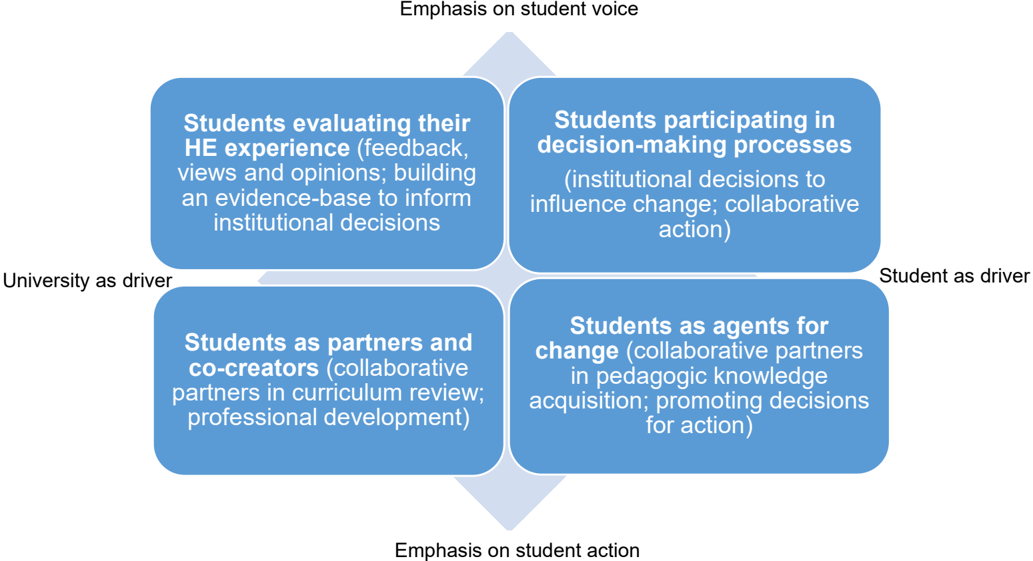
The inclusion of students’ voices in different aspects of quality has evolved over the years. Consequently, students take on different roles – ranging from providing feedback on their educational experiences, to actively participating or even leading change initiatives. In making claims for different ways of conceptualising or including students’ voices, the literature often criticises some forms of engagement with student voices in favour of another. This article is based on the premise that the complexity of quality outcomes in higher education needs to be complemented by a variety of inputs from students. By drawing from examples of two high-impact practices from the University of the Free State, the article further argues for using different forms of student voices to inform how we design institutional support structures to ultimately enhance the quality of students’ educational experiences. At its core, this cyclical interaction between students’ voices and institutional design revolves around evidence – thereby contributing to the quality of educational outcomes, and ultimately students’ success.
Overview
The claims and statistics of this paper haven’t been checked yet.
Run the check — free, no account needed. It reads the open-access text and checks the sources it cites.
Integrity signals
Registry
Cites
Statistics
Figures
Verification
Claims the paper makes
The claims and statistics of this paper haven’t been checked yet.
Run the check — free, no account needed. It reads the open-access text and checks the sources it cites.
Claims other papers make about this one
Each is checked against this paper’s own text: does it say what the citing paper says it does?
In the citing paper
“Student-staff partnerships can also benefit educators by providing valuable feedback and insight on curriculum design and effective teaching practices (Strydom & Loots, 2020)”
From Assessment design through co-creation (2025) · cites this paper as Strydom & Loots, 2020
Self-check
Percentages, sums and reported differences re-computed from the paper’s own numbers.
The self-check needs the paper’s full text.
Citations
Cites
Still being checked.
Research works printed but not linked: 21
- Barnett, R. 1994. Power, enlightenment and quality evaluation. European Journal of Education 29(2): 165-179.
- Brooman, S., S. Darwent and A. Pimor. 2015. The student voice in higher education curriculum design: Is there value in listening? Innovations in Education and Teaching International 52(6): 663-674.
- Canning, J. 2017. Conceptualising student voice in UK higher education: four theoretical lenses. Teaching in Higher Education 22(5): 519-531.
- Dos Reis, K. M. and D. Yu. 2018. Peer mentoring: Enhancing economics first years' academic performance. South African Journal of Higher Education 32(6): 234-250.
- Fomunyam, K. G. 2016. Theorising student constructions of quality education in a South African university. Southern African Review of Education 22: 46-63.
- Hall, V. 2017. A tale of two narratives: Student voice -what lies before us? Oxford Review of Education 43(2): 180-193.
- Klemenčič, M. and I. Chirikov. 2015. "How do we know how students experience higher education? On the use of student surveys." In The European higher education area: Between critical reflections and future policies, ed. A. Curaj, L. Matei, R. Pricopie, J. Salmi and P. Scott. London: Springer.
- Knoesen, R. and L. Naude. 2017. Experiences of flourishing and languishing during the first year at university. Journal of Mental Health 27(3): 269-278.
- Layton, D. M. 2015. The role of the tutorial system in enabling students' academic success. South African Journal of Higher Education 29(4): 198-210.
- Makala, Q. 2017. Peer-assisted learning programme: Supporting students in high-risk subjects at the Mechanical Engineering Department at Walter Sisulu University. Journal of Student Affairs in Africa 5(2): 17-31.
- Manik, S. 2015. As a person you need help every now and then: Accessing students' support needs in a higher education environment. South African Journal of Higher Education 29(3): 101-117.
- Masehela, L. M. and M. Mabika. 2017. An assessment of the impact of the Mentoring Programme on student performance. Journal of Student Affairs in Africa 5(2): 163-182.
- Mayet, R. 2016. Supporting at-risk learners at a comprehensive university in South Africa. Journal of Student Affairs in Africa 4(2): 1-12.
- McGhie, V. and M. du Preez. 2015. Addressing the learning needs of at-risk students at the University of the Western Cape. South African Journal of Higher Education 29(1): 164-180.
- McKay, T. M. 2016. Do tutors matter? Assessing the impact of tutors on first-year academic performance at a South African university. Journal of Student Affairs in Africa 4(1): 53-64.
- Mudehwe-Gonhovi, F. R., G. Galloway, and G. Moyo. 2018. Dialogic pedagogical innovation: Creating liberating learning practices for first year university students. South African Journal of Higher Education 32(5): 140-157.
- Nel, L. 2017. Students as collaborators in creating meaningful learning experiences in technology- enhanced classrooms: An engaged scholarship approach. British Journal of Educational Technology 48(5): 1131-1142.
- Nielsen, G. B. 2019. Radically democratising education? New student movements, equality and engagement in common, yet plural, worlds. Research in Education 103(1): 85-100.
- Seale, J. 2016. How can we confidently judge the extent to which student voice in higher education has been genuinely amplified? A proposal for a new evaluation framework. Research Papers in Education 31(2): 212-233.
- Stuurman, S. 2018. Student activism in a time of crisis in South Africa: The quest for "black power". South African Journal of Education 38(4). DOI: 10.15700/saje.v38n4a1704. · DOI
- Waghid, Y. 2019. Quality, dissonance and rhythm within higher education. South African Journal of Higher Education 33(3): 107.
Cited by
Sorted by citations
Assessment design through co-creation
Williams, A., & Ingle, E. (2025) · International Journal for Students as Partners · doi:10.15173/ijsap.v9i1.5802 · Cited by 3
Metadata
- Authors
- Strydom, F., & Loots, S.
- Affiliations
- University of the Free State (ZA)
- ORCID
- Loots, S.
- Venue
- South African Journal of Higher Education
- Publisher
- Stellenbosch University
- Published
- 2020-10
- Volume
- 35
- Issue
- 4
- ISSN
- 1011-3487 (ISSN-L)
- 1753-5913
- OpenAlex
- W3095474249
- Cited by
- 17
- References
- 0
- Citations by year
- 2025: 2 · 2024: 7 · 2023: 4 · 2022: 3 · 2021: 1
- FWCI
- 3.03
- Type
- journal article
- Language
- en
- Open access
- gold
- doi.org
- Licence
- cc-by-nc-nd
- Locations
- South African Journal of Higher Education (publishedVersion, cc-by-nc-nd)
- Topics
- Social Sciences › Education › Higher Education Practises and Engagement
- Social Sciences › Education › Higher Education Research Studies
- Social Sciences › Education › Higher Education Governance and Development
- Keywords
- student voice, educational quality, institutional design, higher education quality assurance, student engagement, student feedback, evidence-based decision making, University of the Free State
About these checks
Registry, retraction, Cites and statistics results are computed, not judged, with one exception: a printed reference that no index lists is read once by a model before it counts as a citation error. Claims are extracted by a model and kept only when their quote appears verbatim in the text; each cited source is then checked, with a model’s help, for whether it says what the claim relies on. Those verdicts can be wrong — read the claim’s quote and the cited source before relying on one.
Statistics and arithmetic are recomputed, not judged.
Confidence bands are shown only for fields calibrated on our annotated test set. None is calibrated yet, so no band is shown.
What counts as a claim ›How we measure confidence ›How we check this ›
Are you an author, or do you see a problem with this page? Request a review
How to cite
Cite CoChat for the checks on this page, and the paper for its own findings.
- This page
- CoChat. (2026). Citation check: The student voice as contributor to quality education through institutional design. https://app.cochat.ai/papers/10.20853/34-5-4263
- The paper
- Strydom, F., & Loots, S. (2020). The student voice as contributor to quality education through institutional design. South African Journal of Higher Education. https://doi.org/10.20853/34-5-4263
