CoChat

Shiftless, A Critical Piece of the Innate Immune Response to Viral Infection

Open access
Rodriguez, William, Muller, Mandy · 2022 · Viruses

Preprint — published as 10.3390/v14061338

The DOI matches its Crossref record; 1 of the 1 references it cites were found in a registry or an index.

Abstract

Since its initial characterization in 2016, the interferon stimulated gene Shiftless (SHFL) has proven to be a critical piece of the innate immune response to viral infection. SHFL expression stringently restricts the replication of multiple DNA, RNA, and retroviruses with an extraordinary diversity of mechanisms that differ from one virus to the next. These inhibitory strategies include the negative regulation of viral RNA stability, translation, and even the manipulation of RNA granule formation during viral infection. Even more surprisingly, SHFL is the first human protein found to directly inhibit the activity of the -1 programmed ribosomal frameshift, a translation recoding strategy utilized across nearly all domains of life and a several human viruses. Recent literature has shown that SHFL expression also significantly impacts viral pathogenesis in mouse models, highlighting its in-vivo efficacy. To help reconcile the many mechanisms by which SHFL restricts viral replication, we provide here a comprehensive review of this complex ISG, its influence over viral RNA fate, and the implications of its functions on the virus-host arms race for control of the cell.

Overview

The claims and statistics of this paper haven’t been checked yet.

Free: it reads the open-access text and checks the first 5 claims that cite a source we can check. Create a free account to check every claim.

A few free checks a day · papers already verified open instantly · results are public

Integrity signals

Registry

Crossref · 10.20944/preprints202205.0104.v1

Cites

1 of 1 references verified0 citation errors · 0 not checkable

Statistics

Figures

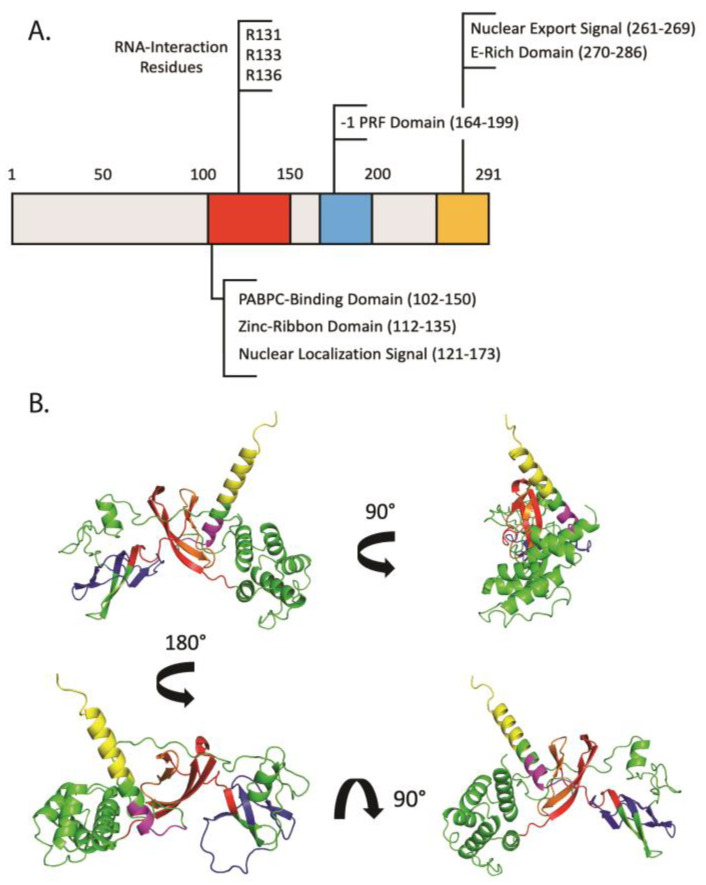
Figure 1 Shiftless Protein Structure. Shiftless is a 291aa long protein of 33 kDa molecular weight. (A) Highlighted in Red is the PABPC-binding domain (PABPC-BD) which also encompasses the Zinc-Ribbon Domain (112–135) and the Nuclear Localization Signal (121–173). Highlighted in Blue is the -1 Programmed Ribosomal Frameshift (PRF) (169–199). Highlighted in Yellow is the C-terminal domain containing the Glutamic Acid (E)-Rich Domain (270–286) and the Nuclear Export Signal (261–269). (B) Alphafold2 predicted protein structure of Shiftless. The PABPC-BD, -1PRF Domain, and the C-terminal Domain are Red, Blue, and Yellow respectively. Also highlighted in orange is the Nuclear Localization Signal and in pink is the Nuclear Export Signal [26,27].
Figure 1 Shiftless Protein Structure. Shiftless is a 291aa long protein of 33 kDa molecular weight. (A) Highlighted in Red is the PABPC-binding domain (PABPC-BD) which also encompasses the Zinc-Ribbon Domain (112–135) and the Nuclear Localization Signal (121–173). Highlighted in Blue is the -1 Programmed Ribosomal Frameshift (PRF) (169–199). Highlighted in Yellow is the C-terminal domain containing the Glutamic Acid (E)-Rich Domain (270–286) and the Nuclear Export Signal (261–269). (B) Alphafold2 predicted protein structure of Shiftless. The PABPC-BD, -1PRF Domain, and the C-terminal Domain are Red, Blue, and Yellow respectively. Also highlighted in orange is the Nuclear Localization Signal and in pink is the Nuclear Export Signal [26,27].CC BY · PubMed Central
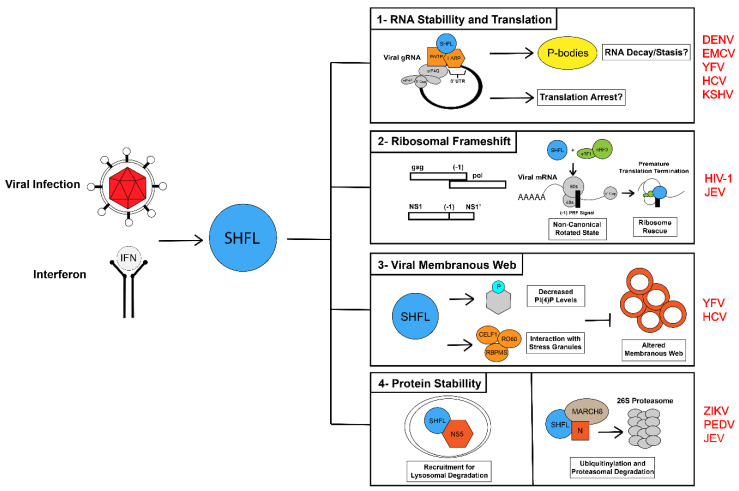
Figure 2 Shiftless Mechanisms of Restricting Viral Infection. Shiftless (SHFL) has been demonstrated to be a potent broad-spectrum anti-viral factor that is upregulated in response to viral infection and interferon signaling. SHFL restricts viral infection through several mechanisms summarized here: (1) SHFL directly interfaces with viral genomic RNA and viral mRNA and restricts viral gene expression at various stages between RNA stability and translation. For flaviviruses, SHFL binds to viral genomic RNA at the 3′ end and may relocalize it to Processing bodies to trigger RNA decay or directly interfere with polyprotein translation. (2) SHFL is one of the first human proteins shown to directly restrict the function of the -1 programmed ribosomal frameshift (-1PRF), a cis-RNA element that extends the coding capacity of several retro- and RNA viruses. The -1PRF signal triggers a non-canonical ribosome rotation, signaling the recruitment of SHFL and eukaryotic ribosome release factors (eRF1/eRF3), which synergistically halt and then trigger the premature release of the ribosome from frameshifting viral RNA. (3) For HCV and YFV, SHFL expression decreases the level of PI(4)P in the cell, a lipid precursor that directly contributes to the formation of the viral membranous web, a collection of reorganized lipid membranes that house viral replication compartments. SHFL was also shown to interact with and localize to Stress Granules during HCV infection. (4) Lastly, SHFL has been recently shown to bind to and trigger the degradation of select viral proteins through lysosomal or ubiquitination based pathways. Abbreviations: Shiftless (SHFL), Dengue virus (DENV), Encephalomyocarditis virus (EMCV), Yellow Fever virus (YFV), Hepatitis C virus (HCV), Kaposi’s sarcoma-associated herpesvirus (KSHV), Human Immunodeficiency virus 1 (HIV-1), Japanese Encephalitis virus (JEV), Zika virus (ZIKV), Porcine Epidemic Diarrhea virus (PEDV), Poly-A Binding Protein (PABP), La-associated RNA binding protein (LARP), eukaryotic Initiation Factor 4G (eIF4G), eukaryotic Initiation Factor 4E (eIF4E), Processing bodies (P-bodies).
Figure 2 Shiftless Mechanisms of Restricting Viral Infection. Shiftless (SHFL) has been demonstrated to be a potent broad-spectrum anti-viral factor that is upregulated in response to viral infection and interferon signaling. SHFL restricts viral infection through several mechanisms summarized here: (1) SHFL directly interfaces with viral genomic RNA and viral mRNA and restricts viral gene expression at various stages between RNA stability and translation. For flaviviruses, SHFL binds to viral genomic RNA at the 3′ end and may relocalize it to Processing bodies to trigger RNA decay or directly interfere with polyprotein translation. (2) SHFL is one of the first human proteins shown to directly restrict the function of the -1 programmed ribosomal frameshift (-1PRF), a cis-RNA element that extends the coding capacity of several retro- and RNA viruses. The -1PRF signal triggers a non-canonical ribosome rotation, signaling the recruitment of SHFL and eukaryotic ribosome release factors (eRF1/eRF3), which synergistically halt and then trigger the premature release of the ribosome from frameshifting viral RNA. (3) For HCV and YFV, SHFL expression decreases the level of PI(4)P in the cell, a lipid precursor that directly contributes to the formation of the viral membranous web, a collection of reorganized lipid membranes that house viral replication compartments. SHFL was also shown to interact with and localize to Stress Granules during HCV infection. (4) Lastly, SHFL has been recently shown to bind to and trigger the degradation of select viral proteins through lysosomal or ubiquitination based pathways. Abbreviations: Shiftless (SHFL), Dengue virus (DENV), Encephalomyocarditis virus (EMCV), Yellow Fever virus (YFV), Hepatitis C virus (HCV), Kaposi’s sarcoma-associated herpesvirus (KSHV), Human Immunodeficiency virus 1 (HIV-1), Japanese Encephalitis virus (JEV), Zika virus (ZIKV), Porcine Epidemic Diarrhea virus (PEDV), Poly-A Binding Protein (PABP), La-associated RNA binding protein (LARP), eukaryotic Initiation Factor 4G (eIF4G), eukaryotic Initiation Factor 4E (eIF4E), Processing bodies (P-bodies).CC BY · PubMed Central

Verification

Claims the paper makes

The claims and statistics of this paper haven’t been checked yet.

Free: it reads the open-access text and checks the first 5 claims that cite a source we can check. Create a free account to check every claim.

A few free checks a day · papers already verified open instantly · results are public

Self-check

Percentages, sums and reported differences re-computed from the paper’s own numbers.

The self-check needs the paper’s full text.

Citations

Cites

Metadata

Authors
Rodriguez, W., & Muller, M.
Affiliations
University of Massachusetts Amherst (US)
Corresponding author
Muller, Mandy
Venue
Viruses
Publisher
MDPI AG
Published
2022-05-09
Volume
14
Issue
6
Pages
1338-1338
ISSN
1999-4915 (ISSN-L)
OpenAlex
W4283319442
Cited by
23
References
1
Citations by year
2026: 3 · 2025: 5 · 2024: 7 · 2023: 5 · 2022: 3
FWCI
0.53
Type
journal article
Language
en
Open access
Locations
  • Viruses (publishedVersion, cc-by)
  • Preprints.org (acceptedVersion, cc-by)
  • PubMed Central (publishedVersion, cc-by)
  • PubMed (publishedVersion)
  • DOAJ (DOAJ: Directory of Open Access Journals) (submittedVersion, cc-by-sa)
Funders
National Institute of General Medical Sciences (R35GM138043)
Topics
  • Life Sciences › Immunology and Microbiology › Immunology › interferon and immune responses
  • Health Sciences › Medicine › Epidemiology › Virology and Viral Diseases
  • Life Sciences › Biochemistry, Genetics and Molecular Biology › Molecular Biology › RNA regulation and disease
Keywords
interferon-stimulated genes, antiviral restriction factors, viral RNA stability, viral translation inhibition, RNA granules, retroviruses, viral pathogenesis
MeSH terms
Animals, Immunity, Innate, RNA, Viral, Virus Diseases, Virus Replication, Mice, Host-Pathogen Interactions

About these checks

Registry, retraction, Cites and statistics results are computed, not judged, with one exception: a printed reference that no index lists is read once by a model before it counts as a citation error. Claims are extracted by a model and kept only when their quote appears verbatim in the text; each cited source is then checked, with a model’s help, for whether it says what the claim relies on. Those verdicts can be wrong — read the claim’s quote and the cited source before relying on one.

Statistics and arithmetic are recomputed, not judged.

Confidence bands are shown only for fields calibrated on our annotated test set. None is calibrated yet, so no band is shown.

What counts as a claim ›How we measure confidence ›How we check this ›

Are you an author, or do you see a problem with this page? Request a review

Data sources

Bibliographic data: Semantic Scholar, OpenAlex, Crossref.

Contains information from the Semantic Scholar Academic Graph Datasets, made available under the ODC Attribution License (ODC-BY 1.0).

Semantic Scholar’s data is described in: Kinney, R., et al. (2023). The Semantic Scholar Open Data Platform. arXiv:2301.10140.