PreprintCited by 21Plant biochemistry and biosynthesisMicrobial Metabolic Engineering and BioproductionAlgal biology and biofuel production

The DOI matches its Crossref record; its reference list is not available.

Exploring the Potential of the Model Cyanobacteria Synecho-Coccus PCC 7002 and PCC 7942 for the Photoproduction of High-Value Terpenes: Comparison With Synechocystis PCC 6803

Open access
Chenebault, Célia, Blanc-Garin, Victoire, Vincent, Marine, Diaz-Santos, Encarnación, Goudet, Amélie, Cassier-Chauvat, Corinne, Chauvat, Franck·2023·Biomolecules

Preprint — published as 10.3390/biom13030504

Abstract

We have performed the first comparative analysis of the potential of two physiologically-diverse model cyanobacteria, Synechococcus PCC 7002 (S.7002) and Synechococcus PCC 7942 (S.7942), for the photosynthetic production of four chemically-different high-value terpenes: two monoterpenes limonene and pinene, and two sesquiterpenes bisabolene and farnesene. We showed, for the first time, that S.7002 and S.7942 can produce farnesene and bisabolene, respectively. Both cyanobac-teria produced farnesene (S.7942 better than S.7002) more efficiently than the other tested terpenes (especially pinene the weakest produced terpene). S.7002 produced limonene better than bisabo-lene, whereas S.7942 produced bisabolene better than limonene. These findings suggest that S.7942 is better suited to produce sesquiterpenes than monoterpenes. Also interestingly, higher levels of terpenes were produced by S.7942 and S.7002 expressing a terpene-synthase gene from both a RSF1010-derived replicating plasmid and a neutral chromosomal site, as compared to ei-ther the plasmid alone or the chromosome alone. These results suggest that in both cyanobacteria the production of terpenes is more limited by the activity of terpene synthases than the abondance of terpene precursors. Finally, higher levels of terpenes were produced by S.7002 growing on urea (a frequent pollutant) as compared to nitrate (or ammonium) the standard nitrogen sources for cyanobacteria (more expensive than urea).

Overview

The claims and statistics of this paper haven’t been checked yet.

Run the check — free, no account needed. It reads the open-access text and checks the sources it cites.

A few free checks a day · papers already verified open instantly · results are public

Integrity signals

Registry

Crossref · 10.20944/preprints202302.0194.v1

Cites

Statistics

Figures

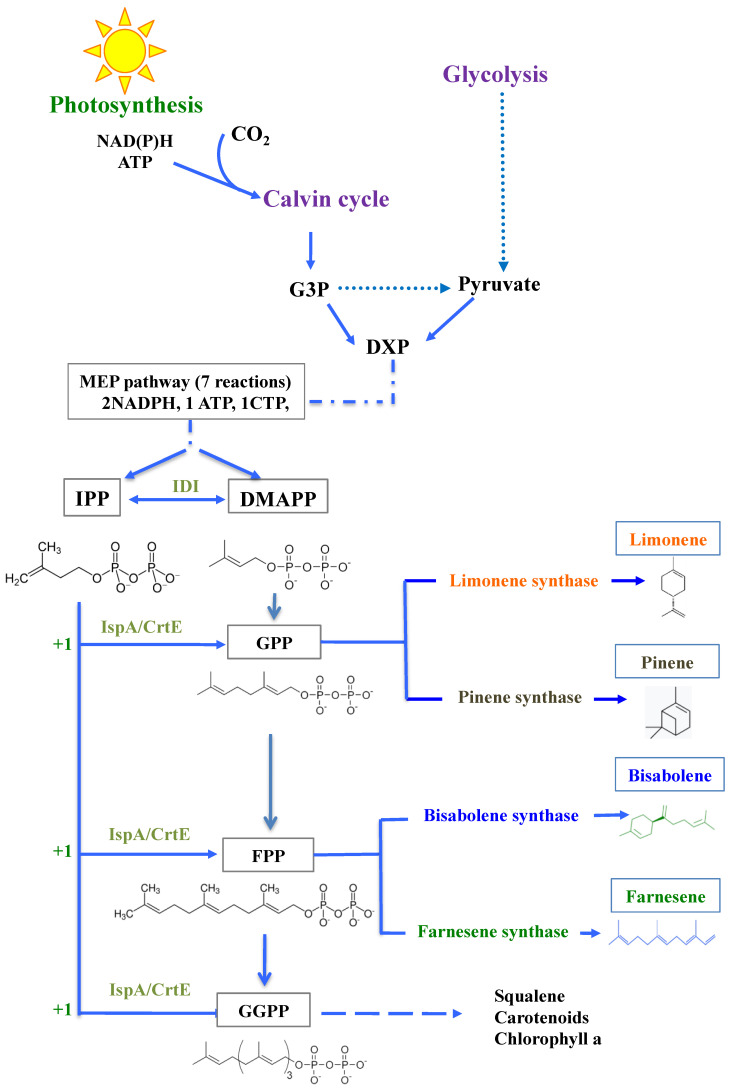
Figure 1 Schematic representation of the metabolic pathway and key compounds acting in the synthesis of terpenes from CO2. Abbreviations: DMAPP: dimethylallyl pyrophosphate; DXP: 1-deoxy-d-xylulose-5-phosphate; FPP: farnesyl pyrophosphate; GPP: geranyl pyrophosphate; GGPP: geranylgeranyl pyrophosphate; G3P: glyceraldehyde 3 phosphate; IPP: isopentenyl pyrophosphate; IDI: isopentenyl-diphosphate isomerase; IspA/CrtE: isoprenyl diphosphate synthase; MEP: methylerythritol 4-phosphate (it consumes 2 NADPH, 1 ATP, and 1 CTP).
Figure 1 Schematic representation of the metabolic pathway and key compounds acting in the synthesis of terpenes from CO2. Abbreviations: DMAPP: dimethylallyl pyrophosphate; DXP: 1-deoxy-d-xylulose-5-phosphate; FPP: farnesyl pyrophosphate; GPP: geranyl pyrophosphate; GGPP: geranylgeranyl pyrophosphate; G3P: glyceraldehyde 3 phosphate; IPP: isopentenyl pyrophosphate; IDI: isopentenyl-diphosphate isomerase; IspA/CrtE: isoprenyl diphosphate synthase; MEP: methylerythritol 4-phosphate (it consumes 2 NADPH, 1 ATP, and 1 CTP).CC BY · PubMed Central
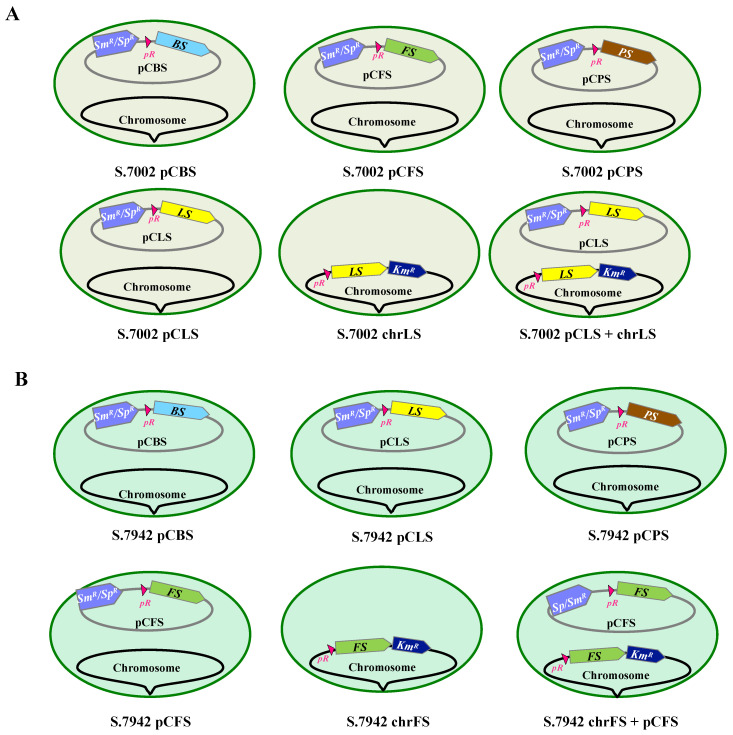
Figure 2 Schematic representation of the cyanobacterial strains engineered in this study. S.7002 (A) and S.7942 (B) cells are represented as green ovals, while their chromosome (black phylactery line) is arbitrarily shown as attached to the cell membrane to distinguish it from the pC-derived replicative plasmids. These SmR/SpR plasmids, which express a terpene-synthase encoding gene from the strong λ phage pR promoter (red triangle), are named pCBS (bisabolene synthase, light-blue arrow), pCFS (farnesene synthase, green arrow), pCLS (limonene synthase, yellow arrow) and pCPS (pinene synthase, brown arrow). Note that the chromosome of two strains of both S.7002 and S.7942 harbor a pR-LS (KmR) and a pR-FS (KmR) gene cassette, respectively. They served for the comparison of terpene production driven by either or both the replicating plasmid and the chromosome.
Figure 2 Schematic representation of the cyanobacterial strains engineered in this study. S.7002 (A) and S.7942 (B) cells are represented as green ovals, while their chromosome (black phylactery line) is arbitrarily shown as attached to the cell membrane to distinguish it from the pC-derived replicative plasmids. These SmR/SpR plasmids, which express a terpene-synthase encoding gene from the strong λ phage pR promoter (red triangle), are named pCBS (bisabolene synthase, light-blue arrow), pCFS (farnesene synthase, green arrow), pCLS (limonene synthase, yellow arrow) and pCPS (pinene synthase, brown arrow). Note that the chromosome of two strains of both S.7002 and S.7942 harbor a pR-LS (KmR) and a pR-FS (KmR) gene cassette, respectively. They served for the comparison of terpene production driven by either or both the replicating plasmid and the chromosome.CC BY · PubMed Central
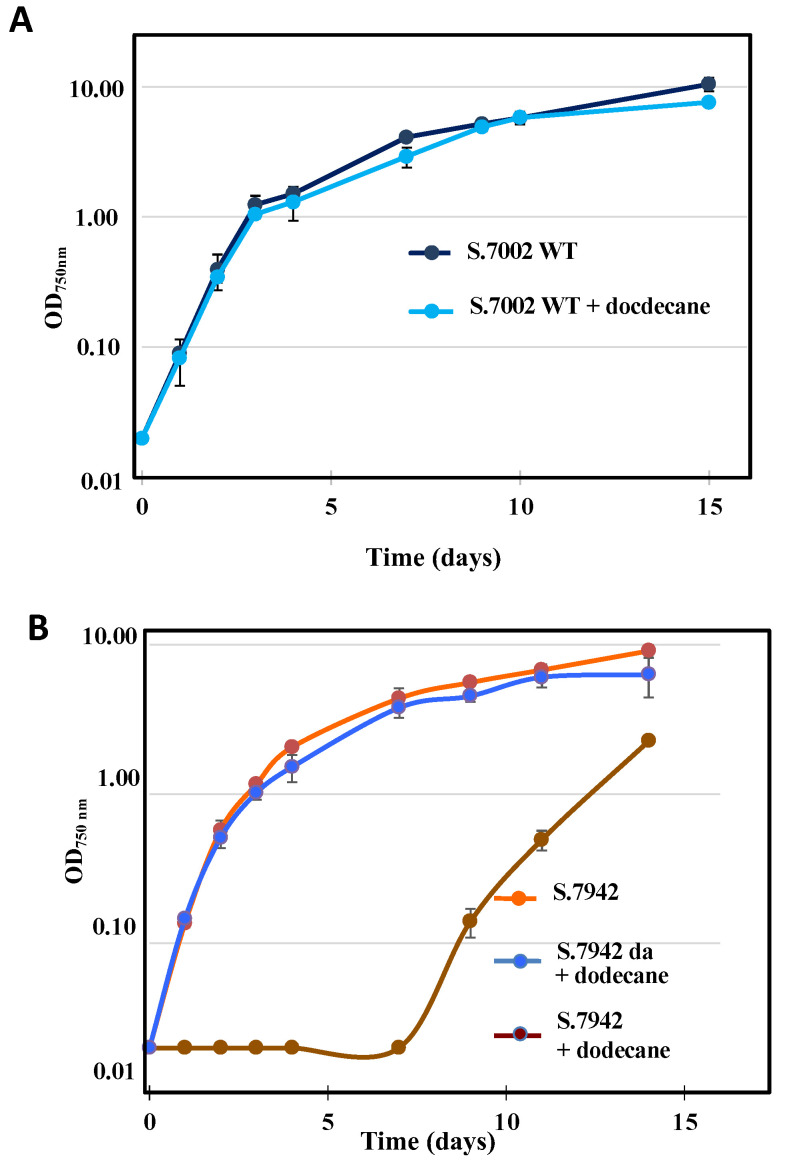
Figure 3 Influence of a dodecane overlay on the photoautotrophic growth of Synechococcus PCC 7002 (S.7002; (A)) and Synechococcus elongatus PCC 7942 (S.7942; (B)). Cells were grown photoautotrophically in the absence or presence of a dodecane (20% vol/vol) overlay. S.7942, denoted as da (da for dodecane-adapted cultures), was inoculated with cells that were precultivated under dodecane for more than two weeks. Error bars represent standard deviations from biological triplicates.
Figure 3 Influence of a dodecane overlay on the photoautotrophic growth of Synechococcus PCC 7002 (S.7002; (A)) and Synechococcus elongatus PCC 7942 (S.7942; (B)). Cells were grown photoautotrophically in the absence or presence of a dodecane (20% vol/vol) overlay. S.7942, denoted as da (da for dodecane-adapted cultures), was inoculated with cells that were precultivated under dodecane for more than two weeks. Error bars represent standard deviations from biological triplicates.CC BY · PubMed Central
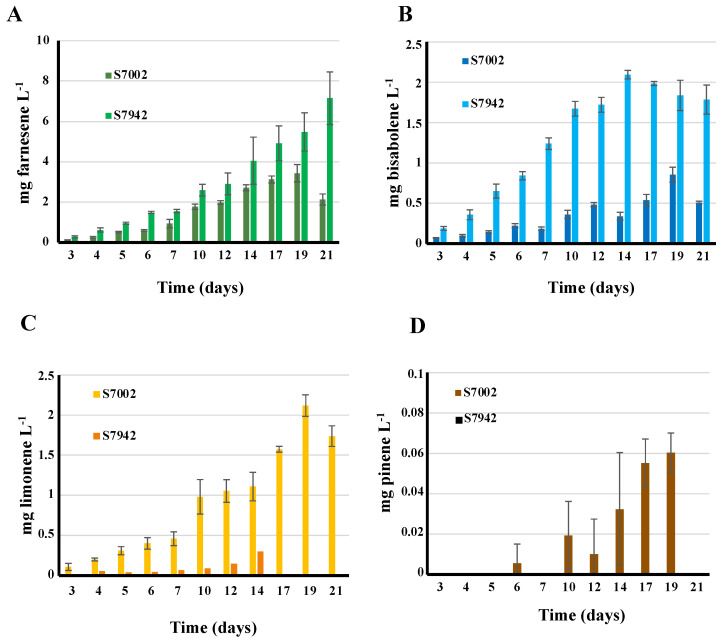
Figure 4 Comparison of the levels of terpene production by the Synechococcus PCC 7002 and Synechococcus elongatus PCC 7942 strains expressing a terpene synthase gene from the following plasmids: (A) pCFS (farnesene synthase), (B) pCBS (bisabolene synthase), (C) pCLS (limonene synthase) and (D) pCPS (pinene synthase). Cells were grown under dodecane (20% vol/vol) in otherwise standard photoautotrophic conditions to assay terpene production for 21 days. Error bars represent standard deviation from n ≥ 2 biological replicates. Note that note that no pinene was produced by S.7942.
Figure 4 Comparison of the levels of terpene production by the Synechococcus PCC 7002 and Synechococcus elongatus PCC 7942 strains expressing a terpene synthase gene from the following plasmids: (A) pCFS (farnesene synthase), (B) pCBS (bisabolene synthase), (C) pCLS (limonene synthase) and (D) pCPS (pinene synthase). Cells were grown under dodecane (20% vol/vol) in otherwise standard photoautotrophic conditions to assay terpene production for 21 days. Error bars represent standard deviation from n ≥ 2 biological replicates. Note that note that no pinene was produced by S.7942.CC BY · PubMed Central
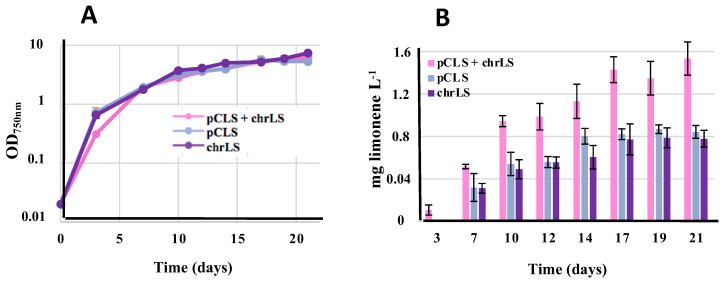
Figure 5 Simultaneous analysis of growth (A) and terpene production (B) of the Synechococcus PCC 7002 strains harboring the strongly expressed limonene synthase gene (LS) in either or both the replative plasmid (pCLS) or a neutral chromosomal site (chrLS). Cells were grown under standard photoautotrophic conditions in the presence of a dodecane overlay (20% vol/vol) to assay terpene production for 21 days. Error bars represent standard deviation from biological triplicates.
Figure 5 Simultaneous analysis of growth (A) and terpene production (B) of the Synechococcus PCC 7002 strains harboring the strongly expressed limonene synthase gene (LS) in either or both the replative plasmid (pCLS) or a neutral chromosomal site (chrLS). Cells were grown under standard photoautotrophic conditions in the presence of a dodecane overlay (20% vol/vol) to assay terpene production for 21 days. Error bars represent standard deviation from biological triplicates.CC BY · PubMed Central
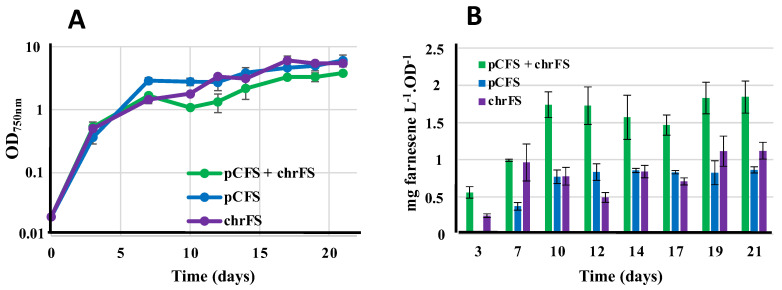
Figure 6 Simultaneous analysis of growth (A) and terpene production (B) of the Synechococcus elongatus PCC 7942 strains harboring the strongly expressed farnesene synthase gene (FS) in either or both the replative plasmid (pCFS) or a neutral chromosomal site (chrFS). Cells were grown under standard photoautotrophic conditions in the presence of a dodecane overlay (20% vol/vol) to assay terpene production for 21 days. Error bars represent standard deviation from biological triplicates.
Figure 6 Simultaneous analysis of growth (A) and terpene production (B) of the Synechococcus elongatus PCC 7942 strains harboring the strongly expressed farnesene synthase gene (FS) in either or both the replative plasmid (pCFS) or a neutral chromosomal site (chrFS). Cells were grown under standard photoautotrophic conditions in the presence of a dodecane overlay (20% vol/vol) to assay terpene production for 21 days. Error bars represent standard deviation from biological triplicates.CC BY · PubMed Central
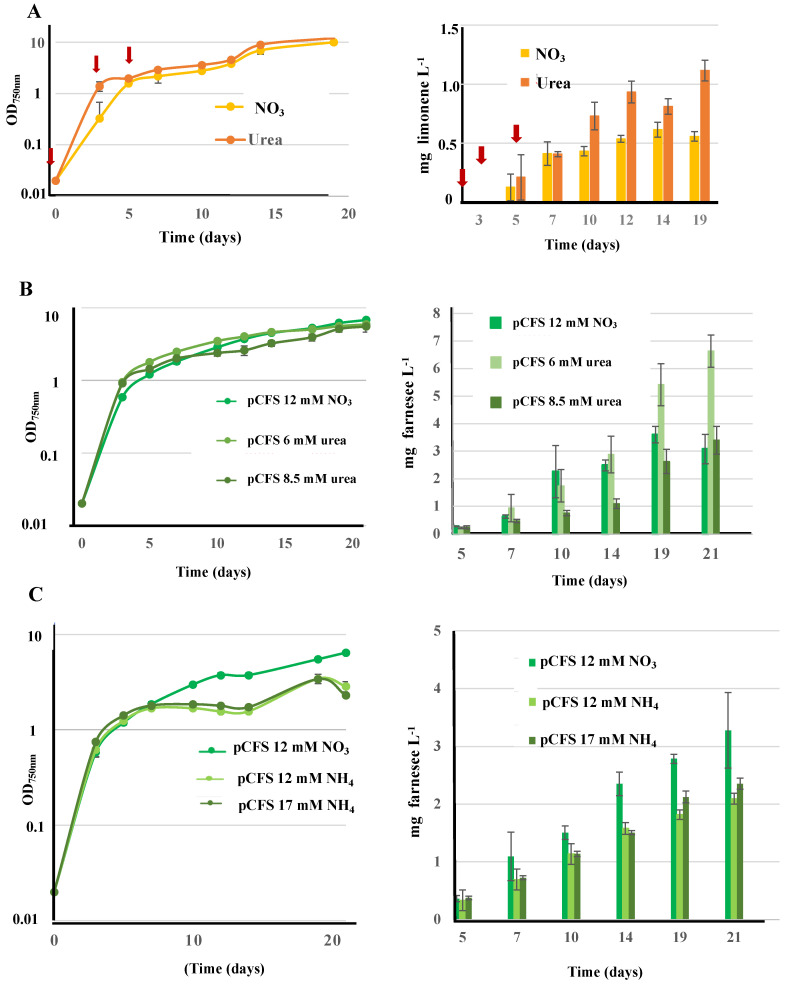
Figure 7 Influence of various nitrogen sources on the growth and terpene production of the Synechococcus PCC 7002 strains harboring pCLS (A) or pCFS (B,C). Cells growing exponentially under standard conditions (12 mM nitrate) were washed twice and resuspended in a nitrogen-free medium. (A) At the times indicated by red arrows (days 0, 3, and 5), the same amount of nitrogen was supplied as either 4 mM NaNO3 or 2 mM urea. (B,C) The indicated doses of either nitrate or urea (B), ammonium (NH4Cl), or nitrate (C) were supplied at the onset of the cultures. In all of these assays, the dodecane overlay (20% vol/vol) was added on day 3. Error bars represent standard deviations from biological triplicates.
Figure 7 Influence of various nitrogen sources on the growth and terpene production of the Synechococcus PCC 7002 strains harboring pCLS (A) or pCFS (B,C). Cells growing exponentially under standard conditions (12 mM nitrate) were washed twice and resuspended in a nitrogen-free medium. (A) At the times indicated by red arrows (days 0, 3, and 5), the same amount of nitrogen was supplied as either 4 mM NaNO3 or 2 mM urea. (B,C) The indicated doses of either nitrate or urea (B), ammonium (NH4Cl), or nitrate (C) were supplied at the onset of the cultures. In all of these assays, the dodecane overlay (20% vol/vol) was added on day 3. Error bars represent standard deviations from biological triplicates.CC BY · PubMed Central

Verification

Claims the paper makes

The claims and statistics of this paper haven’t been checked yet.

Run the check — free, no account needed. It reads the open-access text and checks the sources it cites.

A few free checks a day · papers already verified open instantly · results are public

Claims other papers make about this one

Each is checked against this paper’s own text: does it say what the citing paper says it does?

Self-check

Percentages, sums and reported differences re-computed from the paper’s own numbers.

The self-check needs the paper’s full text.

Citations

No citation lists for this paper

No citation lists for this paper yet — checked again daily.

References 30 · Cited by 21

Metadata

Authors
Chenebault, C., Blanc-Garin, V., Vincent, M., Diaz-Santos, E., Goudet, A., Cassier-Chauvat, C., & Chauvat, F.
Affiliations
  • Centre National de la Recherche Scientifique (FR)
  • Commissariat à l'Énergie Atomique et aux Énergies Alternatives (FR)
Corresponding author
Chauvat, Franck
Venue
Biomolecules
Publisher
MDPI AG
Published
2023-02-13
Volume
13
Issue
3
Pages
504-504
ISSN
2218-273X (ISSN-L)
OpenAlex
W4323842615
Cited by
21
References
30
Citations by year
2026: 7 · 2025: 4 · 2024: 7 · 2023: 3
FWCI
1.85
Type
journal article
Language
en
Open access
Locations
  • Biomolecules (publishedVersion, cc-by)
  • Preprints.org (acceptedVersion, cc-by)
  • PubMed Central (publishedVersion, cc-by)
  • PubMed (publishedVersion)
  • HAL (submittedVersion)
  • DOAJ (DOAJ: Directory of Open Access Journals) (submittedVersion, cc-by-sa)
Funders
  • European Commission (HORIZON2020, 745668)
  • Agence Nationale de la Recherche
Topics
  • Life Sciences › Biochemistry, Genetics and Molecular Biology › Molecular Biology › Plant biochemistry and biosynthesis
  • Life Sciences › Biochemistry, Genetics and Molecular Biology › Molecular Biology › Microbial Metabolic Engineering and Bioproduction
  • Physical Sciences › Energy › Renewable Energy, Sustainability and the Environment › Algal biology and biofuel production
Keywords
Synechococcus sp. PCC 7002, Synechococcus elongatus PCC 7942, Synechocystis sp. PCC 6803, farnesene, bisabolene, limonene, pinene, sesquiterpenes, monoterpenes, terpene synthase, nitrogen source, urea, value-added chemicals
MeSH terms
Limonene, Sesquiterpenes, Terpenes, Monoterpenes, Synechocystis, Synechococcus

About these checks

Registry, retraction, Cites and statistics results are computed, not judged, with one exception: a printed reference that no index lists is read once by a model before it counts as a citation error. Claims are extracted by a model and kept only when their quote appears verbatim in the text; each cited source is then checked, with a model’s help, for whether it says what the claim relies on. Those verdicts can be wrong — read the claim’s quote and the cited source before relying on one.

Statistics and arithmetic are recomputed, not judged.

Confidence bands are shown only for fields calibrated on our annotated test set. None is calibrated yet, so no band is shown.

What counts as a claim ›How we measure confidence ›How we check this ›

Are you an author, or do you see a problem with this page? Request a review

How to cite

Cite CoChat for the checks on this page, and the paper for its own findings.

This page
CoChat. (2026). Citation check: Exploring the Potential of the Model Cyanobacteria Synecho-Coccus PCC 7002 and PCC 7942 for the Photoproduction of High-Value Terpenes: Comparison With Synechocystis PCC 6803. https://app.cochat.ai/papers/10.20944/preprints202302.0194.v1
The paper
Chenebault, C., Blanc-Garin, V., Vincent, M., Diaz-Santos, E., Goudet, A., Cassier-Chauvat, C., & Chauvat, F. (2023). Exploring the Potential of the Model Cyanobacteria Synecho-Coccus PCC 7002 and PCC 7942 for the Photoproduction of High-Value Terpenes: Comparison With Synechocystis PCC 6803. Biomolecules. https://doi.org/10.20944/preprints202302.0194.v1