

The DOI matches its Crossref record; 1 of the 1 references it cites were found in a registry or an index.
The Role of a Lung Vascular Endothelium Enriched Gene TMEM100
Open accessPreprint — published as 10.3390/biomedicines11030937 · Paper page
Abstract
Transmembrane protein 100 (TMEM100) plays an important role in angiogenesis, vascular morphogenesis, integrity and cardiovascular development. TMEM100 is a downstream target of the BMP9/10 and BMPR2/ALK1 signaling pathways. Our recent study demonstrates TMEM100 is a lung endothelium enriched gene. Endothelial-specific deletion of Tmem100 impairs lung endothelial cells regeneration. Activation of Tmem100 signaling represents a novel strategy for lung vascular repair and regeneration. It is interesting and important to understand the roles of TMEM100 in the physiological and pathological conditions. In this review, we summarized the current knowledge of TMEM100.
Overview
The claims and statistics of this paper haven’t been checked yet.
Run the check — free, no account needed. It reads the open-access text and checks the sources it cites.
Integrity signals
Registry
Cites
Statistics
Figures
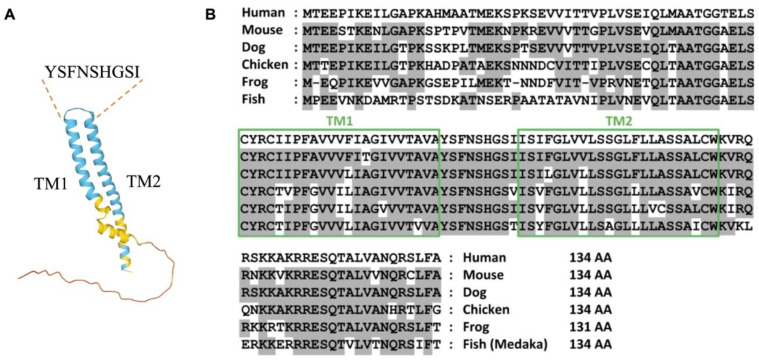
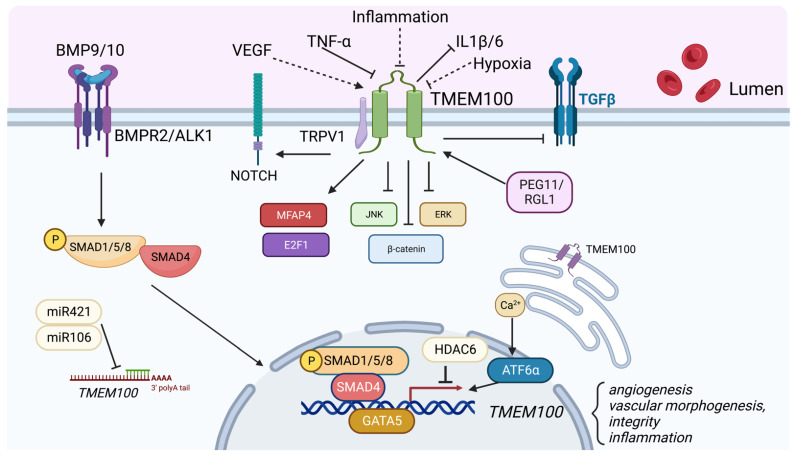
Verification
Claims the paper makes
The claims and statistics of this paper haven’t been checked yet.
Run the check — free, no account needed. It reads the open-access text and checks the sources it cites.
Self-check
Percentages, sums and reported differences re-computed from the paper’s own numbers.
The self-check needs the paper’s full text.
Citations
Cites
Highly accurate protein structure prediction with AlphaFold
Jumper, J., Evans, R., Pritzel, A., Green, T., Figurnov, M., Ronneberger, O., Tunyasuvunakool, K., Bates, R., Žídek, A., Potapenko, A., et al. (2021) · Nature · doi:10.1038/s41586-021-03819-2 · Cited by 43,764
Metadata
- Authors
- Pan, J., Liu, B., & Dai, Z.
- Affiliations
- University of Arizona (US)
- Corresponding author
- Dai, Zhiyu
- ORCID
- Venue
- Biomedicines
- Publisher
- MDPI AG
- Published
- 2023-02-20
- Volume
- 11
- Issue
- 3
- Pages
- 937-937
- ISSN
- 2227-9059 (ISSN-L)
- PMC
- PMC10045937
- OpenAlex
- W4327944883
- Cited by
- 14
- References
- 1
- Citations by year
- 2026: 2 · 2025: 4 · 2024: 5 · 2023: 3
- FWCI
- 0.37
- Type
- journal article
- Language
- en
- Open access
- gold
- doi.org
- Locations
- Biomedicines (publishedVersion, cc-by)
- Preprints.org (acceptedVersion, cc-by)
- PubMed Central (publishedVersion, cc-by)
- PubMed (publishedVersion)
- DOAJ (DOAJ: Directory of Open Access Journals) (submittedVersion, cc-by-sa)
- Funders
- American Heart Association (R00HL138278, RFGA2022-010-06, R01HL158596, 20CDA35310084)
- National Institutes of Health
- National Heart, Lung, and Blood Institute (R00HL138278, R01HL158596)
- Topics
- Life Sciences › Biochemistry, Genetics and Molecular Biology › Molecular Biology › Angiogenesis and VEGF in Cancer
- Health Sciences › Medicine › Pulmonary and Respiratory Medicine › Pulmonary Hypertension Research and Treatments
- Life Sciences › Biochemistry, Genetics and Molecular Biology › Molecular Biology › TGF-β signaling in diseases
- Keywords
- TMEM100, lung endothelium, re-endothelialization, vascular development, lung disease, cardiovascular disease
About these checks
Registry, retraction, Cites and statistics results are computed, not judged, with one exception: a printed reference that no index lists is read once by a model before it counts as a citation error. Claims are extracted by a model and kept only when their quote appears verbatim in the text; each cited source is then checked, with a model’s help, for whether it says what the claim relies on. Those verdicts can be wrong — read the claim’s quote and the cited source before relying on one.
Statistics and arithmetic are recomputed, not judged.
Confidence bands are shown only for fields calibrated on our annotated test set. None is calibrated yet, so no band is shown.
What counts as a claim ›How we measure confidence ›How we check this ›
Are you an author, or do you see a problem with this page? Request a review
