

Structural Modeling of Nanobodies: A Benchmark of State-of-the-Art Artificial Intelligence Programs
Open accessPreprint — published as 10.3390/molecules28103991
The DOI matches its Crossref record; 1 of the 1 references it cites were found in a registry or an index.
Abstract
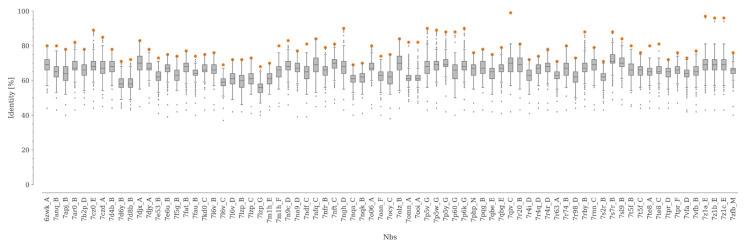
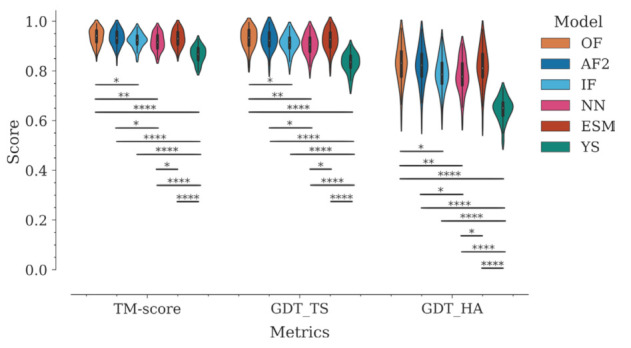
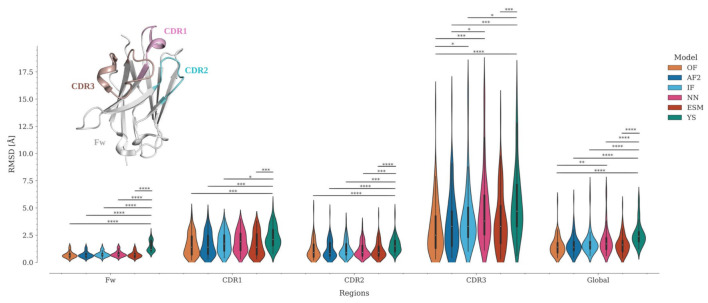
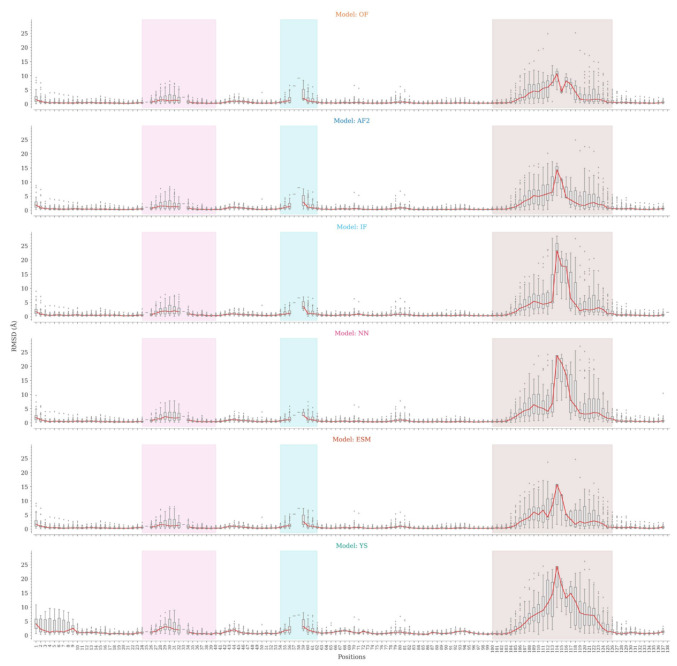
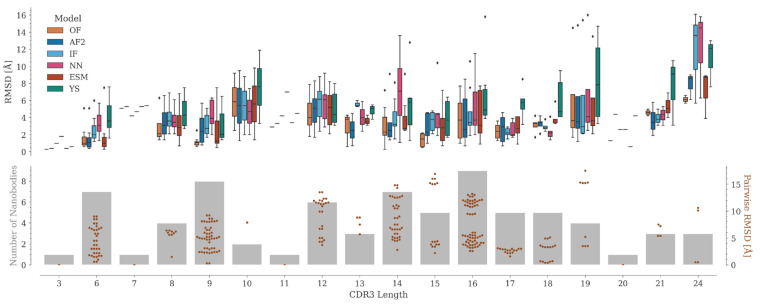
The number of applications for nanobodies is steadily expanding, positioning these molecules as fast-growing biologic products in the biotechnology market. Several of their applications require protein engineering, which in turn would greatly benefit from having a reliable structural model of the nanobody of interest. However, as with antibodies, structural modeling of nanobodies is still a challenge. With the rise of artificial intelligence (AI), several methods have been developed in recent years that attempt to solve the problem of protein modeling. In this study, we have compared the performance in nanobody modeling of several state-of-the-art AI-based programs, either designed for general protein modeling, such as AlphaFold2, OmegaFold, ESMFold and Yang-Server, or specifically designed for antibody modeling, such as IgFold, and Nanonet. While all these programs performed rather well in constructing the nanobody framework and CDRs 1 and 2, modeling of CDR3 sill represents a big challenge. Interestingly, tailoring an AI method for antibody modeling does not necessarily translate into better results for nanobodies.
Overview
The claims and statistics of this paper haven’t been checked yet.
Free: it reads the open-access text and checks the first 5 claims that cite a source we can check. Create a free account to check every claim.
Integrity signals
Registry
Cites
Statistics
Figures
Verification
Claims the paper makes
The claims and statistics of this paper haven’t been checked yet.
Free: it reads the open-access text and checks the first 5 claims that cite a source we can check. Create a free account to check every claim.
Self-check
Percentages, sums and reported differences re-computed from the paper’s own numbers.
The self-check needs the paper’s full text.
Citations
Cites
Highly accurate protein structure prediction with AlphaFold
Jumper, J., Evans, R., Pritzel, A., Green, T., Figurnov, M., Ronneberger, O., Tunyasuvunakool, K., Bates, R., Žídek, A., Potapenko, A., et al. (2021) · Nature · doi:10.1038/s41586-021-03819-2 · Cited by 43,764
Metadata
- Authors
- Valdés-Tresanco, M. S., Valdés-Tresanco, M. E., Jiménez-Gutiérrez, D. E., & Moreno, E.
- Affiliations
- Universidad de Medellín (CO)
- Corresponding author
- Moreno, Ernesto
- Venue
- Molecules
- Publisher
- MDPI AG
- Published
- 2023-04-11
- Volume
- 28
- Issue
- 10
- Pages
- 3991-3991
- ISSN
- 1420-3049 (ISSN-L)
- PMC
- PMC10220908
- OpenAlex
- W4378516410
- Cited by
- 39
- References
- 1
- Citations by year
- 2026: 12 · 2025: 14 · 2024: 8 · 2023: 5
- FWCI
- 3.48
- Type
- journal article
- Language
- en
- Open access
- gold
- doi.org
- Locations
- Molecules (publishedVersion, cc-by)
- Preprints.org (acceptedVersion, cc-by)
- PubMed Central (publishedVersion, cc-by)
- PubMed (publishedVersion)
- DOAJ (DOAJ: Directory of Open Access Journals) (submittedVersion, cc-by-sa)
- Funders
- Ministerio de Ciencia, Tecnología e Innovación
- University of Calgary
- Universidad de Medellín (FP44842-211-2018)
- Instituto Colombiano de Crédito Educativo y Estudios Técnicos en el Exterior (FP44842-211-2018)
- Topics
- Life Sciences › Biochemistry, Genetics and Molecular Biology › Molecular Biology › Protein Structure and Dynamics
- Life Sciences › Immunology and Microbiology › Immunology › Monoclonal and Polyclonal Antibodies Research
- Life Sciences › Biochemistry, Genetics and Molecular Biology › Molecular Biology › vaccines and immunoinformatics approaches
- Keywords
- nanobodies, protein structure prediction, artificial intelligence, AlphaFold2, ESMFold, nanonets, protein engineering, benchmarking
- MeSH terms
- Antibodies, Artificial Intelligence, Biotechnology, Protein Engineering, Benchmarking, Single-Domain Antibodies
About these checks
Registry, retraction, Cites and statistics results are computed, not judged, with one exception: a printed reference that no index lists is read once by a model before it counts as a citation error. Claims are extracted by a model and kept only when their quote appears verbatim in the text; each cited source is then checked, with a model’s help, for whether it says what the claim relies on. Those verdicts can be wrong — read the claim’s quote and the cited source before relying on one.
Statistics and arithmetic are recomputed, not judged.
Confidence bands are shown only for fields calibrated on our annotated test set. None is calibrated yet, so no band is shown.
What counts as a claim ›How we measure confidence ›How we check this ›
Are you an author, or do you see a problem with this page? Request a review
How to cite
Cite CoChat for the checks on this page, and the paper for its own findings.
- This page
- CoChat. (2026). Citation check: Structural Modeling of Nanobodies: A Benchmark of State-of-the-Art Artificial Intelligence Programs. https://app.cochat.ai/papers/10.20944/preprints202304.0195.v1
- The paper
- Valdés-Tresanco, M. S., Valdés-Tresanco, M. E., Jiménez-Gutiérrez, D. E., & Moreno, E. (2023). Structural Modeling of Nanobodies: A Benchmark of State-of-the-Art Artificial Intelligence Programs. Molecules. https://doi.org/10.20944/preprints202304.0195.v1
Data sources
Bibliographic data: Semantic Scholar, OpenAlex, Crossref.
Contains information from the Semantic Scholar Academic Graph Datasets, made available under the ODC Attribution License (ODC-BY 1.0).
Semantic Scholar’s data is described in: Kinney, R., et al. (2023). The Semantic Scholar Open Data Platform. arXiv:2301.10140.
