

Just Keep Rolling? – An Encompassing Review towards Accelerated Vaccine Product Life Cycles
Open accessPreprint — published as 10.3390/vaccines11081287
The DOI matches its Crossref record; 1 of the 1 references it cites were found in a registry or an index.
Abstract
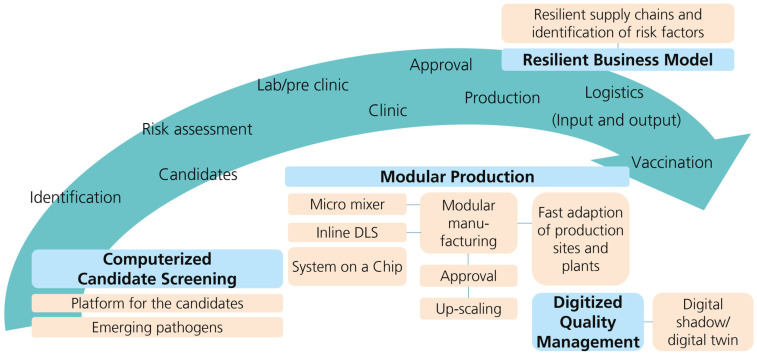
In light of the recent pandemic, several COVID-19 vaccines were developed, tested and approved in a very short time, a process that otherwise takes many years. Above all, these efforts have also unmistakably revealed the capacity limits and potential for improvement in vaccine production. This review aims to emphasize recent approaches for targeted rapid adaptation and production of vaccines from an interdisciplinary multifaceted perspective. Using literature research, stakeholder analysis and a value proposition canvas, we reviewed technological innovations on the pharmacological level, formulation, validation and resilient vaccine production to supply bottlenecks and logistic networks. We identified four main drivers to accelerate the vaccine product life cycle: computerized candidate screening, modular production, digitized quality management and a resilient business model with corresponding transparent supply chains. In summary, the results presented here can serve as a guide and implementation tool for flexible, scalable vaccine production to respond swiftly to pandemic situations in the future.
Overview
The claims and statistics of this paper haven’t been checked yet.
Free: it reads the open-access text and checks the first 5 claims that cite a source we can check. Create a free account to check every claim.
Integrity signals
Registry
Cites
Statistics
Figures
Verification
Claims the paper makes
The claims and statistics of this paper haven’t been checked yet.
Free: it reads the open-access text and checks the first 5 claims that cite a source we can check. Create a free account to check every claim.
Self-check
Percentages, sums and reported differences re-computed from the paper’s own numbers.
The self-check needs the paper’s full text.
Citations
Cites
Highly accurate protein structure prediction with AlphaFold
Jumper, J., Evans, R., Pritzel, A., Green, T., Figurnov, M., Ronneberger, O., Tunyasuvunakool, K., Bates, R., Žídek, A., Potapenko, A., et al. (2021) · Nature · doi:10.1038/s41586-021-03819-2 · Cited by 43,764
Metadata
- Authors
- Stiefel, J., Schloßhauer, J., Vosen, A., Kilz, S., Zimmer, J., & Balakin, S.
- Affiliations
- Fraunhofer Institute for Microengineering and Microsystems (DE)
- Fraunhofer Institute for Cell Therapy and Immunology (DE)
- Fraunhofer Center for International Management and Knowledge Economy (DE)
- Max Bergmann Center of Biomaterials (DE)
- Corresponding author
- Stiefel, Janis
- Venue
- Vaccines
- Publisher
- MDPI AG
- Published
- 2023-07-20
- Volume
- 11
- Issue
- 8
- Pages
- 1287-1287
- ISSN
- 2076-393X (ISSN-L)
- PMC
- PMC10459022
- OpenAlex
- W4385348923
- Cited by
- 11
- References
- 1
- Citations by year
- 2026: 2 · 2025: 6 · 2024: 1 · 2023: 2
- FWCI
- 0.52
- Type
- journal article
- Language
- en
- Open access
- gold
- doi.org
- Locations
- Vaccines (publishedVersion, cc-by)
- Preprints.org (acceptedVersion, cc-by)
- PubMed Central (publishedVersion, cc-by)
- PubMed (publishedVersion)
- DOAJ (DOAJ: Directory of Open Access Journals) (submittedVersion, cc-by-sa)
- Fraunhofer-Publica (Fraunhofer-Gesellschaft) (submittedVersion)
- Funders
- Fraunhofer-Gesellschaft
- Topics
- Health Sciences › Medicine › Infectious Diseases › SARS-CoV-2 and COVID-19 Research
- Social Sciences › Economics, Econometrics and Finance › Economics and Econometrics › Pharmaceutical Economics and Policy
- Life Sciences › Biochemistry, Genetics and Molecular Biology › Molecular Biology › Viral Infectious Diseases and Gene Expression in Insects
- Keywords
- COVID-19 vaccines, vaccine production, modular manufacturing, supply chain resilience, vaccine formulation, business models, pandemic preparedness, stakeholder analysis, value proposition canvas
About these checks
Registry, retraction, Cites and statistics results are computed, not judged, with one exception: a printed reference that no index lists is read once by a model before it counts as a citation error. Claims are extracted by a model and kept only when their quote appears verbatim in the text; each cited source is then checked, with a model’s help, for whether it says what the claim relies on. Those verdicts can be wrong — read the claim’s quote and the cited source before relying on one.
Statistics and arithmetic are recomputed, not judged.
Confidence bands are shown only for fields calibrated on our annotated test set. None is calibrated yet, so no band is shown.
What counts as a claim ›How we measure confidence ›How we check this ›
Are you an author, or do you see a problem with this page? Request a review
Data sources
Bibliographic data: Semantic Scholar, OpenAlex, Crossref.
Contains information from the Semantic Scholar Academic Graph Datasets, made available under the ODC Attribution License (ODC-BY 1.0).
Semantic Scholar’s data is described in: Kinney, R., et al. (2023). The Semantic Scholar Open Data Platform. arXiv:2301.10140.
