

A Deep Reinforcement Learning Approach to DropletRouting for Erroneous Digital Microfluidic Biochips
Open accessPreprint — published as 10.3390/s23218924
The DOI matches its Crossref record; 1 of the 1 references it cites were found in a registry or an index.
Abstract
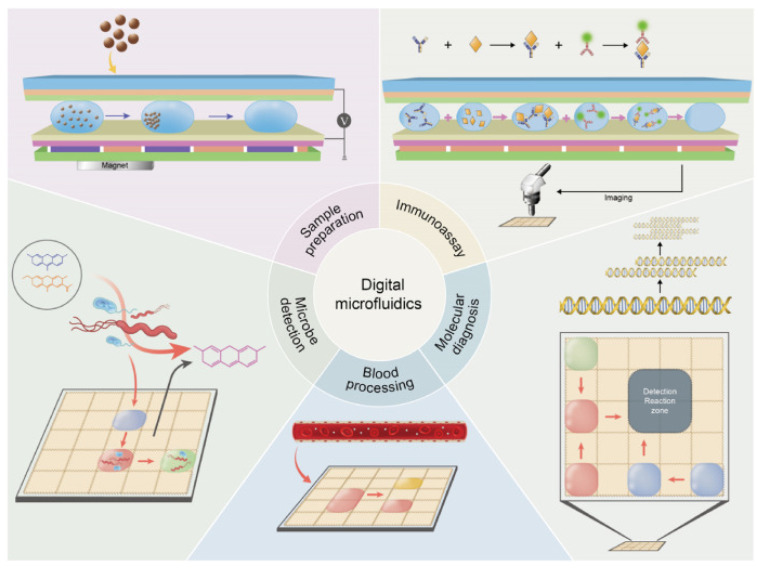
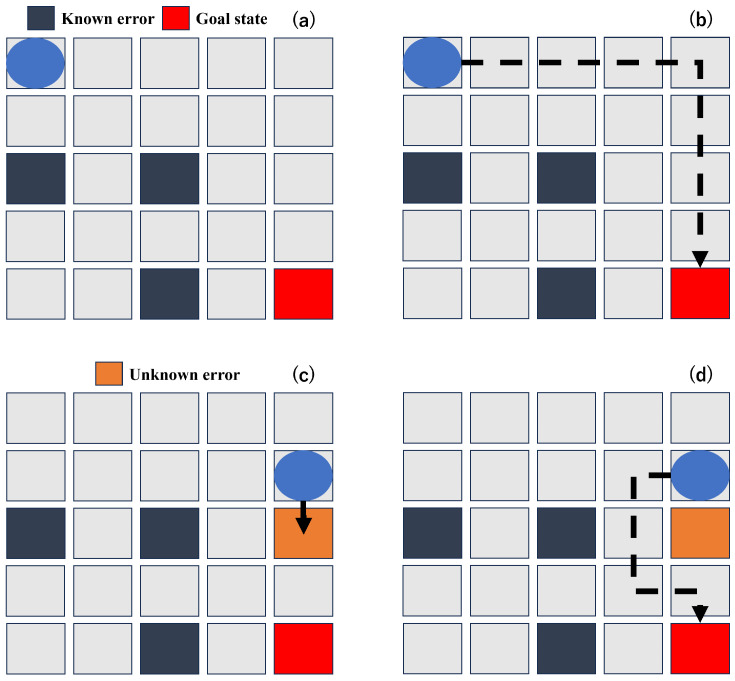
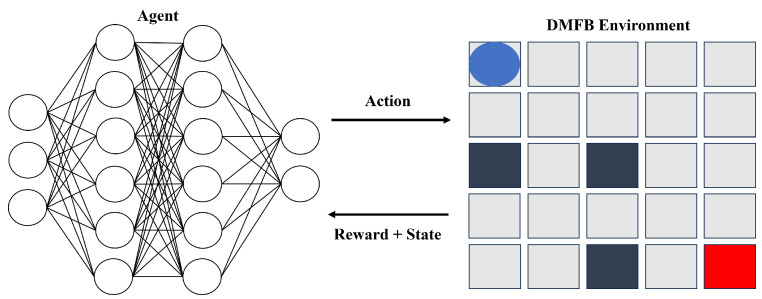
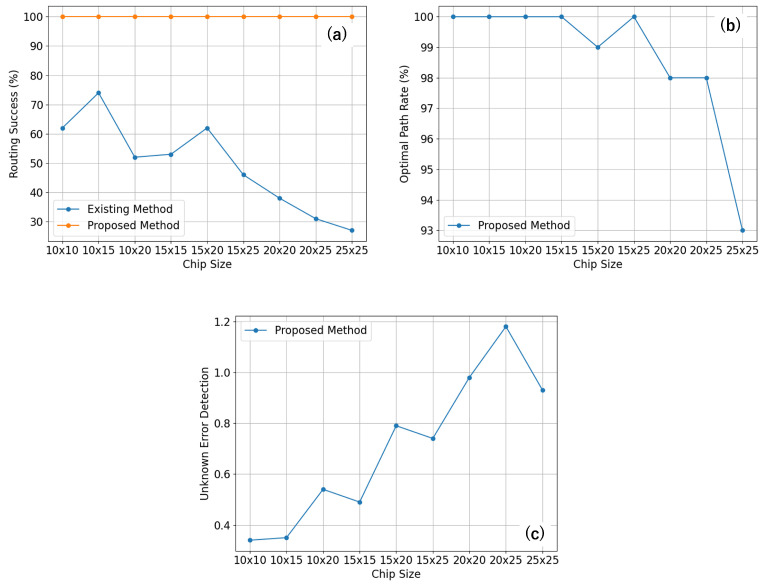
Digital Microfluidic Biochips (DMFBs), used in various kinds of fields like DNA analysis, clinical diagnosis, and PCR testing, have made biochemical experiments more compact, efficient, and user-friendly than previous ways. However, their reliability is often compromised by their inability to adapt to all kinds of errors. All errors in biochips can be categorized into two types: known errors and unknown errors. Known errors are detectable before the start of the routing process through sensors or cameras. Unknown errors, in contrast, become apparent only during the routing process and remain undetected by sensors or cameras, which is the biggest issue to unexpectedly stop the routing process and diminishes the reliability of biochips. This paper introduces a deep reinforcement learning-based routing algorithm designed to manage not only known errors but also unknown errors. Our experiments demonstrate that our algorithm outperforms previous ones in terms of the success rate of the routing in the scenario including both known errors and unknown errors. Additionally, our algorithm contributes to detecting unknown errors during the routing process and identifying the most efficient routing path with high probability.
Overview
The claims and statistics of this paper haven’t been checked yet.
Free: it reads the open-access text and checks the first 5 claims that cite a source we can check. Create a free account to check every claim.
Integrity signals
Registry
Cites
Statistics
Figures
Verification
Claims the paper makes
The claims and statistics of this paper haven’t been checked yet.
Free: it reads the open-access text and checks the first 5 claims that cite a source we can check. Create a free account to check every claim.
Self-check
Percentages, sums and reported differences re-computed from the paper’s own numbers.
The self-check needs the paper’s full text.
Citations
Cites
Highly accurate protein structure prediction with AlphaFold
Jumper, J., Evans, R., Pritzel, A., Green, T., Figurnov, M., Ronneberger, O., Tunyasuvunakool, K., Bates, R., Žídek, A., Potapenko, A., et al. (2021) · Nature · doi:10.1038/s41586-021-03819-2 · Cited by 43,764
Metadata
- Authors
- Kawakami, T., Shiro, C., Nishikawa, H., Kong, X., Tomiyama, H., & Yamashita, S.
- Affiliations
- Ritsumeikan University (JP)
- The University of Osaka (JP)
- Toyama Prefectural University (JP)
- Corresponding author
- Kawakami, Tomohisa
- ORCID
- Venue
- Sensors
- Publisher
- MDPI AG
- Published
- 2023-09-27
- Volume
- 23
- Issue
- 21
- Pages
- 8924-8924
- ISSN
- 1424-8220 (ISSN-L)
- PMC
- PMC10649759
- OpenAlex
- W4388221749
- Cited by
- 13
- References
- 1
- Citations by year
- 2026: 1 · 2025: 9 · 2024: 2 · 2023: 1
- FWCI
- 0.96
- Type
- journal article
- Language
- en
- Open access
- gold
- doi.org
- Locations
- Sensors (publishedVersion, cc-by)
- Preprints.org (acceptedVersion, cc-by)
- PubMed Central (publishedVersion, cc-by)
- PubMed (publishedVersion)
- DOAJ (DOAJ: Directory of Open Access Journals) (submittedVersion, cc-by-sa)
- Funders
- Japan Society for the Promotion of Science (23K20378, 20H00590, 20H04160)
- Topics
- Physical Sciences › Engineering › Electrical and Electronic Engineering › Electrowetting and Microfluidic Technologies
- Physical Sciences › Engineering › Biomedical Engineering › Microfluidic and Capillary Electrophoresis Applications
- Physical Sciences › Engineering › Mechanical Engineering › Modular Robots and Swarm Intelligence
- Keywords
- digital microfluidic biochips, droplet routing, deep reinforcement learning, error detection
- MeSH terms
- Algorithms, Reproducibility of Results, Microfluidics, Microfluidic Analytical Techniques, Microarray Analysis
About these checks
Registry, retraction, Cites and statistics results are computed, not judged, with one exception: a printed reference that no index lists is read once by a model before it counts as a citation error. Claims are extracted by a model and kept only when their quote appears verbatim in the text; each cited source is then checked, with a model’s help, for whether it says what the claim relies on. Those verdicts can be wrong — read the claim’s quote and the cited source before relying on one.
Statistics and arithmetic are recomputed, not judged.
Confidence bands are shown only for fields calibrated on our annotated test set. None is calibrated yet, so no band is shown.
What counts as a claim ›How we measure confidence ›How we check this ›
Are you an author, or do you see a problem with this page? Request a review
Data sources
Bibliographic data: Semantic Scholar, OpenAlex, Crossref.
Contains information from the Semantic Scholar Academic Graph Datasets, made available under the ODC Attribution License (ODC-BY 1.0).
Semantic Scholar’s data is described in: Kinney, R., et al. (2023). The Semantic Scholar Open Data Platform. arXiv:2301.10140.
