

Analysis of CD74 Occurrence in Oncogenic Fusion Proteins
Open accessPreprint — published as 10.3390/ijms242115981
The DOI matches its Crossref record; 1 of the 1 references it cites were found in a registry or an index.
Abstract
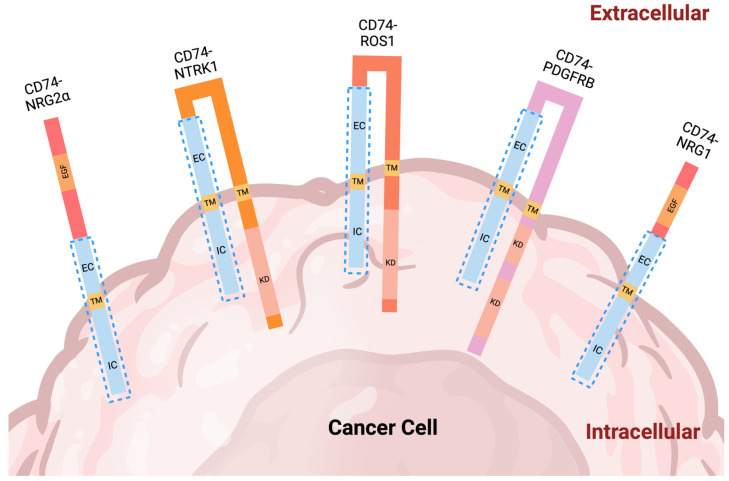
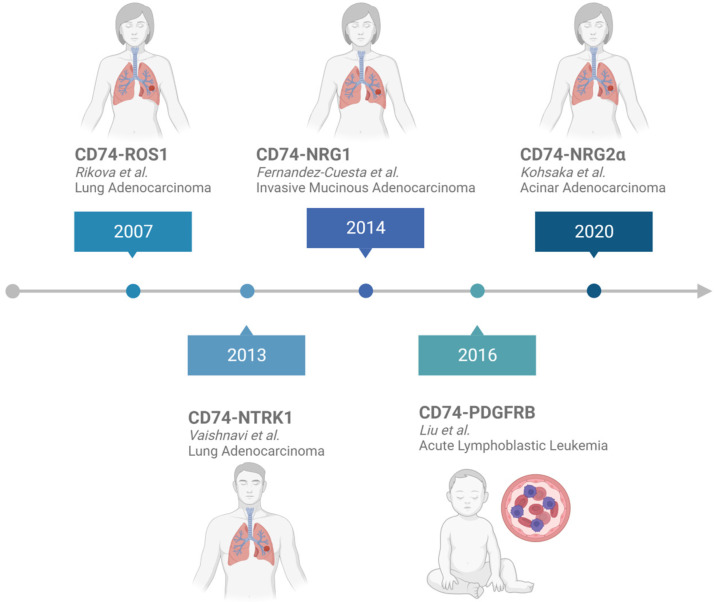
CD74 is a type II cell surface receptor found to be highly expressed in several hematological and solid cancers, due to its ability to activate pathways associated with tumor cell survival and proliferation. Over the past 16 years, CD74 is emerging as a commonly detected fusion partner in multiple oncogenic fusion proteins. Studies have found CD74 fusion proteins in a range of cancers including lung adenocarcinoma, inflammatory breast cancer, and pediatric acute lymphoblastic leukemia. To date, there are five known CD74 fusion proteins, CD74-ROS1, CD74-NTRK1, CD74-NRG1, CD74-NRG2a, and CD74-PDGFRB, with a total of 16 different variants, each with unique genetic signatures. Importantly, the occurrence of CD74 in the formation of fusion proteins has not been well explored despite the fact that ROS1 and NRG1 families utilize CD74 as the primary partner for the formation of oncogenic fusions. Fusion proteins known to be oncogenic drivers, including those of CD74, are typically detected, and targeted after standard chemotherapeutic plans fail and the disease relapses. The analysis reported herein provides insights into early intervention of CD74 fusions and highlight the need for improved routine assessment methods so that targeted therapies can be applied while they are most effective.
Overview
The claims and statistics of this paper haven’t been checked yet.
Free: it reads the open-access text and checks the first 5 claims that cite a source we can check. Create a free account to check every claim.
Integrity signals
Registry
Cites
Statistics
Figures
Verification
Claims the paper makes
The claims and statistics of this paper haven’t been checked yet.
Free: it reads the open-access text and checks the first 5 claims that cite a source we can check. Create a free account to check every claim.
Self-check
Percentages, sums and reported differences re-computed from the paper’s own numbers.
The self-check needs the paper’s full text.
Citations
Cites
Highly accurate protein structure prediction with AlphaFold
Jumper, J., Evans, R., Pritzel, A., Green, T., Figurnov, M., Ronneberger, O., Tunyasuvunakool, K., Bates, R., Žídek, A., Potapenko, A., et al. (2021) · Nature · doi:10.1038/s41586-021-03819-2 · Cited by 43,764
Metadata
- Authors
- Vargas, J., & Pantouris, G.
- Affiliations
- University of the Pacific (US)
- Corresponding author
- Pantouris, Georgios
- Venue
- International Journal of Molecular Sciences
- Publisher
- MDPI AG
- Published
- 2023-09-29
- Volume
- 24
- Issue
- 21
- Pages
- 15981-15981
- ISSN
- 1422-0067 (ISSN-L)
- PMC
- PMC10650716
- OpenAlex
- W4388380354
- Cited by
- 13
- References
- 1
- Citations by year
- 2026: 7 · 2025: 3 · 2024: 3
- FWCI
- 0.60
- Type
- journal article
- Language
- en
- Open access
- gold
- doi.org
- Locations
- International Journal of Molecular Sciences (publishedVersion, cc-by)
- Preprints.org (acceptedVersion, cc-by)
- PubMed Central (publishedVersion, cc-by)
- PubMed (publishedVersion)
- Scholarly Commons (University of the Pacific) (submittedVersion, cc-by)
- Funders
- University of the Pacific
- Topics
- Health Sciences › Medicine › Pulmonary and Respiratory Medicine › Lung Cancer Treatments and Mutations
- Life Sciences › Biochemistry, Genetics and Molecular Biology › Cancer Research › Cancer Genomics and Diagnostics
- Life Sciences › Biochemistry, Genetics and Molecular Biology › Cancer Research › Cancer Mechanisms and Therapy
- Keywords
- CD74, fusion oncogenes, lung adenocarcinoma, inflammatory breast cancer, childhood acute lymphoblastic leukemia, targeted therapy, fusion gene detection, tumor recurrence
- MeSH terms
- Adenocarcinoma of Lung, Child, Humans, Lung Neoplasms, Protein-Tyrosine Kinases, Proto-Oncogene Proteins, Oncogene Proteins, Fusion
About these checks
Registry, retraction, Cites and statistics results are computed, not judged, with one exception: a printed reference that no index lists is read once by a model before it counts as a citation error. Claims are extracted by a model and kept only when their quote appears verbatim in the text; each cited source is then checked, with a model’s help, for whether it says what the claim relies on. Those verdicts can be wrong — read the claim’s quote and the cited source before relying on one.
Statistics and arithmetic are recomputed, not judged.
Confidence bands are shown only for fields calibrated on our annotated test set. None is calibrated yet, so no band is shown.
What counts as a claim ›How we measure confidence ›How we check this ›
Are you an author, or do you see a problem with this page? Request a review
Data sources
Bibliographic data: Semantic Scholar, OpenAlex, Crossref.
Contains information from the Semantic Scholar Academic Graph Datasets, made available under the ODC Attribution License (ODC-BY 1.0).
Semantic Scholar’s data is described in: Kinney, R., et al. (2023). The Semantic Scholar Open Data Platform. arXiv:2301.10140.
