

The DOI matches its Crossref record; 1 of the 1 references it cites were found in a registry or an index.
Role of rs873601 Polymorphisms in Prognosis of Lung Cancer Patients Treated with Platinum-Based Chemotherapy
Open accessPreprint — published as 10.3390/biomedicines11123133 · Paper page
Abstract
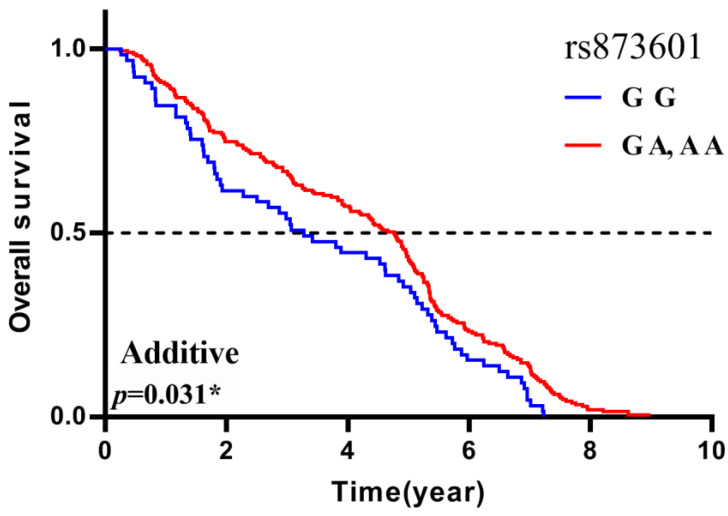
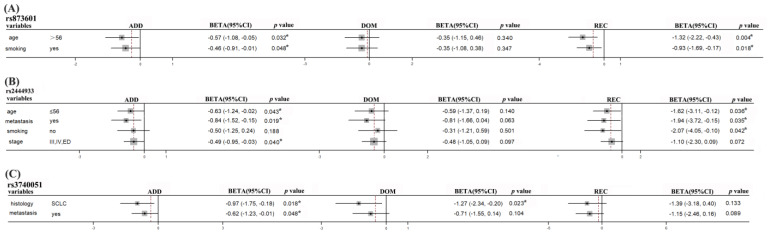
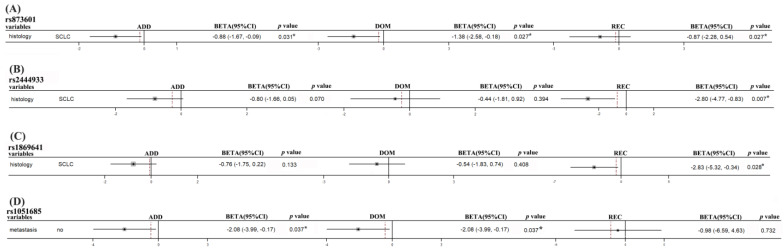
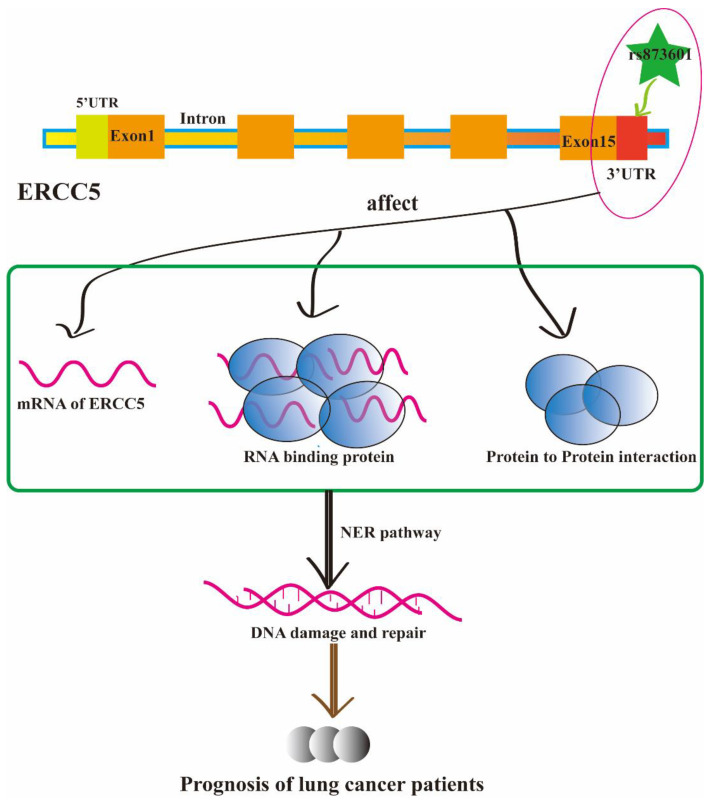
Background: Lung cancer is still the most lethal malignancy in the world from the report of Cancer Statistics in 2021. Platinum-based chemotherapy combined immunotherapy is the first-line treatment in lung cancer patients. However, the 5-year survival rate always affected by the adverse reaction and drug resistance caused by platinum-based chemotherapy. DNA damage and repair system is one of the important mechanisms which can affect the response to chemotherapy and clinical outcome in lung cancer patients. Objective: The objective of this study is to find the relationship between the polymorphisms of DNA repair genes with the prognosis in platinum-based chemotherapy in lung cancer patients. Patients and Methods: We performed genotyping in 17 single nucleotide polymorphisms (SNPs) of Excision Repair Cross-Complementation group (ERCC) genes and X-ray Repair Cross-Complementing (XRCC) genes of 345 lung cancer patients by Sequenom MassARRAY. We used Cox proportional hazard models, state and plink to analyze the associations between SNPs and the prognosis of lung cancer patients. Results: We found that the ERCC5 rs873601 was associated with the overall survival time in lung cancer patients treat by platinum-based chemotherapy (p=0.031*). We also discovered that the polymorphisms in rs873601 was significantly associated with the prognosis in age more than 55 years, Small Cell Lung Cancer (SCLC) and smoking patients, Long Intergenic Non-protein Coding RNA (PNKY) rs2444933 in age less than 55 years, SCLC, metastasis and stage III/IV/ED patients, Short Tau Inversion Recovery (STIR1) rs3740051 in SCLC and metastasis patients, PNKY rs1869641 in SCLC patients, XRCC5 rs1051685 in non-metastasis patients, respectively. Conclusion: The ERCC5 rs873601(G>A) maybe a valuable biomarker for predicting the prognosis in lung cancer patients treated with platinum-based chemotherapy. Statements and Declarations: The authors declare that they have no conflict of interest.
Overview
The claims and statistics of this paper haven’t been checked yet.
Run the check — free, no account needed. It reads the open-access text and checks the sources it cites.
Integrity signals
Registry
Cites
Statistics
Figures
Verification
Claims the paper makes
The claims and statistics of this paper haven’t been checked yet.
Run the check — free, no account needed. It reads the open-access text and checks the sources it cites.
Self-check
Percentages, sums and reported differences re-computed from the paper’s own numbers.
The self-check needs the paper’s full text.
Citations
Cites
The central role of DNA damage in the ageing process
Schumacher, B., Pothof, J., Vijg, J., & Hoeijmakers, J. H. J. (2021) · Nature · doi:10.1038/s41586-021-03307-7 · Cited by 907
Metadata
- Authors
- Zou, T., Liu, J. Y., Qin, Q., Guo, J., Zhou, W. Z., Li, X. P., Zhou, H., Chen, J., & Liu, Z. Q.
- Affiliations
- Central South University (CN)
- Corresponding author
- Chen, Juan
- Venue
- Biomedicines
- Publisher
- MDPI AG
- Published
- 2023-10-13
- Volume
- 11
- Issue
- 12
- Pages
- 3133-3133
- ISSN
- 2227-9059 (ISSN-L)
- PMC
- PMC10741124
- OpenAlex
- W4388969272
- Cited by
- 10
- References
- 1
- Citations by year
- 2026: 4 · 2025: 1 · 2024: 4 · 2023: 1
- FWCI
- 1.84
- Type
- journal article
- Language
- en
- Open access
- gold
- doi.org
- Locations
- Biomedicines (publishedVersion, cc-by)
- Preprints.org (acceptedVersion, cc-by)
- PubMed Central (publishedVersion, cc-by)
- PubMed (publishedVersion)
- DOAJ (DOAJ: Directory of Open Access Journals) (submittedVersion, cc-by-sa)
- Funders
- National Natural Science Foundation of China (2021 JC0002, 82173901, kh2003010, kq2208408)
- Topics
- Health Sciences › Medicine › Pulmonary and Respiratory Medicine › Lung Cancer Treatments and Mutations
- Health Sciences › Medicine › Oncology › Lung Cancer Research Studies
- Life Sciences › Biochemistry, Genetics and Molecular Biology › Genetics › Genetic Associations and Epidemiology
- Keywords
- lung cancer, single nucleotide polymorphisms, DNA repair genes, platinum-based chemotherapy, prognosis, small cell lung cancer, smoking, metastasis, prognostic factors
About these checks
Registry, retraction, Cites and statistics results are computed, not judged, with one exception: a printed reference that no index lists is read once by a model before it counts as a citation error. Claims are extracted by a model and kept only when their quote appears verbatim in the text; each cited source is then checked, with a model’s help, for whether it says what the claim relies on. Those verdicts can be wrong — read the claim’s quote and the cited source before relying on one.
Statistics and arithmetic are recomputed, not judged.
Confidence bands are shown only for fields calibrated on our annotated test set. None is calibrated yet, so no band is shown.
What counts as a claim ›How we measure confidence ›How we check this ›
Are you an author, or do you see a problem with this page? Request a review
How to cite
Cite CoChat for the checks on this page, and the paper for its own findings.
- This page
- CoChat. (2026). Citation check: Role of rs873601 Polymorphisms in Prognosis of Lung Cancer Patients Treated with Platinum-Based Chemotherapy. https://app.cochat.ai/papers/10.20944/preprints202310.0897.v1
- The paper
- Zou, T., Liu, J. Y., Qin, Q., Guo, J., Zhou, W. Z., Li, X. P., Zhou, H., Chen, J., & Liu, Z. Q. (2023). Role of rs873601 Polymorphisms in Prognosis of Lung Cancer Patients Treated with Platinum-Based Chemotherapy. Biomedicines. https://doi.org/10.20944/preprints202310.0897.v1
