

A Proposal for a Consolidated Structural Model of the CagY Protein of Helicobacter pylori
Open accessPreprint — published as 10.3390/ijms242316781 · Paper page
The DOI matches its Crossref record; 1 of the 1 references it cites were found in a registry or an index.
Abstract
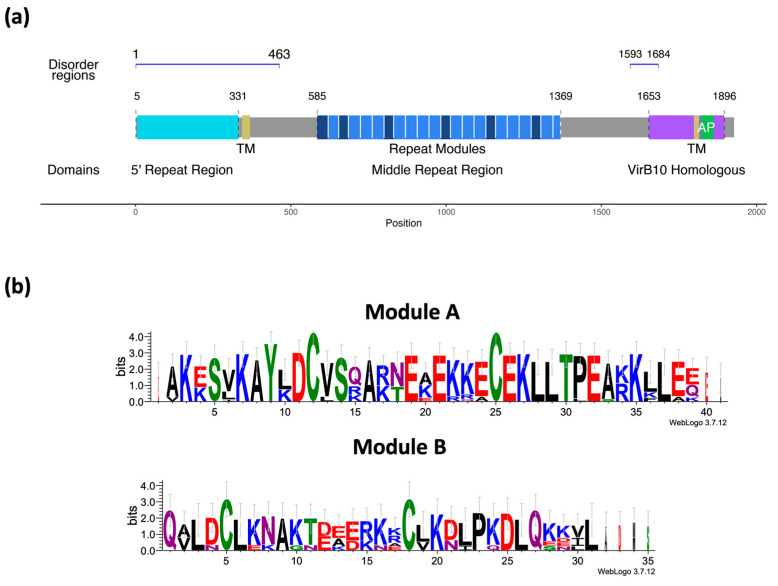
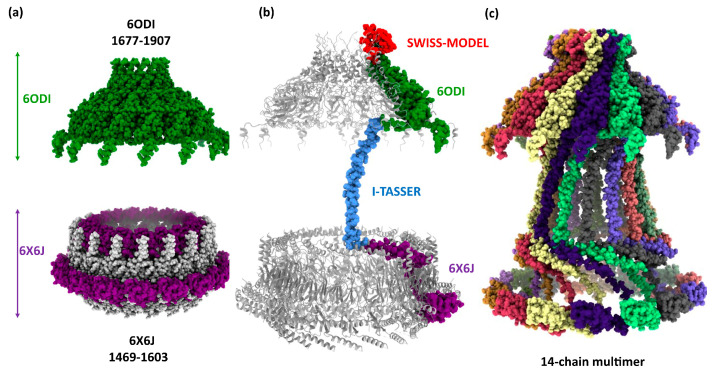
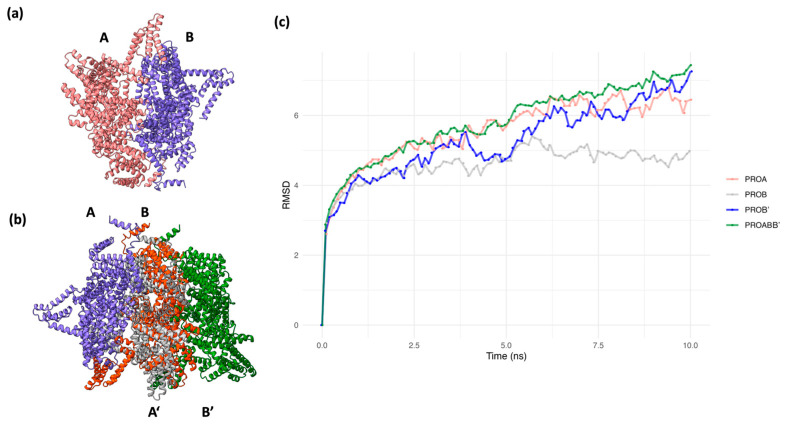
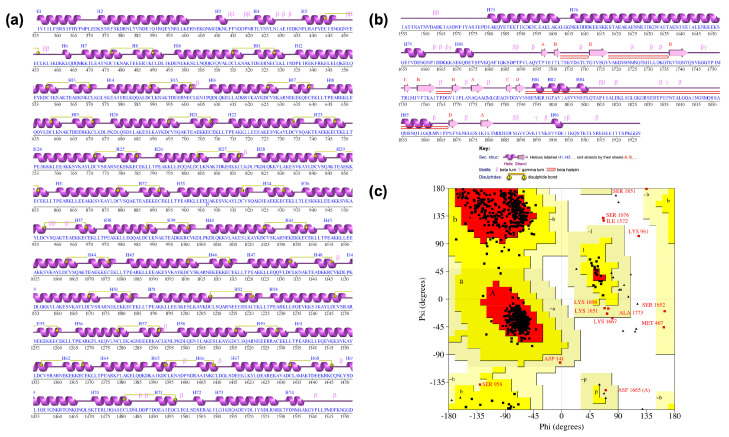
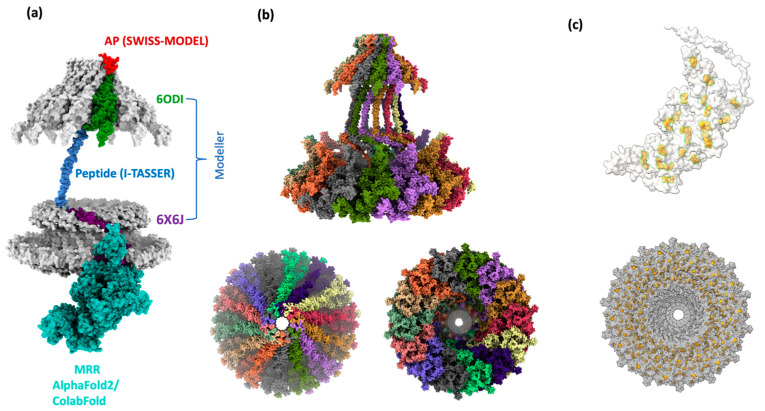
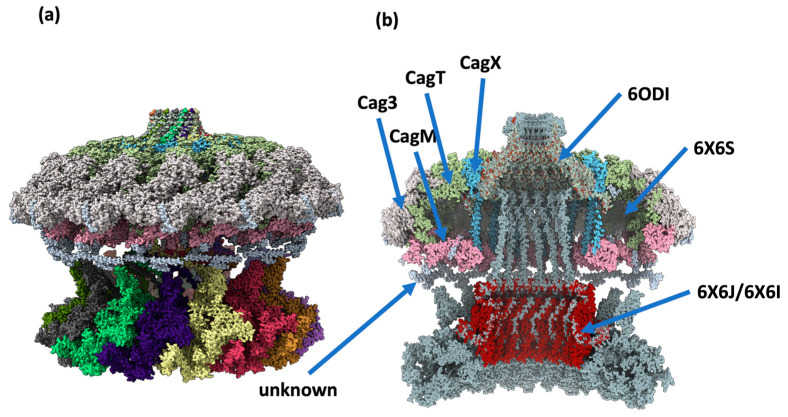
CagY is the largest and most complex protein from Helicobacter pylori's type IV secretion system (T4SS) and may participate in the modulation of gastric tissue inflammation. A three-dimensional structure has been reported for only two segments of the protein. To build a more complete model, particularly the region that spans between the outer membrane (OM) and the inner membrane (IM), we employed different approaches, including homology modeling, ab initio, and deep learning techniques. For the long-middle repeat region (MRR), modeling was performed using deep learning techniques and Molecular Dynamics. The modeled segments were assembled into a chain of 1595 aa, and a 14-chain CagY multimer structure was composed by structural alignment. The final multimer structure correlated with previously published struc-tures and allows to show how the multimer may form the T4SS channel through which CagA and other molecules are translocated to gastric epithelial cells. The model further confirmed that MRR, the most polymorphic and complex region of CagY, presents numerous cysteine residues forming disulfide bonds that stabilize the protein and suggest this domain probably functions as a contractile region that may play an essential role in the modulatory activity of CagY on tissue inflammation.
Overview
The claims and statistics of this paper haven’t been checked yet.
Free: it reads the open-access text and checks the first 5 claims that cite a source we can check. Create a free account to check every claim.
Integrity signals
Registry
Cites
Statistics
Figures
Verification
Claims the paper makes
The claims and statistics of this paper haven’t been checked yet.
Free: it reads the open-access text and checks the first 5 claims that cite a source we can check. Create a free account to check every claim.
Self-check
Percentages, sums and reported differences re-computed from the paper’s own numbers.
The self-check needs the paper’s full text.
Citations
Cites
Highly accurate protein structure prediction with AlphaFold
Jumper, J., Evans, R., Pritzel, A., Green, T., Figurnov, M., Ronneberger, O., Tunyasuvunakool, K., Bates, R., Žídek, A., Potapenko, A., et al. (2021) · Nature · doi:10.1038/s41586-021-03819-2 · Cited by 43,764
Metadata
- Authors
- López-Luis, M. A., Soriano-Pérez, E. E., Parada-Fabián, J. C., Maldonado-Rodríguez, R., Torres, J., & Méndez-Tenorio, A.
- Affiliations
- Instituto Politécnico Nacional (MX)
- Mexican Social Security Institute (MX)
- Corresponding author
- Méndez-Tenorio, Alfonso
- Venue
- International Journal of Molecular Sciences
- Publisher
- MDPI AG
- Published
- 2023-10-18
- Volume
- 24
- Issue
- 23
- Pages
- 16781-16781
- ISSN
- 1422-0067 (ISSN-L)
- PMC
- PMC10706595
- OpenAlex
- W4389056852
- Cited by
- 4
- References
- 1
- Citations by year
- 2026: 2 · 2025: 1 · 2024: 1
- FWCI
- 0.36
- Type
- journal article
- Language
- en
- Open access
- gold
- doi.org
- Locations
- International Journal of Molecular Sciences (publishedVersion, cc-by)
- Preprints.org (acceptedVersion, cc-by)
- PubMed Central (publishedVersion, cc-by)
- PubMed (publishedVersion)
- Funders
- Consejo Nacional de Ciencia y Tecnología
- Topics
- Life Sciences › Biochemistry, Genetics and Molecular Biology › Molecular Biology › Protein Structure and Dynamics
- Health Sciences › Medicine › Gastroenterology › Helicobacter pylori-related gastroenterology studies
- Life Sciences › Biochemistry, Genetics and Molecular Biology › Structural Biology › Enzyme Structure and Function
- Keywords
- Helicobacter pylori, type IV secretion system, protein structure prediction, disulfide bonds, cysteine residues, CagA translocation, gastritis, gastric cancer, equilibrium molecular dynamics
- MeSH terms
- Antigens, Bacterial, Bacterial Proteins, Gastritis, Humans, Inflammation, Helicobacter pylori, Helicobacter Infections
About these checks
Registry, retraction, Cites and statistics results are computed, not judged, with one exception: a printed reference that no index lists is read once by a model before it counts as a citation error. Claims are extracted by a model and kept only when their quote appears verbatim in the text; each cited source is then checked, with a model’s help, for whether it says what the claim relies on. Those verdicts can be wrong — read the claim’s quote and the cited source before relying on one.
Statistics and arithmetic are recomputed, not judged.
Confidence bands are shown only for fields calibrated on our annotated test set. None is calibrated yet, so no band is shown.
What counts as a claim ›How we measure confidence ›How we check this ›
Are you an author, or do you see a problem with this page? Request a review
How to cite
Cite CoChat for the checks on this page, and the paper for its own findings.
- This page
- CoChat. (2026). Citation check: A Proposal for a Consolidated Structural Model of the CagY Protein of Helicobacter pylori. https://app.cochat.ai/papers/10.20944/preprints202310.1146.v1
- The paper
- López-Luis, M. A., Soriano-Pérez, E. E., Parada-Fabián, J. C., Maldonado-Rodríguez, R., Torres, J., & Méndez-Tenorio, A. (2023). A Proposal for a Consolidated Structural Model of the CagY Protein of Helicobacter pylori. International Journal of Molecular Sciences. https://doi.org/10.20944/preprints202310.1146.v1
Data sources
Bibliographic data: Semantic Scholar, OpenAlex, Crossref.
Contains information from the Semantic Scholar Academic Graph Datasets, made available under the ODC Attribution License (ODC-BY 1.0).
Semantic Scholar’s data is described in: Kinney, R., et al. (2023). The Semantic Scholar Open Data Platform. arXiv:2301.10140.
