

Long-term outcomes of lung transplantation in the elderly: an analysis using the UNOS database
Open accessThe DOI matches its Crossref record; 36 of the 36 references it cites were found in a registry or an index; none of the 19 sources its claims cite is checked for support yet.
Abstract
Retrospective cohort study of 30,494 adult lung transplant recipients showing long-term survival declines with increasing age; treated rejection, low BMI, pre-transplant ICU stay, and post-transplant dialysis independently predicted mortality.
Overview
CoChat Summary
## TL;DR
Using SRTR/UNOS registry data on 30,494 adult lung transplant recipients from 2006–2022, the study found progressively worse long-term survival with increasing recipient age, especially for those aged ≥70 years. Age remained an independent predictor of mortality after adjustment, while donor age and donor sex were not significant survival determinants.
## Key findings
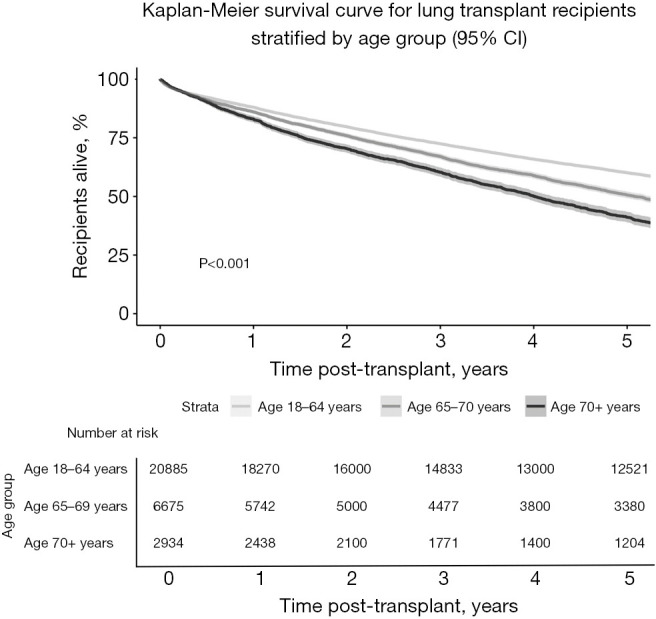
- In the full cohort, 5-year survival declined progressively with age; recipients aged ≥70 years had significantly lower 5-year survival than younger groups.
- In the complete-case multivariable Cox analysis, advanced age remained associated with worse survival: age 65–69 years had HR 1.37 (95% CI: 1.31–1.43) and age ≥70 years had HR 1.56 (95% CI: 1.46–1.67), both P<0.001.
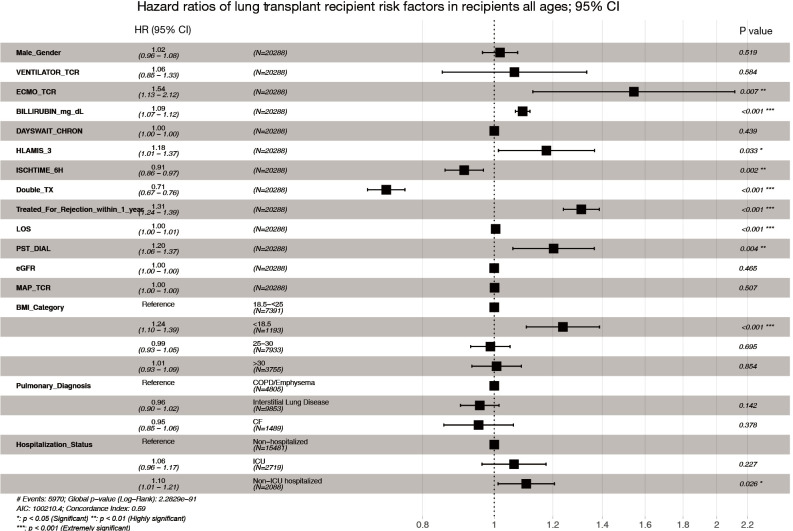
- Overall predictors of mortality included ECMO at transplant (HR 1.54, P=0.007), treated rejection within the first year (HR 1.31, P<0.001), low BMI <18.5 kg/m2 (HR 1.24, P<0.001), post-transplant dialysis (HR 1.2, P=0.004), and donor-recipient HLA mismatch (HR 1.18, P=0.03).
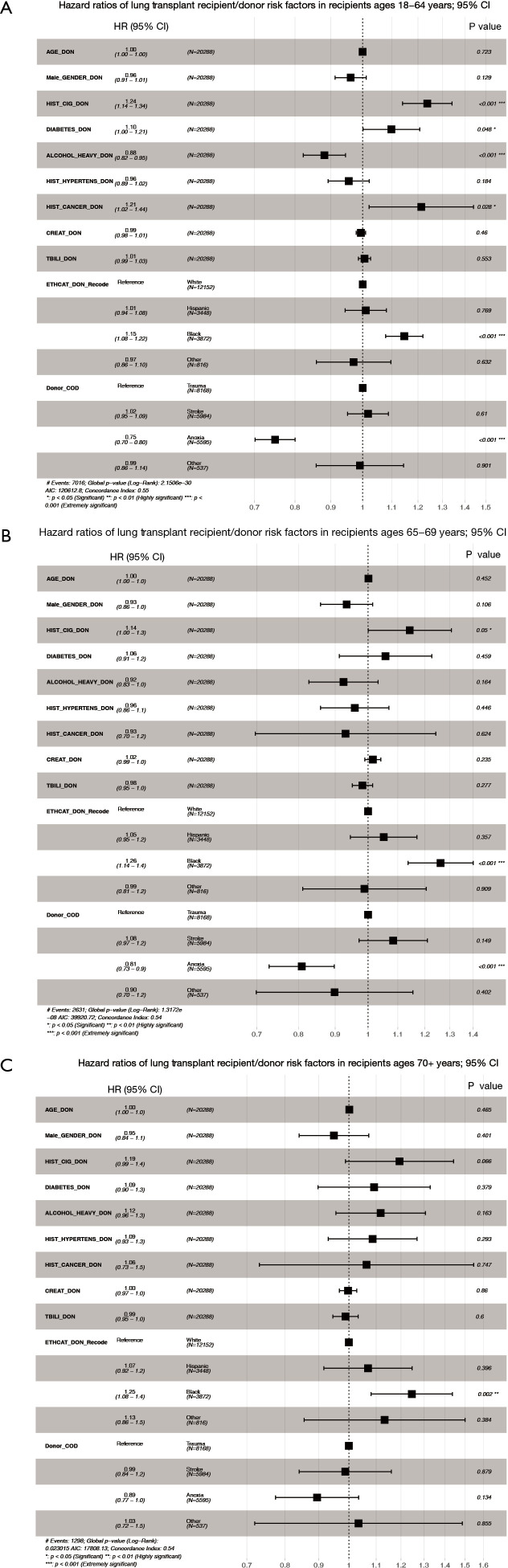
- Donor age and donor sex were not significantly associated with post-transplant mortality; the median donor age was 33 years (IQR 23–46), and donor age did not affect survival in any recipient age group.
## Methods
- Retrospective cohort study using SRTR data from UNOS, covering lung transplants from January 2006 to June 2022.
- Final descriptive cohort: 30,494 adult lung transplant recipients, stratified into ages 18–64 (n=20,885), 65–69 (n=6,675), and ≥70 (n=2,934); complete-case multivariable Cox models used 20,288 recipients after exclusions.
- Main analyses used Kaplan-Meier survival estimates, log-rank tests, and multivariable Cox proportional hazards models; early post-transplant events were additionally assessed with a 1-year landmark design.
## Limitations
- The authors state the study is retrospective registry research and is therefore subject to unmeasured confounding and reporting bias.
- The dataset lacks important clinical variables such as frailty, cognitive function, functional status, and quality-of-life measures; the paper says these are not directly measured in SRTR/UNOS.
- Evident from the text: the complete-case Cox analysis excluded recipients with missing covariate data and those with under 1-year follow-up causing non-convergence, which may limit generalizability.
Model-written summary. Check it against the paper before relying on it.
Integrity signals
Registry
Cites
Statistics
Figures
Verification
Claims the paper makes
0 Valid · 0 Not valid · 13 Not checked · 69 Own results and interpretations
A result the paper reports from its own data — it cites no other source for it, so there is none to check. The quote shows it is in the paper.
In the paper
“An age-by-procedure interaction was statistically significant (interaction P=0.003) (Table S3).”
§ Long-term outcomes of lung transplantation in the elderly: an analysis using the UNOS database > Results > Multivariate analysis
plainstates an association- Asserted: passes — The authors put it forward as true.
- Checkable: passes — It can be checked against evidence.
- Load-bearing: passes — The paper’s conclusions depend on it.
- Based: passes — The paper gives a reason why it holds.
A result the paper reports from its own data — it cites no other source for it, so there is none to check. The quote shows it is in the paper.
In the paper
“Notably, the effect of post-transplant treatment for rejection declined with increasing age, with no clear association observed among recipients aged ≥70 years.”
§ Long-term outcomes of lung transplantation in the elderly: an analysis using the UNOS database > Results > Multivariate analysis
plainstates an association- Asserted: passes — The authors put it forward as true.
- Checkable: passes — It can be checked against evidence.
- Load-bearing: passes — The paper’s conclusions depend on it.
- Based: passes — The paper gives a reason why it holds.
A result the paper reports from its own data — it cites no other source for it, so there is none to check. The quote shows it is in the paper.
In the paper
“Chronic rejection rates also decreased with age from 51% in the 18–64 years group, to 48.5% in the 65–69 years group, and 37% recipients aged ≥70 years (P<0.05).”
§ Long-term outcomes of lung transplantation in the elderly: an analysis using the UNOS database > Results > Outcomes by age cohort
plainstates an association- Asserted: passes — The authors put it forward as true.
- Checkable: passes — It can be checked against evidence.
- Load-bearing: passes — The paper’s conclusions depend on it.
- Based: passes — The paper gives a reason why it holds.
A result the paper reports from its own data — it cites no other source for it, so there is none to check. The quote shows it is in the paper.
In the paper
“Renal function, assessed by estimated glomerular filtration rate (eGFR), was not associated with mortality in any cohort (HR =1.00, 95% CI: 1.00–1.01, P=0.47 in the overall model).”
§ Long-term outcomes of lung transplantation in the elderly: an analysis using the UNOS database > Results > Multivariate analysis
plain- Asserted: passes — The authors put it forward as true.
- Checkable: passes — It can be checked against evidence.
- Load-bearing: unclear — It is unclear whether the paper’s conclusions depend on it.
- Based: passes — The paper gives a reason why it holds.
A result the paper reports from its own data — it cites no other source for it, so there is none to check. The quote shows it is in the paper.
In the paper
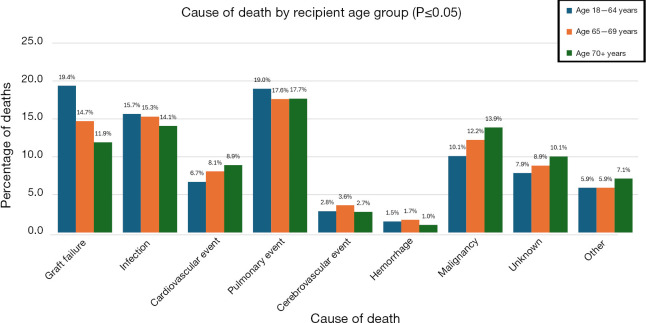
“Malignancy-related deaths were also significantly more frequent in older recipients, occurring in 10% of recipients aged 18–64 years, 12% in those aged 65–69 years, and 14% in the ≥70 years group (P<0.001) (Figure 2).”
§ Long-term outcomes of lung transplantation in the elderly: an analysis using the UNOS database > Results > Cause of death analysis
plainstates an association- Asserted: passes — The authors put it forward as true.
- Checkable: passes — It can be checked against evidence.
- Load-bearing: unclear — It is unclear whether the paper’s conclusions depend on it.
- Based: passes — The paper gives a reason why it holds.
39 more claims
Create a free account to see all 82 claims and every source verdict.
- Probably not a substantial claim. 15
- It may state two separate claims as one. 29
Self-check
Percentages, sums and reported differences re-computed from the paper’s own numbers.
Each contradiction between two passages listed here was confirmed by an independent check.
Rated major: it would touch a result — a value a result rests on, reported and recomputed p-values on opposite sides of the significance level, two passages that conflict with no sign which is right, or a cited work retracted before this paper was published.
In the paper
§ Long-term outcomes of lung transplantation in the elderly: an analysis using the UNOS database > Results > Multivariate analysis
“Donor death due to anoxia was associated with improved survival in the younger age group (below 70 years), but not in the older age group (HR =0.75, P<0.001 in 18–64 years; HR =0.81, P<0.001 in 65–69 years; HR =0.89, P=0.13 in ≥70 years).”
§ Long-term outcomes of lung transplantation in the elderly: an analysis using the UNOS database > Discussion
“In our study, donor death from anoxia was consistently associated with improved survival across all recipient age groups.”
Citations
Cites
Weill, D., Benden, C., Corris, P. A., Dark, J. H., Davis, R. D., Keshavjee, S., Lederer, D. J., Mulligan, M. J., Patterson, G. A., Singer, L. G., et al. (2015) · The Journal of Heart and Lung Transplantation · doi:10.1016/j.healun.2014.06.014 · Cited by 1,329 · cited 1×
“Although the 2015 International Society of Heart and Lung Transplantation (ISHLT) guidelines listed age >65 years as a relative contraindication (7), the 2021 update now categorizes age 65–70 years as a risk factor and age >70 years as high risk (8).”
Chambers, D. C., Yusen, R. D., Cherikh, W. S., Goldfarb, S. B., Kucheryavaya, A. Y., Khusch, K., Levvey, B. J., Lund, L. H., Meiser, B., Rossano, J. W., et al. (2017) · The Journal of Heart and Lung Transplantation · doi:10.1016/j.healun.2017.07.016 · Cited by 1,045 · cited 3×
“Yet, numerous studies challenge the assumption that chronological age alone determines graft viability (25-27), including the 2020 ISHLT Registry Report, which demonstrates that the effect of older donor age on survival is modest and largely limited to the first year post-transplant (28).”
InfluentialLeard, L. E., Holm, A. M., Valapour, M., Glanville, A. R., Attawar, S., Aversa, M., Campos, S. V., Christon, L. M., Cypel, M., Dellgren, G., et al. (2021) · The Journal of Heart and Lung Transplantation · doi:10.1016/j.healun.2021.07.005 · Cited by 821
The Burden of Cardiovascular Disease in the Elderly: Morbidity, Mortality, and Costs
Yazdanyar, A., & Newman, A. B. (2009) · Clinics in Geriatric Medicine · doi:10.1016/j.cger.2009.07.007 · Cited by 666 · cited 1×
“Conditions such as hypertension, atherosclerosis, coronary artery disease, arrhythmias, valvular disease, depression, and obesity are more prevalent in this age group (15,16).”
Yusen, R. D., Christie, J. D., Edwards, L. B., Kucheryavaya, A. Y., Benden, C., Dipchand, A. I., Dobbels, F., Kirk, R., Lund, L. H., Rahmel, A. O., et al. (2013) · The Journal of Heart and Lung Transplantation · doi:10.1016/j.healun.2013.08.007 · Cited by 506
Effect of the lung allocation score on lung transplantation in the United States
Egan, T. M., & Edwards, L. B. (2016) · The Journal of Heart and Lung Transplantation · doi:10.1016/j.healun.2016.01.010 · Cited by 270 · cited 1×
“This change reduced waitlist mortality and reshaped the transplant landscape (3).”
Fleg, J. L., Forman, D. E., Berra, K., Bittner, V., Blumenthal, J. A., Chen, M. A., Cheng, S., Kitzman, D. W., Maurer, M. S., Rich, M. W., et al. (2013) · Circulation · doi:10.1161/01.cir.0000436752.99896.22 · Cited by 219 · cited 1×
“Conditions such as hypertension, atherosclerosis, coronary artery disease, arrhythmias, valvular disease, depression, and obesity are more prevalent in this age group (15,16).”
Donor lung procurement: Assessment and operative technique
Sundaresan, S., Trachiotis, G. D., Aoe, M., Patterson, G. A., & Cooper, J. D. (1993) · The Annals of Thoracic Surgery · doi:10.1016/0003-4975(93)90699-i · Cited by 194
Lung and Heart Allocation in the United States
Colvin, M. M., Valapour, M., Hertz, M. I., Heubner, B. M., Paulson, K., Dhungel, V., Skeans, M. A., Edwards, L. B., Ghimire, V., Waller, C., et al. (2012) · American Journal of Transplantation · doi:10.1111/j.1600-6143.2012.04258.x · Cited by 141 · cited 1×
“The United Network for Organ Sharing (UNOS) first addressed this issue in 1990 with a system based on ABO blood group compatibility and time on the waitlist (1).”
OPTN/SRTR 2022 Annual Data Report: Lung
Valapour, M., Lehr, C. J., Schladt, D. P., Smith, J. M., Swanner, K., Weibel, C. J., Weiss, S. A., & Snyder, J. J. (2024) · American Journal of Transplantation · doi:10.1016/j.ajt.2024.01.017 · Cited by 117 · cited 1×
“Concurrently, LAS scores have trended higher, with more patients scoring above 60, reflecting an increase in medical severity among candidates (4).”
Chambers, D. C., Zuckermann, A. O., Cherikh, W. S., Harhay, M. O., Hayes, D., Hsich, E., Khush, K. K., Potena, L., Sadavarte, A., Singh, T. P., et al. (2020) · The Journal of Heart and Lung Transplantation · doi:10.1016/j.healun.2020.07.009 · Cited by 115 · cited 2×
“Yet, numerous studies challenge the assumption that chronological age alone determines graft viability (25-27), including the 2020 ISHLT Registry Report, which demonstrates that the effect of older donor age on survival is modest and largely limited to the first year post-transplant (28).”
InfluentialExpected effect of the lung Composite Allocation Score system on US lung transplantation
Valapour, M., Lehr, C. J., Wey, A. R., Skeans, M. A., Miller, J. M., & Lease, E. D. (2022) · American Journal of Transplantation · doi:10.1111/ajt.17160 · Cited by 108 · cited 1×
“CAS balances waitlist urgency and post-transplant survival equally and incorporates geographic proximity into allocation decisions to improve equity and access (5,6).”
The use of lung donors older than 55 years: A review of the United Network of Organ Sharing database
Bittle, G. J., Sánchez, P. G., Kon, Z. N., Watkins, A. C., Rajagopal, K., Pierson, R. N., Gammie, J. S., & Griffith, B. P. (2013) · The Journal of Heart and Lung Transplantation · doi:10.1016/j.healun.2013.04.012 · Cited by 102 · cited 1×
“Several studies suggested a negative Hazard ratios of lung transplant recipient/donor risk factors in recipients ages 70+ years; 95% CI P value HR (95% CI) C impact of donor age >55 years on long-term outcomes following transplantation (23,24).”
Ji, L., Jazwinski, S. M., & Kim, S. (2021) · Annals of Geriatric Medicine and Research · doi:10.4235/agmr.21.0080 · Cited by 83 · cited 1×
“Studies have consistently demonstrated its prognostic importance in LT (19,20).”
Influence of donor and recipient age in lung transplantation
Hayes, D., Black, S. M., Tobias, J. D., Higgins, R. S. D., & Whitson, B. A. (2014) · The Journal of Heart and Lung Transplantation · doi:10.1016/j.healun.2014.08.017 · Cited by 65 · cited 1×
“Yet, numerous studies challenge the assumption that chronological age alone determines graft viability (25-27), including the 2020 ISHLT Registry Report, which demonstrates that the effect of older donor age on survival is modest and largely limited to the first year post-transplant (28).”
Survival and spirometry outcomes after lung transplantation from donors aged 70 years and older
Sommer, W., Ius, F., Salman, J., Avsar, M., Tudorache, I., Kühn, C., Wiegmann, B., Marsch, G., Kaufeld, T., Zinne, N., et al. (2015) · The Journal of Heart and Lung Transplantation · doi:10.1016/j.healun.2015.06.002 · Cited by 62 · cited 1×
“Yet, numerous studies challenge the assumption that chronological age alone determines graft viability (25-27), including the 2020 ISHLT Registry Report, which demonstrates that the effect of older donor age on survival is modest and largely limited to the first year post-transplant (28).”
Lung transplantation in older patients?
Mahidhara, R. S., Bastani, S., Ross, D. J., Saggar, R., Lynch, J. P., Schnickel, G. T., Gjertson, D., Beygui, R. E., & Ardehali, A. A. (2008) · Journal of Thoracic and Cardiovascular Surgery · doi:10.1016/j.jtcvs.2007.09.030 · Cited by 61
Does donor cause of death affect the outcome of lung transplantation?
Ciccone, A. M., Stewart, K. C., Meyers, B. F., Guthrie, T. J., Battafarano, R. J., Trulock, E. P., Cooper, J. D., & Patterson, G. A. (2002) · Journal of Thoracic and Cardiovascular Surgery · doi:10.1067/mtc.2002.120732 · Cited by 59
Hayanga, A. J., Aboagye, J. K., Hayanga, H. E., Morrell, M., Huffman, L., Shigemura, N., Bhama, J. K., D׳Cunha, J., & Bermudez, C. A. (2015) · The Journal of Heart and Lung Transplantation · doi:10.1016/j.healun.2014.09.028 · Cited by 56 · cited 1×
“These revisions acknowledge improved short-term outcomes in older recipients but do not fully address their poorer long-term survival (9).”
Hachem, R. R., & Trulock, E. P. (2008) · Seminars in Thoracic and Cardiovascular Surgery · doi:10.1053/j.semtcvs.2008.04.004 · Cited by 48 · cited 1×
“A major shift occurred in 2005 with the introduction of the Lung Allocation Score (LAS), which prioritized candidates based on both disease severity and predicted post-transplant survival (2).”
Donor Smoking and Older Age Increases Morbidity and Mortality After Lung Transplantation
Schultz, H. H. L., Møller, C. H., Zemtsovski, M., Ravn, J. B., Perch, M., Martinussen, T., Carlsen, J., & Iversen, M. (2017) · Transplantation Proceedings · doi:10.1016/j.transproceed.2017.09.021 · Cited by 38 · cited 2×
“These findings are in line with earlier studies linking donor smoking to reduced allograft function and slightly lower survival (24,30).”
Ehrsam, J. P., Benden, C., Seifert, B., Opitz, I., Schneiter, D., Weder, W., & İnci, İ. (2017) · Journal of Thoracic and Cardiovascular Surgery · doi:10.1016/j.jtcvs.2017.07.032 · Cited by 35 · cited 1×
“While each may not individually preclude transplantation, their cumulative or “stacked” presence exerts a synergistic effect, compromising recovery and long-term survival (17,18).”
Lung Transplantation in Patients 60 Years and Older: Results, Complications, and Outcomes
Smith, P. W., Wang, H., Parini, V., Zolak, J. S., Shen, K. R., Daniel, T. M., Robbins, M. K., Tribble, C. G., Kron, I. L., & Jones, D. R. (2006) · The Annals of Thoracic Surgery · doi:10.1016/j.athoracsur.2006.05.036 · Cited by 34
Development of the Lung Transplant Frailty Scale (LT-FS)
Singer, J. P., Christie, J. D., Diamond, J. M., Anderson, M. A., Benvenuto, L. J., Gao, Y., Arcasoy, S. M., Lederer, D. J., Calabrese, D. R., Wang, P., et al. (2023) · The Journal of Heart and Lung Transplantation · doi:10.1016/j.healun.2023.02.006 · Cited by 34 · cited 1×
“The recently developed Lung Transplant Frailty Scale offers a promising, transplant-specific tool to quantify physical frailty and may help identify high-risk candidates, guiding targeted prehabilitation efforts (21).”
The Impact of Donor Smoking on Primary Graft Dysfunction and Mortality after Lung Transplantation
Diamond, J. M., Cantu, E., Calfee, C. S., Anderson, M. R., Clausen, E. S., Shashaty, M. G. S., Courtwright, A., Kalman, L., Oyster, M. L., Crespo, M. M., et al. (2024) · American Journal of Respiratory and Critical Care Medicine · doi:10.1164/rccm.202303-0358oc · Cited by 30 · cited 1×
“Yet, it was not associated with differences in long-term recipient survival, regardless of the exposure definition (31).”
Vanluyten, C., Vandervelde, C. M., Vos, R., Slambrouck, J. V., Fieuws, S., Leyn, P. D., Nafteux, P. R., Decaluwé, H., Veer, H. G. L. V., Depypere, L., et al. (2023) · Annals of Surgery · doi:10.1097/sla.0000000000005813 · Cited by 26 · cited 1×
“…to rigorously account for confounding factors and found no difference in post-transplant outcomes between donors aged ≥ 70 years and younger donors (29), highlighting that previously observed risks may have been driven by confounding factors such as comorbidities, recipient selection, or…”
Okahara, S., Levvey, B. J., McDonald, M., D’Costa, R., Opdam, H. I., Pilcher, D. V., Paul, E. M., & Snell, G. I. (2020) · The Journal of Heart and Lung Transplantation · doi:10.1016/j.healun.2020.05.019 · Cited by 25 · cited 1×
“These findings are in line with earlier studies linking donor smoking to reduced allograft function and slightly lower survival (24,30).”
Pushing the Survival Bar Higher: Two Decades of Innovation in Lung Transplantation
Aburahma, K., de Manna, N. D., Kuehn, C., Salman, J., Greer, M., & Ius, F. (2024) · Journal of Clinical Medicine · doi:10.3390/jcm13185516 · Cited by 18
Lung Transplantation Outcomes in Recipients Aged 70 Years or Older and the Impact of Center Volume
Iyanna, N., Chan, E. G., Ryan, J. P., Furukawa, M., Coster, J. N., Hage, C. A., & Sánchez, P. G. (2023) · Journal of Clinical Medicine · doi:10.3390/jcm12165372 · Cited by 13
Traumatically Brain-Injured Donors and the Impact on Lung Transplantation Survival
Crawford, T. C., Lui, C., Magruder, J. T., Suarez‐Pierre, A., Ha, J. S., Higgins, R. S. D., Broderick, S., Merlo, C. A., Kim, B., & Bush, E. L. (2018) · The Annals of Thoracic Surgery · doi:10.1016/j.athoracsur.2018.03.075 · Cited by 10
The effect of donor age on survival after lung transplantation.
Izbicki, G., Shitrit, D., Aravot, D., Fink, G., Saute, M., Idelman, L., Bakal, I., Sulkes, J., & Kramer, M. R. (2002) · PubMed · Cited by 8
Self-citationImpact of Donor Diabetes on Outcomes of Lung Transplantation in the United States
Mardock, A. L., Ragalie, W. S., Rudasill, S. E., Sanaiha, Y., & Benharash, P. (2019) · Journal of Surgical Research · doi:10.1016/j.jss.2019.06.037 · Cited by 7 · cited 1×
“Although the ISHLT report lacked multivariable modeling due to sample size limitations, these results align with prior adjusted analyses, which have shown reduced survival (32).”
Transplanting candidates with stacked risks negatively affects outcomes
Cantu, E., Dun, J., McCurry, M., Friskey, J., Lisowski, J., Saleh, A., Diamond, J. M., Anderson, M. R., Clausen, E. S., Hsu, J. Y., et al. (2023) · The Journal of Heart and Lung Transplantation · doi:10.1016/j.healun.2023.05.020 · Cited by 7
Transplanting Candidates with Stacked Risks Negatively Affects Outcomes
Cantu, E., Jin, D., McCurry, M., et al. (2023) · The Journal of Heart and Lung Transplantation · doi:10.1016/j.healun.2023.02.1619 · Cited by 6 · cited 1×
“While each may not individually preclude transplantation, their cumulative or “stacked” presence exerts a synergistic effect, compromising recovery and long-term survival (17,18).”
Frailty as a Prognostic Indicator in Lung Transplantation: A Comprehensive Analysis
Hage, R., & Schuurmans, M. M. (2023) · Transplantology · doi:10.3390/transplantology5010001 · Cited by 5 · cited 1×
“Studies have consistently demonstrated its prognostic importance in LT (19,20).”
Long-Term Outcomes of Lung Transplantation in the Elderly: An Analysis Using the UNOS Database
Meyer, J., Shtraichman, O., Zur, A., et al. (2024) · The Journal of Heart and Lung Transplantation · doi:10.1016/j.healun.2024.02.453 · Cited by 2
Self-citation
Metadata
- Authors
- Shtraichman, O., Meyer, J. S., Zur, A., Leor, G., Aravot, D., Peysakhovich, Y., Shostak, Y., Kramer, M. R., & Barac, Y. D.
- Affiliations
- Tel Aviv University (IL)
- Rabin Medical Center (IL)
- Wake Forest University Health Sciences (US)
- Corresponding author
- Meyer, J. Sam
- Venue
- Journal of Thoracic Disease
- Publisher
- AME Publishing Company
- Published
- 2026-05
- Volume
- 18
- Issue
- 5
- Pages
- 496-496
- ISSN
- 2072-1439 (ISSN-L)
- 2077-6624
- PMC
- PMC13266862
- OpenAlex
- W7162794090
- Cited by
- 0
- References
- 35
- FWCI
- 0.00
- Type
- journal article
- Language
- en
- Open access
- diamond
- doi.org
- Licence
- cc-by-nc-nd
- Locations
- Journal of Thoracic Disease (publishedVersion, cc-by-nc-nd)
- PubMed Central (publishedVersion, cc-by-nc-nd)
- PubMed (publishedVersion)
- Funders
- International Society for Heart and Lung Transplantation
- Topics
- Health Sciences › Medicine › Surgery › Transplantation: Methods and Outcomes
- Health Sciences › Medicine › Surgery › Organ Transplantation Techniques and Outcomes
- Health Sciences › Medicine › Public Health, Environmental and Occupational Health › Organ Donation and Transplantation
- Keywords
- lung transplantation, elderly recipients, recipient age, long-term survival, all-cause mortality, graft rejection, graft dysfunction, body mass index, extracorporeal membrane oxygenation, dialysis, ICU length of stay, donor age, donor sex, transplant candidate selection, end-stage lung disease
About these checks
Registry, retraction, Cites and statistics results are computed, not judged, with one exception: a printed reference that no index lists is read once by a model before it counts as a citation error. Claims are extracted by a model and kept only when their quote appears verbatim in the text; each cited source is then checked, with a model’s help, for whether it says what the claim relies on. Those verdicts can be wrong — read the claim’s quote and the cited source before relying on one.
A language model drew the claims from the paper on 2026-10-10, under version 3 of the claim definition (model deepseek-v4.1-flash, prompt extract-v3).
A second model labelled each claim on 2026-10-10 (model jev-1.13-20260917, definition revision gold-guideline-v0.2).
Statistics and arithmetic are recomputed, not judged.
Confidence bands are shown only for fields calibrated on our annotated test set. None is calibrated yet, so no band is shown.
What counts as a claim ›How we measure confidence ›How we check this ›
Are you an author, or do you see a problem with this page? Request a review
Data sources
Bibliographic data: Semantic Scholar, OpenAlex, Crossref.
Contains information from the Semantic Scholar Academic Graph Datasets, made available under the ODC Attribution License (ODC-BY 1.0).
Semantic Scholar’s data is described in: Kinney, R., et al. (2023). The Semantic Scholar Open Data Platform. arXiv:2301.10140.
