

The DOI matches its Crossref record; 1 of the 1 references it cites were found in a registry or an index.
Novel Antimicrobial Peptides Designed Using Recurrent Neural Network Reduce Mortality in Experimental Sepsis
Open accessPreprint — published as 10.3390/antibiotics11030411 · Paper page
Abstract
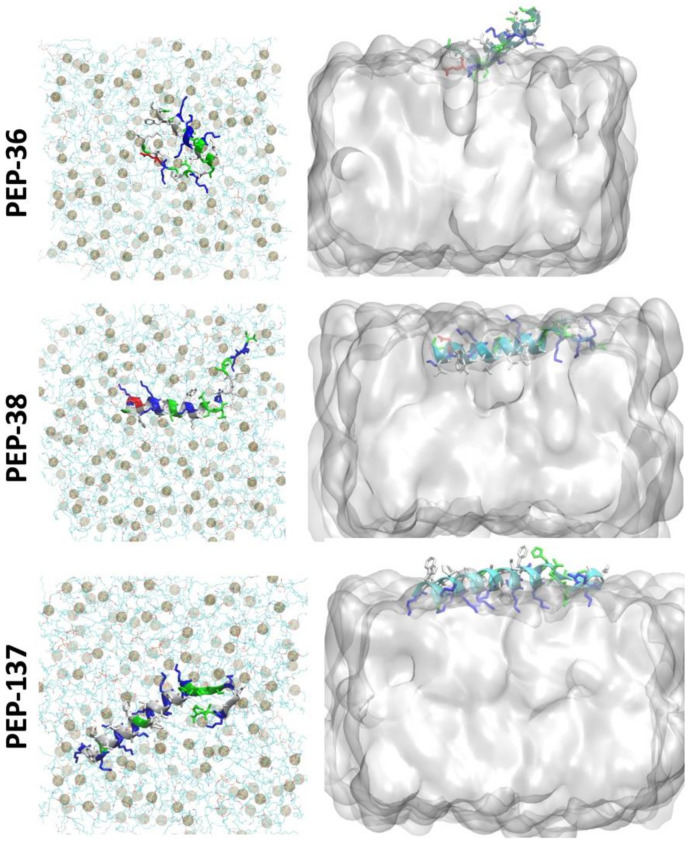
The amino acid sequences of 198 novel peptides were obtained using a generative long short-term memory recurrent neural network (LTSM RNN). To assess their antimicrobial effect, I synthesized 5 out of 198 generated peptides. The PEP-38 and PEP-137 peptides were active in vitro against carbapenem-resistant isolates of Klebsiella aerogenes (n=12) and K. pneumoniae (n=18). PEP-137 was also active against Pseudomonas aeruginosa (n=17). The remaining three peptides (PEP-36, PEP-136 and PEP-174) showed no antibacterial effect. Then I investigated the effect of PEP-38 and PEP-137 (a single intraperitoneal administration of a 100 µg dose 30 min after infection) on animal survival in an experimental murine model of K. pneumoniae-induced sepsis. As a control, I used two groups of mice: one received sterile saline, and the other received inactive in vitro PEP-36 (a single 100 µg dose). The PEP-36 peptide was shown to provide the highest survival rate (66.7%). PEP-137 showed a survival rate of 50%. PEP-38 was found to be ineffective. The data obtained can be used to develop new antibacterial peptide drugs to combat antibiotic resistance.
Overview
The claims and statistics of this paper haven’t been checked yet.
Run the check — free, no account needed. It reads the open-access text and checks the sources it cites.
Integrity signals
Registry
Cites
Statistics
Figures
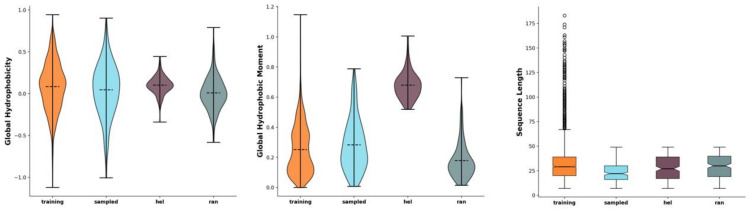
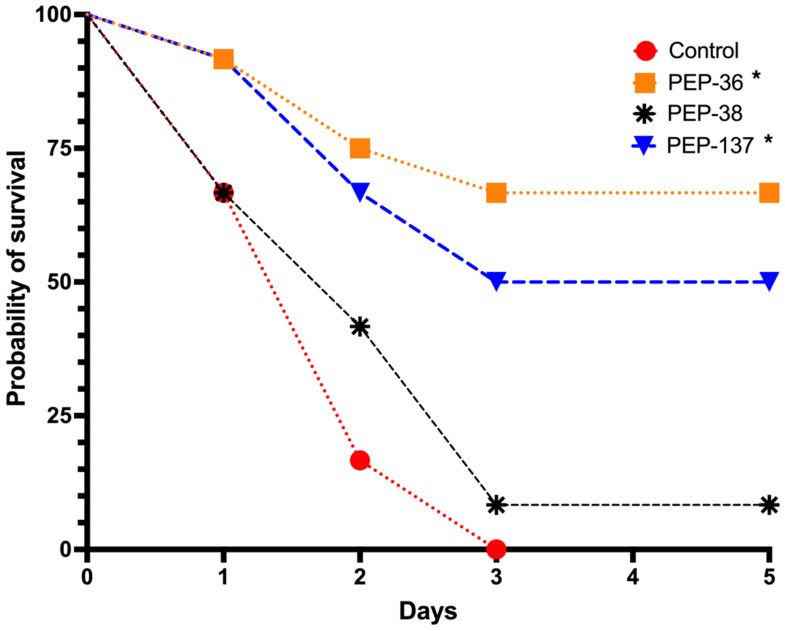
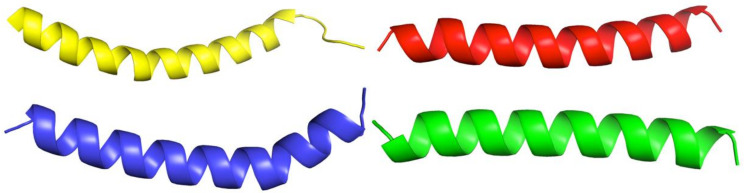
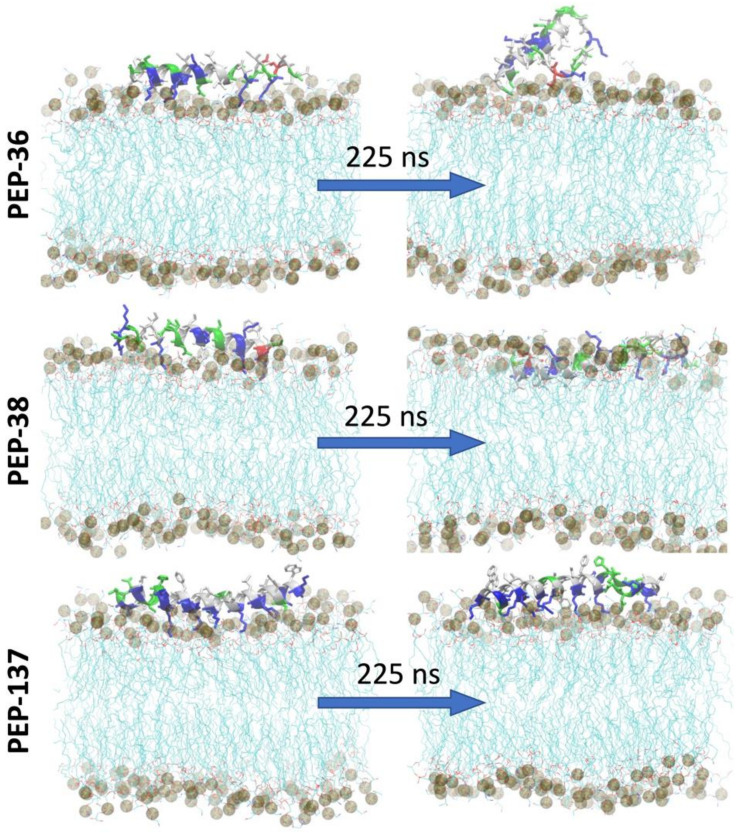
Verification
Claims the paper makes
The claims and statistics of this paper haven’t been checked yet.
Run the check — free, no account needed. It reads the open-access text and checks the sources it cites.
Self-check
Percentages, sums and reported differences re-computed from the paper’s own numbers.
The self-check needs the paper’s full text.
Citations
Cites
Highly accurate protein structure prediction with AlphaFold
Jumper, J., Evans, R., Pritzel, A., Green, T., Figurnov, M., Ronneberger, O., Tunyasuvunakool, K., Bates, R., Žídek, A., Potapenko, A., et al. (2021) · Nature · doi:10.1038/s41586-021-03819-2 · Cited by 43,764
Metadata
- Authors
- Bolatchiev, A.
- Affiliations
- Stavropol State Medical University (RU)
- Corresponding author
- Bolatchiev, Albert
- ORCID
- Bolatchiev, Albert
- Venue
- Antibiotics
- Publisher
- Research Square Platform LLC
- Published
- 2021-12-10
- Volume
- 11
- Issue
- 3
- Pages
- 411-411
- ISSN
- 2079-6382 (ISSN-L)
- PMC
- PMC8944797
- OpenAlex
- W4220710498
- Cited by
- 26
- References
- 1
- Citations by year
- 2026: 5 · 2025: 5 · 2024: 6 · 2023: 7 · 2022: 3
- FWCI
- 3.28
- Type
- journal article
- Language
- en
- Open access
- gold
- doi.org
- Locations
- Antibiotics (publishedVersion, cc-by)
- Research Square (acceptedVersion, cc-by)
- PubMed Central (publishedVersion, cc-by)
- PubMed (publishedVersion)
- DOAJ (DOAJ: Directory of Open Access Journals) (submittedVersion)
- Funders
- Russian Science Foundation (20-75-00004)
- Topics
- Life Sciences › Immunology and Microbiology › Microbiology › Antimicrobial Peptides and Activities
- Life Sciences › Immunology and Microbiology › Applied Microbiology and Biotechnology › Antimicrobial agents and applications
- Physical Sciences › Chemistry › Organic Chemistry › Chemical Synthesis and Analysis
- Keywords
- antimicrobial peptides, de novo peptide design, recurrent neural networks, long short-term memory, antibiotic resistance, carbapenem resistance, Klebsiella pneumoniae, Enterobacter aerogenes, Pseudomonas aeruginosa, sepsis, murine sepsis model, survival rate, antibacterial activity
About these checks
Registry, retraction, Cites and statistics results are computed, not judged, with one exception: a printed reference that no index lists is read once by a model before it counts as a citation error. Claims are extracted by a model and kept only when their quote appears verbatim in the text; each cited source is then checked, with a model’s help, for whether it says what the claim relies on. Those verdicts can be wrong — read the claim’s quote and the cited source before relying on one.
Statistics and arithmetic are recomputed, not judged.
Confidence bands are shown only for fields calibrated on our annotated test set. None is calibrated yet, so no band is shown.
What counts as a claim ›How we measure confidence ›How we check this ›
Are you an author, or do you see a problem with this page? Request a review
Data sources
Bibliographic data: Semantic Scholar, OpenAlex, Crossref.
Contains information from the Semantic Scholar Academic Graph Datasets, made available under the ODC Attribution License (ODC-BY 1.0).
Semantic Scholar’s data is described in: Kinney, R., et al. (2023). The Semantic Scholar Open Data Platform. arXiv:2301.10140.
