

The DOI matches its Crossref record; 1 of the 1 references it cites were found in a registry or an index.
Family Planning Knowledge, Attitudes and Practices Among Rohingya Women Living in Refugee Camps in Bangladesh: A Cross-Sectional Study
Abstract
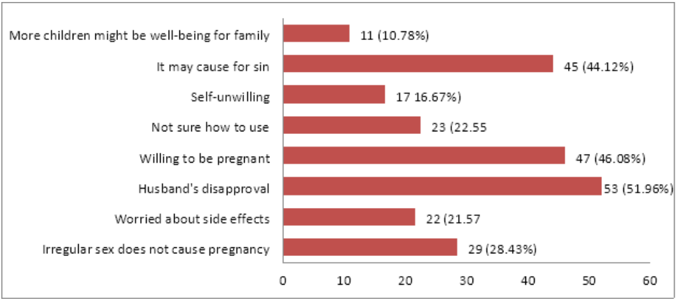
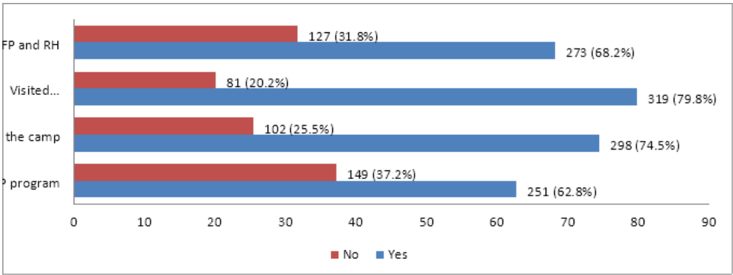
Background: Considering more than 720,000 Rohingya into Bangladesh, unplanned pregnancy, and serious complications of pregnancy among refugees, this study aims to explore the knowledge, attitude, and practice (KAP) of family planning (FP) and associated factors among the Rohingya women living in the refugee camps in Cox’s Bazar, Bangladesh. Methods: Four hundred Rohingya women were investigated, and data were collected using a structured questionnaire, which included socio-demographic characteristics, awareness of contraceptive methods, knowledge, attitudes and practices on FP. Linear regression analysis was performed to identify the predictors of outcome variables. Results: Of the Rohingya refugee women, 60% were unaware that there is no physical harm in adopting a permanent method of birth control. Half of them lack proper knowledge of whether a girl was eligible for marriage before the age of 18. More than two-thirds think family planning methods should not be used without the husband’s permission. Besides, 40% were ashamed and afraid to discuss family planning matters with their husbands, considering it as a sin. Of them, 58% had the opinion that a couple should continue bearing children until a son is born. Linear regression analyses demonstrated that Racidong in Myanmar as the region of residence, being professional, number of children, physician/nurse being the source of FP knowledge, having FP interventions in the camp, participating in a FP program, visiting a health facility, and talking with a health care provider on FP were significantly associated with Rohingya women’s better KAP of FP. Conclusions: The study showed that Rohingya refugee women are a marginalized population in family planning and the comprehensive FP-KAP capability was low. Contraceptives among the Rohingyas are unpopular, mainly due to a lack of education and family planning awareness. In addition, family planning initiatives among Rohingya refugees were limited by some traditional cultural and religious beliefs. Therefore, strengthening FP interventions and increasing the accessibility to essential health services and education are indispensable in order to improve maternal health among refugees.
Overview
The claims and statistics of this paper haven’t been checked yet.
Run the check — free, no account needed. It reads the open-access text and checks the sources it cites.
Integrity signals
Registry
Cites
Statistics
Figures
Verification
Claims the paper makes
The claims and statistics of this paper haven’t been checked yet.
Run the check — free, no account needed. It reads the open-access text and checks the sources it cites.
Claims other papers make about this one
Each is checked against this paper’s own text: does it say what the citing paper says it does?
The source backs part of the claim, not all of it — or backs it for a different population, condition or comparison.
In the citing paper
“Previous studies have primarily concentrated on addressing the challenges and proposing potential solutions to enhance the limited availability of safe maternity care for pregnant women in the refugee camps (Ainul et al., 2018; Azad et al., 2021; Chowdhury et al., 2018; Hossain and Dawson, 2021; Islam et al., 2021; Islam et al., 2022; Jannat et al., 2022; Sarker et al., 2020).”
From Exploring the impact of preconception care and unintended pregnancy on access to antenatal healthcare services among Rohingya women: Insights from a cross-sectional survey (2024) · cites this paper as Azad et al., 2021
Experimental — accuracy not yet measured
Self-check
Percentages, sums and reported differences re-computed from the paper’s own numbers.
The self-check needs the paper’s full text.
Citations
Cites
Ainul, S., Ehsan, I., Haque, E., Amin, S., Rob, U., Melnikas, A., & Falcone, J. (2018) · doi:10.31899/pgy7.1022 · Cited by 42
Research works printed but not linked: 6
- Melnikas, A. J., Ainul, S., Ehsan, I., Haque, E., & Amin, S. (2020). Child marriage practices among the Rohingya in Bangladesh. Con ict and Health, 14(1), 1-12. https://doi.org/10.1186/s13031-020-00274-0 · DOI
- Save the Children. (2019, June 03). 3 in 4 Rohingya Refugee Babies are Born in Unsanitary Bamboo Shelters. Save the Children. https://www.savethechildren.org/us/about-us/media-and-news/2019-press-releases/rohingya-refugee-babies-born-unsanitary-shelters
- Ahmed, R., Aktar, B., Farnaz, N., Ray, P., Awal, A., Hassan, R., … Kobeissi, L.H.(2020). Challenges and strategies in conducting sexual and reproductive health research among Rohingya refugees in Cox's Bazar, Bangladesh. Con ict and Health, 14(1),1-8. https://doi.org/10.1186/s13031-020-00329-2 · DOI
- Tanabe, M., Myers, A., Bhandari, P., Cornier, N., Doraiswamy, S., & Krause, S. (2017). Family planning in refugee settings: ndings and actions from a multi-country study. Con ict and health, 11(1), 9. https://doi.org/10.1186/s13031-017-0112-2 · DOI
- Bangladesh Journal. (2019, May 16). Rohingyas have more children at home to increase strength. https://www.bd- journal.com/bangladesh/72869
- Rogers, E. M. (1973). Communication Strategies for Family Planning. New York: Free Press.
Cited by
Barriers to male condom use in Rohingya refugee camps in Bangladesh: A qualitative study
Islam, M. M., Rahman, M. M., & Khan, M. N. (2022) · The Lancet Regional Health - Southeast Asia · doi:10.1016/j.lansea.2022.04.004 · Cited by 13
Khan, M. N., Khanam, S. J., & Alam, M. B. (2024) · Journal of Migration and Health · doi:10.1016/j.jmh.2024.100213 · Cited by 10
Metadata
- Authors
- Azad, M. A. K., Zakaria, M., Nachrin, T., Das, M. C., Cheng, F., & Xu, J.
- Affiliations
- University of Chittagong
- University of Louisiana at Lafayette
- Tsinghua University
- Zhejiang University
- Publisher
- Research Square Platform LLC
- Published
- 2021-12-28
- Cited by
- 1
- References
- 1
- Type
- Preprint
About these checks
Registry, retraction, Cites and statistics results are computed, not judged, with one exception: a printed reference that no index lists is read once by a model before it counts as a citation error. Claims are extracted by a model and kept only when their quote appears verbatim in the text; each cited source is then checked, with a model’s help, for whether it says what the claim relies on. Those verdicts can be wrong — read the claim’s quote and the cited source before relying on one.
Statistics and arithmetic are recomputed, not judged.
Confidence bands are shown only for fields calibrated on our annotated test set. None is calibrated yet, so no band is shown.
What counts as a claim ›How we measure confidence ›How we check this ›
Are you an author, or do you see a problem with this page? Request a review
Data sources
Bibliographic data: Semantic Scholar, OpenAlex, Crossref.
Contains information from the Semantic Scholar Academic Graph Datasets, made available under the ODC Attribution License (ODC-BY 1.0).
Semantic Scholar’s data is described in: Kinney, R., et al. (2023). The Semantic Scholar Open Data Platform. arXiv:2301.10140.
