

The DOI matches its Crossref record; 1 of the 1 references it cites were found in a registry or an index.
A single amino acid change can alter the specificity of the multi-allelic wheat stem rust resistance locus SR9
Open accessPreprint — published as 10.1038/s41467-023-42747-9 · Paper page
Abstract
Most resistance genes thus far isolated from wheat have a very limited number of functional alleles, with the exception of the powdery mildew PM3 resistance locus. Here we report the isolation of most of the alleles at wheat stem rust resistance gene locus SR9, representing the largest multi-allelic rust resistance locus in common wheat. The seven previously reported resistance alleles (Sr9a, Sr9b, Sr9d, Sr9e, Sr9f, Sr9g, and Sr9h) at the locus were characterised using a synergistic strategy. Loss-of-function mutants and/or transgenic complementation were used to confirm Sr9b, two haplotypes of Sr9e (Sr9e_h1, Sr9e_h2), Sr9g, and Sr9h. Each allele encodes a highly related nucleotide-binding site leucine-rich repeat (NB-LRR) type immune receptor, containing a previously unreported motif at their N termini and an unusual long LRR domain, that confers resistance to a unique spectrum of isolates of the wheat stem rust pathogen. The only SR9 protein effective against stem rust pathogen race TTKSK (Ug99), SR9H, differed from SR9B by a single amino acid. SR9B and SR9G resistance proteins were also distinguished by only a single amino acid. The SR9 allelic series found in the B subgenome are orthologs of wheat stem rust resistance gene Sr21 located in the A subgenome with around 85% identity in protein sequences.
Overview
The claims and statistics of this paper haven’t been checked yet.
Run the check — free, no account needed. It reads the open-access text and checks the sources it cites.
Integrity signals
Registry
Cites
Statistics
Figures
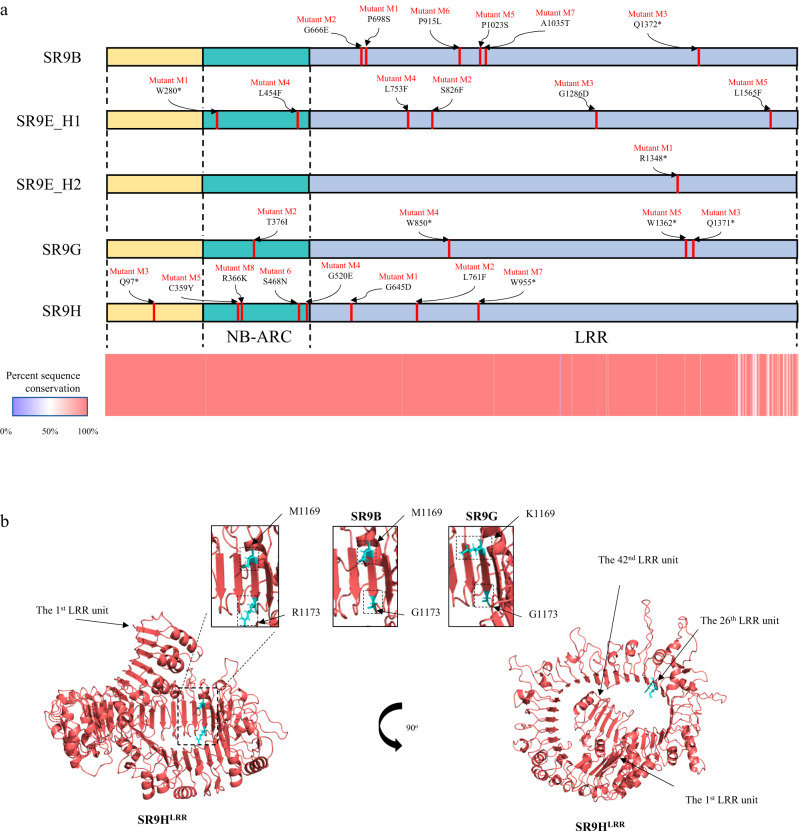
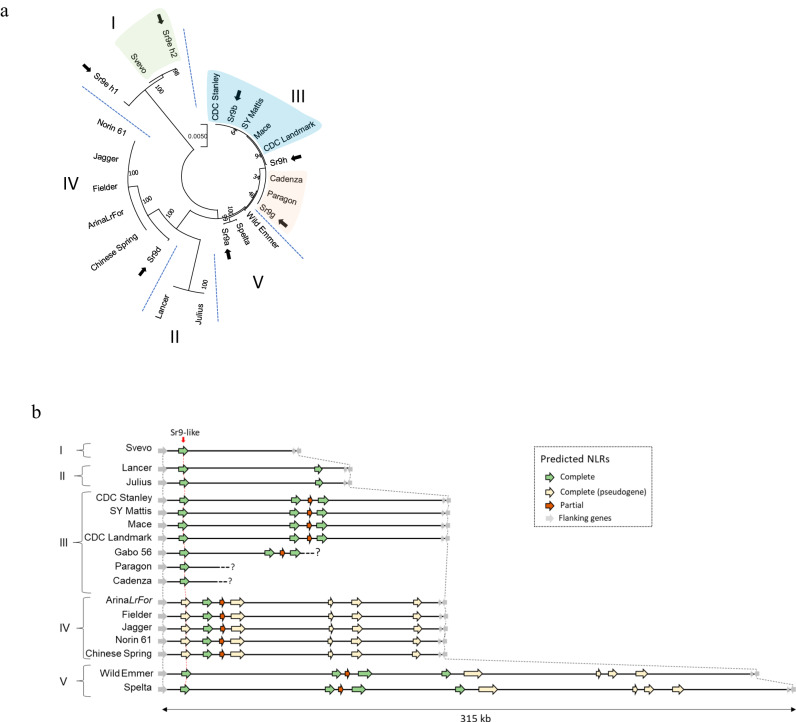
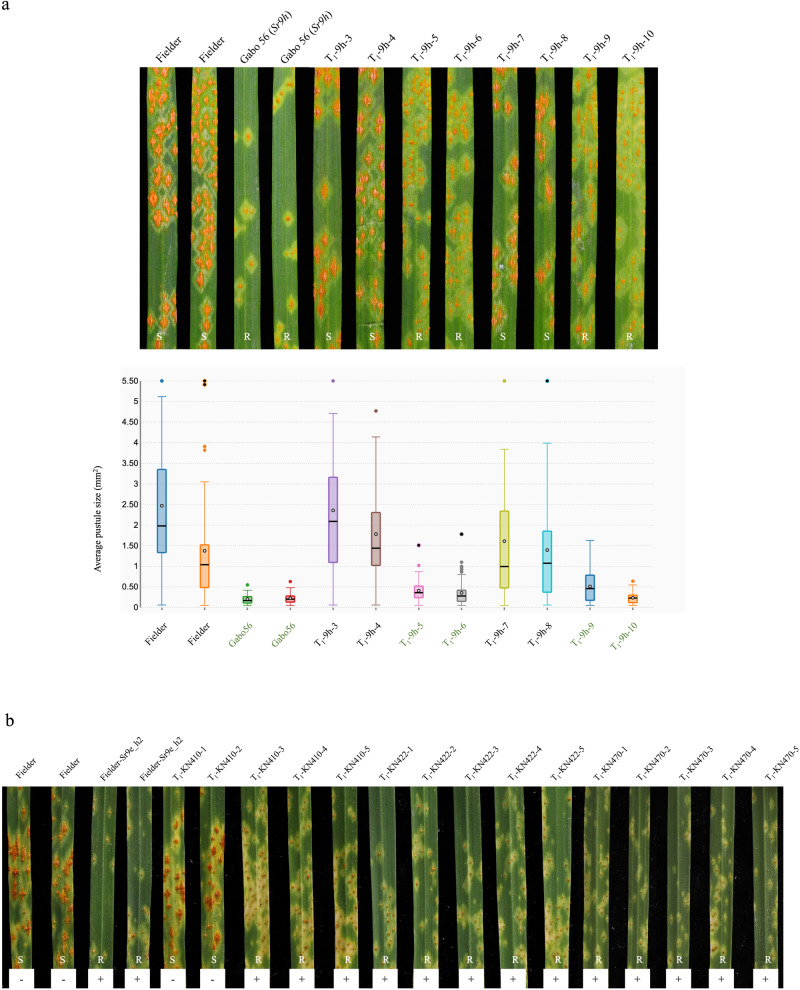
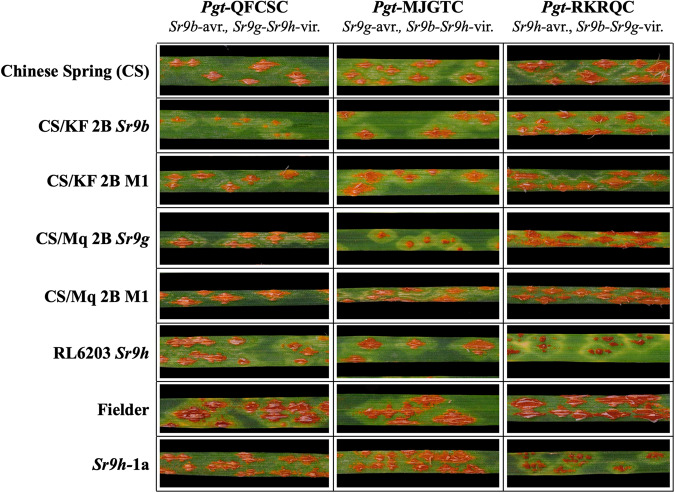
Verification
Claims the paper makes
The claims and statistics of this paper haven’t been checked yet.
Run the check — free, no account needed. It reads the open-access text and checks the sources it cites.
Self-check
Percentages, sums and reported differences re-computed from the paper’s own numbers.
The self-check needs the paper’s full text.
Citations
Cites
Highly accurate protein structure prediction with AlphaFold
Jumper, J., Evans, R., Pritzel, A., Green, T., Figurnov, M., Ronneberger, O., Tunyasuvunakool, K., Bates, R., Žídek, A., Potapenko, A., et al. (2021) · Nature · doi:10.1038/s41586-021-03819-2 · Cited by 43,764
Metadata
- Authors
- Zhang, J., Nirmala, J., Chen, S., Jost, M., Steuernagel, B., Karafiátová, M., Hewitt, T., Li, H., Edae, E., Sharma, K., Hoxha, S., Bhatt, D., Antoniou-Kourounioti, R., Dodds, P., Wulff, B., Doležel, J., Ayliffe, M., Hiebert, C., McIntosh, R., Dubcovsky, J., Zhang, P., Rouse, M., & Lagudah, E.
- Affiliations
- Commonwealth Scientific and Industrial Research Organisation (AU)
- University of Minnesota (US)
- Peking University (CN)
- John Innes Centre (GB)
- Institute of Experimental Botany, Centre of the Region Haná for Biotechnological and Agricultural Research
- CSIRO Agriculture and Food, Canberra, ACT
- Agricultural Research Service (US)
- The University of Sydney (AU)
- University of Glasgow (GB)
- King Abdullah University of Science and Technology (SA)
- Czech Academy of Sciences, Institute of Experimental Botany (CZ)
- Agriculture and Agri-Food Canada (CA)
- Howard Hughes Medical Institute (US)
- Corresponding author
- Zhang, Peng
- Rouse, Matthew
- Lagudah, Evans
- ORCID
- Zhang, Jianping
- Nirmala, Jayaveeramuthu
- Chen, Shisheng
- Jost, Matthias
- Steuernagel, Burkhard
- Karafiátová, Miroslava
- Hewitt, Timothy
- Li, Hongna
- Edae, Erena
- Sharma, Keshav
- Bhatt, Dhara
- Antoniou-Kourounioti, Rea
- Dodds, Peter
- Wulff, Brande
- Doležel, Jaroslav
- Ayliffe, Michael
- Hiebert, Colin
- McIntosh, Robert
- Dubcovsky, Jorge
- Zhang, Peng
- Rouse, Matthew
- Lagudah, Evans
- Venue
- Nature Communications
- Published
- 2022-10-31
- Volume
- 14
- Issue
- 1
- Pages
- 7354-7354
- ISSN
- 2041-1723 (ISSN-L)
- PMC
- PMC10645757
- OpenAlex
- W4388655723
- Cited by
- 19
- References
- 1
- Citations by year
- 2026: 2 · 2025: 11 · 2024: 4 · 2023: 2
- FWCI
- 2.98
- Type
- journal article
- Language
- en
- Open access
- gold
- doi.org
- Locations
- Nature Communications (publishedVersion, cc-by)
- Research Square (acceptedVersion, cc-by)
- PubMed Central (publishedVersion, cc-by)
- PubMed (publishedVersion)
- ENLIGHTEN (Jurnal Bimbingan dan Konseling Islam) (submittedVersion, cc-by)
- eScholarship (California Digital Library) (submittedVersion, cc-by)
- RePEc: Research Papers in Economics (submittedVersion)
- DOAJ (DOAJ: Directory of Open Access Journals) (submittedVersion, cc-by-sa)
- King Abdullah University of Science and Technology Repository (King Abdullah University of Science and Technology) (submittedVersion, cc-by)
- Funders
- Howard Hughes Medical Institute
- U.S. Department of Agriculture (2022-68013-36439)
- Bill and Melinda Gates Foundation
- Commonwealth Scientific and Industrial Research Organisation
- Grains Research and Development Corporation
- Canada Excellence Research Chairs, Government of Canada
- Natural Science Foundation of Shandong Province (ZR2021ZD30, ZR2021MC056)
- Directorate for Biological Sciences
- National Institute of Food and Agriculture (2022‐68013‐36439)
- Agricultural Research Service (2022-68013-36439)
- Biotechnology and Biological Sciences Research Council (BBS/E/J/000PR9780)
- Topics
- Life Sciences › Agricultural and Biological Sciences › Plant Science › Wheat and Barley Genetics and Pathology
- Life Sciences › Agricultural and Biological Sciences › Plant Science › Plant Disease Resistance and Genetics
- Life Sciences › Agricultural and Biological Sciences › Plant Science › Plant-Microbe Interactions and Immunity
- Keywords
- wheat stem rust, Puccinia striiformis, resistance alleles, leucine-rich repeats, Ug99, loss-of-function mutants, transgenic complementation, haplotypes, plant disease resistance
- MeSH terms
- Alleles, Amino Acid Sequence, Basidiomycota, Chromosome Mapping, Haplotypes, Plant Diseases, Disease Resistance
About these checks
Registry, retraction, Cites and statistics results are computed, not judged, with one exception: a printed reference that no index lists is read once by a model before it counts as a citation error. Claims are extracted by a model and kept only when their quote appears verbatim in the text; each cited source is then checked, with a model’s help, for whether it says what the claim relies on. Those verdicts can be wrong — read the claim’s quote and the cited source before relying on one.
Statistics and arithmetic are recomputed, not judged.
Confidence bands are shown only for fields calibrated on our annotated test set. None is calibrated yet, so no band is shown.
What counts as a claim ›How we measure confidence ›How we check this ›
Are you an author, or do you see a problem with this page? Request a review
