

AttSec: protein secondary structure prediction by capturing local patterns from attention map
Open accessPreprint — published as 10.1186/s12859-023-05310-3
The DOI matches its Crossref record; 1 of the 1 references it cites were found in a registry or an index.
Abstract
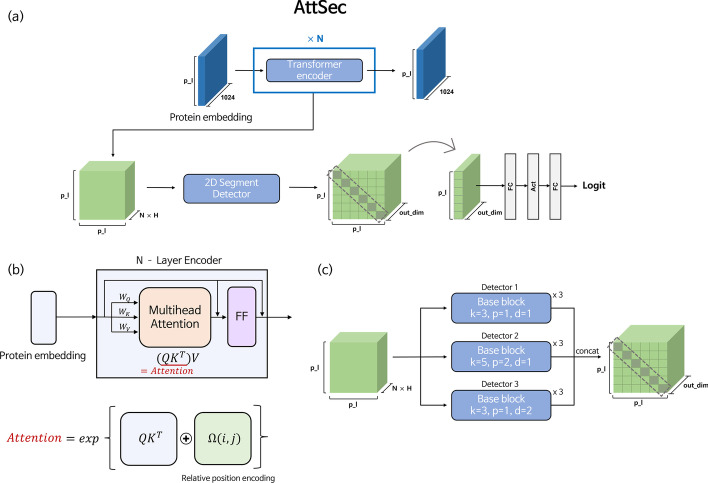
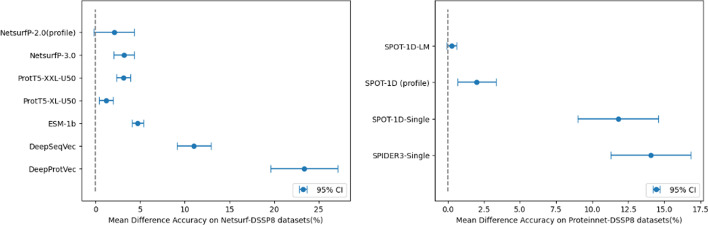
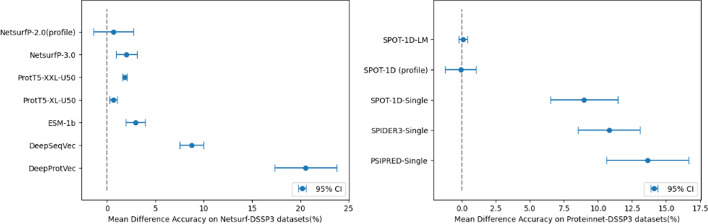
Background: Protein secondary structures that link simple 1D sequences to complex 3D structures can be used as good features for describing the local properties of protein, but also can serve as key features for predicting the complex 3D structures of protein. Thus, it is very important to accurately predict the secondary structure of the protein, which contains a local structural property assigned by the pattern of hydrogen bonds formed between amino acids. In this study, we accurately predict protein secondary structure by capturing the local patterns of protein. For this objective, we present a novel prediction model, AttSec, based on transformer architecture. In particular, AttSec extracts self-attention maps corresponding to pairwise features between amino acid embeddings and passes them through 2D convolution blocks to capture local patterns. In addition, instead of using additional evolutionary information, it uses protein embedding as an input, which is generated by a language model. Results: For the ProteinNet DSSP8 dataset, our model showed 11.8% better performance on the entire evaluation datasets compared with other no-evolutionary-information-based models. For the NetSurfP-2.0 DSSP8 dataset, it showed 0.8% better performance on average. There was an average performance improvement of 9.0% for the ProteinNet DSSP3 dataset and an average of 0.18% for the NetSurfP-2.0 DSSP3 dataset. Conclusion: We accurately predict protein secondary structure by capturing the local patterns of protein. For this objective, we present a novel prediction model, AttSec, based on transformer architecture.Although there was no dramatic accuracy improvement compared with other models, the improvement on DSSP8 was greater than that on DSSP3. This result implies that using our proposed pairwise feature could have a remarkable effect for several challenging tasks that require finely subdivided classification. Github package URL is https://github.com/youjin-DDAI/AttSec.
Overview
The claims and statistics of this paper haven’t been checked yet.
Free: it reads the open-access text and checks the first 5 claims that cite a source we can check. Create a free account to check every claim.
Integrity signals
Registry
Cites
Statistics
Figures
Verification
Claims the paper makes
The claims and statistics of this paper haven’t been checked yet.
Free: it reads the open-access text and checks the first 5 claims that cite a source we can check. Create a free account to check every claim.
Self-check
Percentages, sums and reported differences re-computed from the paper’s own numbers.
The self-check needs the paper’s full text.
Citations
Cites
Highly accurate protein structure prediction with AlphaFold
Jumper, J., Evans, R., Pritzel, A., Green, T., Figurnov, M., Ronneberger, O., Tunyasuvunakool, K., Bates, R., Žídek, A., Potapenko, A., et al. (2021) · Nature · doi:10.1038/s41586-021-03819-2 · Cited by 43,764
Metadata
- Authors
- Kim, Y., & Kwon, J.
- Affiliations
- Chung-Ang University
- Chung-Ang University (KR)
- Corresponding author
- Kwon, Junseok
- ORCID
- Kwon, Junseok
- Venue
- BMC Bioinformatics
- Publisher
- Research Square Platform LLC
- Published
- 2023-01-10
- Volume
- 24
- Issue
- 1
- Pages
- 183-183
- ISSN
- 1471-2105 (ISSN-L)
- PMC
- PMC10161504
- OpenAlex
- W4368364781
- Cited by
- 16
- References
- 1
- Citations by year
- 2026: 1 · 2025: 5 · 2024: 10
- FWCI
- 1.41
- Type
- journal article
- Language
- en
- Open access
- gold
- doi.org
- Locations
- BMC Bioinformatics (publishedVersion, cc-by)
- Research Square (acceptedVersion, cc-by)
- PubMed Central (publishedVersion, cc-by)
- PubMed (publishedVersion)
- DOAJ (DOAJ: Directory of Open Access Journals) (submittedVersion, cc-by-sa)
- Funders
- Ministry of Science and ICT, South Korea (2021‐0‐01341)
- Institute for Information and Communications Technology Promotion (2021-0-01341)
- Topics
- Life Sciences › Biochemistry, Genetics and Molecular Biology › Molecular Biology › Protein Structure and Dynamics
- Life Sciences › Biochemistry, Genetics and Molecular Biology › Molecular Biology › Machine Learning in Bioinformatics
- Life Sciences › Biochemistry, Genetics and Molecular Biology › Structural Biology › Enzyme Structure and Function
- Keywords
- secondary structure prediction, self-attention maps, transformer models, protein embeddings, language model embeddings, DSSP
- MeSH terms
- Amino Acids, Proteins, Protein Structure, Secondary
About these checks
Registry, retraction, Cites and statistics results are computed, not judged, with one exception: a printed reference that no index lists is read once by a model before it counts as a citation error. Claims are extracted by a model and kept only when their quote appears verbatim in the text; each cited source is then checked, with a model’s help, for whether it says what the claim relies on. Those verdicts can be wrong — read the claim’s quote and the cited source before relying on one.
Statistics and arithmetic are recomputed, not judged.
Confidence bands are shown only for fields calibrated on our annotated test set. None is calibrated yet, so no band is shown.
What counts as a claim ›How we measure confidence ›How we check this ›
Are you an author, or do you see a problem with this page? Request a review
How to cite
Cite CoChat for the checks on this page, and the paper for its own findings.
- This page
- CoChat. (2026). Citation check: AttSec: protein secondary structure prediction by capturing local patterns from attention map. https://app.cochat.ai/papers/10.21203/rs.3.rs-2433490/v1
- The paper
- Kim, Y., & Kwon, J. (2023). AttSec: protein secondary structure prediction by capturing local patterns from attention map. BMC Bioinformatics. https://doi.org/10.21203/rs.3.rs-2433490/v1
Data sources
Bibliographic data: Semantic Scholar, OpenAlex, Crossref.
Contains information from the Semantic Scholar Academic Graph Datasets, made available under the ODC Attribution License (ODC-BY 1.0).
Semantic Scholar’s data is described in: Kinney, R., et al. (2023). The Semantic Scholar Open Data Platform. arXiv:2301.10140.
