

GPRC Molecular Dynamics Forecasting using Recurrent Neural Networks
Open accessPreprint — published as 10.1038/s41598-023-48346-4 · Paper page
The DOI matches its Crossref record; 1 of the 1 references it cites were found in a registry or an index.
Abstract
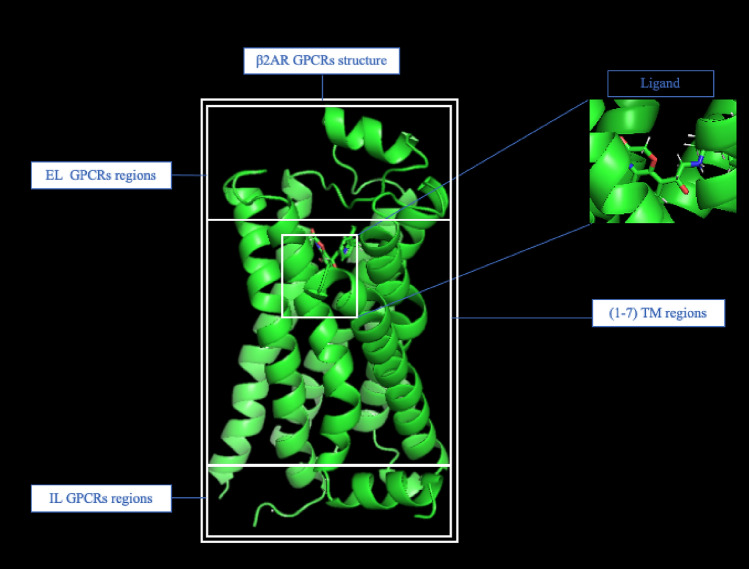
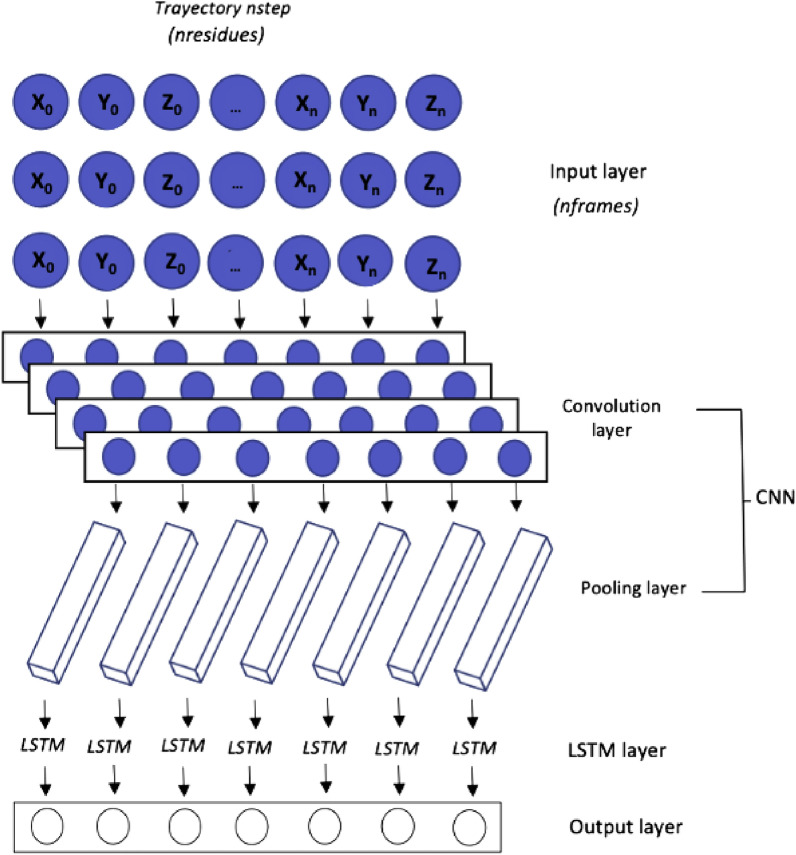
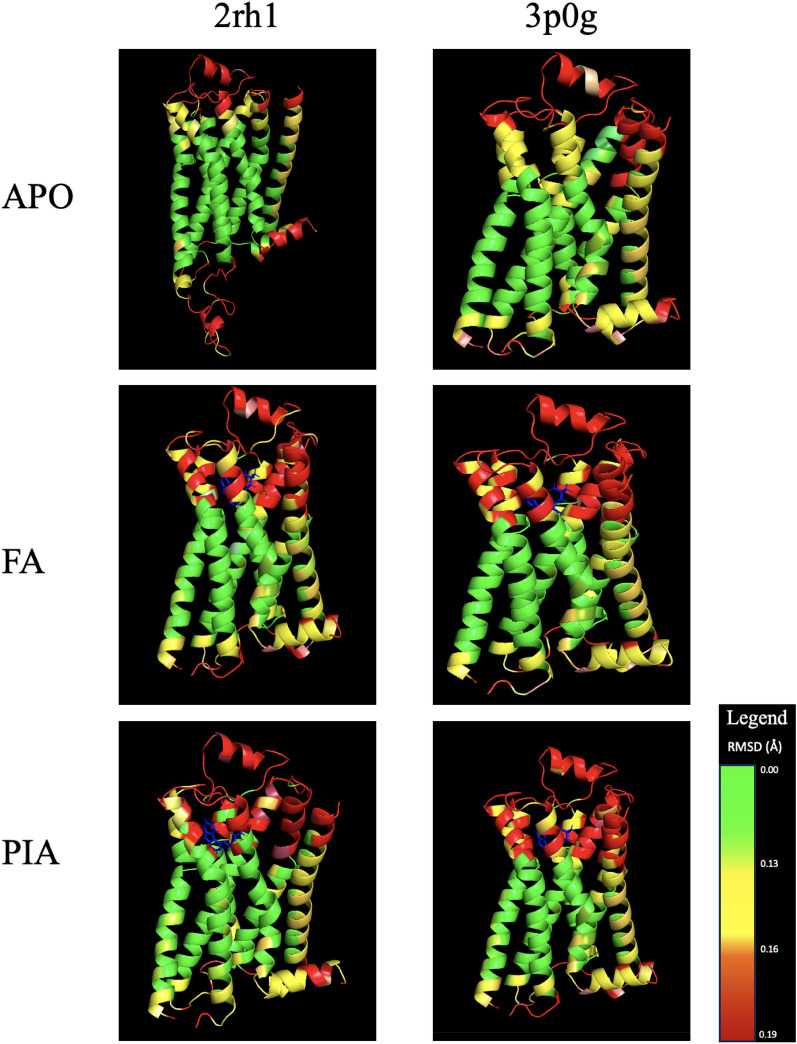
G protein-coupled receptors (GPCRs) are a large super-family of cell membrane proteins that play an important physiological role as transmitters of extra-cellular signals.Signal transmission through the cell membrane depends upon conformational changes in the transmembrane region of the receptor, which makes the investigation of the dynamics in these regions particularly relevant.Molecular dynamics simulations can provide information about the conformational states of the receptor at the atom level and Machine Learning methods can be useful tools for knowledge discovery from this information. In this paper, Recurrent and Convolutional Neural Networks are used to predict the molecular dynamics of GPCRs in different conformations, using the \textbeta 2AR GPRC as an illustration of the process and focusing on specific receptor regions.Active and inactive states of the GPRC are analysed in six scenarios involving APO, Full Agonist (BI-167107) and Partial Inverse Agonist (carazolol) of the receptor. Three Machine Learning models with increasing complexity in terms of neural network architecture are evaluated and their results compared.Results show that the transmembrane helices are the regions whose dynamics are best predicted by these models.
Overview
The claims and statistics of this paper haven’t been checked yet.
Free: it reads the open-access text and checks the first 5 claims that cite a source we can check. Create a free account to check every claim.
Integrity signals
Registry
Cites
Statistics
Figures
Verification
Claims the paper makes
The claims and statistics of this paper haven’t been checked yet.
Free: it reads the open-access text and checks the first 5 claims that cite a source we can check. Create a free account to check every claim.
Self-check
Percentages, sums and reported differences re-computed from the paper’s own numbers.
The self-check needs the paper’s full text.
Citations
Cites
Highly accurate protein structure prediction with AlphaFold
Jumper, J., Evans, R., Pritzel, A., Green, T., Figurnov, M., Ronneberger, O., Tunyasuvunakool, K., Bates, R., Žídek, A., Potapenko, A., et al. (2021) · Nature · doi:10.1038/s41586-021-03819-2 · Cited by 43,764
Metadata
- Authors
- López-Correa, J. M., König, C., & Vellido, A.
- Affiliations
- Universitat Politècnica de Catalunya (ES)
- Corresponding author
- Vellido, Alfredo
- Venue
- Scientific Reports
- Publisher
- Research Square Platform LLC
- Published
- 2023-05-08
- Volume
- 13
- Issue
- 1
- Pages
- 20995-20995
- ISSN
- 2045-2322 (ISSN-L)
- PMC
- PMC10684758
- OpenAlex
- W4389077996
- Cited by
- 16
- References
- 1
- Citations by year
- 2026: 7 · 2025: 9
- FWCI
- 1.43
- Type
- journal article
- Language
- en
- Open access
- gold
- doi.org
- Locations
- Scientific Reports (publishedVersion, cc-by)
- Research Square (acceptedVersion, cc-by)
- PubMed Central (publishedVersion, cc-by)
- PubMed (publishedVersion)
- UPCommons institutional repository (Universitat Politècnica de Catalunya) (submittedVersion, cc-by-nc-nd)
- DOAJ (DOAJ: Directory of Open Access Journals) (submittedVersion, cc-by-sa)
- Funders
- Ministerio de Ciencia e Innovación (PID2019-104551RB-I00, PRE2020-092428, PID2019, PID2022)
- Topics
- Life Sciences › Biochemistry, Genetics and Molecular Biology › Molecular Biology › Receptor Mechanisms and Signaling
- Life Sciences › Biochemistry, Genetics and Molecular Biology › Molecular Biology › Protein Structure and Dynamics
- Life Sciences › Pharmacology, Toxicology and Pharmaceutics › Drug Discovery › Computational Drug Discovery Methods
- Keywords
- G protein-coupled receptors, recurrent neural networks, LSTM, transmembrane helices, receptor activation, agonist binding, inverse agonists, carazolol, protein conformational dynamics
- MeSH terms
- Neural Networks, Computer, Protein Structure, Secondary, Receptors, G-Protein-Coupled, Drug Inverse Agonism, Molecular Dynamics Simulation
About these checks
Registry, retraction, Cites and statistics results are computed, not judged, with one exception: a printed reference that no index lists is read once by a model before it counts as a citation error. Claims are extracted by a model and kept only when their quote appears verbatim in the text; each cited source is then checked, with a model’s help, for whether it says what the claim relies on. Those verdicts can be wrong — read the claim’s quote and the cited source before relying on one.
Statistics and arithmetic are recomputed, not judged.
Confidence bands are shown only for fields calibrated on our annotated test set. None is calibrated yet, so no band is shown.
What counts as a claim ›How we measure confidence ›How we check this ›
Are you an author, or do you see a problem with this page? Request a review
How to cite
Cite CoChat for the checks on this page, and the paper for its own findings.
- This page
- CoChat. (2026). Citation check: GPRC Molecular Dynamics Forecasting using Recurrent Neural Networks. https://app.cochat.ai/papers/10.21203/rs.3.rs-2814141/v1
- The paper
- López-Correa, J. M., König, C., & Vellido, A. (2023). GPRC Molecular Dynamics Forecasting using Recurrent Neural Networks. Scientific Reports. https://doi.org/10.21203/rs.3.rs-2814141/v1
Data sources
Bibliographic data: Semantic Scholar, OpenAlex, Crossref.
Contains information from the Semantic Scholar Academic Graph Datasets, made available under the ODC Attribution License (ODC-BY 1.0).
Semantic Scholar’s data is described in: Kinney, R., et al. (2023). The Semantic Scholar Open Data Platform. arXiv:2301.10140.
