CoChat

Structural and functional analysis of hyper thermostable ancestral L-amino acid oxidase that can convert Trp derivatives to D-forms by chemo-enzymatic reaction

Open access

Preprint — published as 10.1038/s42004-023-01005-1

The DOI matches its Crossref record; 1 of the 1 references it cites were found in a registry or an index.

Abstract

Establishing a reaction system to produce D-amino acids (D-AAs) on a large-scale has been required for now. In this study, we designed a novel L-amino acid oxidase, HTAncLAAO2, by ancestral sequence reconstruction, exhibiting high thermostability and long-term stability. The crystal structure of HTAncLAAO2 was determined at 2.2 Å by X-ray crystallography, revealing that the enzyme has an octameric form like a "ninja-star" feature. Enzymatic property analysis demonstrated that HTAncLAAO2 exhibits three-order larger kcat/Km values towards four L-AAs (L-Phe, L-Leu, L-Met, and L-Ile) than that of L-Trp. Through screening the variants, we obtained the HTAncLAAO2(W220A) variant, which shows >6-fold increase in kcat value toward L-Trp compared to the original enzyme. This variant applies to synthesizing enantio-pure D-Trp derivatives from L- or rac-forms at a preparative scale. Given its excellent properties, HTAncLAAO2 would be a starting point for designing novel oxidases with high activity toward various amines and AAs.

Overview

The claims and statistics of this paper haven’t been checked yet.

Free: it reads the open-access text and checks the first 5 claims that cite a source we can check. Create a free account to check every claim.

A few free checks a day · papers already verified open instantly · results are public

Integrity signals

Registry

Crossref · 10.21203/rs.3.rs-2969058/v1

Cites

1 of 1 references verified0 citation errors · 0 not checkable

Statistics

Figures

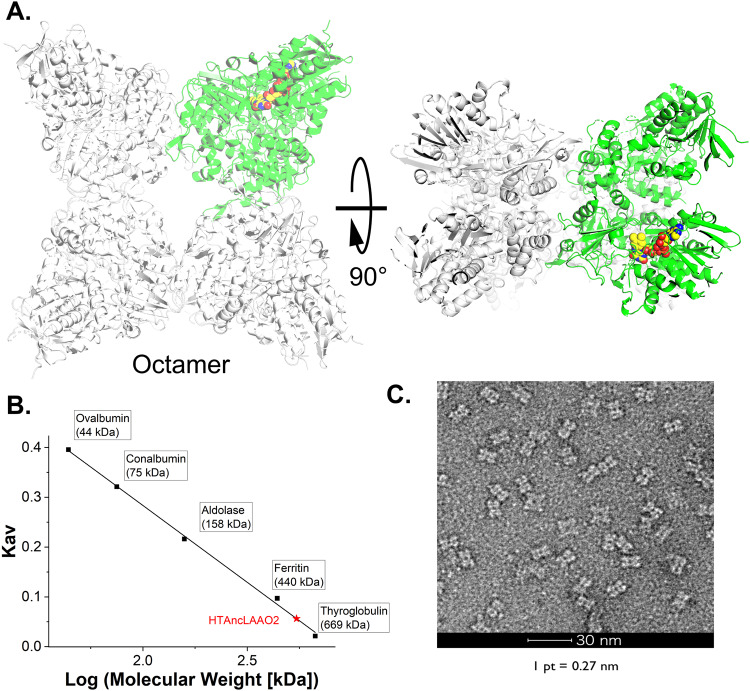
Fig. 1 Structural analysis of HTAncLAAO2. A As shown in the figure, the HTAncLAAO2 forms octamer in the crystal. B Size-exclusion chromatography analysis of HTAncLAAO2. According to the calibration curve, the molecular weight of HTAncLAAO2 was calculated as 544.4 kDa. The molecular weight of the monomer form of HTAncLAAO2 is 63 kDa. C Negative stain EM of HTAncLAAO2.
Fig. 1 Structural analysis of HTAncLAAO2. A As shown in the figure, the HTAncLAAO2 forms octamer in the crystal. B Size-exclusion chromatography analysis of HTAncLAAO2. According to the calibration curve, the molecular weight of HTAncLAAO2 was calculated as 544.4 kDa. The molecular weight of the monomer form of HTAncLAAO2 is 63 kDa. C Negative stain EM of HTAncLAAO2.CC BY · PubMed Central
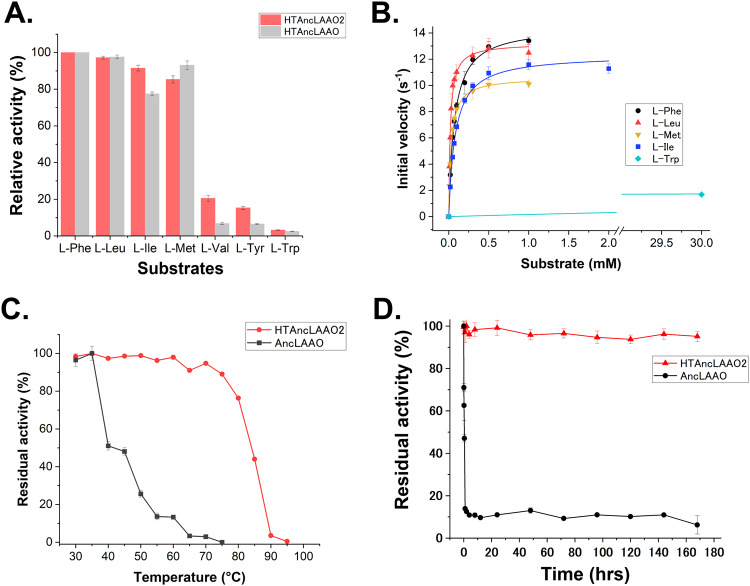
Fig. 2 Enzyme functional analysis of HTAncLAAO2. A The specific activity of HTAncLAAOs toward seven L-amino acids. The relative activity was calculated by normalizing the parameter of L-Phe to 100%. The activity for HTAncLAAO and HTAncLAAO2 was represented as gray and red bar, respectively. B Enzyme kinetic plots of HTAncLAAO2. The initial velocity of HTAncLAAO2 toward L-Phe, L-Leu, L-Met, L-Ile, and L-Trp are shown as a black circle, red upward triangle, orange downward triangle, blue square, and light blue diamond, respectively. The parameters are shown in Table 1. The data are shown as the mean ± SD. C, D Temperature-dependent activity change and long-term thermostability of HTAncLAAO2. Residual activity was calculated by normalizing each sample’s highest activity to 100%. The activities of HTAncLAAO2 and AncLAAO are plotted as red circles and black squares, respectively.
Fig. 2 Enzyme functional analysis of HTAncLAAO2. A The specific activity of HTAncLAAOs toward seven L-amino acids. The relative activity was calculated by normalizing the parameter of L-Phe to 100%. The activity for HTAncLAAO and HTAncLAAO2 was represented as gray and red bar, respectively. B Enzyme kinetic plots of HTAncLAAO2. The initial velocity of HTAncLAAO2 toward L-Phe, L-Leu, L-Met, L-Ile, and L-Trp are shown as a black circle, red upward triangle, orange downward triangle, blue square, and light blue diamond, respectively. The parameters are shown in Table 1. The data are shown as the mean ± SD. C, D Temperature-dependent activity change and long-term thermostability of HTAncLAAO2. Residual activity was calculated by normalizing each sample’s highest activity to 100%. The activities of HTAncLAAO2 and AncLAAO are plotted as red circles and black squares, respectively.CC BY · PubMed Central
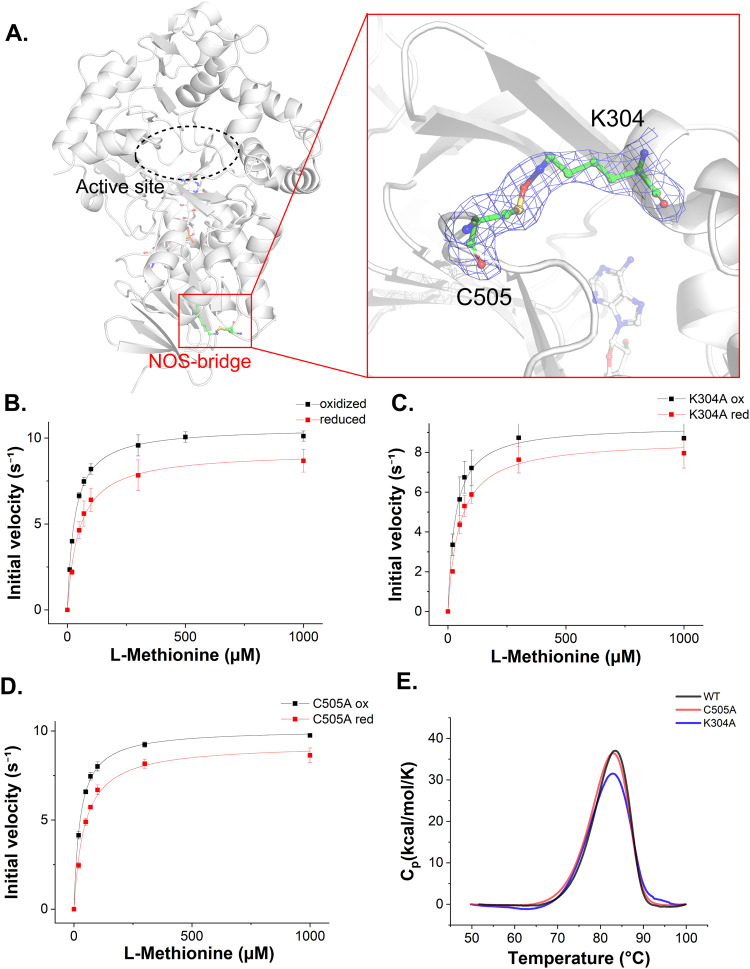
Fig. 3 Structural and functional analysis of NOS-bridge in the HTAncLAAO2. A Electron density map of the NOS-bridge. As shown in the 2Fo-Fc electron density map, which is contoured at 1.0 σ, K304, and C505 formed the bridge. B–D Enzyme kinetic plots of HTAncLAAO2 (B), K304A (C), and C505A variants (D) toward L-Met. The initial velocities were measured under the conditions with (red square) or without (black circle) containing chemical reductants (TCEP). The data are shown as the mean ± SD. E DSC isotherms of HTAncLAAO2 and their variants. The isotherms for HTAncLAAO2, K304A and C505A were plotted by black, blue, and red lines, respectively.
Fig. 3 Structural and functional analysis of NOS-bridge in the HTAncLAAO2. A Electron density map of the NOS-bridge. As shown in the 2Fo-Fc electron density map, which is contoured at 1.0 σ, K304, and C505 formed the bridge. B–D Enzyme kinetic plots of HTAncLAAO2 (B), K304A (C), and C505A variants (D) toward L-Met. The initial velocities were measured under the conditions with (red square) or without (black circle) containing chemical reductants (TCEP). The data are shown as the mean ± SD. E DSC isotherms of HTAncLAAO2 and their variants. The isotherms for HTAncLAAO2, K304A and C505A were plotted by black, blue, and red lines, respectively.CC BY · PubMed Central
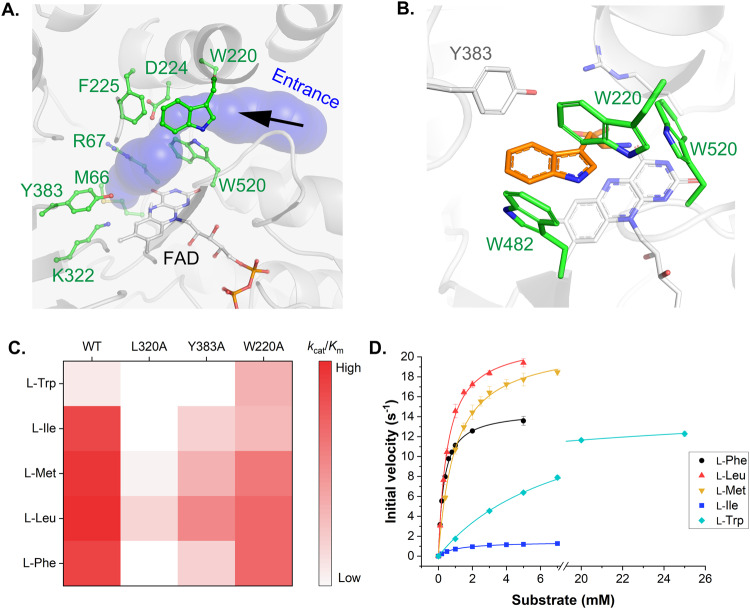
Fig. 4 Screening of HTAncLAAO2 variants that exhibits high activity toward L-Trp derivatives. A Substrate entrance pathway of HTAncLAAO2. The residues surrounding the pathway were shown as green stick and ball models. B Active site structure of HTAncLAAO2. L-Trp (orange) was docked to HTAncLAAO2, referring to the structure of the L-Trp binding form of AncLAAO-N5. C Differences of kcat/Km values of HTAncLAAO2 and variants indicated by the color gradient. In the figure, we showed the parameters of HTAncLAAO2 (WT) and their variants (L320A, Y383A, and W220A). The activity was measured for five L-amino acids (L-Trp, L-Ile, L-Met, L-Leu, and L-Phe). D Enzyme kinetic plots of HTAncLAAO2(W220A) variant toward the five L-amino acids. The initial velocities, which were obtained by utilizing L-Phe, L-Leu, L-Met, L-Ile, and L-Trp as substrates, were colored black, red, orange, blue, and light blue, respectively. The data are shown as the mean ± SD.
Fig. 4 Screening of HTAncLAAO2 variants that exhibits high activity toward L-Trp derivatives. A Substrate entrance pathway of HTAncLAAO2. The residues surrounding the pathway were shown as green stick and ball models. B Active site structure of HTAncLAAO2. L-Trp (orange) was docked to HTAncLAAO2, referring to the structure of the L-Trp binding form of AncLAAO-N5. C Differences of kcat/Km values of HTAncLAAO2 and variants indicated by the color gradient. In the figure, we showed the parameters of HTAncLAAO2 (WT) and their variants (L320A, Y383A, and W220A). The activity was measured for five L-amino acids (L-Trp, L-Ile, L-Met, L-Leu, and L-Phe). D Enzyme kinetic plots of HTAncLAAO2(W220A) variant toward the five L-amino acids. The initial velocities, which were obtained by utilizing L-Phe, L-Leu, L-Met, L-Ile, and L-Trp as substrates, were colored black, red, orange, blue, and light blue, respectively. The data are shown as the mean ± SD.CC BY · PubMed Central
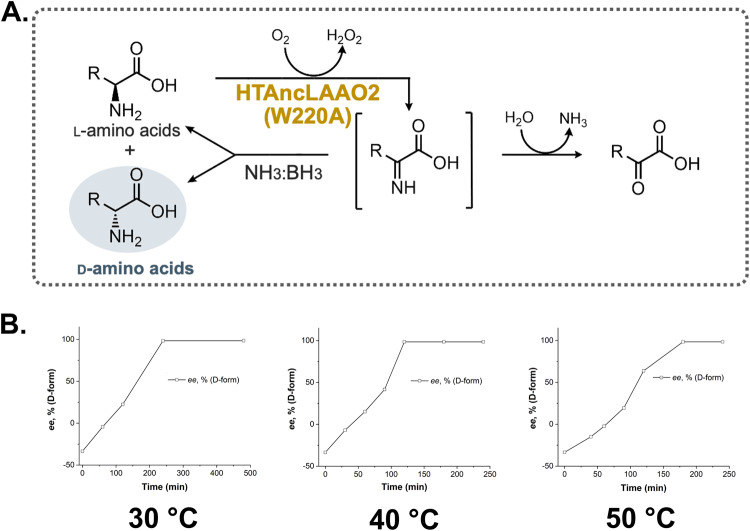
Fig. 5 Optimization of reaction condition to synthesize D-Trp utilizing HTAncLAAO(W220A) variant. A Reaction cascade to obtain enantio-pure D-amino acids from L-forms utilizing HTAncLAAO2. B Time course for production of D-Trp from L-Trp by changing the reaction temperature. The stereoinversion of L-Trp to D-form was achieved in every measured temperature (30, 40, and 50 °C). At 40 °C condition, the reaction was most efficiently progressed.
Fig. 5 Optimization of reaction condition to synthesize D-Trp utilizing HTAncLAAO(W220A) variant. A Reaction cascade to obtain enantio-pure D-amino acids from L-forms utilizing HTAncLAAO2. B Time course for production of D-Trp from L-Trp by changing the reaction temperature. The stereoinversion of L-Trp to D-form was achieved in every measured temperature (30, 40, and 50 °C). At 40 °C condition, the reaction was most efficiently progressed.CC BY · PubMed Central
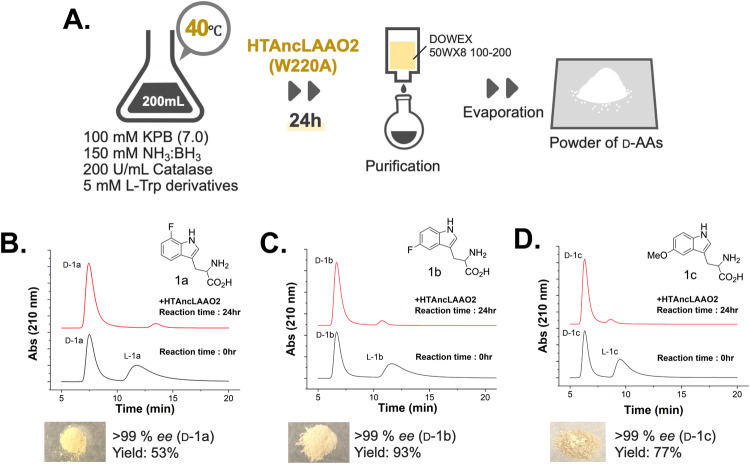
Fig. 6 Preparative scale synthesis of D-Trp derivatives from their racemates utilizing HTAncLAAO2(W220A). A Schematic view to synthesize and purify D-Trp derivatives from racemates at preparative scale. The detailed purification procedures were written in the Material and Method section. B–D HPLC analysis of reaction solution before and after the deracemization (1a for B, 1b for C, and 1c for D). The ee value and the yields of the D-forms were represented in the figure. The products were characterized by HRMS.
Fig. 6 Preparative scale synthesis of D-Trp derivatives from their racemates utilizing HTAncLAAO2(W220A). A Schematic view to synthesize and purify D-Trp derivatives from racemates at preparative scale. The detailed purification procedures were written in the Material and Method section. B–D HPLC analysis of reaction solution before and after the deracemization (1a for B, 1b for C, and 1c for D). The ee value and the yields of the D-forms were represented in the figure. The products were characterized by HRMS.CC BY · PubMed Central

Verification

Claims the paper makes

The claims and statistics of this paper haven’t been checked yet.

Free: it reads the open-access text and checks the first 5 claims that cite a source we can check. Create a free account to check every claim.

A few free checks a day · papers already verified open instantly · results are public

Self-check

Percentages, sums and reported differences re-computed from the paper’s own numbers.

The self-check needs the paper’s full text.

Citations

Cites

Show all 1 references

Metadata

Authors
Kawamura, Y., Ishida, C., Miyata, R., Miyata, A., Hayashi, S., Fujinami, D., Ito, S., & Nakano, S.
Affiliations
  • Shizuoka University (JP)
  • Kyushu University (JP)
Corresponding author
Nakano, Shogo
Venue
Communications Chemistry
Published
2023-05-29
Volume
6
Issue
1
Pages
200-200
ISSN
2399-3669 (ISSN-L)
OpenAlex
W4386945607
Cited by
14
References
1
Citations by year
2026: 4 · 2025: 3 · 2024: 6 · 2023: 1
FWCI
1.24
Type
journal article
Language
en
Open access
Locations
  • Communications Chemistry (publishedVersion, cc-by)
  • Research Square (acceptedVersion, cc-by)
  • PubMed Central (publishedVersion, cc-by)
  • PubMed (publishedVersion)
  • DOAJ (DOAJ: Directory of Open Access Journals) (submittedVersion, cc-by-sa)
Funders
  • Ministry of Education, Culture, Sports, Science and Technology (21K05395, JPMJPR20AB, 18K14391)
  • Japan Society for the Promotion of Science (18K14391, 21K05395, 23K04510, 23K13887)
  • Precursory Research for Embryonic Science and Technology (JPMJPR20AB)
Topics
  • Life Sciences › Biochemistry, Genetics and Molecular Biology › Molecular Biology › Enzyme Catalysis and Immobilization
  • Life Sciences › Biochemistry, Genetics and Molecular Biology › Structural Biology › Enzyme Structure and Function
  • Life Sciences › Biochemistry, Genetics and Molecular Biology › Biotechnology › Enzyme Production and Characterization
Keywords
L-amino acid oxidase, ancestral sequence reconstruction, hyperthermostable enzymes, chemoenzymatic synthesis, tryptophan, enzyme kinetics, site-directed mutagenesis

About these checks

Registry, retraction, Cites and statistics results are computed, not judged, with one exception: a printed reference that no index lists is read once by a model before it counts as a citation error. Claims are extracted by a model and kept only when their quote appears verbatim in the text; each cited source is then checked, with a model’s help, for whether it says what the claim relies on. Those verdicts can be wrong — read the claim’s quote and the cited source before relying on one.

Statistics and arithmetic are recomputed, not judged.

Confidence bands are shown only for fields calibrated on our annotated test set. None is calibrated yet, so no band is shown.

What counts as a claim ›How we measure confidence ›How we check this ›

Are you an author, or do you see a problem with this page? Request a review

How to cite

Cite CoChat for the checks on this page, and the paper for its own findings.

This page
CoChat. (2026). Citation check: Structural and functional analysis of hyper thermostable ancestral L-amino acid oxidase that can convert Trp derivatives to D-forms by chemo-enzymatic reaction. https://app.cochat.ai/papers/10.21203/rs.3.rs-2969058/v1
The paper
Kawamura, Y., Ishida, C., Miyata, R., Miyata, A., Hayashi, S., Fujinami, D., Ito, S., & Nakano, S. (2023). Structural and functional analysis of hyper thermostable ancestral L-amino acid oxidase that can convert Trp derivatives to D-forms by chemo-enzymatic reaction. Communications Chemistry. https://doi.org/10.21203/rs.3.rs-2969058/v1

Data sources

Bibliographic data: Semantic Scholar, OpenAlex, Crossref.

Contains information from the Semantic Scholar Academic Graph Datasets, made available under the ODC Attribution License (ODC-BY 1.0).

Semantic Scholar’s data is described in: Kinney, R., et al. (2023). The Semantic Scholar Open Data Platform. arXiv:2301.10140.