

Acceptability of the Social Robot Mini and Attitudes of People with Dementia and Mild Cognitive Impairment: A Mixed Method Study
Open accessThe DOI matches its Crossref record; 26 of the 26 references it cites were found in a registry or an index.
Abstract
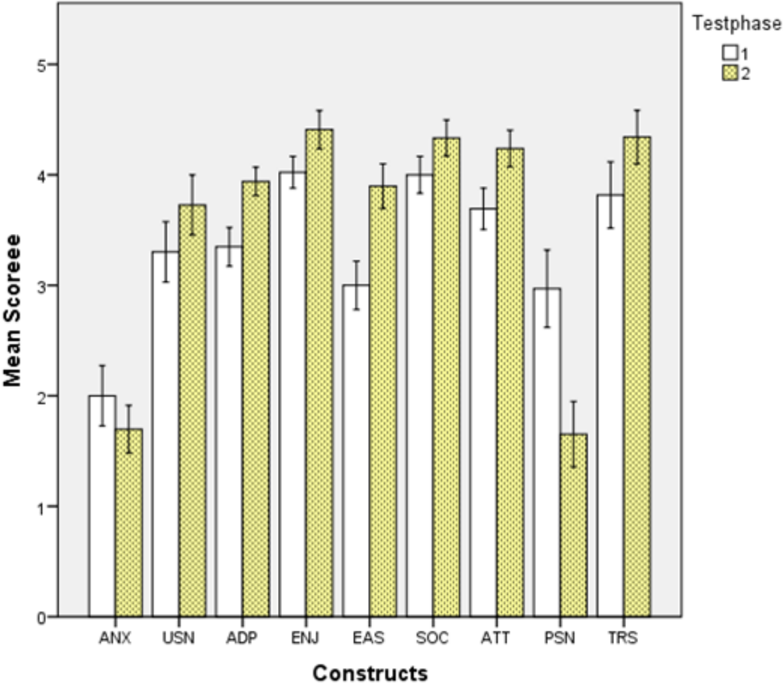
Background: Social robots are considered a promising solution and support in emotional, mental, and physical areas for people with dementia (PwD) and mild cognitive impairments (MCI). Social robots’ effective adoption and outcome may largely depend on this target group’s attitude and acceptance and should be taken into account since the primary stages of design and development. The present study aims to evaluate the acceptability and attitudes of the PwD and MCI towards the Mini robot and understand their expectations. Methods: A mixed-method study was conducted in a clinical setting, with 22 community-dwelling people with dementia and mild cognitive impairment, aged 68-88 years. During the course of a month, the participants engaged in eight sessions of individual interaction with the robot. Pre- and post-evaluation of acceptability were conducted utilizing the Almere questionnaire. Participants completed semi-structured interviews on their attitudes towards the Mini robot at the end of the study. Results: A total of 22 PwD and MCI completed the study and individually participated in eight sessions of interaction with the Mini robot. The data from the Almere questionnaire showed that people were in favour of the Mini robot and the mean values of the ratings were slightly higher in the post-test, except for the social ‘presence/ personality of the robot/social presence’ construct. A collection of ideas emerged from interview data that revealed acceptance and satisfaction with using the Mini robot in clinical settings. Participants viewed the Mini robot as a delightful companion, particularly for those who live alone, as a wonderful advantage. Although the robot’s features were appreciated, some suggestions for improving the robotic platform were made. Conclusion: This research confirms the Mini robot acceptance and the target population's positive opinion towards interacting with Mini robot in clinical settings. The research presented in this article may provide new insights into improving social robots’ design and suggestions for adjusting the robotics’ features to the users’ desires, needs and preferences.
Overview
The claims and statistics of this paper haven’t been checked yet.
Free: it reads the open-access text and checks the first 5 claims that cite a source we can check. Create a free account to check every claim.
Integrity signals
Registry
Cites
Statistics
Figures

Verification
Claims the paper makes
The claims and statistics of this paper haven’t been checked yet.
Free: it reads the open-access text and checks the first 5 claims that cite a source we can check. Create a free account to check every claim.
Claims other papers make about this one
Each is checked against this paper’s own text: does it say what the citing paper says it does?
The cited source says what the claim attributes to it.
In the citing paper
“In another study [25] investigating the acceptance of the MINI robot, the perceived ease of use ratings after one month of interaction were similar to or slightly higher than those in our current study.”
Self-check
Percentages, sums and reported differences re-computed from the paper’s own numbers.
The self-check needs the paper’s full text.
Citations
Cites
Using thematic analysis in psychology
Braun, V., & Clarke, V. (2006) · Qualitative Research in Psychology · doi:10.1191/1478088706qp063oa · Cited by 194,414
Henschel, A., Laban, G., & Cross, E. S. (2021) · Current Robotics Reports · doi:10.1007/s43154-020-00035-0 · Cited by 243
Social Robots for People with Aging and Dementia: A Systematic Review of Literature
Góngora Alonso, S., Hamrioui, S., de la Torre Díez, I., Motta Cruz, E., López-Coronado, M., & Franco, M. (2019) · Telemedicine and e-Health · doi:10.1089/tmj.2018.0051 · Cited by 223
Acceptance and Attitudes Toward a Human-like Socially Assistive Robot by Older Adults
Louie, W.-Y. G., McColl, D., & Nejat, G. (2014) · Assistive Technology · doi:10.1080/10400435.2013.869703 · Cited by 179
Reich-Stiebert, N., & Eyssel, F. (2015) · International Journal of Social Robotics · doi:10.1007/s12369-015-0308-9 · Cited by 160
Mini: A New Social Robot for the Elderly
Salichs, M. A., Castro-González, Á., Salichs, E., Fernández-Rodicio, E., Maroto-Gómez, M., Gamboa-Montero, J. J., Marques-Villarroya, S., Castillo, J. C., Alonso-Martín, F., & Malfaz, M. (2020) · International Journal of Social Robotics · doi:10.1007/s12369-020-00687-0 · Cited by 145
Self-citationCavallo, F., Esposito, R., Limosani, R., Manzi, A., Bevilacqua, R., Felici, E., Di Nuovo, A., Cangelosi, A., Lattanzio, F., & Dario, P. (2018) · Journal of Medical Internet Research · doi:10.2196/jmir.9460 · Cited by 140
Torta, E., Werner, F., Johnson, D. O., Juola, J. F., Cuijpers, R. H., Bazzani, M., Oberzaucher, J., Lemberger, J., Lewy, H., & Bregman, J. (2014) · Journal of Intelligent & Robotic Systems · doi:10.1007/s10846-013-0019-0 · Cited by 123
Ke, C., Lou, V. W.-Q., Tan, K. C.-K., Wai, M. Y., & Chan, L. L. (2020) · International Journal of Medical Informatics · doi:10.1016/j.ijmedinf.2020.104241 · Cited by 107
Identifying Features that Enhance Older Adults’ Acceptance of Robots: A Mixed Methods Study
Chu, L., Chen, H.-W., Cheng, P.-Y., Ho, P., Weng, I. C., Yang, P.-L., Chien, S.-E., Tu, Y., Yang, C.-C., Wang, T., et al. (2019) · Gerontology · doi:10.1159/000494881 · Cited by 102
Investigating the Suitability of Social Robots for the Wellbeing of the Elderly
Hutson, S., Lim, S. L., Bentley, P. J., Bianchi‐Berthouze, N., & Bowling, A. (2011) · Lecture notes in computer science · doi:10.1007/978-3-642-24600-5_61 · Cited by 88
Humanoid robots in the care of older persons: A scoping review
Andtfolk, M., Nyholm, L., Eide, H., & Fagerström, L. (2022) · Assistive Technology · doi:10.1080/10400435.2021.1880493 · Cited by 80
User Experience in Social Robots
Shourmasti, E. S., Colomo‐Palacios, R., Holone, H., & Demi, S. (2021) · Sensors · doi:10.3390/s21155052 · Cited by 72
Long-term acceptance of social robots in domestic environments: Insights from a user's perspective
Graaf, D. M. M. A., Allouch, S. B., & Dijk, V. J. A. G. M. (2016) · University of Twente Research Information · Cited by 69
Acceptance and Long-Term Use of a Social Robot by Elderly Users in a Domestic Environment
Piasek-Skupna, J., & Wieczorowska–Tobis, K. (2018) · Conference on Human System Interactions · doi:10.1109/hsi.2018.8431348 · Cited by 57
Fattal, C., Cossin, I., Pain, F., Haize, E., Marissael, C., Schmutz, S., & Ocnarescu, I. (2020) · Disability and Rehabilitation Assistive Technology · doi:10.1080/17483107.2020.1786732 · Cited by 56
Park, Y., Chang, H., Lee, M. H., & Lee, S. H. (2019) · BMC Geriatrics · doi:10.1186/s12877-019-1227-7 · Cited by 51
Mahmoudi Asl, A., Molinari Ulate, M., Franco Martin, M., & van der Roest, H. (2022) · Journal of Medical Internet Research · doi:10.2196/37434 · Cited by 50
Self-citationDosso, J. A., Bandari, E., Malhotra, A., Guerra, G. K., Hoey, J., Michaud, F., Prescott, T. J., & Robillard, J. M. (2022) · Journal of Rehabilitation and Assistive Technologies Engineering · doi:10.1177/20556683221108364 · Cited by 40
Venkatesh et al.'s Unified Theory of Acceptance and Use of Technology (UTAUT) (2003)
Chakraborty, M., & Rashdi, S. A. (2018) · IGI Global eBooks · doi:10.4018/978-1-5225-5201-7.ch077 · Cited by 37
Social service robots to support independent living: Experiences from a field trial
Pripfl, J., Körtner, T., Batko-Klein, D., Hebesberger, D., Weninger, M., & Gisinger, C. (2016) · Zeitschrift für Gerontologie und Geriatrie · doi:10.1007/s00391-016-1067-4 · Cited by 36
Natarajan, N., Vaitheswaran, S., Lima, M. R., Wairagkar, M., & Vaidyanathan, R. (2022) · The American Journal of Geriatric Psychiatry · doi:10.1016/j.jagp.2021.05.003 · Cited by 20
Lehmann, S., Ruf, E., & Misoch, S. (2021) · Communications in computer and information science · doi:10.1007/978-3-030-70807-8_2 · Cited by 19
Asl, A. M., Toribio-Guzmán, J. M., van der Roest, H. G., Castro‐González, Á., Malfáz, M., Salichs, M. A., & Franco, M. (2022) · BMC Psychiatry · doi:10.1186/s12888-022-04418-9 · Cited by 19
Self-citationA Social Robot Assisting in Cognitive Stimulation Therapy
Salichs, E., Fernández-Rodicio, E., Castillo, J. C., Castro-González, Á., Malfaz, M., & Salichs, M. Á. (2018) · Lecture Notes in Computer Science · doi:10.1007/978-3-319-94580-4_35 · Cited by 18
Self-citationKachaturoff, M., Shidler, K., Fasbinder, A., & Caboral-Stevens, M. F. (2021) · Journal of Gerontological Nursing · doi:10.3928/00989134-20210803-05 · Cited by 11
Research works printed but not linked: 6
- 2. Gerłowska J, Skrobas U, Grabowska-Aleksandrowicz K, Korchut A, Szklener S, Szczęśniak-Stańczyk D et al. Assessment of Perceived Attractiveness, Usability, and Societal Impact of a Multimodal Robotic Assistant for Aging Patients With Memory Impairments. 2018;9.
- 7. Feil-Seifer D, Mataric MJ, editors. De ning socially assistive robotics. 9th International Conference on Rehabilitation Robotics, 2005 ICORR 2005; 2005: IEEE. .
- 19. Lehmann S, Ruf E, Misoch S, editors. Emotions and Attitudes of Older Adults Toward Robots of Different Appearances and in Different Situations. Information and Communication Technologies for Ageing Well and e-Health; 2021 2021//; Cham: Springer International Publishing.
- 24. Fernaeus Y, Håkansson M, Jacobsson M, Ljungblad S. How do you play with a robotic toy animal? a long-term study of Pleo. Proceedings of the 9th International Conference on Interaction Design and Children; Barcelona, Spain: Association for Computing Machinery; 2010. p. 39-48.
- 32. Blackman TJA. Society. Care robots for the supermarket shelf: a product gap in assistive technologies. 2013;33(5):763-81.
- 33. Mahmoudi Asl ADR, Franco Martin M, van der Henriëtte H, Castro-González, Kouters S. Potential facilitators and barriers to implementing the MINI robot in community-based meeting centres in the Netherlands and Spain. JMIR Preprints; 2023.
Cited by
Mahmoudi Asl, A., Toribio-Guzmán, J. M., Castro-González, Á., Malfaz, M., Salichs, M. A., & Franco Martín, M. (2024) · Sensors · doi:10.3390/s24227180 · Cited by 13
Self-citationRaß, E., Unbehaun, D., Aal, K., Tandler, J., Lenz, G., & Wulf, V. (2025) · Proceedings of the ACM on Human-Computer Interaction · doi:10.1145/3701190 · Cited by 7
Unbehaun, D., Raß, E., Tandler, J., Lenz, G., & Wulf, V. (2025) · Design for inclusion · doi:10.1007/978-3-031-84901-5_6 · Cited by 1
Metadata
- Authors
- Asl, A. M., Toribio-Guzmán, J. M., Castro-González, Á., Castillo, J. C., Martin, F. A., Salichs, M. A., Roest, H. V. D., & Martin, M. F.
- Affiliations
- Instituto de Investigación Biomédica de Salamanca (ES)
- Psycho-Sciences Research Group of the Biomedical Research Institute of Salamanca
- Robotics Lab, Department of System Engineering and Automation, Universidad Carlos III de Madrid
- Universidad Carlos III de Madrid (ES)
- Netherlands Institute of Mental Health and Addiction (Trimbos Institute)
- Corresponding author
- Asl, Aysan Mahmoudi
- Venue
- Research Square
- Published
- 2023-08-17
- OpenAlex
- W4385949763
- Cited by
- 2
- References
- 26
- Citations by year
- 2025: 1 · 2024: 1
- Type
- posted content
- Language
- en
- Open access
- green
- doi.org
- Locations
- Research Square (acceptedVersion, cc-by)
- Funders
- Ministerio de Ciencia, Innovación y Universidades (RTI2018-096338-B-I00, RTI2018)
- European Commission (H2020-MSCA-ITN, 813196, H2020-MSCA-ITN-2018, HORIZON2020, H2020, MSCA-ITN-2018, H2020-MSCA)
- Horizon 2020 Framework Programme (MSCA‐ITN‐2018, H2020-MSCA, 813196, H2020-MSCA-ITN-2018, H2020-MSCA-ITN)
- Agencia Estatal de Investigación
- Topics
- Social Sciences › Psychology › Social Psychology › Social Robot Interaction and HRI
- Health Sciences › Medicine › Psychiatry and Mental health › Dementia and Cognitive Impairment Research
- Health Sciences › Medicine › Geriatrics and Gerontology › Technology Use by Older Adults
- Keywords
- social robots, small robots, acceptability, attitudes toward robots, dementia, mild cognitive impairment, social presence, robot personality, robot companionship, robot design, community-dwelling older adults
About these checks
Registry, retraction, Cites and statistics results are computed, not judged, with one exception: a printed reference that no index lists is read once by a model before it counts as a citation error. Claims are extracted by a model and kept only when their quote appears verbatim in the text; each cited source is then checked, with a model’s help, for whether it says what the claim relies on. Those verdicts can be wrong — read the claim’s quote and the cited source before relying on one.
Statistics and arithmetic are recomputed, not judged.
Confidence bands are shown only for fields calibrated on our annotated test set. None is calibrated yet, so no band is shown.
What counts as a claim ›How we measure confidence ›How we check this ›
Are you an author, or do you see a problem with this page? Request a review
Data sources
Bibliographic data: Semantic Scholar, OpenAlex, Crossref.
Contains information from the Semantic Scholar Academic Graph Datasets, made available under the ODC Attribution License (ODC-BY 1.0).
Semantic Scholar’s data is described in: Kinney, R., et al. (2023). The Semantic Scholar Open Data Platform. arXiv:2301.10140.
