

The DOI matches its Crossref record; 1 of the 1 references it cites were found in a registry or an index.
Interaction-aware 3D Molecular Generative Framework for Generalizable Structure-based Drug Design
Open accessPreprint — published as 10.1038/s41467-024-47011-2
Abstract
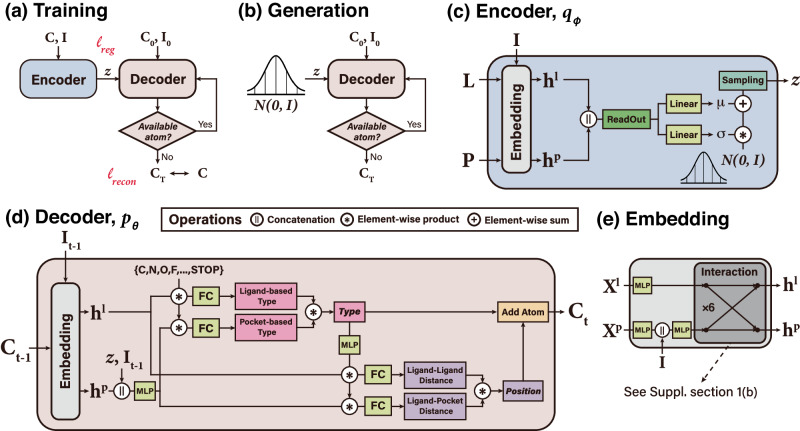
Deep generative modeling has a strong potential to accelerate drug design. However, existing generative models often face challenges in generalization due to limited data, leading to less innovative designs and unfavorable interactions with target proteins. To address these issues, we propose an interaction-aware 3D molecular generative framework with its conditional generative model named DeepICL. By leveraging the universal nature of protein-ligand interactions, our model can achieve a generalizable structure-based drug design even with a small experimental dataset. Our framework's generalization ability is comprehensively assessed by analyzing generated ligands for unseen targets in terms of binding pose stability, affinity, geometric patterns, diversity, and novelty. The successful design of mutant-selective inhibitors further manifests the impact of our interaction-aware conditional generation approach in real-world applications.
Overview
The claims and statistics of this paper haven’t been checked yet.
Run the check — free, no account needed. It reads the open-access text and checks the sources it cites.
Integrity signals
Registry
Cites
Statistics
Figures
Verification
Claims the paper makes
The claims and statistics of this paper haven’t been checked yet.
Run the check — free, no account needed. It reads the open-access text and checks the sources it cites.
Self-check
Percentages, sums and reported differences re-computed from the paper’s own numbers.
The self-check needs the paper’s full text.
Citations
Cites
Highly accurate protein structure prediction with AlphaFold
Jumper, J., Evans, R., Pritzel, A., Green, T., Figurnov, M., Ronneberger, O., Tunyasuvunakool, K., Bates, R., Žídek, A., Potapenko, A., et al. (2021) · Nature · doi:10.1038/s41586-021-03819-2 · Cited by 43,764
Metadata
- Authors
- Kim, W. Y., Zhung, W., & Kim, H.
- Affiliations
- Korea Advanced Institute of Science and Technology (KR)
- Corresponding author
- Kim, Woo Youn
- Venue
- Nature Communications
- Published
- 2023-10-27
- Volume
- 15
- Issue
- 1
- Pages
- 2688-2688
- ISSN
- 2041-1723 (ISSN-L)
- PMC
- PMC10973397
- OpenAlex
- W4393222489
- Cited by
- 87
- References
- 1
- Citations by year
- 2026: 37 · 2025: 37 · 2024: 13
- FWCI
- 18.39
- Type
- journal article
- Language
- en
- Open access
- gold
- doi.org
- Locations
- Nature Communications (publishedVersion, cc-by)
- Research Square (acceptedVersion, cc-by)
- PubMed Central (publishedVersion, cc-by)
- PubMed (publishedVersion)
- RePEc: Research Papers in Economics (submittedVersion)
- DOAJ (DOAJ: Directory of Open Access Journals) (submittedVersion)
- Funders
- National Research Foundation (2018R1A5A1025208)
- National Research Foundation of Korea (RS-2023-00257479, NRF-2023R1A2C2004376, NRF‐2018R1A5A1025208, 2018R1A5A1025208)
- Ministry of Science and ICT, South Korea (RS-2023-00257479, 2018R1A5A1025208)
- Topics
- Life Sciences › Pharmacology, Toxicology and Pharmaceutics › Drug Discovery › Computational Drug Discovery Methods
- Life Sciences › Biochemistry, Genetics and Molecular Biology › Molecular Biology › Protein Degradation and Inhibitors
- Physical Sciences › Materials Science › Materials Chemistry › Machine Learning in Materials Science
- Keywords
- generative models, 3D molecular generation, protein-ligand interactions, binding pocket, structure-based drug design, binding affinity, mutant-selective inhibitors
- MeSH terms
- Ligands, Proteins, Drug Design
About these checks
Registry, retraction, Cites and statistics results are computed, not judged, with one exception: a printed reference that no index lists is read once by a model before it counts as a citation error. Claims are extracted by a model and kept only when their quote appears verbatim in the text; each cited source is then checked, with a model’s help, for whether it says what the claim relies on. Those verdicts can be wrong — read the claim’s quote and the cited source before relying on one.
Statistics and arithmetic are recomputed, not judged.
Confidence bands are shown only for fields calibrated on our annotated test set. None is calibrated yet, so no band is shown.
What counts as a claim ›How we measure confidence ›How we check this ›
Are you an author, or do you see a problem with this page? Request a review
