

Abnormal Activity Detection for the Elderly People using ConvLSTM Autoencoder
Open accessThe DOI matches its Crossref record; 22 of the 23 references it cites were found in a registry or an index.
Abstract
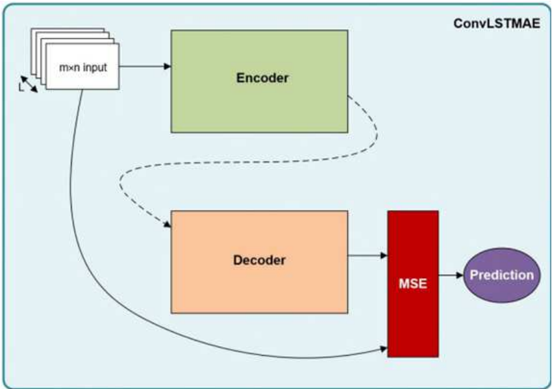
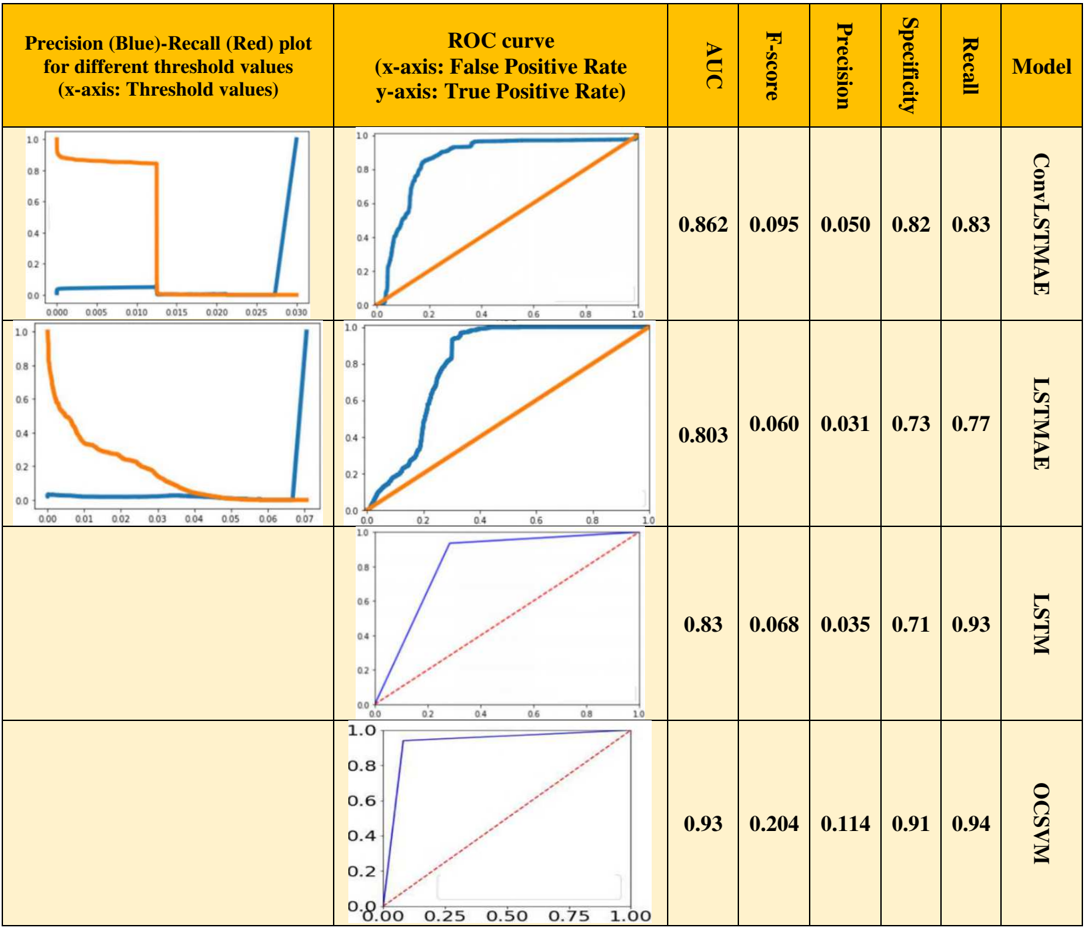
Independent living for elderly people is often viewed as an impossible task, due to the great many perils and difficulties. With advancements of Ambient Intelligence, this scenario is no longer out of reach and smart homes offer a computationally inexpensive solution to this problem. In this paper we address these difficulties and propose a novel method for Anomaly Detection in elderly’s daily routine and behavior. Our proposed model is a ConvLSTM Autoencoder for processing spatiotemporal data, given the fact that these type of behavior and anomalies are sparse and rare, it is safe to presume anomalies are harder to recreate in Autoencoder and have a much higher reproduction error compared to normal behavior. We utilized two datasets from the WSU CASAS smart home project to validate our proposed method by comparing it to the other state-of-the-art approaches.
Overview
The claims and statistics of this paper haven’t been checked yet.
Free: it reads the open-access text and checks the first 5 claims that cite a source we can check. Create a free account to check every claim.
Integrity signals
Registry
Cites
Statistics
Figures
Verification
Claims the paper makes
The claims and statistics of this paper haven’t been checked yet.
Free: it reads the open-access text and checks the first 5 claims that cite a source we can check. Create a free account to check every claim.
Claims other papers make about this one
Each is checked against this paper’s own text: does it say what the citing paper says it does?
The source backs part of the claim, not all of it — or backs it for a different population, condition or comparison.
In the citing paper
“Most of the previous studies, consider activity recognition (AR) [9], [12], anomalous detection (AD) [19], and next sequence prediction [17], [20] separately, or AR and AD are discussed together only [2], [14], [21].”
From Activities Recognition, Anomaly Detection and Next Activity Prediction Based on Neural Networks in Smart Homes (2022) · cites this paper as [19]
Experimental — accuracy not yet measured
Self-check
Percentages, sums and reported differences re-computed from the paper’s own numbers.
The self-check needs the paper’s full text.
Citations
Cites
Elman, J. L. (1990) · Cognitive Science · doi:10.1207/s15516709cog1402_1 · Cited by 11,212 · cited 1×
“Long short-term memory networks [16] were introduced in 1997 and outperformed traditional RNN models [17].”
Convolutional LSTM Network: A Machine Learning Approach for Precipitation Nowcasting
Shi, X., Chen, Z., Wang, H., Yeung, D.-Y., Wong, W.-K., & Woo, W.-C. (2015) · arXiv · doi:10.48550/arxiv.1506.04214 · Cited by 7,709
Convolutional networks for images, speech, and time series
LeCun, Y., & Bengio, Y. (1998) · HAL (Le Centre pour la Communication Scientifique Directe) · doi:10.5555/303568.303704 · Cited by 4,231
Deep Convolutional and LSTM Recurrent Neural Networks for Multimodal Wearable Activity Recognition
Ordóñez, F., & Roggen, D. (2016) · Sensors · doi:10.3390/s16010115 · Cited by 2,761 · cited 2×
“Recently, researchers all around the world have shown great interest in Convolutional Neural Networks (CNNs) [10, 11, 12] and Recurrent Neural Networks (RNNs) [13] in human activity recognition.”
Human activity recognition with smartphone sensors using deep learning neural networks
Ronao, C. A., & Cho, S.-B. (2016) · Expert Systems with Applications · doi:10.1016/j.eswa.2016.04.032 · Cited by 1,215 · cited 2×
“Recently, researchers all around the world have shown great interest in Convolutional Neural Networks (CNNs) [10, 11, 12] and Recurrent Neural Networks (RNNs) [13] in human activity recognition.”
(2015) · Cited by 989
Convolutional Neural Networks for Human Activity Recognition using Mobile Sensors
Zeng, M., Nguyen, L. T., Yu, B., Mengshoel, O. J., Zhu, J., Wu, P., & Zhang, J. (2014) · Proceedings of the 6th International Conference on Mobile Computing, Applications and Services · doi:10.4108/icst.mobicase.2014.257786 · Cited by 876 · cited 1×
“Recently, researchers all around the world have shown great interest in Convolutional Neural Networks (CNNs) [10, 11, 12] and Recurrent Neural Networks (RNNs) [13] in human activity recognition.”
LSTM-based Encoder-Decoder for Multi-sensor Anomaly Detection
Malhotra, P., Ramakrishnan, A., Anand, G., Vig, L., Agarwal, P., & Shroff, G. (2016) · arXiv · doi:10.48550/arxiv.1607.00148 · Cited by 819 · cited 2×
“Malhorta et al. [24] developed an LSTM-based Encoder-Decoder for anomaly detection, which was the inspiration to this research, but the main assumption in their research is that data instances are not topologically correlated.”
Cook, D. J., Crandall, A. S., Thomas, B. L., & Krishnan, N. C. (2013) · Computer · doi:10.1109/mc.2012.328 · Cited by 716 · cited 2×
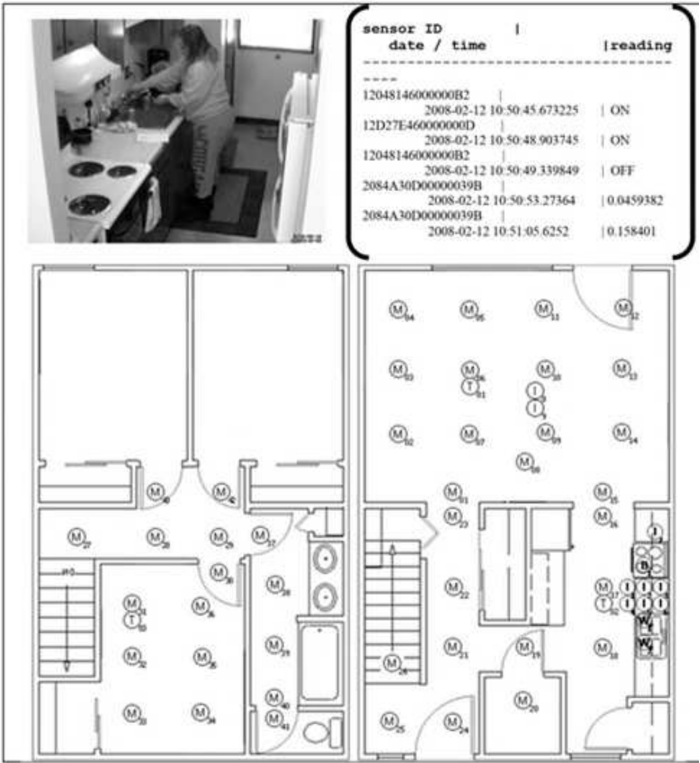
“In this work, we employ Autoencoder together with ConvLSTM cells in order to perform anomaly detection the Aruba and Kyoto daily activity datasets, both from WSU CASAS smart home project [15].”
A survey of anomaly detection techniques in financial domain
Ahmed, M., Mahmood, A. N., & Islam, M. R. (2016) · Future Generation Computer Systems · doi:10.1016/j.future.2015.01.001 · Cited by 528
Research works printed but not linked: 7
- M. Vijayan and P. Reddy, "Stroke, Cascular Dementia, and Alzheimer's Disease: Molecular Links," Journal of Alzheimer's Disease, vol. 54, no. 2, pp. 427-443, 2016.
- Q. Deng and G. Mei, "Combining self-organizing map and k-means clustering," in IEEE International Conference on Granular Computing, 2009.
- J. Shin, B. Lee and K. Park, "Detection of abnormal living patterns for elderly living alone," in IEEE Trans. Inf. Technol. Biomed, 2011.
- D. Arifoglu and A. Bouchachia, "Detection of abnormal behaviour for dementia sufferers using Convolutional," Artificial Intelligence In Medicine, vol. 94, pp. 88-95, 2019.
- S. Hochreiter and J. Schmidhuber, "Long Short-Term Memory," Neural Computation, vol. 9(8), pp. 1735-17880, 1997.
- I. Goodfellow, Y. Bengio and A. Courville, Deep Learning, The MIT Press, 2016.
- T. Zhang, W. Fu, J. Ye and M. Fischer, "Learning movement patterns of the occupant in smart home," Journal of Ambient Intelligence and Humanized Computing, vol. 8, pp. 133-146, 2017.
Cited by
Shokrollahi, A., Persson, J., Malekian, R., Sarkheyli-Hägele, A., & Karlsson, F. (2024) · Sensors · doi:10.3390/s24051533 · Cited by 78
“In the most recent effort to detect anomalous activities, Nazerfard et al. introduced a novel method that presents a ConvLSTM autoencoder (ConvLSTMAE) designed for identifying abnormal activities in elderly individuals [109].”
MethodAlaghbari, K. A., Md. Saad, M. H., Hussain, A., & Alam, M. R. (2022) · IEEE Access · doi:10.1109/access.2022.3157726 · Cited by 61
“In [19], convLSTM autoencoder is used for anomaly detection, instances with high reconstruction error are assumed to be anomalies because they cannot be reconstructed like normal instances.”
BackgroundMethodCejudo, A., Beristain, A., Almeida, A., Rebescher, K. M., Martín, C., & Macía, I. (2025) · Medical & Biological Engineering & Computing · doi:10.1007/s11517-025-03308-y · Cited by 24
“As in this study, in many cases labeled anomalies are not available and previous works have explored different classification approaches such as the prediction of simulated anomalies [33, 52] or box-plot analysis [3, 23], whereas there are some that predict meaningful clinical events [20, 45].”
Berdjouh, C., Meftah, M. C. E., Laouid, A., Hammoudeh, M. A. A., & Kumar, A. (2023) · IEEE Internet of Things Journal · doi:10.1109/jiot.2023.3271831 · Cited by 6
“ConvLSTM autoencoder was applied in [13] for the detection of abnormal activity in older people, e.g., sleep disruption and disorientation.”
MethodActivity recognition using unsupervised learning
Alexan, A., Alexan, A. I., & Oniga, S. (2022) · IEEE International Conference on Automation, Quality and Testing, Robotics (AQTR) · doi:10.1109/aqtr55203.2022.9801956 · Cited by 2
“Acquisition sensors were installed in this space, and the students executed the activity scenario, [14].”
Background
Metadata
- Authors
- Nazerfard, E., Atashgahy, Z., & Nadali, A.
- Affiliations
- Amirkabir University of Technology (IR)
- Venue
- Research Square
- Published
- 2021-07-20
- OpenAlex
- W3183926262
- Cited by
- 5
- References
- 23
- Citations by year
- 2025: 1 · 2024: 1 · 2023: 1 · 2022: 2
- Type
- posted content
- Language
- en
- Open access
- green
- doi.org
- Locations
- Research Square (acceptedVersion, cc-by)
- Topics
- Physical Sciences › Computer Science › Computer Vision and Pattern Recognition › Context-Aware Activity Recognition Systems
- Physical Sciences › Computer Science › Artificial Intelligence › Anomaly Detection Techniques and Applications
- Physical Sciences › Computer Science › Computer Vision and Pattern Recognition › Human Pose and Action Recognition
- Keywords
- elderly activity monitoring, anomaly detection, home automation, ambient intelligence, independent living, spatio-temporal data
About these checks
Registry, retraction, Cites and statistics results are computed, not judged, with one exception: a printed reference that no index lists is read once by a model before it counts as a citation error. Claims are extracted by a model and kept only when their quote appears verbatim in the text; each cited source is then checked, with a model’s help, for whether it says what the claim relies on. Those verdicts can be wrong — read the claim’s quote and the cited source before relying on one.
Statistics and arithmetic are recomputed, not judged.
Confidence bands are shown only for fields calibrated on our annotated test set. None is calibrated yet, so no band is shown.
What counts as a claim ›How we measure confidence ›How we check this ›
Are you an author, or do you see a problem with this page? Request a review
How to cite
Cite CoChat for the checks on this page, and the paper for its own findings.
- This page
- CoChat. (2026). Citation check: Abnormal Activity Detection for the Elderly People using ConvLSTM Autoencoder. https://app.cochat.ai/papers/10.21203/rs.3.rs-693084/v1
- The paper
- Nazerfard, E., Atashgahy, Z., & Nadali, A. (2021). Abnormal Activity Detection for the Elderly People using ConvLSTM Autoencoder. Research Square. https://doi.org/10.21203/rs.3.rs-693084/v1
Data sources
Bibliographic data: Semantic Scholar, OpenAlex, Crossref.
Contains information from the Semantic Scholar Academic Graph Datasets, made available under the ODC Attribution License (ODC-BY 1.0).
Semantic Scholar’s data is described in: Kinney, R., et al. (2023). The Semantic Scholar Open Data Platform. arXiv:2301.10140.
