

Effectiveness of Spironolactone in Reducing Osteoporosis and Future Fracture Risk in Middle-Aged and Elderly Hypertensive Patients
Open accessThe DOI matches its Crossref record; 57 of the 57 references it cites were found in a registry or an index.
Abstract
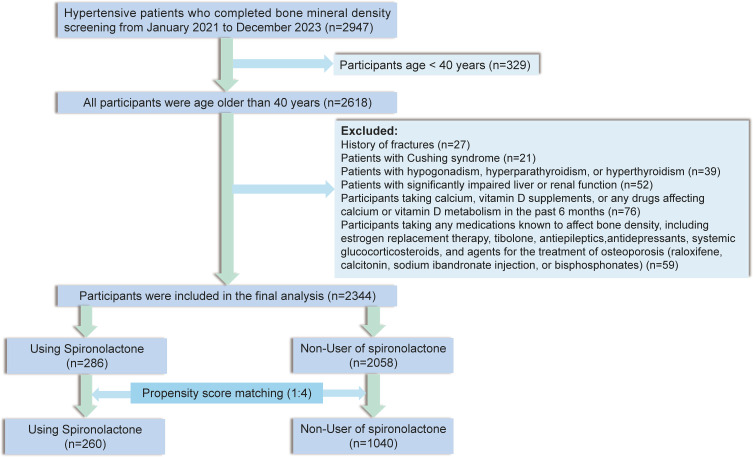
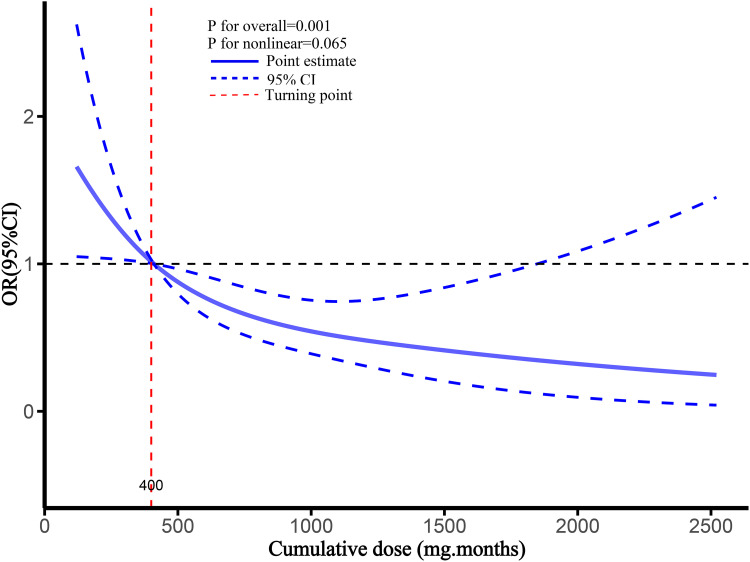
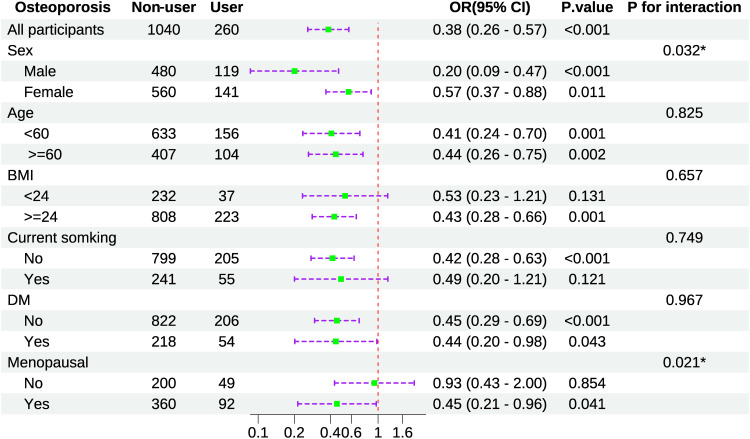
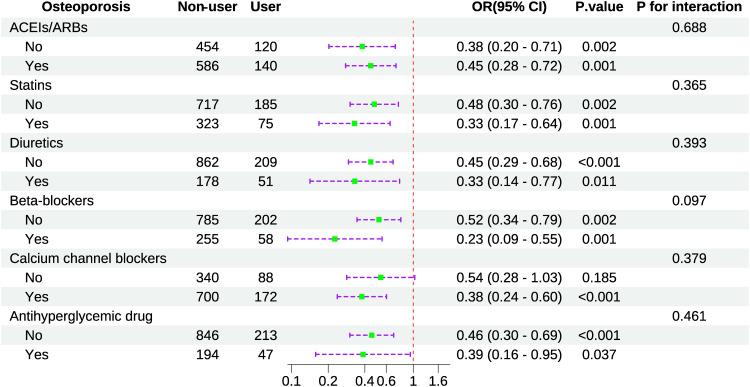
Objective: While the role of aldosterone in bone metabolism is well established, the specific effects of the widely used aldosterone antagonist, spironolactone, on bone health are not fully understood. This study aimed to investigate the effects of spironolactone on osteoporosis and future fracture risk in middle-aged and elderly hypertensive patients, revealing its potential benefits for bone health. Methods: Propensity score matching was employed in this study to create matched groups of spironolactone users and non-users at a 1:4 ratio. We investigated the association between spironolactone use and the risk of osteoporosis using multivariate logistic regression analysis. Furthermore, we conducted multivariate linear regression analysis to explore the relationship between cumulative dosage and the FRAX score. Subgroup analysis was also performed to assess the effects under different stratification conditions. Results: In both pre-match and post-match analyses, multivariable logistic regression revealed a significant reduction in the risk of osteoporosis in the spironolactone usage group (pre-match: odds ratios [OR] 0.406, 95% confidence interval [CI], 0.280-0.588; post-match: OR 0.385, 95% CI, 0.259-0.571). Furthermore, post-match multivariable linear regression demonstrated a clear negative correlation between cumulative spironolactone dosage and the FRAX score. Subgroup analyses consistently supported these findings. Conclusion: This study offers evidence supporting the significant positive impact of the antihypertensive drug spironolactone on bone health, resulting in a substantial reduction in the risk of osteoporosis and future fractures in hypertensive patients. Future research should consider conducting large-scale, multicenter, randomized controlled trials to further investigate the long-term effects of spironolactone on bone health in hypertensive patients.
Overview
The claims and statistics of this paper haven’t been checked yet.
Free: it reads the open-access text and checks the first 5 claims that cite a source we can check. Create a free account to check every claim.
Integrity signals
Registry
Cites
Statistics
Figures
Verification
Claims the paper makes
The claims and statistics of this paper haven’t been checked yet.
Free: it reads the open-access text and checks the first 5 claims that cite a source we can check. Create a free account to check every claim.
Claims other papers make about this one
Each is checked against this paper’s own text: does it say what the citing paper says it does?
The source backs part of the claim, not all of it — or backs it for a different population, condition or comparison.
In the citing paper
“Clinical reports have shown that the drug spironolactone (an aldosterone inhibitor), has a significant impact on the bone health of hypertensive patients [65].”
From A physiology-based mathematical model of the renin-angiotensin system, bone remodeling, and calcium homeostasis: Effects of estrogen and renin-angiotensin system inhibitors (2025) · cites this paper as [65]
Experimental — accuracy not yet measured
Self-check
Percentages, sums and reported differences re-computed from the paper’s own numbers.
The self-check needs the paper’s full text.
Citations
Cites
An estimate of the worldwide prevalence and disability associated with osteoporotic fractures
Johnell, O., & Kanis, J. A. (2006) · Osteoporosis International · doi:10.1007/s00198-006-0172-4 · Cited by 4,704 · cited 1×
“7,8 While lifestyle interventions are crucial for managing blood pressure (BP), pharmacological treatments play a more prominent role in reducing BP and the risk of atherosclerotic cardiovascular disease.”
BackgroundBlack, D. M., Cummings, S. R., Karpf, D. B., Cauley, J. A., Thompson, D. E., Nevitt, M. C., Bauer, D. C., Genant, H. K., Haskell, W. L., Marcus, R., et al. (1996) · The Lancet · doi:10.1016/s0140-6736(96)07088-2 · Cited by 3,846
Mills, K. T., Bundy, J. D., Kelly, T. N., Reed, J. E., Kearney, P. M., Reynolds, K., Chen, J., & He, J. (2016) · Circulation · doi:10.1161/circulationaha.115.018912 · Cited by 3,531
Calcium plus Vitamin D Supplementation and the Risk of Fractures
Jackson, R. D., LaCroix, A. Z., Gass, M., Wallace, R. B., Robbins, J., Lewis, C. E., Bassford, T., Beresford, S. A. A., Black, H. R., Blanchette, P., et al. (2006) · New England Journal of Medicine · doi:10.1056/nejmoa055218 · Cited by 1,883 · cited 1×
“12–14 In recent years, a growing body of research has provided additional evidence supporting the notion that excessive aldosterone secretion within the RAAS system results in increased urinary calcium excretion.”
BackgroundCamacho, P. M., Petak, S. M., Binkley, N., Clarke, B. L., Harris, S. T., Hurley, D. L., Kleerekoper, M., Lewiecki, E. M., Miller, P. D., Narula, H. S., et al. (2016) · Endocrine Practice · doi:10.4158/ep161435.esgl · Cited by 1,140
Lu, J., Lu, Y., Wang, X., Li, X., Linderman, G. C., Wu, C., Cheng, X., Mu, L., Zhang, H., Liu, J., et al. (2017) · The Lancet · doi:10.1016/s0140-6736(17)32478-9 · Cited by 1,133 · cited 1×
“5,6 Hypertension is a risk factor for osteoporosis and osteoporotic fractures, significantly impacting morbidity and mortality in both men and women.”
BackgroundEnsrud, K. E., & Crandall, C. J. (2017) · Annals of Internal Medicine · doi:10.7326/aitc201708010 · Cited by 726
Xiao, P.-L., Cui, A.-Y., Hsu, C.-J., Peng, R., Jiang, N., Xu, X.-H., Ma, Y.-G., Liu, D., & Lu, H.-D. (2022) · Osteoporosis International · doi:10.1007/s00198-022-06454-3 · Cited by 573
Austin, P. C. (2011) · Multivariate Behavioral Research · doi:10.1080/00273171.2011.540480 · Cited by 420 · cited 1×
“32,33”
Lemann, J., Pleuss, J. A., Gray, R. W., & Hoffmann, R. G. (1991) · Kidney International · doi:10.1038/ki.1991.123 · Cited by 232
Cited by
Song, S., Cai, X., Hu, J., Zhu, Q., Shen, D., Ma, H., Zhang, Y., Ma, R., Zhou, P., Yang, W., et al. (2024) · Frontiers in Endocrinology · doi:10.3389/fendo.2024.1424207 · Cited by 38
Self-citationLiu, Q., Cui, Z., Deng, C., Yang, C., & Tao, S. (2024) · Frontiers in Pharmacology · doi:10.3389/fphar.2024.1485190 · Cited by 36
Song, S., Cai, X., Hu, J., Zhu, Q., Shen, D., Ma, H., Zhang, Y., Ma, R., Zhou, P., Yang, W., et al. (2025) · Metabolites · doi:10.3390/metabo15010015 · Cited by 20
“Elevated SUA can trigger an inflammatory response, increasing osteo-clast activity, which in turn raises the risk of osteoporosis and fractures [20,27,29,37].”
Self-citationSong, S., Cai, X., Shen, D., Hu, J., Zhu, Q. C., Ma, H., Zhang, Y., Ma, R., Zhou, P., Zhang, Z., et al. (2025) · American Journal of Nephrology · doi:10.1159/000545451 · Cited by 17
“Recent studies have increasingly shown that elevated PAC is not only associated with a variety of diseases, including CVD, but also pose risks to kidney health [20 – 25].”
Self-citationRen, X., Wang, J.-X., Wang, J., Wang, G., Ren, H., Xu, P., Yang, M., & Xu, K. (2025) · Lipids in Health and Disease · doi:10.1186/s12944-025-02558-x · Cited by 12
Metadata
- Authors
- Song, S., Cai, X., Hu, J., Zhu, Q., Shen, D., Ma, H., Zhang, Y., Ma, R., Yang, W., Hong, J., Zhang, D., & Li, N.
- Affiliations
- People's Hospital of Xinjiang Uygur Autonomous Region (CN)
- Corresponding author
- Li, Nanfang
- ORCID
- Venue
- Drug Design, Development and Therapy
- Publisher
- Informa UK Limited
- Published
- 2024-06
- Volume
- Volume 18
- Pages
- 2215-2225
- ISSN
- 1177-8881 (ISSN-L)
- PMC
- PMC11180452
- OpenAlex
- W4399594357
- Cited by
- 25
- References
- 56
- Citations by year
- 2026: 4 · 2025: 15 · 2024: 6
- FWCI
- 11.20
- Type
- journal article
- Language
- en
- Open access
- gold
- doi.org
- Licence
- Locations
- Drug Design Development and Therapy (publishedVersion, cc-by-nc)
- PubMed Central (publishedVersion, cc-by-nc)
- PubMed (publishedVersion)
- Dove Medical Press (Taylor and Francis Group) (submittedVersion, cc-by-nc)
- Topics
- Health Sciences › Medicine › Orthopedics and Sports Medicine › Bone health and osteoporosis research
- Health Sciences › Medicine › Endocrinology, Diabetes and Metabolism › Hormonal Regulation and Hypertension
- Health Sciences › Medicine › Endocrinology, Diabetes and Metabolism › Menopause: Health Impacts and Treatments
- Keywords
- spironolactone, osteoporosis, fracture risk, hypertension, bone health, mineralocorticoid receptor antagonists, FRAX score, middle-aged and elderly patients, antihypertensive drugs
- MeSH terms
- Aged, Female, Humans, Hypertension, Male, Middle Aged, Osteoporosis, Risk Factors, Spironolactone, Fractures, Bone
About these checks
Registry, retraction, Cites and statistics results are computed, not judged, with one exception: a printed reference that no index lists is read once by a model before it counts as a citation error. Claims are extracted by a model and kept only when their quote appears verbatim in the text; each cited source is then checked, with a model’s help, for whether it says what the claim relies on. Those verdicts can be wrong — read the claim’s quote and the cited source before relying on one.
Statistics and arithmetic are recomputed, not judged.
Confidence bands are shown only for fields calibrated on our annotated test set. None is calibrated yet, so no band is shown.
What counts as a claim ›How we measure confidence ›How we check this ›
Are you an author, or do you see a problem with this page? Request a review
Data sources
Bibliographic data: Semantic Scholar, OpenAlex, Crossref.
Contains information from the Semantic Scholar Academic Graph Datasets, made available under the ODC Attribution License (ODC-BY 1.0).
Semantic Scholar’s data is described in: Kinney, R., et al. (2023). The Semantic Scholar Open Data Platform. arXiv:2301.10140.
