

The DOI matches its Crossref record; the references it cites are not checked yet.
Factors Associated with Healthy Behavior for Preventing Non-Communicable Diseases
Open accessAbstract
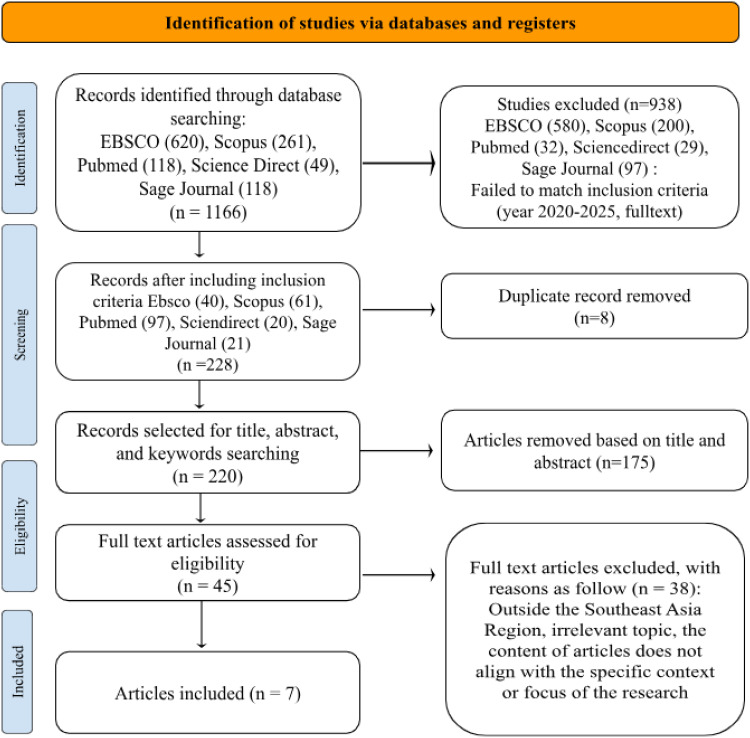
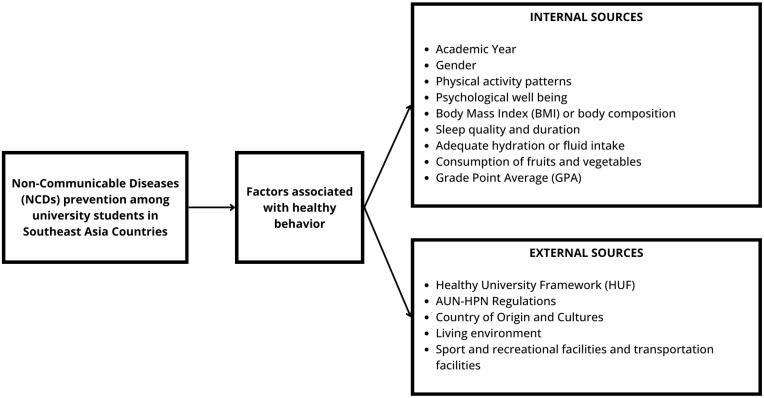
Background: The increasing burden of Non-Communicable Diseases (NCDs) in both low- and high-income ASEAN countries highlights an urgent need for effective management and prevention strategies. These strategies are critical for reducing premature deaths, alleviating the healthcare costs, and saving lives. Unhealthy lifestyle behaviors, such as poor dietary habits, lack of physical activity, alcohol consumption, and inadequate sleep, significantly elevate the risk of metabolic syndrome and other NCDs. Purpose: Mapping the literature on factors related to healthy behaviors for preventing and managing NCDs among college students in ASEAN countries. Methods: A Scoping Review with a PCC (Population-Concept-Context) framework and was referred to the Scoping Review Framework by Arksey and O'Malley. This article reviewed both qualitative and quantitative studies, restricted to full-text articles in English and Indonesian published from 2020 to 2024, focused on University Students, Healthy Behaviour, conducted in ASEAN countries. Results: Of the 1166 articles, 7 studies, involving 71,923 participants, met the criteria. The findings indicate that internal (eg, dietary habits, sleep quality, and mental well-being) and external factors, (eg, student knowledge and perception, and the Health University Framework (HUF)) are significantly associated with health behaviors among university students. Several studies also demonstrate a relationship between healthy behavior and students' psychological conditions and susceptibility to cardiovascular disease. Conclusion: This review found that internal factors, such as dietary habits, sleep quality, BMI, along with external factors, including HUF Implementation and students' knowledge and perceptions, significantly influence healthy behaviors among university students in ASEAN. These factors related with psychological well-being and cardiovascular disease risk. Therefore, effective interventions and implementation of the holistic AUN-HPN HUF framework in universities are essential for preventing and managing NCDs among young adults.
Overview
The claims and statistics of this paper haven’t been checked yet.
Run the check — free, no account needed. It reads the open-access text and checks the sources it cites.
Integrity signals
Registry
Cites
Statistics
Figures
Verification
Claims the paper makes
The claims and statistics of this paper haven’t been checked yet.
Run the check — free, no account needed. It reads the open-access text and checks the sources it cites.
Claims other papers make about this one
Each is checked against this paper’s own text: does it say what the citing paper says it does?
The cited source says what the claim attributes to it.
In the citing paper
“University students represent a particularly vulnerable group prone to adopting unhealthy lifestyles that increase the risk of developing NCDs [9, 10].”
From Psychometric validation and measurement invariance of the Health-Promoting Lifestyle Profile II in Honduran university students (2025) · cites this paper as [10]
Self-check
Percentages, sums and reported differences re-computed from the paper’s own numbers.
The self-check needs the paper’s full text.
Citations
The citation lists haven’t been fetched yet
References 35 · Cited by 12
Research works printed but not linked: 2
- Mora, 2019, J Physic Educ Sport, 19, 2397, 10.7752/jpes.2019.04363 · DOI
- Zahra, 2023, J Educ Technol Health Sci, 2023, 19954
Metadata
- Authors
- Nursiswati, N., Candradewini, C., Sari, D., Kurniasih, S., & Ibrahim, K.
- Affiliations
- Padjadjaran University (ID)
- Corresponding author
- Nursiswati, Nursiswati
- Venue
- Journal of Multidisciplinary Healthcare
- Publisher
- Informa UK Limited
- Published
- 2025-03
- Volume
- Volume 18
- Pages
- 1597-1613
- ISSN
- 1178-2390 (ISSN-L)
- PMC
- PMC11929413
- OpenAlex
- W4408503820
- Cited by
- 12
- References
- 35
- Citations by year
- 2026: 8 · 2025: 4
- FWCI
- 2.38
- Type
- journal article
- Language
- en
- Open access
- gold
- doi.org
- Licence
- Locations
- Journal of Multidisciplinary Healthcare (publishedVersion, cc-by-nc)
- Europe PMC (PubMed Central) (publishedVersion, cc-by-nc)
- PubMed Central (publishedVersion, cc-by-nc)
- PubMed (publishedVersion)
- Dove Medical Press (Taylor and Francis Group) (acceptedVersion, other-oa)
- Funders
- Universitas Padjadjaran
- Topics
- Health Sciences › Medicine › Public Health, Environmental and Occupational Health › Health and Lifestyle Studies
- Health Sciences › Health Professions › General Health Professions › Health and Wellbeing Research
- Health Sciences › Medicine › Public Health, Environmental and Occupational Health › School Health and Nursing Education
- Keywords
- non-communicable diseases, health behavior, university students, ASEAN countries, dietary habits, sleep quality, psychological well-being, cardiovascular risk, body mass index, alcohol consumption, physical activity, non-communicable disease prevention
About these checks
Registry, retraction, Cites and statistics results are computed, not judged, with one exception: a printed reference that no index lists is read once by a model before it counts as a citation error. Claims are extracted by a model and kept only when their quote appears verbatim in the text; each cited source is then checked, with a model’s help, for whether it says what the claim relies on. Those verdicts can be wrong — read the claim’s quote and the cited source before relying on one.
Statistics and arithmetic are recomputed, not judged.
Confidence bands are shown only for fields calibrated on our annotated test set. None is calibrated yet, so no band is shown.
What counts as a claim ›How we measure confidence ›How we check this ›
Are you an author, or do you see a problem with this page? Request a review
How to cite
Cite CoChat for the checks on this page, and the paper for its own findings.
- This page
- CoChat. (2026). Citation check: Factors Associated with Healthy Behavior for Preventing Non-Communicable Diseases. https://app.cochat.ai/papers/10.2147/jmdh.s504338
- The paper
- Nursiswati, N., Candradewini, C., Sari, D., Kurniasih, S., & Ibrahim, K. (2025). Factors Associated with Healthy Behavior for Preventing Non-Communicable Diseases. Journal of Multidisciplinary Healthcare. https://doi.org/10.2147/jmdh.s504338
