

Non-Hispanic Black-White disparities in pain and pain management among newly admitted nursing home residents with cancer
Open accessThe DOI matches its Crossref record; 39 of the 39 references it cites were found in a registry or an index.
Abstract
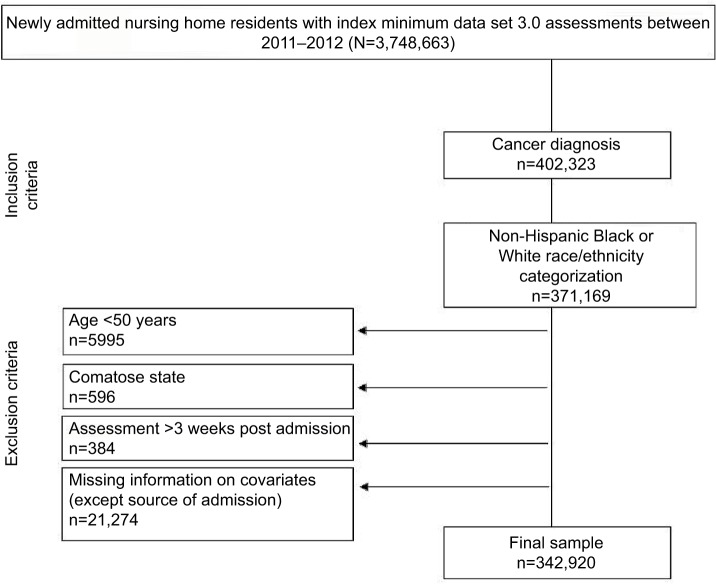
BACKGROUND: Racial disparities in pain management persist across health care settings and likely extend into nursing homes. No recent studies have evaluated racial disparities in pain management among residents with cancer in nursing homes at time of admission. METHODS: Using a cross-sectional study design, we compared reported pain and pain management between non-Hispanic White and non-Hispanic Black newly admitted nursing home residents with cancer (n=342,920) using the de-identified Minimum Data Set version 3.0. Pain management strategies included the use of scheduled analgesics, pro re nata analgesics, and non-pharmacological methods. Presence of pain was based on self-report when residents were able, and staff report when unable. Robust Poisson models provided estimates of adjusted prevalence ratios (aPR) and 95% CIs for reported pain and pain management strategies. RESULTS: Among nursing home residents with cancer, ~60% reported pain with non-Hispanic Blacks less likely to have both self-reported pain (aPR [Black versus White]: 0.98, 95% CI: 0.97-0.99) and staff-reported pain (aPR: 0.89, 95% CI: 0.86-0.93) documentation compared with Non-Hispanic Whites. While most residents received some pharmacologic pain management, Blacks were less likely to receive any compared with Whites (Blacks: 66.6%, Whites: 71.1%; aPR: 0.98, 95% CI: 0.97-0.99), consistent with differences in receipt of non-pharmacologic treatments (Blacks: 25.8%, Whites: 34.0%; aPR: 0.98, 95 CI%: 0.96-0.99). CONCLUSION: Less pain was reported for Black compared with White nursing home residents and White residents subsequently received more frequent pain management at admission. The extent to which unequal reporting and management of pain persists in nursing homes should be further explored.
Overview
The claims and statistics of this paper haven’t been checked yet.
Free: it reads the open-access text and checks the first 5 claims that cite a source we can check. Create a free account to check every claim.
Integrity signals
Registry
Cites
Statistics
Figures
Verification
Claims the paper makes
The claims and statistics of this paper haven’t been checked yet.
Free: it reads the open-access text and checks the first 5 claims that cite a source we can check. Create a free account to check every claim.
Claims other papers make about this one
Each is checked against this paper’s own text: does it say what the citing paper says it does?
The source backs part of the claim, not all of it — or backs it for a different population, condition or comparison.
In the citing paper
“Largely due to their segregation into lower quality facilities, Black nursing home residents as compared with their white counterparts report lower quality of life (Shippee et al., 2020), are more often physically restrained (Cassie and Cassie, 2013), and receive pain treatment less often (Mack et al., 2018).”
From Algorithmic harms and digital ageism in the use of surveillance technologies in nursing homes (2022) · cites this paper as Mack et al., 2018
Experimental — accuracy not yet measured
Self-check
Percentages, sums and reported differences re-computed from the paper’s own numbers.
The self-check needs the paper’s full text.
Citations
Cites
Race, Gender, and Partnership in the Patient-Physician Relationship
Cooper-Patrick, L. (1999) · JAMA · doi:10.1001/jama.282.6.583 · Cited by 2,148 · cited 1×
“Two studies have shown that minority patients participate less in their medical decision making than their non-Hispanic White counterparts.(42,43) This discrepancy in medical decision making could lead to less communication in pain reporting and worse outcomes in pain management for minority patients.”
BackgroundPain and Its Treatment in Outpatients with Metastatic Cancer
Cleeland, C. S., Gonin, R., Hatfield, A. K., Edmonson, J. H., Blum, R. H., Stewart, J. A., & Pandya, K. J. (1994) · New England Journal of Medicine · doi:10.1056/nejm199403033300902 · Cited by 2,019
Morris, J. N., Fries, B. E., & Morris, S. A. (1999) · The Journals of Gerontology Series A: Biological Sciences and Medical Sciences · doi:10.1093/gerona/54.11.m546 · Cited by 1,408
Management of Pain in Elderly Patients With Cancer
Bernabei, R. (1998) · JAMA · doi:10.1001/jama.279.23.1877 · Cited by 1,158 · cited 5×
“Previous studies have shown an underreporting of pain among minority races, including African-Americans in US nursing facilities.(7,8,38,39) One study found that Black nursing home residents were 20% less likely to have documented daily pain that was at times excruciating when compared with White residents.”
BackgroundResultSelf-citationZech, D. F. J., Grond, S., Lynch, J., Hertel, D., & Lehmann, K. A. (1995) · Pain · doi:10.1016/0304-3959(95)00017-m · Cited by 1,015
Pharmacological Management of Persistent Pain in Older Persons
American Geriatrics Society Panel on the Pharmacological Management of Persistent Pain in Older Persons (2009) · Journal of the American Geriatrics Society · doi:10.1111/j.1532-5415.2009.02376.x · Cited by 1,008
Teno, J. M., Gozalo, P. L., Bynum, J. P. W., Leland, N. E., Miller, S. C., Morden, N. E., Scupp, T., Goodman, D. C., & Mor, V. (2013) · JAMA · doi:10.1001/jama.2012.207624 · Cited by 966
Patient Race/Ethnicity and Quality of Patient–Physician Communication During Medical Visits
Johnson, R. L., Roter, D., Powe, N. R., & Cooper, L. A. (2004) · American Journal of Public Health · doi:10.2105/ajph.94.12.2084 · Cited by 955 · cited 1×
“These studies have mostly considered non-Hispanic Blacks to be the “exposed” group and non-Hispanic Whites to be the reference group.(14,17,21,29)”
BackgroundPharmacological Management of Persistent Pain in Older Persons
(2009) · Pain Medicine · doi:10.1111/j.1526-4637.2009.00699.x · Cited by 916
Pergolizzi, J., Böger, R. H., Budd, K., Dahan, A., Erdine, S., Hans, G., Kress, H., Langford, R., Likar, R., Raffa, R. B., et al. (2008) · Pain Practice · doi:10.1111/j.1533-2500.2008.00204.x · Cited by 854
Research works printed but not linked: 1
- [16]Institute of Medicine Chapter 4: assessing potential sources of racial and ethnic disparities in care: the clinical encounter Unequal Treatment Smedley B Stith AY Nelson AR National Academies Press Washington, DC, USA 2002
Cited by
Management of Pain in the United States—A Brief History and Implications for the Opioid Epidemic
Bernard, S. A., Chelminski, P. R., Ives, T. J., & Ranapurwala, S. I. (2018) · Health Services Insights · doi:10.1177/1178632918819440 · Cited by 85
Addressing systemic racism in nursing homes: a time for action
Sloane, P. D., Yearby, R., Konetzka, R. T., Li, Y., Espinoza, R., & Zimmerman, S. (2021) · Journal of the American Medical Directors Association · doi:10.1016/j.jamda.2021.02.023 · Cited by 76
Disparities in Pain Management
Nguyen, L. H., Dawson, J. E., Brooks, M., Khan, J. S., & Telusca, N. (2023) · Anesthesiology Clinics · doi:10.1016/j.anclin.2023.03.008 · Cited by 55
Algorithmic harms and digital ageism in the use of surveillance technologies in nursing homes
Berridge, C., & Grigorovich, A. (2022) · Frontiers in Sociology · doi:10.3389/fsoc.2022.957246 · Cited by 47
“As a result of systemic racism, care quality and outcomes are worse in facilities that house primarily Black or Hispanic residents (Mor et al., 2004; Smith et al., 2008; Fennell et al., 2010; Cassie and Cassie, 2013; Li et al., 2015; Mack et al., 2018).”
Background“I Was Literally Just Not Myself”: How Chronic Pain Changes Multiple Frames of Identity
Voorhees, H. L. (2022) · Health Communication · doi:10.1080/10410236.2022.2025702 · Cited by 36
“There is evidence that people belonging to a racial minority are less likely to seek treatment for medical conditions of all types (Mack et al., 2018), and are commonly undertreated when they do seek medical care for pain (Green et al., 2003a), even though they may experience more severe levels of…”
Background
Metadata
- Authors
- Mack, D. S., Hunnicutt, J., Jesdale, B., & Lapane, K.
- Affiliations
- University of Massachusetts Chan Medical School (US)
- Corresponding author
- Lapane, Kate
- Venue
- Journal of Pain Research
- Publisher
- Informa UK Limited
- Published
- 2018-04
- Volume
- Volume 11
- Pages
- 753-761
- ISSN
- 1178-7090 (ISSN-L)
- PMC
- PMC5905487
- OpenAlex
- W2798225624
- Cited by
- 31
- References
- 39
- Citations by year
- 2026: 1 · 2025: 2 · 2024: 7 · 2023: 6 · 2022: 6 · 2021: 3 · 2020: 3 · 2019: 2 · 2018: 1
- FWCI
- 3.30
- Type
- journal article
- Language
- en
- Open access
- gold
- doi.org
- Licence
- Locations
- Journal of Pain Research (publishedVersion, cc-by-nc)
- Europe PMC (PubMed Central) (publishedVersion, cc-by-nc)
- PubMed Central (publishedVersion, cc-by-nc)
- PubMed (publishedVersion)
- The Journal of the American Medical Association (JAMA) Network (American Medical Association) (submittedVersion, cc-by-nc)
- DOAJ (DOAJ: Directory of Open Access Journals) (submittedVersion, cc-by-sa)
- Dove Medical Press (Taylor and Francis Group) (submittedVersion, cc-by-nc)
- Funders
- National Institutes of Health (TL1TR001454, TR001454)
- National Cancer Institute (R21CA198172)
- National Center for Advancing Translational Sciences
- Topics
- Health Sciences › Medicine › Anesthesiology and Pain Medicine › Pain Management and Opioid Use
- Health Sciences › Medicine › Geriatrics and Gerontology › Geriatric Care and Nursing Homes
- Health Sciences › Medicine › Public Health, Environmental and Occupational Health › Palliative Care and End-of-Life Issues
- Keywords
- racial disparities, pain management, cancer pain, nursing home residents, black-white disparities, newly admitted residents, analgesic use, non-pharmacological pain management, pain reporting, Minimum Data Set, end-of-life care
About these checks
Registry, retraction, Cites and statistics results are computed, not judged, with one exception: a printed reference that no index lists is read once by a model before it counts as a citation error. Claims are extracted by a model and kept only when their quote appears verbatim in the text; each cited source is then checked, with a model’s help, for whether it says what the claim relies on. Those verdicts can be wrong — read the claim’s quote and the cited source before relying on one.
Statistics and arithmetic are recomputed, not judged.
Confidence bands are shown only for fields calibrated on our annotated test set. None is calibrated yet, so no band is shown.
What counts as a claim ›How we measure confidence ›How we check this ›
Are you an author, or do you see a problem with this page? Request a review
Data sources
Bibliographic data: Semantic Scholar, OpenAlex, Crossref.
Contains information from the Semantic Scholar Academic Graph Datasets, made available under the ODC Attribution License (ODC-BY 1.0).
Semantic Scholar’s data is described in: Kinney, R., et al. (2023). The Semantic Scholar Open Data Platform. arXiv:2301.10140.
