

The DOI matches its Crossref record; 47 of the 49 references it cites were found in a registry or an index.
The Impact of Event Scale – Revised: psychometric properties of the Italian version in a sample of flood victims
Open accessAbstract
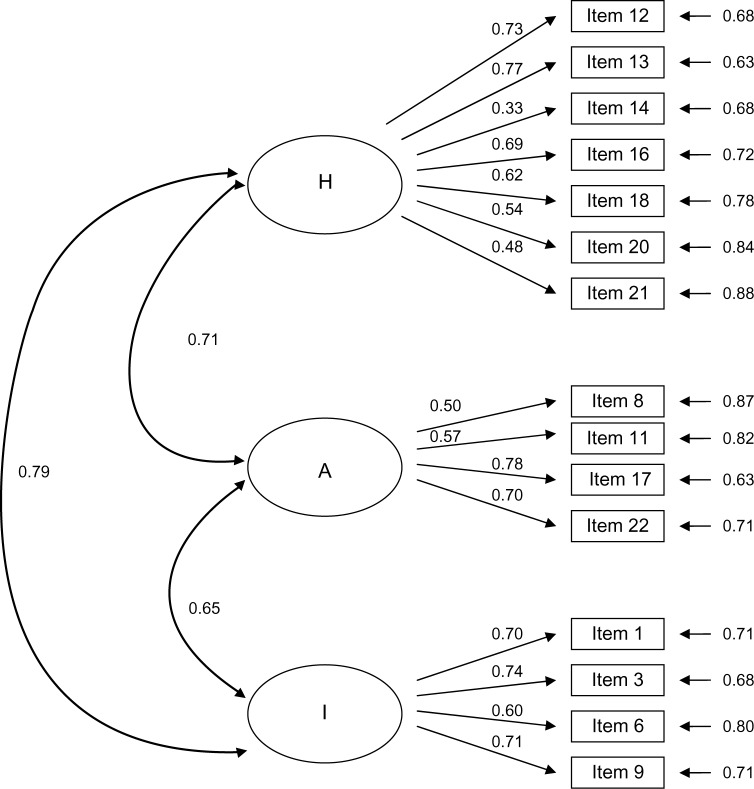
BACKGROUND: This study aims to verify the main psychometric properties of the Italian version of the Impact of Event Scale - Revised (IES-R) in a sample of flood victims. METHODS: The sample was composed of 262 subjects involved in the natural disaster of 2009 in the city of Messina (Italy). All participants completed the IES-R and the Dissociative Experiences Scale-II (DES-II) in order to verify some aspects of convergent validity. RESULTS: THE EXPLORATORY AND CONFIRMATORY FACTOR ANALYSIS, USED TO VERIFY THE CONSTRUCT VALIDITY OF THE MEASURE, SHOWED A CLEAR FACTOR STRUCTURE WITH THREE INDEPENDENT DIMENSIONS: intrusion, avoidance, and hyper-arousal. The goodness-of-fit indices (non-normed fit index [NNFI] = 0.99; comparative fit index [CFI] = 0.99; standardized root mean square residual [SRMR] = 0.04; and root mean square error of approximation [RMSEA] = 0.02) indicated a good adaptation of the model to the data. The IES-R scales showed satisfactory values of internal consistency (intrusion, α = 0.78; avoidance, α = 0.72; hyper-arousal, α = 0.83) and acceptable values of correlation with the DES-II. CONCLUSION: These results suggest that this self-reported and easily administered instrument for assessing the dimensions of trauma has good psychometric properties and can be adopted usefully, both for research and for practice in Italy.
Overview
The claims and statistics of this paper haven’t been checked yet.
Run the check — free, no account needed. It reads the open-access text and checks the sources it cites.
Integrity signals
Registry
Cites
Statistics
Figures
Verification
Claims the paper makes
The claims and statistics of this paper haven’t been checked yet.
Run the check — free, no account needed. It reads the open-access text and checks the sources it cites.
Claims other papers make about this one
Each is checked against this paper’s own text: does it say what the citing paper says it does?
The cited source says what the claim attributes to it.
In the citing paper
“The Italian version of the IES-R [29] has a clear factor structure with three independent and robust dimensions: intrusion, avoidance, and hyperarousal.”
In the citing paper
“To assess the perceived emotional distress that accompanies a stressful life event, we used the impact of event scale–revised (IES–R), that showed a high internal consistency (Cronbach’s α = 0.95) [26,27,28].”
From Anxiety, depression and risk of post-traumatic stress disorder in health workers: the relationship with burnout during COVID-19 pandemic in Italy (2021) · cites this paper as [27]
Self-check
Percentages, sums and reported differences re-computed from the paper’s own numbers.
The self-check needs the paper’s full text.
Citations
Cites
Diagnostic and Statistical Manual of Mental Disorders
Williams, J. B. W., & First, M. B. (2013) · Oxford University Press eBooks · doi:10.1093/acrefore/9780199975839.013.104 · Cited by 109,842
Tabachnick, B. G., & Fidell, L. S. (1983) · Cited by 79,882
Herne, H., Cooley, W. W., & Lohnes, P. R. (1973) · Journal of the Royal Statistical Society Series A (General) · doi:10.2307/2344428 · Cited by 35,801
(1991) · Cited by 15,554
Scale Development: Theory and Applications.
Xie, Y.-P., & Devellis, R. (1992) · Contemporary Sociology A Journal of Reviews · doi:10.2307/2075704 · Cited by 14,143
(1998) · DigitalCommons - Kennesaw State University (Kennesaw State University) · Cited by 13,997
The Scree Test For The Number Of Factors
Cattell, R. B. (1966) · Multivariate Behavioral Research · doi:10.1207/s15327906mbr0102_10 · Cited by 13,554
EQS : structural equations program manual
Bentler, P. M. (1989) · Medical Entomology and Zoology · Cited by 9,669
Impact of Event Scale: A Measure of Subjective Stress
Horowitz, M., Wilner, N., & Alvarez, W. (1979) · Psychosomatic Medicine · doi:10.1097/00006842-197905000-00004 · Cited by 7,813
Diagnostic and Statistical Manual of Mental Disorders, 5th Edition
(2013) · American Psychiatric Association Publishing eBooks · doi:10.1176/appi.books.9780890425596.893619 · Cited by 4,407
Diagnostic and Statistical Manual of Mental Disorders
Siegel, L. J., & Fletcher‐Janzen, E. (2014) · Wiley eBooks · doi:10.1002/9781118660584.ese0728 · Cited by 3,438
Haslwanter, T. (2016) · Statisctics and computing/Statistics and computing · doi:10.1007/978-3-319-28316-6_12 · Cited by 3,094
The Impact of Event Scale: Revised
Weiss, D. S. (2007) · Springer eBooks · doi:10.1007/978-0-387-70990-1_10 · Cited by 3,053
(1993) · Cited by 1,279
Assessing psychological trauma and PTSD
Wilson, J.-P., & Keane, T. (1997) · Choice Reviews Online · doi:10.5860/choice.34-5966 · Cited by 1,274
Impact of Event Scale--Revised
Weiss, D. S., & Marmar, C. R. (1997) · PsycTESTS Dataset · doi:10.1037/t12199-000 · Cited by 790
Impact of Event Scale: psychometric properties
Sundin, E., & Horowitz, M. J. (2002) · The British Journal of Psychiatry · doi:10.1192/bjp.180.3.205 · Cited by 689
ASUKAI, N., KATO, H., KAWAMURA, N., KIM, Y., YAMAMOTO, K., KISHIMOTO, J., MIYAKE, Y., & NISHIZONO-MAHER, A. (2002) · The Journal of Nervous and Mental Disease · doi:10.1097/00005053-200203000-00006 · Cited by 679
Beck, J. G., Grant, D. M., Read, J. P., Clapp, J. D., Coffey, S. F., Miller, L. M., & Palyo, S. A. (2007) · Journal of Anxiety Disorders · doi:10.1016/j.janxdis.2007.02.007 · Cited by 506
A NOTE ON GUTTMAN'S LOWER BOUND FOR THE NUMBER OF COMMON FACTORS 1
Kaiser, H. F. (1961) · British Journal of Statistical Psychology · doi:10.1111/j.2044-8317.1961.tb00061.x · Cited by 441
Psychometric evaluation of Horowitz's impact of event scale: A review
Joseph, S. (2000) · Journal of Traumatic Stress · doi:10.1023/a:1007777032063 · Cited by 392
Validation of a French Version of the Impact of Event Scale-Revised
Brunet, A., St-Hilaire, A., Jehel, L., & King, S. (2003) · Canadian journal of psychiatry. Revue canadienne de psychiatrie · doi:10.1177/070674370304800111 · Cited by 349
Horowitz’s Impact of Event Scale Evaluation of 20 Years of Use
Sundin, E., & Horowitz, M. J. (2003) · Psychosomatic Medicine · doi:10.1097/01.psy.0000084835.46074.f0 · Cited by 308
Construct Validation of the Dutch Version of the Impact of Event Scale.
van der Ploeg, E., Mooren, T. T. M., Kleber, R. J., van der Velden, P. G., & Brom, D. (2004) · Psychological Assessment · doi:10.1037/1040-3590.16.1.16 · Cited by 294
Psicoterapia cognitiva e comportamentale
Sanavio, E. (1991) · Padua Research Archive (University of Padova) · Cited by 289
The development of the Chinese version of Impact of Event Scale - Revised (CIES-R)
Wu, K. K., & Chan, K. S. (2003) · Social Psychiatry and Psychiatric Epidemiology · doi:10.1007/s00127-003-0611-x · Cited by 251
Pietrantonio, F., Gennaro, L. D., Paolo, M. C. D., & Solano, L. (2003) · Journal of Psychosomatic Research · doi:10.1016/s0022-3999(02)00638-4 · Cited by 235
Análisis y modificación de conducta
Herreras, E. B. (2003) · Dialnet (Universidad de la Rioja) · Cited by 112
Reliability and validity of the Korean version of the Impact of Event Scale-Revised
Lim, H. K., Woo, J., Kim, T., Kim, T., Choi, K., Chung, S., Chee, I., Lee, K., Paik, K. C., Seo, H., et al. (2008) · Comprehensive Psychiatry · doi:10.1016/j.comppsych.2008.09.011 · Cited by 94
Validation of a Swedish version of the Impact of Event Scale-Revised (IES-R) in patients with burns
Sveen, J., Low, A., Dyster‐Aas, J., Ekselius, L., Willebrand, M., & Gerdin, B. (2010) · Journal of Anxiety Disorders · doi:10.1016/j.janxdis.2010.03.021 · Cited by 92
Franzonı, E., Verrotti, A., Gualandi, Caretti, Schimmenti, A., Pietro, D., Craparo, G., Franchi, Pellicciari, A., & Pellegrini (2013) · Neuropsychiatric Disease and Treatment · doi:10.2147/ndt.s34822 · Cited by 82
Self-citationInternet addiction, dissociation, and alexithymia
Craparo, G. (2011) · Procedia - Social and Behavioral Sciences · doi:10.1016/j.sbspro.2011.10.205 · Cited by 63
Self-citationKing, D. W., Orazem, R. J., Lauterbach, D., King, L. A., Hebenstreit, C. L., & Shalev, A. Y. (2009) · Psychological Trauma Theory Research Practice and Policy · doi:10.1037/a0016990 · Cited by 57
Rutter, L. A., Weatherill, R. P., Krill, S. C., Orazem, R. J., & Taft, C. T. (2011) · Psychological Trauma Theory Research Practice and Policy · doi:10.1037/a0021996 · Cited by 53
Luca, M., Giannini, M., Gori, A., & Littleton, H. (2011) · Body Image · doi:10.1016/j.bodyim.2011.04.007 · Cited by 48
Self-citationLilly, M. M., & Pierce, H. (2012) · Psychological Trauma Theory Research Practice and Policy · doi:10.1037/a0026850 · Cited by 41
Chen, S., Lai, Y., Liao, C.-T., & Lin, C. (2005) · Supportive Care in Cancer · doi:10.1007/s00520-005-0775-x · Cited by 36
Validation of the Impact of Event Scale on a Sample of American Vietnam Veterans
Hendrix, C. C., Jurich, A. P., & Schumm, W. R. (1994) · Psychological Reports · doi:10.2466/pr0.1994.75.1.321 · Cited by 30
Manna, G., Faraci, P., & Como, M. R. (2013) · Europe’s Journal of Psychology · doi:10.5964/ejop.v9i2.500 · Cited by 26
Self-citationReliability and validity of the Impact of Event Scale (IES): version for Brazilian burn victims
Echevarría-Guanilo, M. E., Dantas, R. A. S., Farina, J. A., Alonso, J., Rajmil, L., & Rossi, L. A. (2011) · Journal of Clinical Nursing · doi:10.1111/j.1365-2702.2010.03607.x · Cited by 23
Gori, A., Giannini, M., Socci, S., Luca, M., Dewey, D., Schuldberg, D., & Craparo, G. (2013) · The Mathematics Enthusiast · Cited by 22
Self-citationJohn, P. B., & Russell, P. S. S. (2007) · Clinical Practice and Epidemiology in Mental Health · doi:10.1186/1745-0179-3-4 · Cited by 15
Fear of flying assessment: A contribution to the Italian validation of two self-report measures
Faraci, P., Triscari, M. T., D’Angelo, V., & Urso, V. (2011) · University of Zagreb University Computing Centre (SRCE) · Cited by 12
Self-citationIl Disturbo Post-Traumatico da Stress
Pieraccini, F., Bossini, L., Lombardelli, A., Calossi, S., Traverso, S., Annese, P. M., & Castrogiovanni, P. (2004) · Nóos · Cited by 7
Il disturbo post-traumatico da stress
Onnis, A., & Carucci, S. (2023) · Medico e Bambino · doi:10.53126/meb42451 · Cited by 5
The psychometric cross-cultural validation of the Impact of Event Scale.
Aghanwa, H. S., Walkey, F. H., & Taylor, A. J. W. (2003) · PubMed · Cited by 4
Manna, G., Faraci, P., & Como, M. R. (2013) · PsycEXTRA Dataset · doi:10.1037/e562792013-008 · Cited by 4
Self-citation
Cited by
Sorted by citations
Forte, G., Favieri, F., Tambelli, R., & Casagrande, M. (2020) · International Journal of Environmental Research and Public Health · doi:10.3390/ijerph17114151 · Cited by 394
Lasalvia, A., Bonetto, C., Porru, S., Carta, A., Tardivo, S., Bovo, C., Ruggeri, M., & Amaddeo, F. (2020) · Epidemiology and Psychiatric Sciences · doi:10.1017/s2045796020001158 · Cited by 229
Surviving COVID-19 in Bergamo province: a post-acute outpatient re-evaluation
Venturelli, S., Benatti, S. V., Casati, M., Binda, F., Zuglian, G., Imeri, G., Conti, C., Biffi, A. M., Spada, M. S., Bondi, E., et al. (2021) · Epidemiology and Infection · doi:10.1017/s0950268821000145 · Cited by 146
Internet Addiction Test (IAT): Which is the Best Factorial Solution?
Faraci, P., Craparo, G., Messina, R., & Severino, S. (2013) · Journal of Medical Internet Research · doi:10.2196/jmir.2935 · Cited by 148
Self-citationTheodorou, A., Panno, A., Carrus, G., Carbone, G. A., Massullo, C., & Imperatori, C. (2021) · Urban forestry & urban greening · doi:10.1016/j.ufug.2021.127091 · Cited by 128
Metadata
- Authors
- Craparo, G., Faraci, P., Rotondo, G., & Gori, A.
- Affiliations
- Università degli Studi di Enna Kore (IT)
- Fondazione Istituto G. Giglio di Cefalù (IT)
- University of Florence (IT)
- Corresponding author
- Craparo, Giuseppe
- Venue
- Neuropsychiatric Disease and Treatment
- Publisher
- Informa UK Limited
- Published
- 2013-09
- Volume
- 9
- Pages
- 1427
- ISSN
- 1176-6328 (ISSN-L)
- PMC
- PMC3788700
- OpenAlex
- W2039905564
- Cited by
- 146
- References
- 49
- Citations by year
- 2026: 7 · 2025: 8 · 2024: 20 · 2023: 15 · 2022: 32 · 2021: 30 · 2020: 15 · 2019: 1 · 2018: 3 · 2017: 3 · 2016: 2 · 2015: 2 · 2014: 5 · 2013: 3
- FWCI
- 4.45
- Type
- journal article
- Language
- en
- Open access
- gold
- doi.org
- Licence
- Locations
- Neuropsychiatric Disease and Treatment (publishedVersion, cc-by-nc)
- Europe PMC (PubMed Central) (publishedVersion, cc-by-nc)
- PubMed Central (publishedVersion, cc-by-nc)
- PubMed (publishedVersion)
- Dove Medical Press (Taylor and Francis Group) (submittedVersion, cc-by-nc)
- Florence Research (University of Florence) (submittedVersion)
- Topics
- Social Sciences › Psychology › Clinical Psychology › Posttraumatic Stress Disorder Research
- Social Sciences › Decision Sciences › Management Science and Operations Research › Psychometric Methodologies and Testing
- Social Sciences › Psychology › Experimental and Cognitive Psychology › Anxiety, Depression, Psychometrics, Treatment, Cognitive Processes
- Keywords
- Impact of Event Scale-Revised, psychometric properties, Italian adaptation, flood victims, natural disasters, post-traumatic stress, intrusion, avoidance, hyperarousal, dissociation, convergent validity, factor structure
About these checks
Registry, retraction, Cites and statistics results are computed, not judged, with one exception: a printed reference that no index lists is read once by a model before it counts as a citation error. Claims are extracted by a model and kept only when their quote appears verbatim in the text; each cited source is then checked, with a model’s help, for whether it says what the claim relies on. Those verdicts can be wrong — read the claim’s quote and the cited source before relying on one.
Statistics and arithmetic are recomputed, not judged.
Confidence bands are shown only for fields calibrated on our annotated test set. None is calibrated yet, so no band is shown.
What counts as a claim ›How we measure confidence ›How we check this ›
Are you an author, or do you see a problem with this page? Request a review
