

TMEFF2 inhibits pancreatic cancer cells proliferation, migration, and invasion by suppressing phosphorylation of the MAPK signaling pathway
Open accessThe DOI matches its Crossref record; 40 of the 50 references it cites were found in a registry or an index.
Abstract
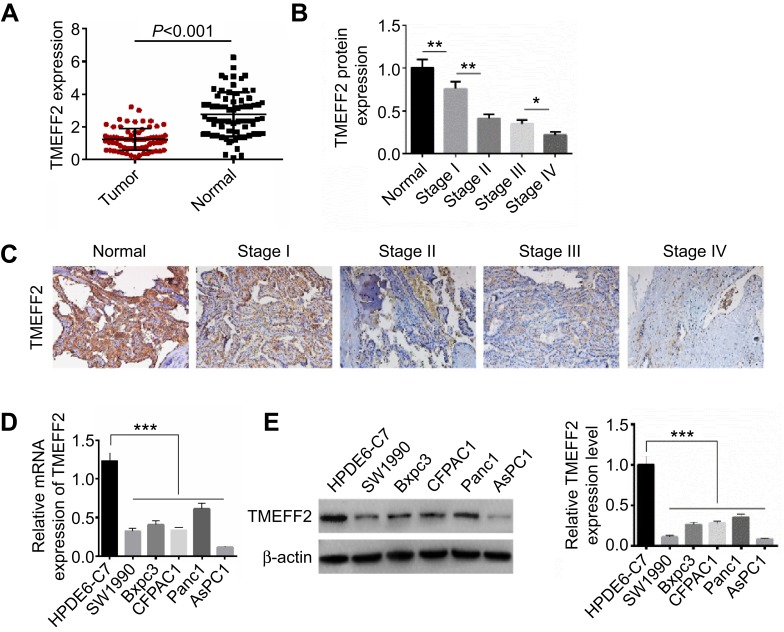
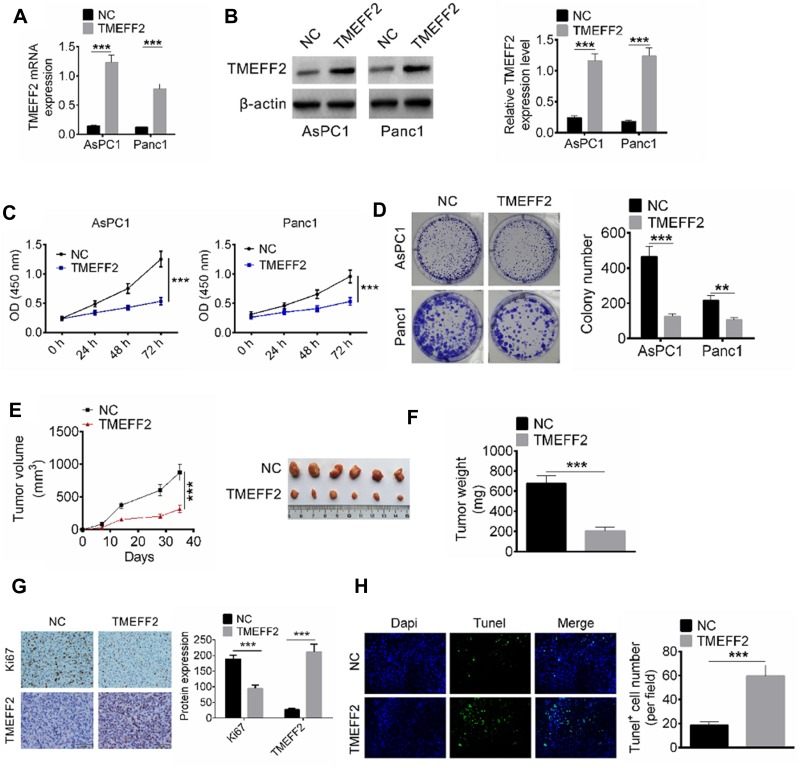
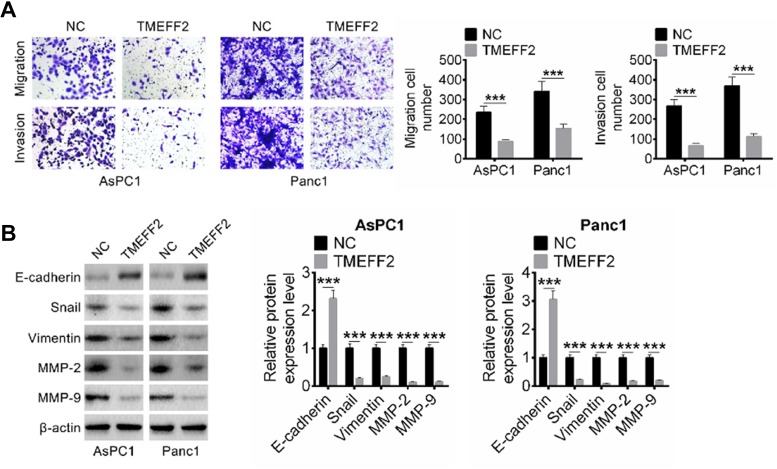
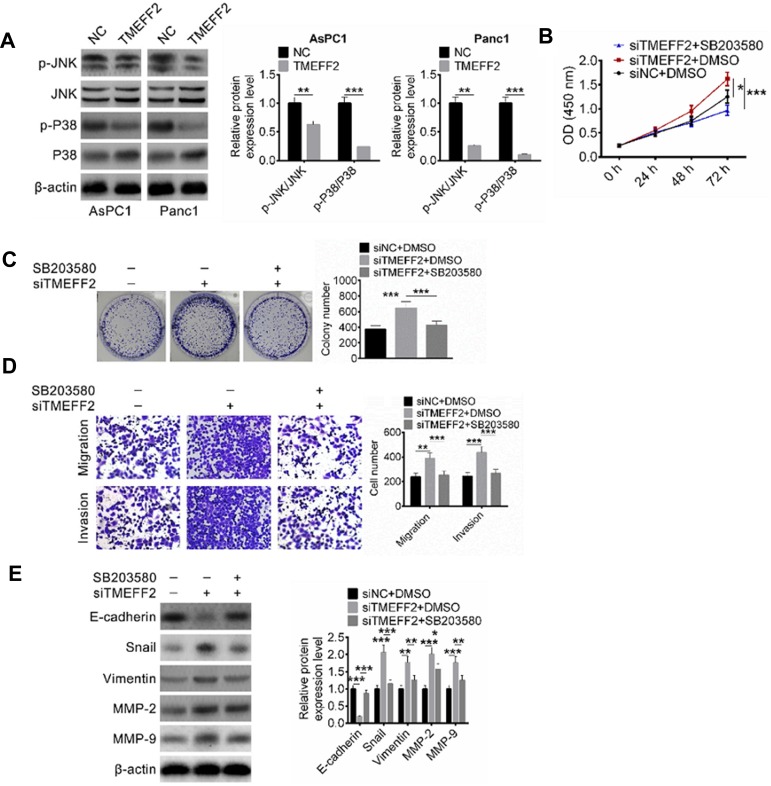
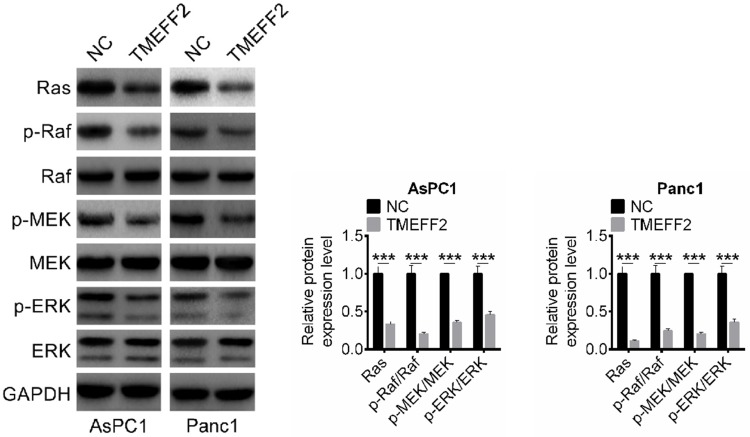
PURPOSE: This paper studied the effect of TMEFF2 expression on pancreatic cancer and its mechanism. METHODS: A total of 72 pancreatic cancer patients were enrolled. AsPC1 and Panc1 cells were transfected. SB203580 was used to treat AsPC1 cells. CCK8 assay, colony formation analysis, Transwell experiment and Tunel test were performed. In vivo studies in nude mice were conducted. Immunohistochemistry, qRT-PCR and Western blot were used to detect genes expression. RESULTS: <0.01). Compared with the NC group, AsPC1 and Panc1 cells of the TMEFF2 group exhibited much lower OD450 values, colony number, tumor volume and weight, migration and invasion cell numbers, obviously higher E-cadherin protein expression, lower Snail, Vimentin, MMP-2 and MMP-9 proteins expression, lower phosphorylation level of MAPK signaling pathway, and more apoptotic cells. AsPC1 cells of the SB203580 group showed much lower OD450 value when compared with the siTMEFF2 group. Significantly decreased colony number, migration and invasion number, higher E-cadherin protein expression and lower Snail, Vimentin, MMP-2 and MMP-9 proteins expression were found in AsPC1 cells of the siTMEFF2+ SB203580 group when compared with the siTMEFF2+ DMSO group. CONCLUSION: TMEFF2 inhibits pancreatic cancer cells proliferation, migration, and invasion by suppressing the phosphorylation of the MAPK signaling pathway.
Overview
The claims and statistics of this paper haven’t been checked yet.
Free: it reads the open-access text and checks the first 5 claims that cite a source we can check. Create a free account to check every claim.
Integrity signals
Registry
Cites
Statistics
Figures
Verification
Claims the paper makes
The claims and statistics of this paper haven’t been checked yet.
Free: it reads the open-access text and checks the first 5 claims that cite a source we can check. Create a free account to check every claim.
Claims other papers make about this one
Each is checked against this paper’s own text: does it say what the citing paper says it does?
In the citing paper
“The cancer-related proteins are abnormally expressed (overexpressed, low expressed, or mutant) in cancer cells compared to normal cells.”
From The design and development of covalent protein-protein interaction inhibitors for cancer treatment (2020) · cites this paper as [17]
Self-check
Percentages, sums and reported differences re-computed from the paper’s own numbers.
The self-check needs the paper’s full text.
Citations
Cites
Yaşlı Kadınlarda Üreme Sağlığı
Kokanalı, D., & Engin Üstün, Y. (n.d.) · DergiPark (Istanbul University) · Cited by 170,090
Yaşlı Kadınlarda Üreme Sağlığı
Kokanalı, D., & Üstün, Y. E. (2019) · Jinekoloji-Obstetrik ve Neonatoloji Tıp Dergisi · Cited by 169,629
Siegel, R. L., Miller, K. D., & Jemal, A. (2015) · CA: A Cancer Journal for Clinicians · doi:10.3322/caac.21254 · Cited by 11,853
Epithelial-Mesenchymal Transitions in Development and Disease
Thiery, J. P., Acloque, H., Huang, R. Y. J., & Nieto, M. A. (2009) · Cell · doi:10.1016/j.cell.2009.11.007 · Cited by 9,931
Spencer, P. M., Cameron, J. L., & Lin, L. (2000) · Cited by 7,202
Kamisawa, T., Wood, L. D., Itoi, T., & Takaori, K. (2016) · The Lancet · doi:10.1016/s0140-6736(16)00141-0 · Cited by 2,212
Epithelial-mesenchymal transitions: the importance of changing cell state in development and disease
Acloque, H., Adams, M. S., Fishwick, K., Bronner-Fraser, M., & Nieto, M. A. (2009) · Journal of Clinical Investigation · doi:10.1172/jci38019 · Cited by 1,370 · cited 1×
“Decreased adhesion between cells, rupture of cell desmosome and hemidesmosome, loss of cell polarity, secretion of matrix metalloproteinase and degradation of extracellular matrix are the main features of EMT, which enable tumor cells to gain greater exercise capacity and more space for migration and invasion.(27) E-c…”
BackgroundKi67 is a promising molecular target in the diagnosis of cancer (Review)
LI, L. T., JIANG, G., CHEN, Q., & ZHENG, J. N. (2015) · Molecular Medicine Reports · doi:10.3892/mmr.2014.2914 · Cited by 859
Asati, V., Mahapatra, D. K., & Bharti, S. K. (2016) · European Journal of Medicinal Chemistry · doi:10.1016/j.ejmech.2016.01.012 · Cited by 612 · cited 1×
“The Ras/Raf/MEK/ERK signaling pathwaywas one of themost classical pathway in the MAPKpathways, whichwaswidely involved in the regulation of cell biological behavior and was closely related to the malignant phenotype of tumor cells.(36) After the Ras/Raf/ MEK/ERK signaling pathway was activated, the expression of Ras,…”
BackgroundINFECTIOUS COMPLICATIONS IN PATIENTS WITH ACUTE PROMYELOCITIC LEUKEMIA TREATED WITH THE AIDA REGIMEN
C, G., M, B., La Tagliata, R., Spadea, A., D'Andrea, M., P, M., Lo‐Coco, F., Gentile, G., Micozzi, A., Alimena, G., et al. (2003) · IRIS Research product catalog (Sapienza University of Rome) · doi:10.1038/sj · Cited by 510
Cited by
The design and development of covalent protein-protein interaction inhibitors for cancer treatment
Cheng, S.-S., Yang, G.-J., Wang, W., Leung, C.-H., & Ma, D.-L. (2020) · Journal of Hematology & Oncology · doi:10.1186/s13045-020-00850-0 · Cited by 98
LncRNA MNX1-AS1: A novel oncogenic propellant in cancers
Li, T., Zhou, S., Yang, Y. C., Xu, Y., Gong, X., Cheng, Y., & Wang, Y. (2022) · Biomedicine & Pharmacotherapy · doi:10.1016/j.biopha.2022.112801 · Cited by 22
Integrated analysis of tRNA-derived small RNAs in proliferative human aortic smooth muscle cells
Zhao, J., Li, Q.-Y., Lin, J., Yang, L., Du, M.-Y., Wang, Y., Liu, K., Jiang, Z.-A., Li, H., Wang, S., et al. (2022) · Cellular & Molecular Biology Letters · doi:10.1186/s11658-022-00346-4 · Cited by 21
Tiwari, A., Rahi, S., & Mehan, S. (2020) · Current Drug Targets · doi:10.2174/1389450121666201020155010 · Cited by 19
TMEFF2: A Transmembrane Proteoglycan with Multifaceted Actions in Cancer and Disease
Masood, M., Grimm, S., El-Bahrawy, M. A., & Yagüe, E. (2020) · Cancers · doi:10.3390/cancers12123862 · Cited by 19
“On the other hand, when compared to adjacent normal tissue, TMEFF2 mRNA was do nregulat d in pancreatic cancer (72 atients) [48], and an inverse correlation was observed between TEMFF2 protein in panc eatic cancer tissue and the clinical stage of t disease.”
BackgroundInfluentialGu, M., Liu, Y., Xin, P., Guo, W., Zhao, Z., Xu, Y., Ma, R., Jiao, T., & Zheng, W. (2024) · Cancer Letters · doi:10.1016/j.canlet.2024.216738 · Cited by 16
Role of Serum Creatinine Levels in Prognostic Risk Stratification of Prostate Cancer Patients
Gu, X., Wu, J., Liu, X., Hong, Y., Wu, Y., & Tian, Y. (2022) · Medical Science Monitor · doi:10.12659/msm.937100 · Cited by 14
“A relevant domestic study has shown that the combined detection of sarcosine levels and matrix metallopeptidase 9 has diagnostic value for prostate cancer, and sarcosine is involved in the cancerous process of the prostate [20].”
BackgroundLi, J., Fang, R., Wu, J., Si, Y., Bai, J., & Wang, Q. (2022) · Bioengineered · doi:10.1080/21655979.2022.2050491 · Cited by 11
“The absorbance was measured at 450 nm (OD 450 nm) after 24, 48, and 72 h to assess the cell proliferation ability, according to the instructions of the Cell Counting Kit-8 (Dojindo) [21].”
MethodZhao, J.-Z., Li, Q.-Y., Lin, J.-J., Yang, L.-Y., Du, M.-Y., Wang, Y., Liu, K.-X., Jiang, Z., Li, H.-H., Wang, S.-F., et al. (2022) · Figshare · doi:10.6084/m9.figshare.20080928
Zhao, J.-Z., Li, Q.-Y., Lin, J.-J., Yang, L.-Y., Du, M.-Y., Wang, Y., Liu, K.-X., Jiang, Z.-A., Li, H.-H., Wang, S.-F., et al. (2022) · Figshare · doi:10.6084/m9.figshare.20080949
Zhao, J.-Z., Li, Q.-Y., Lin, J.-J., Yang, L.-Y., Du, M.-Y., Wang, Y., Liu, K.-X., Jiang, Z.-A., Li, H.-H., Wang, S.-F., et al. (2022) · Figshare · doi:10.6084/m9.figshare.20080940
Zhao, J.-Z., Li, Q.-Y., Lin, J.-J., Yang, L.-Y., Du, M.-Y., Wang, Y., Liu, K.-X., Jiang, Z.-A., Li, H.-H., Wang, S.-F., et al. (2022) · Figshare · doi:10.6084/m9.figshare.20080943
Zhao, J.-Z., Li, Q.-Y., Lin, J.-J., Yang, L.-Y., Du, M.-Y., Wang, Y., Liu, K.-X., Jiang, Z.-A., Li, H.-H., Wang, S.-F., et al. (2022) · Figshare · doi:10.6084/m9.figshare.20080952
Zhao, J.-Z., Li, Q.-Y., Lin, J.-J., Yang, L.-Y., Du, M.-Y., Wang, Y., Liu, K.-X., Jiang, Z.-A., Li, H.-H., Wang, S.-F., et al. (2022) · Figshare · doi:10.6084/m9.figshare.20080961
Zhao, J.-Z., Li, Q.-Y., Lin, J.-J., Yang, L.-Y., Du, M.-Y., Wang, Y., Liu, K.-X., Jiang, Z.-A., Li, H.-H., Wang, S.-F., et al. (2022) · Figshare · doi:10.6084/m9.figshare.20080925
Zhao, J.-Z., Li, Q.-Y., Lin, J.-J., Yang, L.-Y., Du, M.-Y., Wang, Y., Liu, K.-X., Jiang, Z.-A., Li, H.-H., Wang, S.-F., et al. (2022) · Figshare · doi:10.6084/m9.figshare.20080931
Zhao, J.-Z., Li, Q.-Y., Lin, J.-J., Yang, L.-Y., Du, M.-Y., Wang, Y., Liu, K.-X., Jiang, Z.-A., Li, H.-H., Wang, S.-F., et al. (2022) · Figshare · doi:10.6084/m9.figshare.20080919
Zhao, J.-Z., Li, Q.-Y., Lin, J.-J., Yang, L.-Y., Du, M.-Y., Wang, Y., Liu, K.-X., Jiang, Z.-A., Li, H.-H., Wang, S.-F., et al. (2022) · Figshare · doi:10.6084/m9.figshare.20080958
Zhao, J.-Z., Li, Q.-Y., Lin, J.-J., Yang, L.-Y., Du, M.-Y., Wang, Y., Liu, K.-X., Jiang, Z.-A., Li, H.-H., Wang, S.-F., et al. (2022) · Figshare · doi:10.6084/m9.figshare.20080922
Zhao, J.-Z., Li, Q.-Y., Lin, J.-J., Yang, L.-Y., Du, M.-Y., Wang, Y., Liu, K.-X., Jiang, Z.-A., Li, H.-H., Wang, S.-F., et al. (2022) · Figshare · doi:10.6084/m9.figshare.20080946
Zhao, J.-Z., Li, Q.-Y., Lin, J.-J., Yang, L.-Y., Du, M.-Y., Wang, Y., Liu, K.-X., Jiang, Z.-A., Li, H.-H., Wang, S.-F., et al. (2022) · Figshare · doi:10.6084/m9.figshare.20080916
Moaven, O., Aslanabadi, S., Mansouri, A., Hart, O., Cios, A., Hartupee, C. D., Yalcin, D., Sinha, G., Wyczechowska, D. D., Cheng, Z., et al. (2026) · Research Square · doi:10.21203/rs.3.rs-9943137/v1
Metadata
- Authors
- Han, H., Zhan, Z., Xu, J., & Song, Z.
- Affiliations
- Yancheng Third People's Hospital (CN)
- Nanjing Medical University (CN)
- Corresponding author
- Song, Zhenshun
- Venue
- OncoTargets and Therapy
- Publisher
- Informa UK Limited
- Published
- 2019-12
- Volume
- Volume 12
- Pages
- 11371-11382
- ISSN
- 1178-6930 (ISSN-L)
- PMC
- PMC6939404
- OpenAlex
- W2996526415
- Cited by
- 21
- References
- 50
- Citations by year
- 2024: 1 · 2022: 17 · 2020: 3
- FWCI
- 2.09
- Type
- journal article
- Language
- en
- Open access
- gold
- doi.org
- Licence
- Locations
- OncoTargets and Therapy (publishedVersion, cc-by-nc)
- PubMed Central (publishedVersion, cc-by-nc)
- PubMed (publishedVersion)
- DOAJ (DOAJ: Directory of Open Access Journals) (acceptedVersion)
- Dove Medical Press (Taylor and Francis Group) (submittedVersion, cc-by-nc)
- Topics
- Health Sciences › Medicine › Oncology › Pancreatic and Hepatic Oncology Research
- Life Sciences › Biochemistry, Genetics and Molecular Biology › Molecular Biology › Mechanisms of cancer metastasis
- Life Sciences › Biochemistry, Genetics and Molecular Biology › Molecular Biology › Protein Kinase Regulation and GTPase Signaling
- Keywords
- TMEFF2, pancreatic cancer, MAPK signaling, cell proliferation, cell migration, cell invasion, E-cadherin, epithelial-mesenchymal transition, snails, vimentin, MMP-2, MMP-9, apoptosis, SB203580, MAPK inhibitors
About these checks
Registry, retraction, Cites and statistics results are computed, not judged, with one exception: a printed reference that no index lists is read once by a model before it counts as a citation error. Claims are extracted by a model and kept only when their quote appears verbatim in the text; each cited source is then checked, with a model’s help, for whether it says what the claim relies on. Those verdicts can be wrong — read the claim’s quote and the cited source before relying on one.
Statistics and arithmetic are recomputed, not judged.
Confidence bands are shown only for fields calibrated on our annotated test set. None is calibrated yet, so no band is shown.
What counts as a claim ›How we measure confidence ›How we check this ›
Are you an author, or do you see a problem with this page? Request a review
Data sources
Bibliographic data: Semantic Scholar, OpenAlex, Crossref.
Contains information from the Semantic Scholar Academic Graph Datasets, made available under the ODC Attribution License (ODC-BY 1.0).
Semantic Scholar’s data is described in: Kinney, R., et al. (2023). The Semantic Scholar Open Data Platform. arXiv:2301.10140.
