

استخدام استراتيجية "SWOM" لتنمية بعض مهارات الحس العددي لدى تلاميذ المرحلة الابتدائية بالمدارس الرسمية لغات
Open accessThe DOI matches its Crossref record; 3 of the 3 references it cites were found in a registry or an index; none of the 3 sources its claims cite is checked for support yet.
Abstract
هدف البحث الحالي إلى استخدام استراتيجية "SWOM" لتنمية بعض مهارات الحس العددي لدى تلاميذ المرحلة الابتدائية بالمدارس الرسمية لغات، ولتحقيق ذلك تم تحديد المحتوى المختار الذي تمثل في وحدة "جمع وطرح الكسور الاعتياديةAdding and Subtracting Fractions " من مقرر مادة الرياضيات للصف الخامس الابتدائي (الفصل الدراسي الثاني) من العام الدراسي 2023/2024م، ثم إعداد دليل المعلم وأوراق عمل التلاميذ في ضوء استراتيجية "SWOM". وتكونت مجموعة البحث من (80) تلميذاً وتلميذة من تلاميذ الصف الخامس الابتدائي بالمدارس الرسمية لغات، تم تقسيمهم إلى مجموعتين إحداهما تجريبية وعددها (40) تلميذاً وتلميذة، والأخرى ضابطة وعددها (40) تلميذاً وتلميذة، وتمثلت أداة البحث في اختبار مهارات الحس العددي (مهارة إدراك الكم المطلق والنسبي للعدد، مهارة إدراك التأثير النسبي للعمليات على الاعداد، مهارة إدراك العلامة العددية المميزة واستخدامها، مهارة إدراك استراتيجيات الحساب الذهني والتقدير التقريبي، مهارة إصدار الأحكام على معقولية نواتج العمليات، مهارة التعبير بالأعداد عن علاقات ممثلة بنماذج بصرية)، وتم تطبيق أداة البحث قبلياً وبعدياً على مجموعتي البحث، وتوصلت نتائج البحث إلى:• وجود فرق ذي دلالة إحصائية عند مستوى دلالة (α ≤ 0.05) بين متوسطي درجات تلاميذ المجموعتين التجريبية والضابطة في التطبيق البعدي لاختبار مهارات الحس العددي ككل وفي كل مهارة على حده، لصالح تلاميذ المجموعة التجريبية.• وجود فرق ذي دلالة إحصائية عند مستوى دلالة (α ≤ 0.05) بين متوسطي درجات تلاميذ المجموعة التجريبية في التطبيقين القبلي والبعدي لاختبار مهارات الحس العددي ككل وفي كل مهارة على حده، لصالح درجات التطبيق البعدي.
Overview
CoChat Summary
TL;DR
This quasi-experimental study examined whether teaching with the SWOM (School Wide Optimum Model) strategy develops number-sense skills among fifth-grade pupils in Egyptian official language schools. It reports statistically significant gains favouring the SWOM-taught experimental group over the control group on a number-sense post-test.
Key findings
- Statistically significant differences at α ≤ 0.05 were found between the experimental and control groups on the post-test of number-sense skills, both as a whole and on each individual skill, in favour of the experimental group (n = 22 per group).
- Reported effect sizes for the strategy on the number-sense skills as a whole and per skill were large, given as 2.080–2.250.
- For the second hypothesis, significant differences at α ≤ 0.05 were found between the experimental group's pre- and post-test scores in favour of the post-test, with reported effect-size percentages of 12.8%–21.2%.
- The number-sense skills targeted were: questioning, comparison, generating possibilities, prediction, problem solving, and decision making.
Methods
- Quasi-experimental design with an experimental group taught via the SWOM strategy and a control group taught conventionally; both groups took a number-sense skills test before and after the intervention.
- Sample: 22 pupils in each group (experimental and control) from the fifth grade of primary stage in official language schools, second term of the 2022/2023 school year; the content unit was "Adding and Subtracting Fractions."
- Instruments included a list of number-sense skills appropriate for fifth-grade pupils, a pupil activity booklet and teacher's guide prepared according to SWOM, and a number-sense skills test; analysis used means, standard deviations, t-values, and effect-size estimates.
Limitations
- The paper does not state explicit limitations. Evident from the text: the sample is small (22 pupils per group) and confined to fifth-grade pupils in official language schools and to a single mathematics unit, which limits generalizability.
- The provided full text is heavily garbled by OCR, so several reported statistics (e.g., exact t-values, means, and degrees of freedom) could not be read reliably and are not reproduced here.
Model-written summary. Check it against the paper before relying on it.
Integrity signals
Registry
Cites
Statistics
Figures
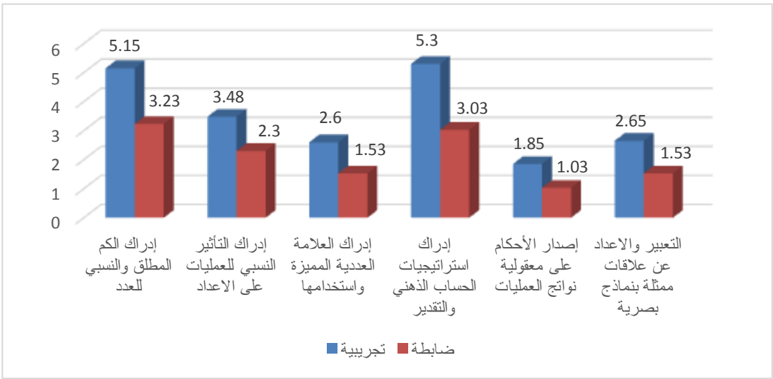
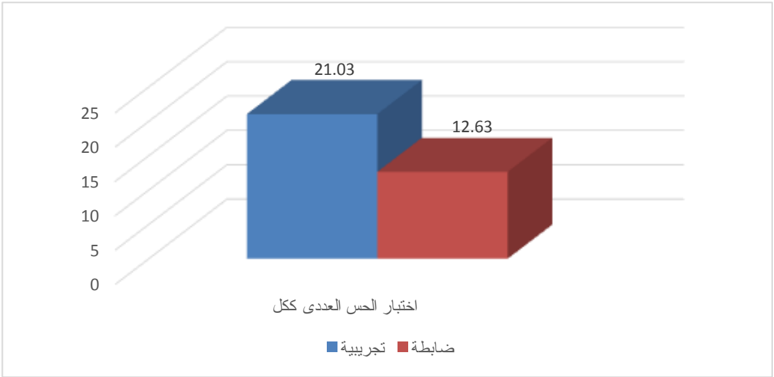
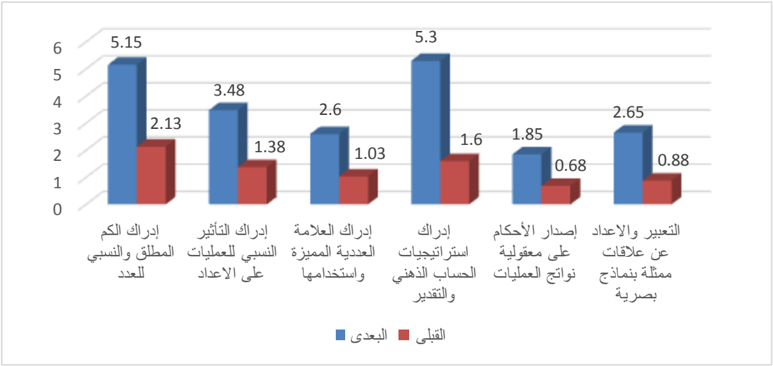
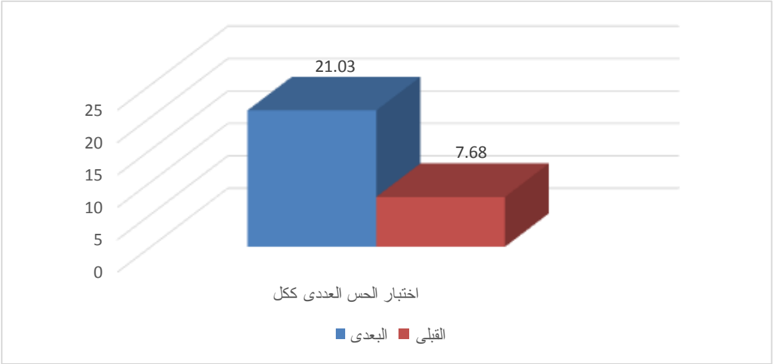
Verification
Claims the paper makes
0 Valid · 0 Not valid · 1 Not checked · 5 Own results and interpretations
A result the paper reports from its own data — it cites no other source for it, so there is none to check. The quote shows it is in the paper.
In the paper
“2.128 -2.212”
plain- Asserted: passes — The authors put it forward as true.
- Checkable: passes — It can be checked against evidence.
- Load-bearing: unclear — It is unclear whether the paper’s conclusions depend on it.
- Based: passes — The paper gives a reason why it holds.
A result the paper reports from its own data — it cites no other source for it, so there is none to check. The quote shows it is in the paper.
In the paper
“ه علم ة ميى 12.8 % -21.2 .%”
plainstates a cause- Asserted: passes — The authors put it forward as true.
- Checkable: passes — It can be checked against evidence.
- Load-bearing: passes — The paper’s conclusions depend on it.
- Based: passes — The paper gives a reason why it holds.
- It may state two separate claims as one. 3
- The quote only partly states this claim. 1
- Probably not a substantial claim. 2
Citations
Cites
The publisher hasn’t deposited this paper’s reference list.
Research works printed but not linked: 2
- Kirkland, P., Guang, C., Cheng, Y., Trinter, C., Kumar, S., Nakfoor, S., Sullivan, T., & McNeil, S. (2022). Middle School Students' Mature Number Sense is Uniquely Associated with Grade Level Mathematics Achievement, National Science Foundation, Proceedings of the forty-fourth annual meeting of the North American Chapter of the International Group for the Psychology of Mathematics Education.
- Santos ollantes a e arra entang 2022). Innate Mathematical Characteristics and Number Sense Competencies of Junior High School Students, International Journal of Learning, Teaching and Educational Research, 21(10), 325-340.
Cited by
Still being checked.
Metadata
- Authors
- مصرى ثابت عبدالملاك, د.
- Venue
- مجلة کلية التربية. بنها
- Publisher
- Egyptian Knowledge Bank
- Published
- 2024-07-01
- Volume
- 35
- Issue
- 139.2
- Pages
- 429-462
- ISSN
- 1110-2411 (ISSN-L)
- 2682-3373
- OpenAlex
- W4403874998
- Cited by
- 0
- References
- 0
- FWCI
- 0.00
- Type
- journal article
- Language
- ar
- Open access
- diamond
- doi.org
- Licence
- cc-by-nc
- Locations
- مجلة كلية التربية جامعة بنها (publishedVersion, cc-by-nc)
- DOAJ (DOAJ: Directory of Open Access Journals) (submittedVersion, cc-by-sa)
- Topics
- Social Sciences › Education › Mathematics Education and Pedagogy
- Social Sciences › Psychology › Developmental and Educational Psychology › Cognitive and developmental aspects of mathematical skills
- Social Sciences › Education › Mathematics Education and Teaching Techniques
- Keywords
- SWOM strategy, number sense, fractions, adding and subtracting fractions, fifth grade students, Arabic language schools, mathematics teaching methods, teacher's guide, student worksheets, mental arithmetic, estimation, visual models, student motivation, student self-confidence, student self-regulation
About these checks
Registry, retraction, Cites and statistics results are computed, not judged, with one exception: a printed reference that no index lists is read once by a model before it counts as a citation error. Claims are extracted by a model and kept only when their quote appears verbatim in the text; each cited source is then checked, with a model’s help, for whether it says what the claim relies on. Those verdicts can be wrong — read the claim’s quote and the cited source before relying on one.
A language model drew the claims from the paper on 2026-11-16, under version 3 of the claim definition (model deepseek-v4.1-flash, prompt extract-v3).
A second model labelled each claim on 2026-11-16 (model jev-1.13-20260917, definition revision gold-guideline-v0.2).
Statistics and arithmetic are recomputed, not judged.
Confidence bands are shown only for fields calibrated on our annotated test set. None is calibrated yet, so no band is shown.
What counts as a claim ›How we measure confidence ›How we check this ›
Are you an author, or do you see a problem with this page? Request a review
How to cite
Cite CoChat for the checks on this page, and the paper for its own findings.
- This page
- CoChat. (2026). Citation check: استخدام استراتيجية "SWOM" لتنمية بعض مهارات الحس العددي لدى تلاميذ المرحلة الابتدائية بالمدارس الرسمية لغات. https://app.cochat.ai/papers/10.21608/jfeb.2024.299542.1943
- The paper
- مصرى ثابت عبدالملاك, د. (2024). استخدام استراتيجية "SWOM" لتنمية بعض مهارات الحس العددي لدى تلاميذ المرحلة الابتدائية بالمدارس الرسمية لغات. مجلة کلية التربية. بنها. https://doi.org/10.21608/jfeb.2024.299542.1943
Data sources
Bibliographic data: Semantic Scholar, OpenAlex, Crossref.
Contains information from the Semantic Scholar Academic Graph Datasets, made available under the ODC Attribution License (ODC-BY 1.0).
Semantic Scholar’s data is described in: Kinney, R., et al. (2023). The Semantic Scholar Open Data Platform. arXiv:2301.10140.
