

The DOI matches its Crossref record; 2 of the 2 references it cites were found in a registry or an index.
Institutional arrangements for water reuse: assessing challenges for the transition to water circularity
Abstract
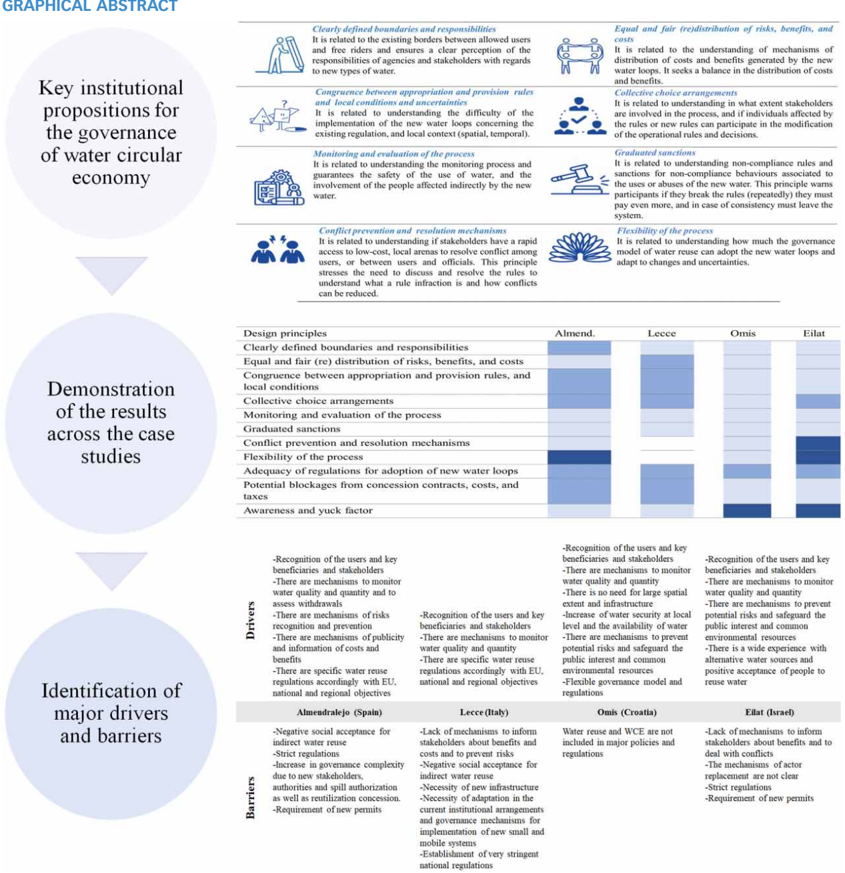
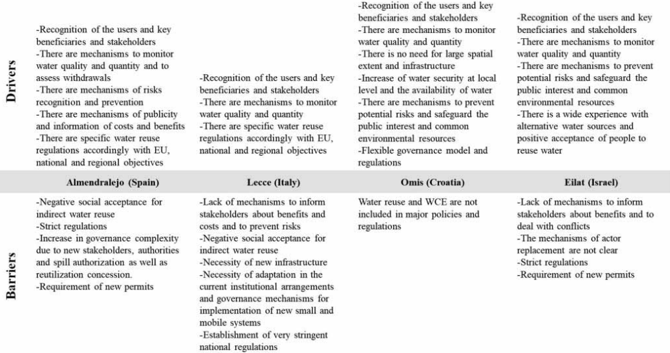
Water scarcity and security drive attention to water reuse in policy and business. However, water reuse may generate new water loops and challenge water governance with new and different types of water, risks, involved actors, and responsibilities. These challenges demand robust institutional arrangements related to water governance. This article assesses the institutional arrangements associated with four case studies in Spain, Italy, Croatia, and Israel. The findings reveal that the more diverse the water uses and users, the more challenges and risks, particularly those associated with institutional arrangements such as quality standards, sanctions, and conflict prevention, are likely to emerge. The weaknesses of governance models and regulations to deal with changes, uncertainties, and public resistance call for special attention to the design of the institutional arrangements before the adoption. Independent of the type of technology adopted, governance may be improved by ensuring internal and external water monitoring; integrating water management with spatial concerns; improving training, expert engagement, and civil society awareness; and reducing water reuse costs. In addition, alternative models that guarantee the efficiency of governance in attaining objectives and assuring the participation of new water users in the management of water reuse loops may also improve governance.
Overview
The claims and statistics of this paper haven’t been checked yet.
Run the check — free, no account needed. It reads the open-access text and checks the sources it cites.
Integrity signals
Registry
Cites
Statistics
Figures
Verification
Claims the paper makes
The claims and statistics of this paper haven’t been checked yet.
Run the check — free, no account needed. It reads the open-access text and checks the sources it cites.
Claims other papers make about this one
Each is checked against this paper’s own text: does it say what the citing paper says it does?
In the citing paper
“Second, we present a public policy analysis of CE in a yet little studied empirical context: wastewater [21 , 22].”
From The Importance of Being Consistent: Circularity Policy Aims in the European Wastewater Sector (2025) · cites this paper as [22]
In the citing paper
“Therefore, while far from being the only barrier [21 , 22 , 57], inconsistencies in policy aims across governance levels and the uncertainties that this creates for actors help to explain why a transition towards CE in wastewater sector is not taking place.”
From The Importance of Being Consistent: Circularity Policy Aims in the European Wastewater Sector (2025) · cites this paper as [22]
Self-check
Percentages, sums and reported differences re-computed from the paper’s own numbers.
The self-check needs the paper’s full text.
Citations
Cites
Huntjens, P., Lebel, L., Pahl-Wostl, C., Camkin, J., Schulze, R., & Kranz, N. (2012) · Global Environmental Change · doi:10.1016/j.gloenvcha.2011.09.015 · Cited by 290
Abu-Ghunmi, D., Abu-Ghunmi, L., Kayal, B., & Bino, A. (2016) · Journal of Cleaner Production · doi:10.1016/j.jclepro.2016.05.043 · Cited by 102
Research works printed but not linked: 48
- 10.1080/07900620048536 · DOI
- Alcalde-Sanz, 2017, Minimum Quality Requirements for Water Reuse in Agricultural Irrigation and Aquifer Recharge – Towards A Legal Instrument on Water Reuse at EU Level
- 10.2166/wp.2016.001 · DOI
- 10.1007/s00168-011-0441-9 · DOI
- 10.1016/j.scitotenv.2020.138264 · DOI
- 10.1016/j.desal.2005.04.070 · DOI
- 10.1073/pnas.0706553104 · DOI
- 10.2166/wst.2009.022 · DOI
- 10.1080/13549830802475658 · DOI
- 10.1080/07900620903392174 · DOI
- 10.1016/j.gloenvcha.2015.06.012 · DOI
- 10.5751/ES-03704-150438 · DOI · Paper page
- European Commission (EC), 2016, Guidelines on Integrating Water Reuse Into Water Planning and Management in the Context of the WFD, 1
- 10.1111/lre.12141 · DOI
- 10.1016/j.resconrec.2016.06.006 · DOI
- 10.1007/s10657-010-9169-8 · DOI
- 10.1080/07900627.2018.1431526 · DOI
- 10.1332/030557318X15230060131727 · DOI
- 10.1111/j.1541-0072.2010.00399.x · DOI
- 10.2166/wp.2021.075 · DOI
- 10.1016/j.gloenvcha.2018.03.006 · DOI
- 10.1016/j.wasec.2020.100073 · DOI
- 10.1080/00343404.2015.1020776 · DOI
- 10.1016/j.jclepro.2020.123352 · DOI
- 10.1080/08941920590947995 · DOI
- 10.14456/ea.2019.40 · DOI
- 10.2166/wp.2015.191 · DOI
- 10.1257/jep.5.1.97 · DOI
- OECD, 2011, Guidelines for Performance-Based Contracts Between Water Utilities and Municipalities. Lessons Learnt From Eastern Europe, Caucasus and Central Asia
- OECD, 2015, Results of the OECD Survey on the Governance of Water Regulators, 10.1787/9789264231092-en · DOI
- 10.1111/j.1541-0072.2010.00394.x · DOI · Paper page
- 10.1016/j.geoforum.2020.12.021 · DOI
- 10.1007/PL00012594 · DOI
- 10.1016/j.watres.2017.09.023 · DOI
- 10.1016/j.jclepro.2021.125803 · DOI
- 10.1016/j.agwat.2019.03.017 · DOI
- 10.2166/wp.2009.007 · DOI
- 10.1080/07900627.2015.1045970 · DOI
- 10.1016/j.landusepol.2020.104755 · DOI
- 10.1111/j.1541-0072.2009.00319.x · DOI
- 10.1080/1573062X.2017.1293694 · DOI
- 10.2166/wst.2005.0286 · DOI
- 10.1007/s12665-017-6461-8 · DOI
- 10.1007/s10795-009-9090-x · DOI
- 10.1016/j.coesh.2018.01.005 · DOI · Paper page
- 10.2166/wp.2019.160 · DOI
- 10.1016/j.ijdrr.2017.09.034 · DOI
- 10.1016/j.jclepro.2013.09.002 · DOI
Cited by
Sorted by citations
The Importance of Being Consistent: Circularity Policy Aims in the European Wastewater Sector
Mäkitie, T., Damman, S., Hansen, T., Haugland, B. T., & Lund, H. B. (2025) · Circular Economy and Sustainability · doi:10.1007/s43615-025-00665-6 · Cited by 8
Metadata
- Authors
- Riazi, F., Fidélis, T., Matos, M. V., Sousa, M. C., Teles, F., & Roebeling, P.
- Venue
- Water Policy
- Publisher
- IWA Publishing
- Published
- 2023-02-20
- Volume
- 25
- Issue
- 3
- Pages
- 218-236
- ISSN
- 1366-7017
- 1996-9759
- Cited by
- 33
- References
- 2
- Language
- en
- Funders
- Project Ô - Demonstration of planning and technology tools for a circular, integrated and symbiotic use of water (776816)
- Research Unit on Governance, Competitiveness and Public Policy ((UIDB/04058/2020) (UIDP/04058/2020))
- Centre for Environmental and Marine Studies ((UIDP/50017/2020 + UIDB/50017/2020))
- The Foundation for Science and Technology (2020.05570.BD)
- FCT/MCTES (within the PT2020 Partnership Agreement and Compete 2020)
About these checks
Registry, retraction, Cites and statistics results are computed, not judged, with one exception: a printed reference that no index lists is read once by a model before it counts as a citation error. Claims are extracted by a model and kept only when their quote appears verbatim in the text; each cited source is then checked, with a model’s help, for whether it says what the claim relies on. Those verdicts can be wrong — read the claim’s quote and the cited source before relying on one.
Statistics and arithmetic are recomputed, not judged.
Confidence bands are shown only for fields calibrated on our annotated test set. None is calibrated yet, so no band is shown.
What counts as a claim ›How we measure confidence ›How we check this ›
Are you an author, or do you see a problem with this page? Request a review
