

The DOI matches its Crossref record; 459 of the 461 references it cites were found in a registry or an index.
Multi-Target-Directed Ligands and other Therapeutic Strategies in the Search of a Real Solution for Alzheimer’s Disease
Open accessAbstract
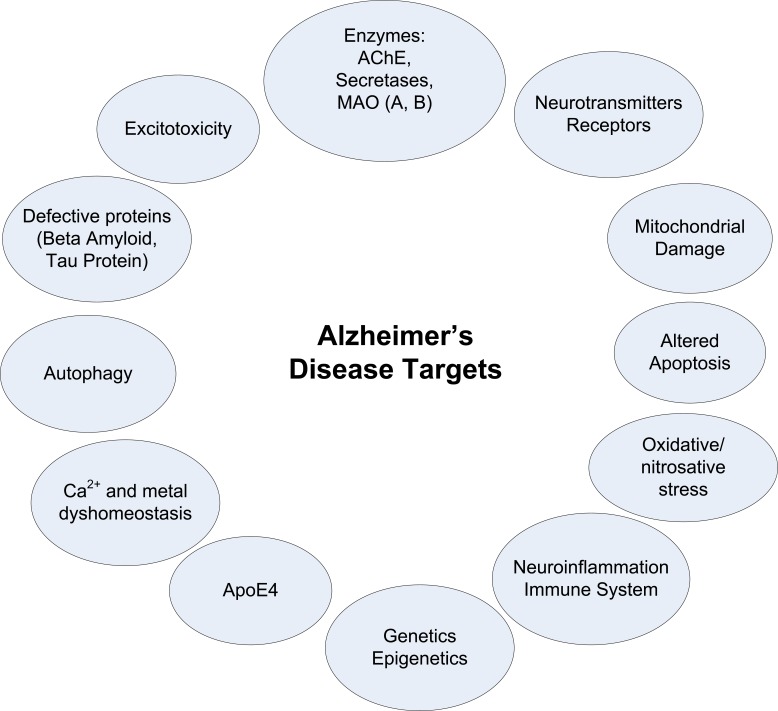
The lack of an adequate therapy for Alzheimer's Disease (AD) contributes greatly to the continuous growing amount of papers and reviews, reflecting the important efforts made by scientists in this field. It is well known that AD is the most common cause of dementia, and up-to-date there is no prevention therapy and no cure for the disease, which contrasts with the enormous efforts put on the task. On the other hand many aspects of AD are currently debated or even unknown. This review offers a view of the current state of knowledge about AD which includes more relevant findings and processes that take part in the disease; it also shows more relevant past, present and future research on therapeutic drugs taking into account the new paradigm "Multi-Target-Directed Ligands" (MTDLs). In our opinion, this paradigm will lead from now on the research toward the discovery of better therapeutic solutions, not only in the case of AD but also in other complex diseases. This review highlights the strategies followed by now, and focuses other emerging targets that should be taken into account for the future development of new MTDLs. Thus, the path followed in this review goes from the pathology and the processes involved in AD to the strategies to consider in on-going and future researches.
Overview
The claims and statistics of this paper haven’t been checked yet.
Run the check — free, no account needed. It reads the open-access text and checks the sources it cites.
Integrity signals
Registry
Cites
Statistics
Figures
Verification
Claims the paper makes
The claims and statistics of this paper haven’t been checked yet.
Run the check — free, no account needed. It reads the open-access text and checks the sources it cites.
Claims other papers make about this one
Each is checked against this paper’s own text: does it say what the citing paper says it does?
In the citing paper
“NTFs contain, as their first component, aggregates of the protein tau (τ) in a hyperphosphorylated state.”
From Multi-Target Mechanisms of Phytochemicals in Alzheimer’s Disease: Effects on Oxidative Stress, Neuroinflammation and Protein Aggregation (2022) · cites this paper as [20]
In the citing paper
“in healthy neuronal cells, following consecutive and reversible enzymatic processes of phosphorylation and dephosphorylation, it has the task of assembling and stabilizing microtubules and determining their binding with other components of the cytoskeleton [19,20].”
From Multi-Target Mechanisms of Phytochemicals in Alzheimer’s Disease: Effects on Oxidative Stress, Neuroinflammation and Protein Aggregation (2022) · cites this paper as [20]
In the citing paper
“a complex and multifactorial disorder, such as AD, must be approached with multitarget-directed ligands (MTDLs) (Agis-Torres et al., 2014).”
From Multi-target neuroprotective effects of herbal medicines for Alzheimer's disease (2022) · cites this paper as Agis-Torres et al., 2014
Self-check
Percentages, sums and reported differences re-computed from the paper’s own numbers.
The self-check needs the paper’s full text.
Citations
Cites
2 retracted
Items 401–459 of 459
Hieke, M., Neß, J., Steri, R., Dittrich, M., Greiner, C., Werz, O., Baumann, K., Schubert‐Zsilavecz, M., Weggen, S., & Zettl, H. (2010) · Journal of Medicinal Chemistry · doi:10.1021/jm1003073 · Cited by 36
Ansari, N., & Khodagholi, F. (2013) · Current Drug Targets · doi:10.2174/138945013804806532 · Cited by 35
Boddapati, S. P., Levites, Y., & Sierks, M. R. (2010) · Journal of Molecular Biology · doi:10.1016/j.jmb.2010.10.054 · Cited by 35
Forlenza, O. V., Schaeffer, E. L., & Gattaz, W. F. (2006) · Journal of Neural Transmission · doi:10.1007/s00702-006-0597-0 · Cited by 34
Prodromal Metabolic Phenotype in MCI Cybrids: Implications for Alzheimer’s Disease
F. Silva, D., Santana, I., R. Esteves, A., Baldeiras, I., M. Arduino, D., R. Oliveira, C., & M. Cardoso, S. (2013) · Current Alzheimer Research · doi:10.2174/1567205011310020008 · Cited by 33
Retromers in Alzheimer’s Disease
Siegenthaler, B. M., & Rajendran, L. (2012) · Neurodegenerative Diseases · doi:10.1159/000335910 · Cited by 33
Latrepirdine, a potential novel treatment for Alzheimer's disease and Huntington's chorea.
Sabbagh, M. N., & Shill, H. A. (2010) · PubMed · Cited by 32
Dual Binding Site Acetylcholinesterase Inhibitors: Potential New Disease-Modifying Agents for AD
del Monte-Millán, M., García‐Palomero, E., Valenzuela, R., Usán, P., de Austria, C., Muñoz-Ruiz, P., Rubio, L., Dorronsoro, I., Martı́nez, A., & Medina, M. (2006) · Journal of Molecular Neuroscience · doi:10.1385/jmn:30:1:85 · Cited by 32
Conforti, F., Rigano, D., Formisano, C., Bruno, M., Loizzo, M. R., Menichini, F., & Senatore, F. (2009) · Journal of Enzyme Inhibition and Medicinal Chemistry · doi:10.3109/14756360903018260 · Cited by 31
PeptideT/araC coniugates. Solid phase synthesis and biological activity of N4-(acylpeptidyl)-AraC
S, M., M, M., R, T., E, D., S, S., T, M., C, M., E, M. M., P., L. C., & Pani, A. (2000) · UNICA IRIS Institutional Research Information System (University of Cagliari) · doi:10.1016/s0968-0896 · Cited by 31
Preclinical Success against Alzheimer's Disease with an Old Drug
LaFerla, F. M. (2012) · New England Journal of Medicine · doi:10.1056/nejmcibr1204890 · Cited by 30
Orozco, C., Rı́os, C. D. L., Arias, E., Leon, R. M., Garcı́a, A. G., Marco, J. L., Villarroya, M., & López, M. G. (2004) · Journal of Pharmacology and Experimental Therapeutics · doi:10.1124/jpet.104.068189 · Cited by 29
Synthesis of Monomeric Derivatives To Probe Memoquin’s Bivalent Interactions
Bolognesi, M. L., Chiriano, G., Bartolini, M., Mancini, F., Bottegoni, G., Maestri, V., Czvitkovich, S., Windisch, M., Cavalli, A., Minarini, A., et al. (2011) · Journal of Medicinal Chemistry · doi:10.1021/jm200691d · Cited by 28
Inhibition of phospholipase A2 in rat brain decreases the levels of total Tau protein
Schaeffer, E. L., de Paula, V. D. J. R., Aquino, E. R. D. S., Novaes, B. D. A., Skaf, H. D., Forlenza, O. V., & Gattaz, W. F. (2011) · Journal of Neural Transmission · doi:10.1007/s00702-011-0619-4 · Cited by 28
der Schyf, C. V., Mandel, S. A., Geldenhuys, W. J., Amit, T., Avramovich‐Tirosh, Y., Zheng, H., Fridkin, M., Gal, S., Weinreb, O., Am, O., et al. (2007) · Current Alzheimer Research · doi:10.2174/156720507783018226 · Cited by 28
Pecic, S., McAnuff, M. A., & Harding, W. W. (2010) · Journal of Enzyme Inhibition and Medicinal Chemistry · doi:10.3109/14756361003671078 · Cited by 27
Cui, W., Cui, G., Li, W., Zhang, Z., Hu, S., Mak, S., Zhang, H., Carlier, P. R., Choi, C., Wong, Y.-T., et al. (2011) · Brain Research · doi:10.1016/j.brainres.2011.05.042 · Cited by 27
Gelsolin as therapeutic target in Alzheimer's disease
Carro, E. (2010) · Expert Opinion on Therapeutic Targets · doi:10.1517/14728222.2010.488222 · Cited by 27
Mohamed, T., Yeung, J. C. K., & Rao, P. P. N. (2011) · Bioorganic & Medicinal Chemistry Letters · doi:10.1016/j.bmcl.2011.07.091 · Cited by 26
Bartolini, M., Pistolozzi, M., Andrisano, V., Egea, J., López, M. G., Iriepa, I., Moraleda, I., Galvez‐Ruano, E., Marco, J. L., & Samadi, A. (2011) · ChemMedChem · doi:10.1002/cmdc.201100239 · Cited by 26
Incerti, M., Flammini, L., Saccani, F., Morini, G., Comini, M., Coruzzi, M., Barocelli, E., Ballabeni, V., & Bertoni, S. (2010) · ChemMedChem · doi:10.1002/cmdc.201000008 · Cited by 25
Glebov, K., & Walter, J. (2011) · Neurodegenerative Diseases · doi:10.1159/000332595 · Cited by 25
Multiple enzyme inhibitions by histamine H3 receptor antagonists as potential procognitive agents.
Petroianu, G. A., Arafat, K., Sasse, B. C., & Stark, H. (2006) · PubMed · Cited by 25
Yi, P., Schrott, L. M., Castor, T. P., & Alexander, J. (2012) · Journal of Molecular Neuroscience · doi:10.1007/s12031-012-9816-3 · Cited by 24
Roman, S. A., Vivas, N. M., Badı́a, A., & Clos, M. V. (2002) · Neuroscience Letters · doi:10.1016/s0304-3940(02)00245-8 · Cited by 24
Cannabinoids and Neurodegenerative Diseases
Romero, J., & Martínez-Orgado, J. A. (2009) · CNS & Neurological Disorders - Drug Targets · doi:10.2174/187152709789824589 · Cited by 24
Nutrition and Dementia: Are we Asking the Right Questions?
Shea, T. B., Rogers, E. J., & Remington, R. (2012) · Journal of Alzheimer s Disease · doi:10.3233/jad-2012-112231 · Cited by 23
Triazolyl tryptoline derivatives as β-secretase inhibitors
Jiaranaikulwanitch, J., Boonyarat, C., Fokin, V. V., & Vajragupta, O. (2010) · Bioorganic & Medicinal Chemistry Letters · doi:10.1016/j.bmcl.2010.09.043 · Cited by 23
Hopeahainol A attenuates memory deficits by targeting β‐amyloid in APP / PS 1 transgenic mice
Zhu, X., Ye, L., Ge, H. M., Chen, L., Jiang, N., Qian, L., Li, L., Liu, R., Shen, J., Zhang, S., et al. (2012) · Aging Cell · doi:10.1111/acel.12022 · Cited by 23
Schaeffer, E. L., Skaf, H. D., Novaes, B. D. A., Aquino, E. R. D. S., Martins, B. A., Joaquim, H., & Gattaz, W. F. (2011) · Progress in Neuro-Psychopharmacology and Biological Psychiatry · doi:10.1016/j.pnpbp.2011.05.001 · Cited by 22
Han, H. J., Kim, B. C., Lee, J., Ryu, S., Na, H. R., Yoon, S. J., Park, H. Y., Shin, J. H., Cho, S., Yi, H.-A., et al. (2012) · Dementia and Geriatric Cognitive Disorders · doi:10.1159/000342927 · Cited by 21
Neuroprotective effects of INM-176 against lipopolysaccharide-induced neuronal injury
Park, S. J., Jung, H.-J., Son, M.-S., Jung, J. M., Kim, D. H., Jung, I. H., Cho, Y.-B., Lee, E. H., & Ryu, J. H. (2012) · Pharmacology Biochemistry and Behavior · doi:10.1016/j.pbb.2012.02.003 · Cited by 21
Timosaponin-BII inhibits the up-regulation of BACE1 induced by Ferric Chloride in rat retina
Huang, J.-F., Shang, L., Liu, P., Zhang, M.-Q., Chen, S., Chen, D., Fan, C.-L., Wang, H., & Xiong, K. (2012) · BMC Complementary and Alternative Medicine · doi:10.1186/1472-6882-12-189 · Cited by 21
Characterisation of acetylcholinesterase release from neuronal cells
Hicks, D. A., Makova, N. Z., Nalivaeva, N. N., & Turner, A. J. (2012) · Chemico-Biological Interactions · doi:10.1016/j.cbi.2012.09.019 · Cited by 20
Li, J., Hu, J. J., Shao, B., Zhou, W., Cui, Y., Dong, C., Ezoulin, J.-M. M., Zhu, X., Ding, W., Heymans, F., et al. (2009) · Cellular and Molecular Neurobiology · doi:10.1007/s10571-009-9351-0 · Cited by 20
Cholinergic Modulation by Opioid Receptor Ligands: Potential Application to Alzheimer's Disease
Motel, W. C., Coop, A., & Cunningham, C. W. (2013) · Mini-Reviews in Medicinal Chemistry · doi:10.2174/138955713804999784 · Cited by 19
Ezoulin, J.-M. M., Shao, B.-Y., Xia, Z., Xie, Q., Li, J., Cui, Y., Wang, H., Dong, C., Zhao, Y., Massicot, F., et al. (2009) · The International Journal of Neuropsychopharmacology · doi:10.1017/s1461145709000455 · Cited by 19
Zheng, W., Li, J., Qiu, Z., Xia, Z., Li, W., Yu, L., Chen, H., Chen, J., Chen, Y., Hu, Z., et al. (2012) · Toxicology and Applied Pharmacology · doi:10.1016/j.taap.2012.07.018 · Cited by 18
Rojsanga, P., Boonyarat, C., Utsintong, M., Nemecz, Á., Yamauchi, J. G., Talley, T. T., Olson, A. J., Matsumoto, K., & Vajragupta, O. (2012) · Life Sciences · doi:10.1016/j.lfs.2012.06.017 · Cited by 18
Lockman, J. A., Geldenhuys, W. J., Jones-Higgins, M. R., Patrick, J. D., Allen, D. D., & der Schyf, C. J. V. (2012) · Brain Research · doi:10.1016/j.brainres.2012.10.029 · Cited by 16
Piehl, F., & Olsson, T. P. (2008) · Neuroscience · doi:10.1016/j.neuroscience.2008.08.031 · Cited by 15
Sachdeva, D., & Burns, A. S. (2010) · CNS Neuroscience & Therapeutics · doi:10.1111/j.1755-5949.2010.00156.x · Cited by 13
Cordeiro, Q., Noguti, R., Bottino, C. M. C., & Vallada, H. (2010) · Arquivos de Neuro-Psiquiatria · doi:10.1590/s0004-282x2010000200007 · Cited by 13
Weinreb, O., Amit, T., Mandel, S. A., & Youdim, M. B. H. (2011) · Neurodegenerative Diseases · doi:10.1159/000332597 · Cited by 13
SAR studies of acidic dual γ-secretase/PPARγ modulators
Hieke, M., Neß, J., Steri, R., Greiner, C., Werz, O., Schubert‐Zsilavecz, M., Weggen, S., & Zettl, H. (2011) · Bioorganic & Medicinal Chemistry · doi:10.1016/j.bmc.2011.08.003 · Cited by 11
Effects of ensaculin on dopamine metabolite levels and K+-induced glutamate release
Teismann, P., & Ferger, B. (2000) · European Journal of Pharmacology · doi:10.1016/s0014-2999(00)00290-9 · Cited by 10
Clicked tacrine conjugates as acetylcholinesterase and β-amyloid directed compounds
Ouberai, M. M., Brännström, K., Vestling, M., Olofsson, A., Dumy, P., Chierici, S., & Garcia, J. (2010) · Organic & Biomolecular Chemistry · doi:10.1039/c0ob00393j · Cited by 10
The green tea polyphenol (2)-epigallocatechin-3-gallate (EGCG) is not a β-secretase inhibitor
Cheng, X., Zhou, J.-W., Zhou, Y., Cheng, J., Yang, R., Zhou, W., Zhang, Y., & Yun, L. (2011) · Bioorganic & Medicinal Chemistry Letters · doi:10.1016/j.bmcl.2011.12.034 · Cited by 9
Lecanu, L., Tillement, L., McCourty, A., Rammouz, G., Yao, W., Greeson, J., & Papadopoulos, V. (2010) · Medicinal Chemistry · doi:10.2174/1573406411006030123 · Cited by 9
Tissue Transglutaminase: A Novel Therapeutic Target in Cerebral Amyloid Angiopathy
Wilhelmus, M. M. M., de Jager, M., & Drukarch, B. (2011) · Neurodegenerative Diseases · doi:10.1159/000333224 · Cited by 9
p53, a Pivotal Effector of a Functional Cross-Talk Linking Presenilins and Pen-2
Checler, F., & Dunys, J. (2011) · Neurodegenerative Diseases · doi:10.1159/000332935 · Cited by 7
Current Status and Future Promise of Pharmacotherapeutic Strategies for Alzheimer’s Disease
Standridge, J. B. (2005) · Journal of the American Medical Directors Association · doi:10.1016/j.jamda.2005.03.004 · Cited by 7
A novel acetylcholinesterase inhibitor, Ro 46-5934, which interacts with muscarinic M2 receptors
Borroni, E., Damsma, G., Giovacchini, C., Mutel, V., Jakob-Røtne, R., & Prada, M. D. (1994) · Biochemical Society Transactions · doi:10.1042/bst0220755 · Cited by 7
Muñoz‐Torrero, D., Pera, M., Relat, J., Ratia, M., Galdeano, C., Viayna, E., Sola, I., Formosa, X., Camps, P., Badı́a, A., et al. (2012) · Neurodegenerative Diseases · doi:10.1159/000333225 · Cited by 6
Ansari, N., & Khodagholi, F. (2012) · Current Drug Targets · doi:10.2174/1389450111314010012 · Cited by 6
Targeting glycogen synthase kinase-3 in Alzheimer's disease
Huang, H., O’Brien, W. T., & Klein, P. S. (2006) · Drug Discovery Today Therapeutic Strategies · doi:10.1016/j.ddstr.2006.10.020 · Cited by 5
What are the prospects of slowing the progression of Alzheimer's disease?
Palmer, A. M. (2012) · Drug Discovery Today · doi:10.1016/j.drudis.2012.09.009 · Cited by 4
Current Status and Future Promise of Pharmacotherapeutic Strategies for Alzheimer’s Disease
Standridge, J. B. (2006) · Journal of the American Medical Directors Association · doi:10.1016/j.jamda.2006.01.009 · Cited by 3
Kršková, Z., Martin, J., & Dušek, J. (2011) · PubMed · Cited by 1
Cited by
Sorted by citations
Molecular Hybridization as a Tool for Designing Multitarget Drug Candidates for Complex Diseases
Ivasiv, V., Albertini, C., Gonçalves, A. E., Rossi, M., & Bolognesi, M. L. (2019) · Current Topics in Medicinal Chemistry · doi:10.2174/1568026619666190619115735 · Cited by 396
Potential Impact of the Multi-Target Drug Approach in the Treatment of Some Complex Diseases
Makhoba, X. H., Viegas, C., Mosa, R. A., Viegas, F. P. D., & Pooe, O. J. (2020) · Drug Design Development and Therapy · doi:10.2147/dddt.s257494 · Cited by 337
Guzior, N., Wi.eckowska, A., Panek, D., & Malawska, B. (2014) · Current Medicinal Chemistry · doi:10.2174/0929867321666141106122628 · Cited by 323
Jouanne, M., Rault, S., & Voisin‐Chiret, A. S. (2017) · European Journal of Medicinal Chemistry · doi:10.1016/j.ejmech.2017.07.070 · Cited by 279
Antibacterial and antioxidant activities for natural and synthetic dual-active compounds
Martelli, G., & Giacomini, D. (2018) · European Journal of Medicinal Chemistry · doi:10.1016/j.ejmech.2018.09.009 · Cited by 232
Metadata
- Authors
- Agis-Torres, A., Sollhuber, M., Fernandez, M., & Sanchez-Montero, J. M.
- Affiliations
- Universidad Complutense de Madrid (ES)
- Venue
- Current Neuropharmacology
- Publisher
- Bentham Science Publishers Ltd.
- Published
- 2014-01-31
- Volume
- 12
- Issue
- 1
- Pages
- 2-36
- ISSN
- 1570-159X (ISSN-L)
- PMC
- PMC3915347
- OpenAlex
- W2031507955
- Cited by
- 202
- References
- 461
- Citations by year
- 2026: 10 · 2025: 13 · 2024: 10 · 2023: 12 · 2022: 18 · 2021: 11 · 2020: 18 · 2019: 24 · 2018: 21 · 2017: 25 · 2016: 22 · 2015: 12 · 2014: 6
- FWCI
- 15.81
- Type
- journal article
- Language
- en
- Open access
- bronze
- doi.org
- Locations
- Current Neuropharmacology (publishedVersion)
- PubMed Central (publishedVersion, cc-by-nc)
- PubMed (publishedVersion)
- Topics
- Life Sciences › Neuroscience › Cellular and Molecular Neuroscience › Alzheimer's disease research and treatments
- Health Sciences › Medicine › Pharmacology (medical) › Cholinesterase and Neurodegenerative Diseases
- Health Sciences › Medicine › Psychiatry and Mental health › Dementia and Cognitive Impairment Research
- Keywords
- Alzheimer's disease, multi-target-directed ligands, Alzheimer's disease therapeutics, disease pathology, therapeutic drug development, complex diseases
About these checks
Registry, retraction, Cites and statistics results are computed, not judged, with one exception: a printed reference that no index lists is read once by a model before it counts as a citation error. Claims are extracted by a model and kept only when their quote appears verbatim in the text; each cited source is then checked, with a model’s help, for whether it says what the claim relies on. Those verdicts can be wrong — read the claim’s quote and the cited source before relying on one.
Statistics and arithmetic are recomputed, not judged.
Confidence bands are shown only for fields calibrated on our annotated test set. None is calibrated yet, so no band is shown.
What counts as a claim ›How we measure confidence ›How we check this ›
Are you an author, or do you see a problem with this page? Request a review
