

The Generalizability of Randomized Controlled Trials of Self-Guided Internet-Based Cognitive Behavioral Therapy for Depressive Symptoms: Systematic Review and Meta-Regression Analysis
Open accessPublished version of a preprint
The DOI matches its Crossref record; 44 of the 44 references it cites were found in a registry or an index.
Abstract
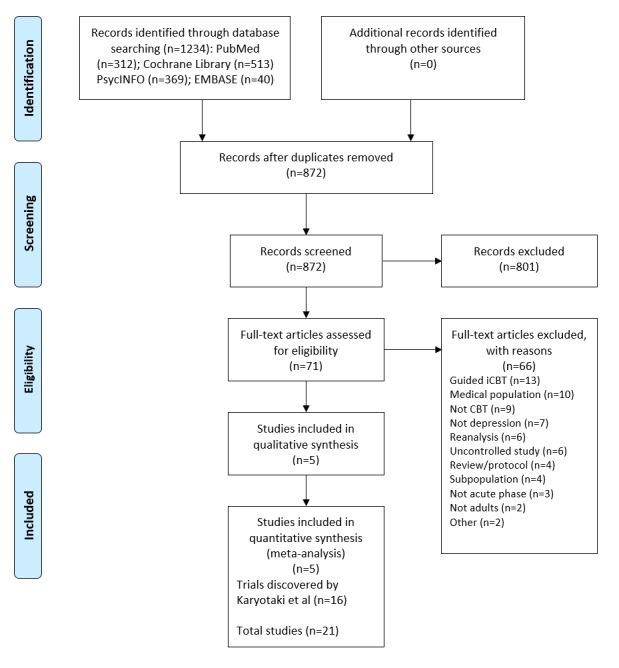
BACKGROUND: Self-guided internet-based cognitive behavioral therapies (iCBTs) for depressive symptoms may substantially increase accessibility to mental health treatment. Despite this, questions remain as to the generalizability of the research on self-guided iCBT. OBJECTIVE: We sought to describe the clinical entry criteria used in studies of self-guided iCBT, explore the criteria's effects on study outcomes, and compare the frequency of use of these criteria with their use in studies of face-to-face psychotherapy and antidepressant medications. We hypothesized that self-guided iCBT studies would use more stringent criteria that would bias the sample toward those with a less complex clinical profile, thus inflating treatment outcomes. METHODS: We updated a recently published meta-analysis by conducting a systematic literature search in PubMed, MEDLINE, PsycINFO, and EMBASE. We conducted a meta-regression analysis to test the effect of the different commonly used psychiatric entry criteria on the treatment-control differences. We also compared the frequency with which exclusion criteria were used in the self-guided iCBT studies versus studies of face-to-face psychotherapy and antidepressants from a recently published review. RESULTS: Our search yielded 5 additional studies, which we added to the 16 studies identified by Karyotaki and colleagues in 2017. Few self-guided iCBT studies excluded patients with severe depressive symptoms (6/21, 29%), but self-guided iCBT studies were more likely than antidepressant (14/170, 8.2%) studies to use this criterion. However, self-guided iCBT studies did not use this criterion more frequently than face-to-face psychotherapy studies (6/16, 38%). Beyond this, we found no evidence that self-guided iCBTs used more stringent entry criteria. Strong evidence suggested that they were actually less likely to use most entry criteria, especially exclusions on the basis of substance use or personality pathology. None of the entry criteria used had an effect on outcomes. CONCLUSIONS: A conservative interpretation of our findings is that the patient population sampled in the literature on self-guided iCBT is relatively comparable with that of studies of antidepressants or face-to-face psychotherapy. Alternatively, studies of unguided cognitive behavioral therapy may sample from a more heterogeneous and representative patient population. Until evidence emerges to suggest otherwise, the patient population sampled in self-guided iCBT studies cannot be considered as less complex than the patient population from face-to-face psychotherapy or antidepressant studies.
Overview
The claims and statistics of this paper haven’t been checked yet.
Free: it reads the open-access text and checks the first 5 claims that cite a source we can check. Create a free account to check every claim.
Integrity signals
Registry
Cites
Statistics
Figures
Verification
Claims the paper makes
The claims and statistics of this paper haven’t been checked yet.
Free: it reads the open-access text and checks the first 5 claims that cite a source we can check. Create a free account to check every claim.
Claims other papers make about this one
Each is checked against this paper’s own text: does it say what the citing paper says it does?
The source backs part of the claim, not all of it — or backs it for a different population, condition or comparison.
In the citing paper
“and is also effective in patients with emotional disorders (Lorenzo-Luaces et al., 2018; López-López et al., 2019).”
From A systematic review of cognitive behavioral therapy-based interventions for comorbid chronic pain and clinically relevant psychological distress (2023) · cites this paper as Lorenzo-Luaces et al., 2018
Experimental — accuracy not yet measuredThe cited source says what the claim attributes to it.
In the citing paper
“These results are consistent with the reported efficacy of CBT-based interventions for depression or chronic pain in previous systematic reviews (Lorenzo-Luaces et al., 2018; López-López et al., 2019; Williams et al., 2020), but with a more modest magnitude.”
From A systematic review of cognitive behavioral therapy-based interventions for comorbid chronic pain and clinically relevant psychological distress (2023) · cites this paper as Lorenzo-Luaces et al., 2018
The cited source says what the claim attributes to it.
In the citing paper
“Like previous meta-analyses in chronic pain (Williams et al., 2020) and depression (Lorenzo-Luaces et al., 2018), the efficacy of CBT-based interventions for comorbid pain and depression is clinically relevant on average (Sanabria-Mazo et al., 2020).”
From A systematic review of cognitive behavioral therapy-based interventions for comorbid chronic pain and clinically relevant psychological distress (2023) · cites this paper as Lorenzo-Luaces et al., 2018
Self-check
Percentages, sums and reported differences re-computed from the paper’s own numbers.
The self-check needs the paper’s full text.
Citations
Cites
Conducting Meta-Analyses in R with the metafor Package
Viechtbauer, W. (2010) · Journal of Statistical Software · doi:10.18637/jss.v036.i03 · Cited by 20,464
Murray, C. J. L., Vos, T., Lozano, R., Naghavi, M., Flaxman, A. D., Michaud, C., Ezzati, M., Shibuya, K., Salomon, J. A., Abdalla, S., et al. (2012) · The Lancet · doi:10.1016/s0140-6736(12)61689-4 · Cited by 8,888
Kessler, R. C., Berglund, P., Demler, O., Jin, R., Koretz, D., Merikangas, K. R., Rush, A. J., Walters, E. E., & Wang, P. S. (2003) · JAMA · doi:10.1001/jama.289.23.3095 · Cited by 7,988
Assessing Risk of Bias in Included Studies
Higgins, J. P., & Altman, D. G. (2008) · Cochrane Handbook for Systematic Reviews of Interventions · doi:10.1002/9780470712184.ch8 · Cited by 3,396
IntHout, J., Ioannidis, J. P., & Borm, G. F. (2014) · BMC Medical Research Methodology · doi:10.1186/1471-2288-14-25 · Cited by 2,419
The effectiveness of psychotherapy: the Consumer Reports study
Seligman, M. E. P. (1995) · American Psychologist · doi:10.1037/0003-066x.50.12.965 · Cited by 1,608
Rebooting psychotherapy research and practice to reduce the burden of mental illness
Kazdin, A. E., & Blase, S. L. (2011) · Perspectives on Psychological Science · doi:10.1177/1745691610393527 · Cited by 1,254
The impact of guidance on Internet-based mental health interventions — A systematic review
Baumeister, H., Reichler, L., Munzinger, M., & Lin, J. (2014) · Internet Interventions · doi:10.1016/j.invent.2014.08.003 · Cited by 1,037
Karyotaki, E., Riper, H., Twisk, J., Hoogendoorn, A., Kleiboer, A., Mira, A., Mackinnon, A., Meyer, B., Botella, C., Littlewood, E., et al. (2017) · JAMA Psychiatry · doi:10.1001/jamapsychiatry.2017.0044 · Cited by 691 · cited 1×
“Example search terms Studies identified by Karyotaki et al. 2017: 1.”
MethodWesten, D., & Morrison, K. (2001) · Journal of Consulting and Clinical Psychology · doi:10.1037/0022-006x.69.6.875 · Cited by 635
Research works printed but not linked: 1
- Office of Applied Studies Suicidal Thoughts, Suicide Attempts, Major Depressive Episode, and Substance Use among Adults 2006 Rockville, MD Substance Abuse and Mental Health Services Administration 31
Cited by
Malhi, G. S., Bell, E., Bassett, D., Boyce, P., Bryant, R., Hazell, P., Hopwood, M., Lyndon, B., Mulder, R., Porter, R., et al. (2021) · Australian & New Zealand Journal of Psychiatry · doi:10.1177/0004867420979353 · Cited by 614
“…further by evidence that trials included in iCBT meta-analyses include severe and complex presentations of depression (see also Bower et al., 2013; Lorenzo-Luaces et al., 2018a) and that effect sizes from controlled trials generalise to everyday practice (Flygare et al., 2020; Staples et al.,…”
BackgroundWakefield, S., Kellett, S., Simmonds‐Buckley, M., Stockton, D., Bradbury, A., & Delgadillo, J. (2021) · British Journal of Clinical Psychology · doi:10.1111/bjc.12259 · Cited by 222
Guerra, O., & Eboreime, E. (2021) · Behavioral Sciences · doi:10.3390/bs11090119 · Cited by 105
Lorenzo‐Luaces, L., Peipert, A., Jesús-Romero, R. D., Rutter, L. A., & Rodríguez‐Quintana, N. (2020) · International Journal of Cognitive Therapy · doi:10.1007/s41811-020-00094-3 · Cited by 72
Self-citationSanabria-Mazo, J. P., Colomer-Carbonell, A., Fernández-Vázquez, Ó., Noboa-Rocamora, G., Cardona-Ros, G., McCracken, L. M., Montes-Pérez, A., Castaño-Asins, J. R., Edo, S., Borràs, X., et al. (2023) · Frontiers in Psychology · doi:10.3389/fpsyg.2023.1200685 · Cited by 56
Metadata
- Authors
- Lorenzo-Luaces, L., Johns, E., & Keefe, J. R.
- Affiliations
- Indiana University Bloomington (US)
- University of Pennsylvania (US)
- Venue
- Journal of Medical Internet Research
- Publisher
- JMIR Publications Inc.
- Published
- 2018-11-09
- Volume
- 20
- Issue
- 11
- Pages
- e10113
- ISSN
- 1438-8871 (ISSN-L)
- PMC
- PMC6251981
- OpenAlex
- W2883346910
- Cited by
- 36
- References
- 44
- Citations by year
- 2026: 2 · 2025: 2 · 2024: 5 · 2023: 7 · 2022: 5 · 2021: 4 · 2020: 7 · 2019: 4
- FWCI
- 0.51
- Type
- journal article
- Language
- en
- Open access
- gold
- doi.org
- Licence
- cc-by
- Locations
- Journal of Medical Internet Research (publishedVersion, cc-by)
- Europe PMC (PubMed Central) (publishedVersion, cc-by)
- PubMed Central (publishedVersion, cc-by)
- PubMed (publishedVersion)
- IUScholarWorks Open (Indiana University) (submittedVersion)
- Topics
- Social Sciences › Psychology › Applied Psychology › Digital Mental Health Interventions
- Social Sciences › Psychology › Experimental and Cognitive Psychology › Anxiety, Depression, Psychometrics, Treatment, Cognitive Processes
- Health Sciences › Medicine › Psychiatry and Mental health › Mental Health Treatment and Access
- Keywords
- depressive symptoms, generalizability, exclusion criteria, sample selection bias, antidepressant treatment, face-to-face psychotherapy, severe depression, substance use, personality pathology, meta-regression, digital mental health interventions
- MeSH terms
- Depression, Female, Humans, Psychotherapy, Regression Analysis, Cognitive Behavioral Therapy, Randomized Controlled Trials as Topic, Treatment Outcome, Internet
About these checks
Registry, retraction, Cites and statistics results are computed, not judged, with one exception: a printed reference that no index lists is read once by a model before it counts as a citation error. Claims are extracted by a model and kept only when their quote appears verbatim in the text; each cited source is then checked, with a model’s help, for whether it says what the claim relies on. Those verdicts can be wrong — read the claim’s quote and the cited source before relying on one.
Statistics and arithmetic are recomputed, not judged.
Confidence bands are shown only for fields calibrated on our annotated test set. None is calibrated yet, so no band is shown.
What counts as a claim ›How we measure confidence ›How we check this ›
Are you an author, or do you see a problem with this page? Request a review
How to cite
Cite CoChat for the checks on this page, and the paper for its own findings.
- This page
- CoChat. (2026). Citation check: The Generalizability of Randomized Controlled Trials of Self-Guided Internet-Based Cognitive Behavioral Therapy for Depressive Symptoms: Systematic Review and Meta-Regression Analysis. https://app.cochat.ai/papers/10.2196/10113
- The paper
- Lorenzo-Luaces, L., Johns, E., & Keefe, J. R. (2018). The Generalizability of Randomized Controlled Trials of Self-Guided Internet-Based Cognitive Behavioral Therapy for Depressive Symptoms: Systematic Review and Meta-Regression Analysis. Journal of Medical Internet Research. https://doi.org/10.2196/10113
Data sources
Bibliographic data: Semantic Scholar, OpenAlex, Crossref.
Contains information from the Semantic Scholar Academic Graph Datasets, made available under the ODC Attribution License (ODC-BY 1.0).
Semantic Scholar’s data is described in: Kinney, R., et al. (2023). The Semantic Scholar Open Data Platform. arXiv:2301.10140.
