

Effectiveness of a Technology-Based Supportive Educational Parenting Program on Parental Outcomes (Part 1): Randomized Controlled Trial
Open accessPublished version of a preprint
The DOI matches its Crossref record; 89 of the 89 references it cites were found in a registry or an index; 8 of the 37 sources its claims cite were checked for support.
Abstract
BACKGROUND: Transitioning into parenthood can be stressful for new parents, especially with the lack of continuity of care from health care professionals during the postpartum period. Short hospital stays limit the availability of support and time parents need to be well equipped with parenting and infant care skills. Poor parental adjustment may, in turn, lead to negative parental outcomes and adversely affect the child's development. For the family's future well-being, and to facilitate a smoother transition into parenthood, there is a need for easily accessible, technology-based educational programs to support parents during the crucial perinatal period. OBJECTIVE: This study aimed to examine the effectiveness of a technology-based supportive educational parenting program (SEPP) on parenting outcomes during the perinatal period in couples. METHODS: A randomized, single-blinded, parallel-armed, controlled trial was conducted. The study recruited 236 parents (118 couples) from an antenatal clinic of a tertiary hospital in Singapore. Eligible parents were randomly assigned to the intervention group (n=118) or the control group (n=118). The SEPP is based on Bandura's self-efficacy theory and Bowlby's theory of attachment. Components of the intervention include 2 telephone-based educational sessions (1 antenatal and 1 immediately postnatal) and a mobile health app follow-up for 1 month. The control group only received routine perinatal care provided by the hospital. Outcome measures including parenting self-efficacy (PSE), parental bonding, perceived social support, parenting satisfaction, postnatal depression (PND), and anxiety were measured using reliable and valid instruments. Data were collected over 6 months at 4 time points: during pregnancy (third trimester), 2 days postpartum, 1 month postpartum, and 3 months postpartum. Outcomes were standardized using baseline means and SDs. Linear mixed models were used to compare the groups for postpartum changes in the outcome variables. RESULTS: The intervention group showed significantly better outcome scores than the control group from baseline to 3 months postpartum for PSE (mean difference, MD, 0.37; 95% CI 0.06 to 0.68; P=.02), parental bonding (MD -1.32; 95% CI -1.89 to -0.75; P<.001), self-perceived social support (MD 0.69; 95% CI 0.18 to 1.19; P=.01), parenting satisfaction (MD 1.40; 95% CI 0.86 to 1.93; P<.001), and PND (MD -0.91; 95% CI -1.34 to -0.49; P<.001). Postnatal anxiety (PNA) scores of the intervention group were only significantly better after adjusting for covariates (MD -0.82; 95% CI -1.15 to -0.49; P<.001). CONCLUSIONS: The technology-based SEPP is effective in enhancing parental bonding, PSE, perceived social support and parental satisfaction, and in reducing PND and PNA. Health care professionals could incorporate it with existing hands-on infant care classes and routine care to better meet parents' needs and create positive childbirth experiences, which may in turn encourage parents to have more children. TRIAL REGISTRATION: ISRCTN Registry ISRCTN48536064; http://www.isrctn.com/ISRCTN48536064 (Archived by WebCite at http://www.webcitation.org/6wMuEysiO).
Overview
CoChat Summary
TL;DR
A technology-based supportive educational parenting program (SEPP) delivered via telephone sessions and a 4-week mHealth app improved several parental outcomes among 118 couples in Singapore compared with routine care. Benefits were not seen at 2 days postpartum but emerged by 1 and 3 months postpartum for parenting self-efficacy, bonding, social support, parenting satisfaction, and reduced postnatal depression/anxiety, with anxiety significant only after covariate adjustment.
Key findings
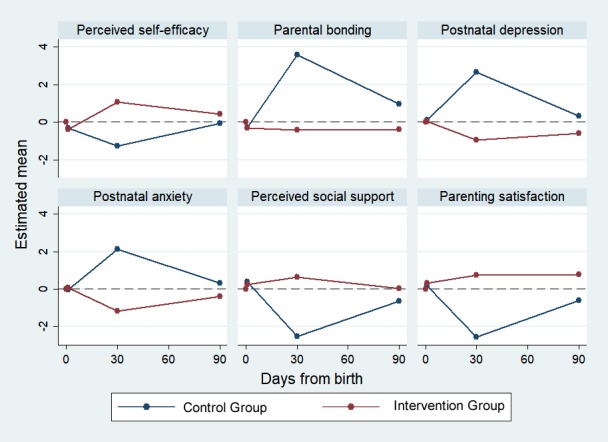
- At 3 months postpartum, the intervention group had significantly better scores than control for parenting self-efficacy (MD 0.37; 95% CI 0.06–0.68; P=.02), parental bonding (MD −1.32; 95% CI −1.89 to −0.75; P<.001), perceived social support (MD 0.69; 95% CI 0.18–1.19; P=.01), parenting satisfaction (MD 1.40; 95% CI 0.86–1.93; P<.001), and postnatal depression (MD −0.91; 95% CI −1.34 to −0.49; P<.001).
- Postnatal anxiety was significantly better in the intervention group only after adjusting for covariates (MD −0.82; 95% CI −1.15 to −0.49; P<.001).
- Immediately postpartum (2 days), mean differences between groups were not significant for all parental outcomes; at 1 month postpartum, differences were significant for all outcomes except postnatal anxiety in the unadjusted analysis, which became significant after adjustment.
- Subgroup analyses showed fathers had significant differences for all parental outcomes at 1 and 3 months postpartum, whereas mothers at 3 months had significant differences only for parental bonding, postnatal depression, postnatal anxiety, and parenting satisfaction; social support became significant after adjustment, and parenting self-efficacy remained non-significant.
Methods
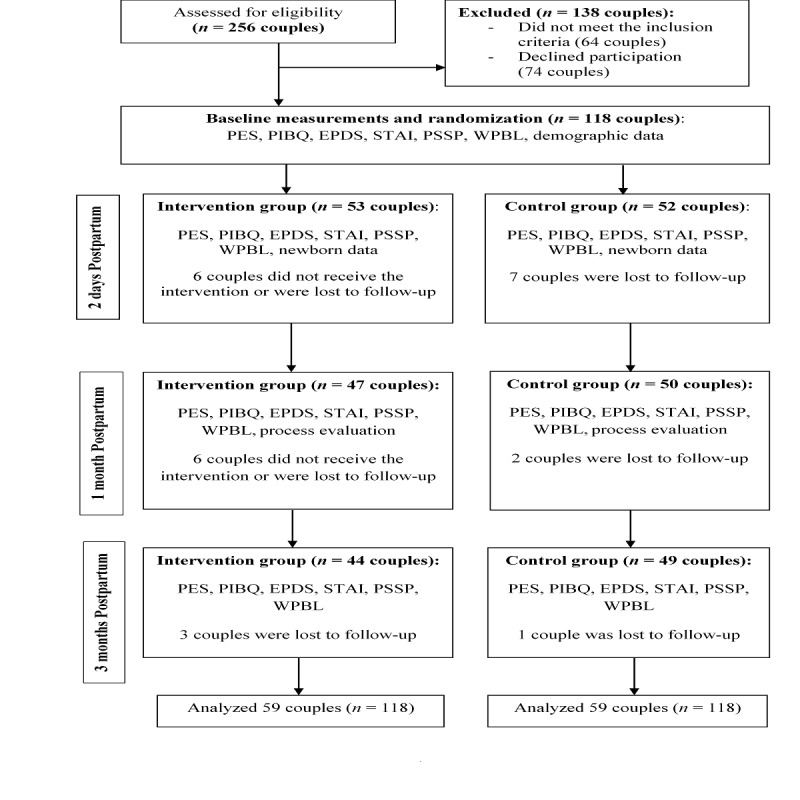
- Randomized, single-blinded, parallel-armed controlled trial conducted at the antenatal clinic of a tertiary hospital in Singapore from December 2016 to December 2017; 236 parents (118 couples) were randomized 1:1 to SEPP intervention (n=118) or control (n=118).
- SEPP included a 30-minute telephone antenatal educational session, a 60-minute telephone immediate postnatal session, and a mobile health app follow-up for 4 weeks postpartum; controls received routine perinatal care.
- Outcomes were measured at third trimester baseline, 2 days postpartum, 1 month postpartum, and 3 months postpartum using validated self-report instruments; intention-to-treat linear mixed models compared standardized outcome z-scores, with sensitivity analyses using complete cases and multiple imputation and subgroup models for mothers and fathers.
Limitations
- The authors state the SEPP had no practical hands-on skill component, lacked cost-effectiveness and infant outcome data, was a single-site study of married English-speaking couples, did not assess long-term effects beyond 3 months, and used a Parent-to-Infant Bonding Questionnaire whose internal validity was not optimal for multiracial parents.
- Evident from the text: overall attrition was 21.8%, with 3-month follow-up completed by 44/59 intervention couples and 49/59 control couples; baseline age and marriage length differed significantly between groups; and several PIBQ Cronbach alphas were low across time points (.585–.704).
Model-written summary. Check it against the paper before relying on it.
Integrity signals
Registry
Cites
Statistics
Figures
Verification
Claims the paper makes
2 Valid · 2 Not valid · 10 Not checked · 81 Own results and interpretations
A result the paper reports from its own data — it cites no other source for it, so there is none to check. The quote shows it is in the paper.
In the paper
“There were significant differences in parental bonding scores between the control and intervention groups at 1 month and 3 months postpartum.”
§ Effectiveness of a Technology-Based Supportive Educational Parenting Program on Parental Outcomes (Part 1): Randomized Controlled Trial > Discussion > Parental Bonding
plainstates an association- Asserted: passes — The authors put it forward as true.
- Checkable: passes — It can be checked against evidence.
- Load-bearing: passes — The paper’s conclusions depend on it.
- Based: passes — The paper gives a reason why it holds.
A result the paper reports from its own data — it cites no other source for it, so there is none to check. The quote shows it is in the paper.
In the paper
“Similarly, for the analysis of parental outcome scores for fathers, the mean difference of the scores between the groups was not significant immediately postpartum.”
§ Effectiveness of a Technology-Based Supportive Educational Parenting Program on Parental Outcomes (Part 1): Randomized Controlled Trial > Results > Subgroup Analysis
plain- Asserted: passes — The authors put it forward as true.
- Checkable: passes — It can be checked against evidence.
- Load-bearing: unclear — It is unclear whether the paper’s conclusions depend on it.
- Based: passes — The paper gives a reason why it holds.
A result the paper reports from its own data — it cites no other source for it, so there is none to check. The quote shows it is in the paper.
In the paper
“they had significantly better parental outcome scores than those in the control group at 1 and 3 months postpartum”
§ Effectiveness of a Technology-Based Supportive Educational Parenting Program on Parental Outcomes (Part 1): Randomized Controlled Trial > Discussion > Overview
plainstates a cause- Asserted: passes — The authors put it forward as true.
- Checkable: passes — It can be checked against evidence.
- Load-bearing: passes — The paper’s conclusions depend on it.
- Based: passes — The paper gives a reason why it holds.
A result the paper reports from its own data — it cites no other source for it, so there is none to check. The quote shows it is in the paper.
In the paper
“For the analysis of parental outcome scores for mothers, the mean difference of scores between groups immediately postpartum was not significant for all outcomes, but the mean difference of scores between groups (ie, intervention × time effects) was significant for all parental outcomes at 1 month postpartum.”
§ Effectiveness of a Technology-Based Supportive Educational Parenting Program on Parental Outcomes (Part 1): Randomized Controlled Trial > Results > Subgroup Analysis
plain- Asserted: passes — The authors put it forward as true.
- Checkable: passes — It can be checked against evidence.
- Load-bearing: unclear — It is unclear whether the paper’s conclusions depend on it.
- Based: passes — The paper gives a reason why it holds.
A result the paper reports from its own data — it cites no other source for it, so there is none to check. The quote shows it is in the paper.
In the paper
“The intervention group scored significantly higher than the control group for perceived social support at 1 month postpartum.”
§ Effectiveness of a Technology-Based Supportive Educational Parenting Program on Parental Outcomes (Part 1): Randomized Controlled Trial > Discussion > Social Support
plain- Asserted: passes — The authors put it forward as true.
- Checkable: passes — It can be checked against evidence.
- Load-bearing: passes — The paper’s conclusions depend on it.
- Based: passes — The paper gives a reason why it holds.
56 more claims
Create a free account to see all 95 claims and every source verdict.
- It may state two separate claims as one. 20
- The quote only partly states this claim. 1
- Probably not a substantial claim. 18
Claims other papers make about this one
Each is checked against this paper’s own text: does it say what the citing paper says it does?
The check wasn’t confident either way, so it gives no verdict — never disputed.
In the citing paper
“three articles stated that information about the participants’ acceptance was reported elsewhere [37, 57, 77]”
From Mental health-related telemedicine interventions for pregnant women and new mothers: a systematic literature review (2023) · cites this paper as [77]
Experimental — accuracy not yet measured
Self-check
Percentages, sums and reported differences re-computed from the paper’s own numbers.
Each contradiction between two passages listed here was confirmed by an independent check.
Rated major: it would touch a result — a value a result rests on, reported and recomputed p-values on opposite sides of the significance level, two passages that conflict with no sign which is right, or a cited work retracted before this paper was published.
In the paper
§ Effectiveness of a Technology-Based Supportive Educational Parenting Program on Parental Outcomes (Part 1): Randomized Controlled Trial > Discussion > Postnatal Depression and Postnatal Anxiety
“However, in the intervention group, PND scores increased after the termination of SEPP, indicating more depressive symptoms.”
§ Effectiveness of a Technology-Based Supportive Educational Parenting Program on Parental Outcomes (Part 1): Randomized Controlled Trial > Results > Participants’ Details
“| Postnatal depression (EPDSb, 0-30) | 6.02 (4.1) | 6.39 (4.1) | 5.96 (4.6) | 6.09 (3.8) | 4.76 (4.9) | 5.65 (4.2) | 4.16 (4.3) | 5.37 (4.1) |”
Rated major: it would touch a result — a value a result rests on, reported and recomputed p-values on opposite sides of the significance level, two passages that conflict with no sign which is right, or a cited work retracted before this paper was published.
In the paper
§ Effectiveness of a Technology-Based Supportive Educational Parenting Program on Parental Outcomes (Part 1): Randomized Controlled Trial > Discussion > Overview
“For the intervention group, scores for PSE, social support, and parenting satisfaction decreased”
§ Effectiveness of a Technology-Based Supportive Educational Parenting Program on Parental Outcomes (Part 1): Randomized Controlled Trial > Results > Participants’ Details
“| Parenting satisfaction (WPBLe, 0-99) | 85.32 (12.2) | 82.14 (12.1) | 83.32 (12.1) | 81.18 (12.7) | 83.87 (13.5) | 82.8 (12.2) | 88.85 (8.7) | 87.61 (10.5) |”
Rated major: it would touch a result — a value a result rests on, reported and recomputed p-values on opposite sides of the significance level, two passages that conflict with no sign which is right, or a cited work retracted before this paper was published.
In the paper
§ Effectiveness of a Technology-Based Supportive Educational Parenting Program on Parental Outcomes (Part 1): Randomized Controlled Trial > Discussion > Overview
“For the intervention group, scores for PSE, social support, and parenting satisfaction decreased”
§ Effectiveness of a Technology-Based Supportive Educational Parenting Program on Parental Outcomes (Part 1): Randomized Controlled Trial > Results > Participants’ Details
“| Parenting self-efficacy (10-40) | 28.45 (6.2) | 29.91 (5.8) | 27.37 (5.9) | 27.27 (6.3) | 29.46 (6.2) | 29.07 (5.9) | 32.10 (4.8) | 31.95 (4.4) |”
Rated minor: it would not touch a result — a value no result rests on, a p-value that stays on the same side of the significance level, or a conflict that is clerical, resolved elsewhere in the paper, or outside its own findings.
In the paper
§ Effectiveness of a Technology-Based Supportive Educational Parenting Program on Parental Outcomes (Part 1): Randomized Controlled Trial > Discussion > Parenting Satisfaction
“There was an increase in parenting satisfaction scores in the intervention group, whereas there was a large decrease in parenting satisfaction scores in the control group.”
§ Effectiveness of a Technology-Based Supportive Educational Parenting Program on Parental Outcomes (Part 1): Randomized Controlled Trial > Results > Participants’ Details
“| Parenting satisfaction (WPBLe, 0-99) | 85.32 (12.2) | 82.14 (12.1) | 83.32 (12.1) | 81.18 (12.7) | 83.87 (13.5) | 82.8 (12.2) | 88.85 (8.7) | 87.61 (10.5) |”
Rated minor: it would not touch a result — a value no result rests on, a p-value that stays on the same side of the significance level, or a conflict that is clerical, resolved elsewhere in the paper, or outside its own findings.
In the paper
§ Effectiveness of a Technology-Based Supportive Educational Parenting Program on Parental Outcomes (Part 1): Randomized Controlled Trial > Discussion > Overview
“whereas scores for PND, PNA, and parental bonding increased.”
§ Effectiveness of a Technology-Based Supportive Educational Parenting Program on Parental Outcomes (Part 1): Randomized Controlled Trial > Results > Participants’ Details
“| Postnatal anxiety (STAIc, 40-160) | 67.46 (17.2) | 68.23 (17.8) | 66.47 (19.2) | 69.29 (18.1) | 64.34 (21.9) | 66.97 (17.8) | 61.28 (16.7) | 62.29 (18.2) |”
2 more findings
Create a free account to see every finding of this check.
Citations
Cites
Self-efficacy: Toward a unifying theory of behavioral change
Bandura, A. (1977) · Psychological Review · doi:10.1037/0033-295x.84.2.191 · Cited by 43,925 · cited 4×
“Self-efficacy can be developed through the mastery of experiences, vicarious experiences, social persuasion, and affective and physiological factors [12].”
BackgroundMethodResultInfluential(1970) · Cited by 24,983
Self-efficacy: the exercise of control
(1997) · Choice Reviews Online · doi:10.5860/choice.35-1826 · Cited by 24,281
Detection of Postnatal Depression: Development of the 10-item Edinburgh Postnatal Depression Scale
Cox, J. L., Holden, J. M., & Sagovsky, R. (1987) · British Journal of Psychiatry · doi:10.1192/bjp.150.6.782 · Cited by 14,183 · cited 1×
“The 10-item Edinburgh Postnatal Depression Scale (EPDS), with a score range of 0 to 30, was used to measure PND [47].”
MethodSelf-efficacy: Toward a unifying theory of behavioral change
Bandura, A. (1978) · Advances in Behaviour Research and Therapy · doi:10.1016/0146-6402(78)90002-4 · Cited by 10,586
Julian, L. J. (2011) · Arthritis Care & Research · doi:10.1002/acr.20561 · Cited by 1,794 · cited 1×
“The 40-item State Trait Anxiety Inventory (STAI) [50] is widely used to measure PNA and has a score range of 40 to 160, with a higher score indicating a higher level of parental anxiety [31,51].”
MethodLamers, F., van Oppen, P., Comijs, H. C., Smit, J. H., Spinhoven, P., van Balkom, A. J. L. M., Nolen, W. A., Zitman, F. G., Beekman, A. T. F., & Penninx, B. W. J. H. (2011) · The Journal of Clinical Psychiatry · doi:10.4088/jcp.10m06176blu · Cited by 913 · cited 1×
“According to a study in the Netherlands, in 57% of the comorbid cases, anxiety preceded depression, and in 18% of cases, depression preceded anxiety [72].”
BackgroundFirst‐time mothers: social support, maternal parental self‐efficacy and postnatal depression
Leahy‐Warren, P., McCarthy, G., & Corcoran, P. (2012) · Journal of Clinical Nursing · doi:10.1111/j.1365-2702.2011.03701.x · Cited by 710
Prevalence, Course, and Risk Factors for Antenatal Anxiety and Depression
Lee, A. M., Lam, S. K., Sze Mun Lau, S. M., Chong, C. S. Y., Chui, H. W., & Fong, D. Y. T. (2007) · Obstetrics & Gynecology · doi:10.1097/01.aog.0000287065.59491.70 · Cited by 706
A Negative Birth Experience: Prevalence and Risk Factors in a National Sample
Waldenström, U., Hildingsson, I., Rubertsson, C., & Rådestad, I. (2004) · Birth · doi:10.1111/j.0730-7659.2004.0270.x · Cited by 657
Research works printed but not linked: 4
- JonesGThe Japanese Journal of Population2012032018-12-07Late marriage and low fertility in Singapore: the limits of policy https://pdfs.semanticscholar.org/0505/ddda55ac9f93082a62a93f877220afb0bbd5.pdf
- Bowlby, J, 1969, Attachment and Loss, Volume 1: Attachment
- Abarashi, Z, 2014, Iran J Psychiatry Behav Sci, 8, 19
- Midmer, D, 1995, Fam Med, 27, 200
Cited by
Zhou, C., Hu, H., Wang, C., Zhu, Z., Feng, G., Xue, J., & Yang, Z. (2020) · Journal of Telemedicine and Telecare · doi:10.1177/1357633x20917816 · Cited by 131
Self-Efficacy in a Nursing Context
Shorey, S., & López, V. (2021) · Springer eBooks · doi:10.1007/978-3-030-63135-2_12 · Cited by 146
Self-citationStentzel, U., Grabe, H. J., Schmidt, S., Tomczyk, S., van den Berg, N., & Beyer, A. (2023) · BMC Psychiatry · doi:10.1186/s12888-023-04790-0 · Cited by 52
“Telephone, emails or other messengers (n = 1) 1 (100%) [77]”
BackgroundInfluentialShorey, S., & Ng, E. D. (2019) · Journal of Medical Internet Research · doi:10.2196/12915 · Cited by 54
“Previous local studies have also seen successful results with supportive technology-based interventions involving the use of online forums and mobile apps [39,40].”
Self-citationShorey, S., Law, E. C. N., Thilagamangai, Mathews, J., Lim, S. H., Shi, L., Chua, J. S., Du, R., Chan, Y. H., Tan, T. C., et al. (2023) · Journal of Medical Internet Research · doi:10.2196/41859 · Cited by 59
“Cronbach α of the EPDS in this study showed high internal consistency ( α =.848), similar to that of a previous study on Singaporean parents [10] where Cronbach α ranged from .811 to .853.”
InfluentialSelf-citation
Metadata
- Authors
- Shorey, S., Ng, Y. P. M., Ng, E. D., Siew, A. L., Mörelius, E., Yoong, J., & Gandhi, M.
- Affiliations
- National University of Singapore (SG)
- National University Hospital (SG)
- Linköping University (SE)
- Singapore Clinical Research Institute (SG)
- Corresponding author
- Shorey, Shefaly
- ORCID
- Venue
- Journal of Medical Internet Research
- Publisher
- JMIR Publications Inc.
- Published
- 2019-02-13
- Volume
- 21
- Issue
- 2
- Pages
- e10816
- ISSN
- 1438-8871 (ISSN-L)
- PMC
- PMC6391716
- OpenAlex
- W2901647060
- Semantic Scholar
- eaf92ef5c8091d4a8b76f571eb247593c8d33633
- Cited by
- 97
- References
- 81
- Citations by year
- 2026: 12 · 2025: 15 · 2024: 15 · 2023: 24 · 2022: 8 · 2021: 16 · 2020: 3 · 2019: 3
- FWCI
- 5.47
- Type
- journal article
- Language
- en
- Open access
- gold
- doi.org
- Licence
- cc-by
- Locations
- Journal of Medical Internet Research (publishedVersion, cc-by)
- Europe PMC (PubMed Central) (publishedVersion, cc-by)
- PubMed Central (publishedVersion, cc-by)
- PubMed (publishedVersion)
- National University of Singapore (submittedVersion, cc-by)
- DiVA (Linkoping University) (submittedVersion, other-oa)
- Topics
- Health Sciences › Medicine › Public Health, Environmental and Occupational Health › Maternal Mental Health During Pregnancy and Postpartum
- Health Sciences › Health Professions › General Health Professions › Mobile Health and mHealth Applications
- Health Sciences › Medicine › Pediatrics, Perinatology and Child Health › Maternal and Neonatal Healthcare
- Keywords
- mobile health apps, perinatal period, parental self-efficacy, parental bonding, perceived social support, parenting satisfaction, postpartum depression, postpartum anxiety, transition to parenthood, prenatal care, postpartum care, couples, self-efficacy theory, attachment theory
- MeSH terms
- Adult, Female, Humans, Male, Middle Aged, Parents, Social Support, Program Evaluation, Parenting, Young Adult
About these checks
Registry, retraction, Cites and statistics results are computed, not judged, with one exception: a printed reference that no index lists is read once by a model before it counts as a citation error. Claims are extracted by a model and kept only when their quote appears verbatim in the text; each cited source is then checked, with a model’s help, for whether it says what the claim relies on. Those verdicts can be wrong — read the claim’s quote and the cited source before relying on one.
The claim verdicts this report counts are experimental: their accuracy is not yet measured.
A language model drew the claims from the paper on 2026-10-10, under version 3 of the claim definition (model deepseek-v4.1-flash, prompt extract-v3).
A second model labelled each claim on 2026-10-10 (model jev-1.13-20260917, definition revision gold-guideline-v0.2).
Statistics and arithmetic are recomputed, not judged.
Confidence bands are shown only for fields calibrated on our annotated test set. None is calibrated yet, so no band is shown.
What counts as a claim ›How we measure confidence ›How we check this ›
Are you an author, or do you see a problem with this page? Request a review
Data sources
Bibliographic data: Semantic Scholar, OpenAlex, Crossref.
Contains information from the Semantic Scholar Academic Graph Datasets, made available under the ODC Attribution License (ODC-BY 1.0).
Semantic Scholar’s data is described in: Kinney, R., et al. (2023). The Semantic Scholar Open Data Platform. arXiv:2301.10140.
