

Using the Facebook Advertisement Platform to Recruit Chinese, Korean, and Latinx Cancer Survivors for Psychosocial Research: Web-Based Survey Study
Open accessPublished version of a preprint
The DOI matches its Crossref record; 13 of the 13 references it cites were found in a registry or an index.
Abstract
BACKGROUND: Ethnic minority cancer survivors remain an understudied and underrepresented population in cancer research, in part, due to the challenge of low participant recruitment rates. Therefore, identifying effective recruitment strategies is imperative for reducing cancer health disparities among this population. With the widespread use of social media, health researchers have turned to Facebook as a potential source of recruitment. OBJECTIVE: We aimed to evaluate the feasibility and effectiveness of purchasing ads on Facebook to recruit Chinese, Korean, and Latinx cancer survivors residing in the United States. We assessed their experience with participating in a Web-based survey and their interest for future research. METHODS: We showed 5 purchased ads in English, simplified Chinese, traditional Chinese, Korean, and Spanish on Facebook. Participants who clicked on the Facebook ad were directed to the study website and asked to submit their emails to receive the link to the 30-minute Web-based survey. Inclusion criteria included being of Asian or Latinx heritage, age ≥18 years, having a cancer diagnosis, and being within 5 years of cancer treatment. Participants who completed the survey were sent a US $10 Walmart eGiftcard. RESULTS: The Facebook ads were shown for 48 consecutive days for a total spending of US $1200.46 (US $25/day budget). Overall, 11 East Asian and 15 Latinx cancer survivors completed the study, resulting in an average cost per participant of US $46.17. The East Asian and Latinx cancer survivors did not significantly differ in age, years lived in the United States, education level, generation status, and time since diagnosis. However, Latinx cancer survivors were marginally more likely to have limited English proficiency and lower annual income than East Asian cancer survivors. Both Latinx and East Asian cancer survivors reported that they enjoyed participating in this study and indicated an interest in participating in future psychosocial research studies. CONCLUSIONS: The use of Facebook ads successfully resulted in the recruitment of East Asian and Latinx cancer survivors with different cancer diagnoses who reside in various geographic regions of the United States. We found that East Asian and Latinx cancer survivors recruited through Facebook were interested in participating in future psychosocial research, thereby providing support for the feasibility and effectiveness of using Facebook as a source of recruitment for ethnic minority cancer survivors.
Overview
The claims and statistics of this paper haven’t been checked yet.
Free: it reads the open-access text and checks the first 5 claims that cite a source we can check. Create a free account to check every claim.
Integrity signals
Registry
Cites
Statistics
Figures
Verification
Claims the paper makes
The claims and statistics of this paper haven’t been checked yet.
Free: it reads the open-access text and checks the first 5 claims that cite a source we can check. Create a free account to check every claim.
Claims other papers make about this one
Each is checked against this paper’s own text: does it say what the citing paper says it does?
In the citing paper
“Web-based recruitment strategies using social media platforms such as WhatsApp and Facebook have been popular for recruiting African Americans, Hispanics, and Asians [22,36].”
From Recruitment and Retention Strategies Among Racial and Ethnic Minorities in Web-Based Intervention Trials: Retrospective Qualitative Analysis (2021) · cites this paper as [22]
Self-check
Percentages, sums and reported differences re-computed from the paper’s own numbers.
The self-check needs the paper’s full text.
Citations
Cites
EFFECTIVE RECRUITMENT AND RETENTION OF MINORITY RESEARCH PARTICIPANTS
Yancey, A. K., Ortega, A. N., & Kumanyika, S. K. (2006) · Annual Review of Public Health · doi:10.1146/annurev.publhealth.27.021405.102113 · Cited by 1,196 · cited 1×
“These reasons may include language barriers [7], low socioeconomic status, lack of health insurance and access to care [8], cultural barriers such as distrust of researchers [9], and stigmatized beliefs about cancer [10].”
The Use of Facebook in Recruiting Participants for Health Research Purposes: A Systematic Review
Whitaker, C., Stevelink, S., & Fear, N. (2017) · Journal of Medical Internet Research · doi:10.2196/jmir.7071 · Cited by 724 · cited 1×
“Because this population represents a significantly understudied and underserved population with significant cancer health disparities [5], our findings build upon a growing number of studies that have demonstrated the success of using Facebook to recruit harder-to-reach medical populations [18].”
Recruiting for health, medical or psychosocial research using Facebook: Systematic review
Thornton, L., Batterham, P. J., Fassnacht, D. B., Kay-Lambkin, F., Calear, A. L., & Hunt, S. (2016) · Internet Interventions · doi:10.1016/j.invent.2016.02.001 · Cited by 326 · cited 4×
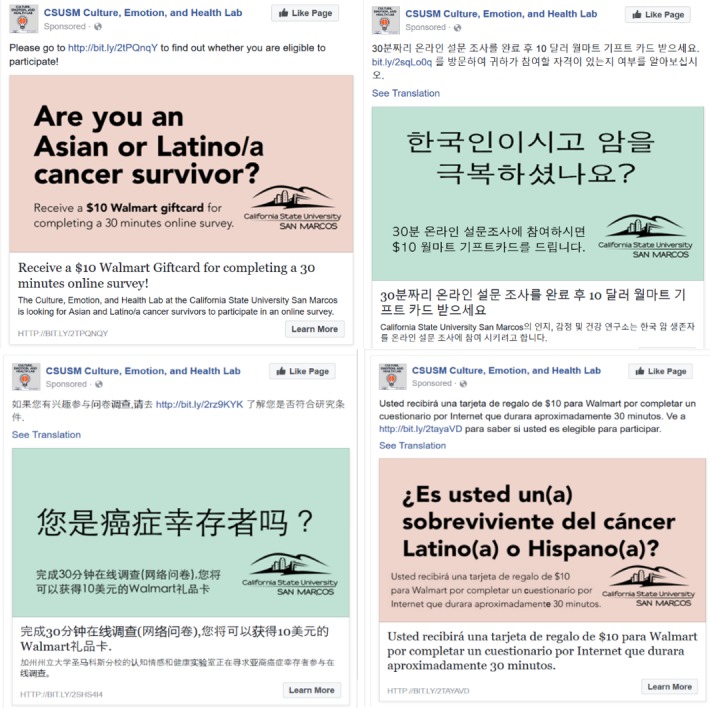
“Following the recommendations by Thornton et al [11], the ads were concise, showed the affiliation of the research study with a university, and offered incentives for participation (Figure 1).”
InfluentialCancer, Culture, and Health Disparities: Time to Chart a New Course?
Kagawa-Singer, M., Valdez Dadia, A., Yu, M. C., & Surbone, A. (2010) · CA: A Cancer Journal for Clinicians · doi:10.3322/caac.20051 · Cited by 280 · cited 1×
“Because ethnic minority cancer survivors experience cancer health disparities along the entire cancer control continuum [1], initiatives such as the Healthy People 2020 [2] have called for greater attention and efforts to increase the representation of ethnic minorities in cancer research.”
Kearney, N., McCann, L., Norrie, J., Taylor, L., Gray, P., McGee-Lennon, M., Sage, M., Miller, M., & Maguire, R. (2009) · Supportive Care in Cancer · doi:10.1007/s00520-008-0515-0 · Cited by 263 · cited 1×
“%) participants had access to smartphones and, thus, could participate in Web-based or mobile-based psychosocial interventions that have become increasingly popular in recent years [17].”
Ethnic Minority Older Adults Participating in Clinical Research
Moreno-John, G., Gachie, A., Fleming, C. M., NÁpoles-Springer, A., Mutran, E., Manson, S. M., & PÉrez-Stable, E. J. (2004) · Journal of Aging and Health · doi:10.1177/0898264304268151 · Cited by 205 · cited 2×
“These reasons may include language barriers [7], low socioeconomic status, lack of health insurance and access to care [8], cultural barriers such as distrust of researchers [9], and stigmatized beliefs about cancer [10].”
Cho, J., Choi, E., Kim, S. Y., Shin, D. W., Cho, B., Kim, C., Koh, D. H., Guallar, E., Bardwell, W. A., & Park, J. H. (2013) · Psycho-Oncology · doi:10.1002/pon.3302 · Cited by 134 · cited 1×
“These reasons may include language barriers [7], low socioeconomic status, lack of health insurance and access to care [8], cultural barriers such as distrust of researchers [9], and stigmatized beliefs about cancer [10].”
Social Media Methods for Studying Rare Diseases
Schumacher, K. R., Stringer, K. A., Donohue, J. E., Yu, S., Shaver, A., Caruthers, R. L., Zikmund-Fisher, B. J., Fifer, C., Goldberg, C., & Russell, M. W. (2014) · Pediatrics · doi:10.1542/peds.2013-2966 · Cited by 117 · cited 1×
“For example, we did not manually post our ads on cancer-related Facebook pages and groups [19].”
Gomez, S. L., Von Behren, J., McKinley, M., Clarke, C. A., Shariff-Marco, S., Cheng, I., Reynolds, P., & Glaser, S. L. (2017) · Breast Cancer Research and Treatment · doi:10.1007/s10549-017-4229-1 · Cited by 98 · cited 1×
“Recent research has also showed increases in the annual incidence rate of breast cancer among Asian American women [6].”
Self-citationJoseph, G., & Dohan, D. P. (2009) · Contemporary Clinical Trials · doi:10.1016/j.cct.2009.06.009 · Cited by 88 · cited 1×
“Despite researchers’ persistent efforts, traditional recruitment strategies such as utilizing physician referrals, purchasing newspaper ads, and using cancer registries have resulted in mixed results [3,4].”
Cited by
Social Media Use for Research Participant Recruitment: Integrative Literature Review
Darko, E. M., Kleib, M., & Olson, J. (2022) · Journal of Medical Internet Research · doi:10.2196/38015 · Cited by 202
Ford, K. L., Albritton, T., Dunn, T. A., Crawford, K., Neuwirth, J., & Bull, S. (2019) · JMIR Public Health and Surveillance · doi:10.2196/14080 · Cited by 66
“Third, the study contributed to the literature by describing low-cost approaches for reaching young people using paid social media advertising [5,29,31].”
BackgroundMassett, H. A., Mitchell, A. K., Alley, L., Simoneau, E., Burke, P., Han, S. H., Gallop‐Goodman, G., & McGowan, M. (2021) · Journal of Alzheimer s Disease · doi:10.3233/jad-201463 · Cited by 55
“Several studies have shown that Facebook advertising can be successful in increasing diversity in engagement with information about clinical trials [206–208].”
InfluentialHwang, D. A., Lee, A., Song, J. M., & Han, H.-R. (2021) · Journal of Medical Internet Research · doi:10.2196/23959 · Cited by 30
“…flyers posted at local businesses, partnerships with community-or faith-based organizations, and event tabling) [16] (e-CHECC-uP study) • Dissemination of study progress with sharing of research experiences and findings through writing or voice recording [22] or video recording (e-CHECC-uP study)”
van Gelder, M. M. H. J., van de Belt, T. H., Engelen, L. J., Hooijer, R., Bredie, S. J. H., & Roeleveld, N. (2019) · Maternal and Child Health Journal · doi:10.1007/s10995-019-02797-2 · Cited by 27
Metadata
- Authors
- Tsai, W., Zavala, D., & Gomez, S.
- Affiliations
- New York University (US)
- California State University, San Marcos (US)
- Corresponding author
- Tsai, William
- Venue
- Journal of Medical Internet Research
- Publisher
- JMIR Publications Inc.
- Published
- 2019-01-10
- Volume
- 21
- Issue
- 1
- Pages
- e11571
- ISSN
- 1438-8871 (ISSN-L)
- PMC
- PMC6329895
- OpenAlex
- W2896522583
- Cited by
- 15
- References
- 13
- Citations by year
- 2026: 1 · 2024: 2 · 2023: 2 · 2022: 4 · 2021: 4 · 2019: 2
- FWCI
- 1.61
- Type
- journal article
- Language
- en
- Open access
- gold
- doi.org
- Licence
- cc-by
- Locations
- Journal of Medical Internet Research (publishedVersion, cc-by)
- Europe PMC (PubMed Central) (publishedVersion, cc-by)
- PubMed Central (publishedVersion, cc-by)
- PubMed (publishedVersion)
- Funders
- National Institute of General Medical Sciences (T34GM008807)
- Topics
- Social Sciences › Health › Social Media in Health Education
- Social Sciences › Sociology and Political Science › Survey Methodology and Nonresponse
- Health Sciences › Medicine › Public Health, Environmental and Occupational Health › Ethics in Clinical Research
- Keywords
- Facebook advertising, participant recruitment, cancer survivors, psychosocial research, social media recruitment, cost per participant, limited English proficiency, cancer disparities
- MeSH terms
- Cancer Survivors, Advertising, Female, Hispanic or Latino, Humans, Male, Middle Aged, Surveys and Questionnaires, United States, Internet, Asian People, Republic of Korea, Social Media
About these checks
Registry, retraction, Cites and statistics results are computed, not judged, with one exception: a printed reference that no index lists is read once by a model before it counts as a citation error. Claims are extracted by a model and kept only when their quote appears verbatim in the text; each cited source is then checked, with a model’s help, for whether it says what the claim relies on. Those verdicts can be wrong — read the claim’s quote and the cited source before relying on one.
Statistics and arithmetic are recomputed, not judged.
Confidence bands are shown only for fields calibrated on our annotated test set. None is calibrated yet, so no band is shown.
What counts as a claim ›How we measure confidence ›How we check this ›
Are you an author, or do you see a problem with this page? Request a review
How to cite
Cite CoChat for the checks on this page, and the paper for its own findings.
- This page
- CoChat. (2026). Citation check: Using the Facebook Advertisement Platform to Recruit Chinese, Korean, and Latinx Cancer Survivors for Psychosocial Research: Web-Based Survey Study. https://app.cochat.ai/papers/10.2196/11571
- The paper
- Tsai, W., Zavala, D., & Gomez, S. (2019). Using the Facebook Advertisement Platform to Recruit Chinese, Korean, and Latinx Cancer Survivors for Psychosocial Research: Web-Based Survey Study. Journal of Medical Internet Research. https://doi.org/10.2196/11571
Data sources
Bibliographic data: Semantic Scholar, OpenAlex, Crossref.
Contains information from the Semantic Scholar Academic Graph Datasets, made available under the ODC Attribution License (ODC-BY 1.0).
Semantic Scholar’s data is described in: Kinney, R., et al. (2023). The Semantic Scholar Open Data Platform. arXiv:2301.10140.
