

Evaluation of a Technology-Based Peer-Support Intervention Program for Preventing Postnatal Depression (Part 1): Randomized Controlled Trial
Open accessPublished version of a preprint
The DOI matches its Crossref record; 67 of the 67 references it cites were found in a registry or an index.
Abstract
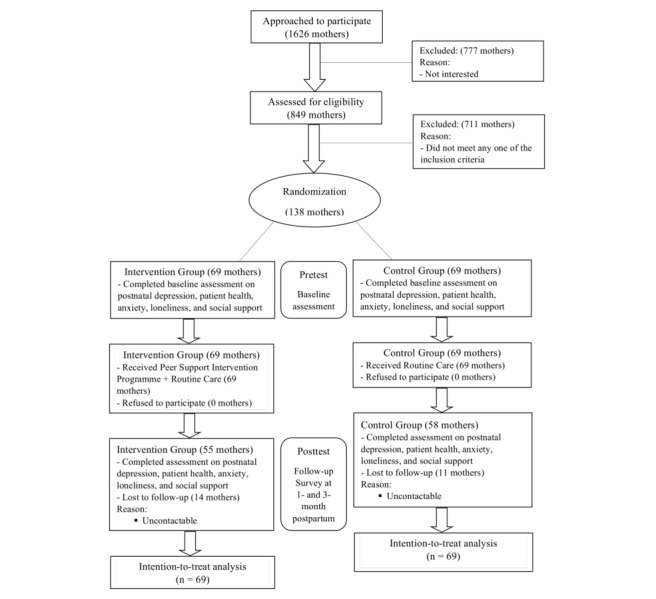
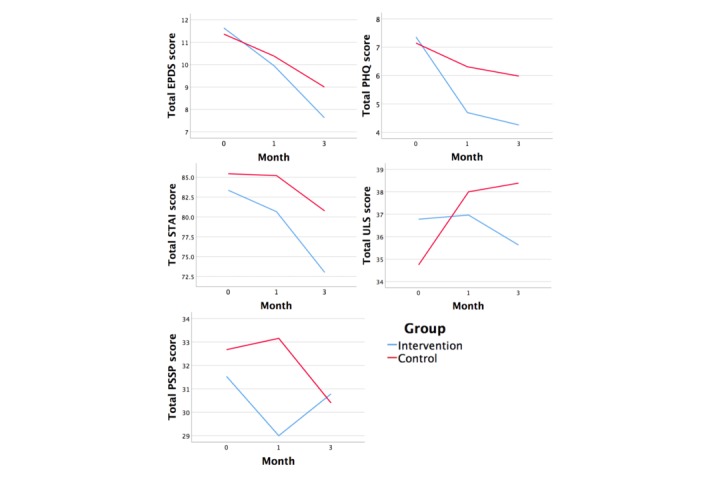
Background: The frenzy of postbirth events often takes a toll on mothers’ mental well-being, leaving them susceptible to postpartum psychological disorders such as postnatal depression (PND). Social support has been found to be effective in restoring the emotional well-being of new mothers. Therefore, mothers need to be supported during the crucial postpartum period to buffer the negative after effects of childbirth and to promote healthier maternal well-being. Objective: This study aimed to evaluate the effectiveness of a technology-based peer-support intervention program (PIP) on maternal outcomes during the early postpartum period. Methods: A randomized, parallel-armed controlled trial was conducted. The study recruited 138 mothers (69 in intervention group, 69 in control group) at risk of PND from a tertiary hospital in Singapore. To support these mothers, 20 peer volunteers were recruited by word of mouth and trained by a psychiatrist in social support skills before the intervention commenced. The 4-week–long intervention included a weekly follow-up with a peer volunteer through phone calls or text messages. The intervention group received peer support in addition to the standard care offered by the hospital. The control group only received postnatal standard care. Maternal outcomes (PND, postnatal anxiety [PNA], loneliness, and perceived social support) were measured with reliable and valid instruments. Data were collected immediately postpartum, at 1 month postpartum and at 3 months postpartum. The general linear model was used to compare the groups for postpartum percentage changes in the outcome variables at first and third months, and the linear mixed model was used to compare the trend over the study period. Results: There was a statistically significant difference in Edinburgh Postnatal Depression Scale scores (d=–2.11; 95% CI −4.0 to −0.3; P=.03) between the intervention and control groups at 3 months postpartum after adjusting for covariates. The intervention group had a significant change over time compared with the control group. Conclusions: The technology-based PIP was found to be effective in reducing the risk of PND among new mothers and showed a generally positive trend in reducing PNA and loneliness and increasing perceived social support. This study highlights the importance of training paraprofessionals to provide needed support for new mothers postpartum. A further long-term evaluation of the PIP on maternal and family outcomes and its cost-effectiveness is needed to inform clinical practices. Trial Registration: ISRCTN Registry ISRCTN14864807; https://www.isrctn.com/ISRCTN14864807 International Registered Report Identifier (IRRID): RR2-10.2196/resprot.9416
Overview
The claims and statistics of this paper haven’t been checked yet.
Free: it reads the open-access text and checks the first 5 claims that cite a source we can check. Create a free account to check every claim.
Integrity signals
Registry
Cites
Statistics
Figures
Verification
Claims the paper makes
The claims and statistics of this paper haven’t been checked yet.
Free: it reads the open-access text and checks the first 5 claims that cite a source we can check. Create a free account to check every claim.
Claims other papers make about this one
Each is checked against this paper’s own text: does it say what the citing paper says it does?
The source backs part of the claim, not all of it — or backs it for a different population, condition or comparison.
In the citing paper
“Specifically, mHealth technologies that provide platforms for peer interaction and support and psychoeducation have been shown to be both acceptable and effective in improving mood symptoms in women during the perinatal period [25–29].”
From Technology-Based Approaches for Supporting Perinatal Mental Health (2022) · cites this paper as [25]
Experimental — accuracy not yet measuredThe source backs part of the claim, not all of it — or backs it for a different population, condition or comparison.
In the citing paper
“These studies have been largely limited to mothers without prior mental health histories, those with only mild to moderate depressive symptoms, those with healthy infants, and in a single language, limiting the generalizability of this research.”
From Technology-Based Approaches for Supporting Perinatal Mental Health (2022) · cites this paper as [25]
Experimental — accuracy not yet measuredThe check wasn’t confident either way, so it gives no verdict — never disputed.
In the citing paper
“the remaining 14 studies in this review did not mention this issue [35, 36, 40, 44, 47, 50, 56, 66, 67, 69, 73–76].”
From Mental health-related telemedicine interventions for pregnant women and new mothers: a systematic literature review (2023) · cites this paper as [67]
Experimental — accuracy not yet measured
Self-check
Percentages, sums and reported differences re-computed from the paper’s own numbers.
The self-check needs the paper’s full text.
Citations
Cites
The PHQ-9: Validity of a brief depression severity measure
Kroenke, K., Spitzer, R. L., & Williams, J. B. W. (2001) · Journal of General Internal Medicine · doi:10.1046/j.1525-1497.2001.016009606.x · Cited by 44,910
(1970) · Cited by 24,983
Stress, social support, and the buffering hypothesis
Cohen, S., & Wills, T. A. (1985) · Psychological Bulletin · doi:10.1037/0033-2909.98.2.310 · Cited by 18,093 · cited 2×
“Social support has long been proven to buffer stress and promote healthy psychological well-being [24].”
Detection of Postnatal Depression: Development of the 10-item Edinburgh Postnatal Depression Scale
Cox, J. L., Holden, J. M., & Sagovsky, R. (1987) · British Journal of Psychiatry · doi:10.1192/bjp.150.6.782 · Cited by 14,183
Cohen, J. (1992) · Current Directions in Psychological Science · doi:10.1111/1467-8721.ep10768783 · Cited by 5,870
UCLA loneliness scale (version 3): reliability, validity, and factor structure
Russell, D. W. (1996) · Journal of Personality Assessment · doi:10.1207/s15327752jpa6601_2 · Cited by 5,800
Kawachi, I. (2001) · Journal of Urban Health: Bulletin of the New York Academy of Medicine · doi:10.1093/jurban/78.3.458 · Cited by 3,538
Rates and risk of postpartum depression – a meta-analysis
O'hara, M. W., & Swain, A. M. (1996) · International Review of Psychiatry · doi:10.3109/09540269609037816 · Cited by 3,116 · cited 2×
“This conflicts with most literature that reported the predictive effects of loneliness on PND [3,20].”
Maternal depression and parenting behavior
Lovejoy, M. C., Graczyk, P. A., O'Hare, E., & Neuman, G. (2000) · Clinical Psychology Review · doi:10.1016/s0272-7358(98)00100-7 · Cited by 2,667
Effects of perinatal mental disorders on the fetus and child
Stein, A., Pearson, R. M., Goodman, S. H., Rapa, E., Rahman, A., McCallum, M., Howard, L. M., & Pariante, C. M. (2014) · The Lancet · doi:10.1016/s0140-6736(14)61277-0 · Cited by 2,166 · cited 2×
“Furthermore, PND adversely affects the quality of mother-child interaction and bonding [11] as mothers who suffer from PND tend to be more negligent, less tolerant, and hostile toward their children [12-14].”
Research works printed but not linked: 5
- Holopainen, D, 2002, Aust J Adv Nurs, 19, 39
- Barrera, AZ, 2015, Rev Panam Salud Publica, 37, 148
- 10.1037/0033-2909.104.1.97 · doi:10.1037/0033-2909.104.1.97 · Paper page
- Abarashi, Z, 2014, Iran J Psychiatry Behav Sci, 8, 19
- Hudson, DB, 2000, Adolescence, 35, 445
Cited by
Smit, D., Miguel, C., Vrijsen, J. N., Groeneweg, B. F., Spijker, J., & Cuijpers, P. J. (2022) · Psychological Medicine · doi:10.1017/s0033291722002422 · Cited by 192
Singla, D. R., Lawson, A., Kohrt, B. A., Jung, J. W., Meng, Z., Ratjen, C., Zahedi, N., Dennis, C.-L., & Patel, V. (2021) · JAMA Psychiatry · doi:10.1001/jamapsychiatry.2020.4556 · Cited by 122
Self-citationSufredini, F., Catling, C., Zugai, J. S., & Chang, S. (2022) · Journal of Affective Disorders · doi:10.1016/j.jad.2022.09.005 · Cited by 147
Zhao, L., Chen, J., Lan, L., Deng, N., Liao, Y., Yue, L., Chen, I., Wen, S. W., & Xie, R.-H. (2021) · JMIR mHealth and uHealth · doi:10.2196/32544 · Cited by 91
Zhou, C., Hu, H., Wang, C., Zhu, Z., Feng, G., Xue, J., & Yang, Z. (2020) · Journal of Telemedicine and Telecare · doi:10.1177/1357633x20917816 · Cited by 131
Alsubheen, S., Oliveira, A., Habash, R., Goldstein, R. S., & Brooks, D. (2021) · Current Psychology · doi:10.1007/s12144-021-02494-w · Cited by 102
Vigod, S. N., Frey, B. N., Clark, C. T., Grigoriadis, S., Barker, L. C., Brown, H. K., Charlebois, J., Dennis, C., Fairbrother, N., Green, S. M., et al. (2025) · The Canadian Journal of Psychiatry · doi:10.1177/07067437241303031 · Cited by 117
Self-citationMörelius, E., Robinson, S., Arabiat, D. H., & Whitehead, L. (2021) · Journal of Medical Internet Research · doi:10.2196/31665 · Cited by 97
Perspectives of pregnant women during the COVID-19 pandemic: A qualitative study
Atmuri, K., Sarkar, M., Obudu, E., & Kumar, A. (2021) · Women and Birth · doi:10.1016/j.wombi.2021.03.008 · Cited by 90
Shorey, S., & Chan, V. (2020) · Midwifery · doi:10.1016/j.midw.2020.102821 · Cited by 81
Self-citationHanach, N., de Vries, N., Radwan, H., & Bissani, N. (2021) · Midwifery · doi:10.1016/j.midw.2020.102906 · Cited by 75
Chew, Y. J. M., Ang, S. L. L., & Shorey, S. (2020) · Journal of Advanced Nursing · doi:10.1111/jan.14602 · Cited by 80
Self-citationCommunity-based perinatal mental health peer support: a realist review
McLeish, J., Ayers, S., & McCourt, C. (2023) · BMC Pregnancy and Childbirth · doi:10.1186/s12884-023-05843-8 · Cited by 75
Effect of peer support intervention on perinatal depression: A meta-analysis
Fang, Q., Lü, L., Chen, Q., Yuan, Y., Wang, S., Zhang, Y., Liu, T., Cheng, H., & Tian, L. (2021) · General Hospital Psychiatry · doi:10.1016/j.genhosppsych.2021.12.001 · Cited by 68
Kent‐Marvick, J., Simonsen, S. E., Pentecost, R., Taylor, E., & McFarland, M. (2022) · Systematic Reviews · doi:10.1186/s13643-022-02065-5 · Cited by 64
Shorey, S., & Ng, E. D. (2019) · Journal of Medical Internet Research · doi:10.2196/12915 · Cited by 54
Self-citationShorey, S., Law, E. C. N., Thilagamangai, Mathews, J., Lim, S. H., Shi, L., Chua, J. S., Du, R., Chan, Y. H., Tan, T. C., et al. (2023) · Journal of Medical Internet Research · doi:10.2196/41859 · Cited by 59
Self-citationStentzel, U., Grabe, H. J., Schmidt, S., Tomczyk, S., van den Berg, N., & Beyer, A. (2023) · BMC Psychiatry · doi:10.1186/s12888-023-04790-0 · Cited by 52
“Education lessons (n = 10) 5 (50%) [36, 37, 67, 71, 75]”
BackgroundInfluentialNan, Y., Zhang, J., Nisar, A., Huo, L., Yang, L., Yin, J., Wang, D., Rahman, A., Gao, Y., & Li, X. (2020) · BMC Pregnancy and Childbirth · doi:10.1186/s12884-020-03087-4 · Cited by 57
Goodman, S. H., Simon, H. F. M., McCarthy, L., Ziegler, J., & Ceballos, A. (2022) · Clinical Child and Family Psychology Review · doi:10.1007/s10567-022-00398-0 · Cited by 54
O’Leary, T. K., Parmar, D., Ólafsson, S., Paasche‐Orlow, M. K., Bickmore, T., & Parker, A. G. (2022) · CHI Conference on Human Factors in Computing Systems · doi:10.1145/3491102.3517700 · Cited by 52
Davis, J. A., Ohan, J. L., Gibson, L. Y., Prescott, S. L., & Finlay‐jones, A. L. (2022) · Journal of Medical Internet Research · doi:10.2196/36620 · Cited by 49
Social support is linked to mental health, quality of life, and motor function in multiple sclerosis
Kever, A., Buyukturkoglu, K., Riley, C., Jager, P. L. D., & Leavitt, V. M. (2021) · Journal of Neurology · doi:10.1007/s00415-020-10330-7 · Cited by 46
Wong, T. S. M., & Shorey, S. (2022) · Journal of Pediatric Nursing · doi:10.1016/j.pedn.2022.09.004 · Cited by 43
Self-citationRefaeli, L. B., Rodrigues, M., Neaman, A., Bertele, N., Ziv, Y., Talmon, A., & Enav, Y. (2023) · Patient Education and Counseling · doi:10.1016/j.pec.2023.108090 · Cited by 47
Merza, D., Amani, B., Savoy, C. D., Babiy, Z., Bieling, P., Streiner, D. L., Ferro, M. A., & Lieshout, R. J. V. (2023) · Acta Psychiatrica Scandinavica · doi:10.1111/acps.13611 · Cited by 40
Technology-Based Approaches for Supporting Perinatal Mental Health
Novick, A. M., Kwitowski, M., Dempsey, J., Cooke, D. L., & Dempsey, A. G. (2022) · Current Psychiatry Reports · doi:10.1007/s11920-022-01349-w · Cited by 35
“Specifically, mHealth technologies that provide platforms for peer interaction and support and psychoeducation have been shown to be both acceptable and effective in improving mood symptoms in women during the perinatal period [25–29].”
BackgroundShorey, S., & Chua, J. Y. X. (2022) · Journal of Mental Health · doi:10.1080/09638237.2021.2022630 · Cited by 37
Self-citationPeer support and mobile health for perinatal mental health: A scoping review
Liblub, S., Pringle, K. G., McLaughlin, K., & Cummins, A. M. (2024) · Birth · doi:10.1111/birt.12814 · Cited by 35
Shah, L., Chua, J. Y. X., Goh, Y. S., Chee, C. Y. I., Chong, S. C., Mathews, J., Lim, L. H. K., Chan, Y. H., Mörelius, E., & Shorey, S. (2024) · Worldviews on Evidence-Based Nursing · doi:10.1111/wvn.12747 · Cited by 28
Self-citationSaad, A., Magwood, O., Aubry, T., Alkhateeb, Q., Hashmi, S. S., Hakim, J. C.-E., Ford, L., Kassam, A., Tugwell, P., & Pottie, K. C. (2021) · PLoS ONE · doi:10.1371/journal.pone.0259474 · Cited by 25
Beňová, L., Semaan, A. T., Portela, A. G., Bonet, M., van den Akker, T., Pembe, A. B., Moran, A. C., & Duclos, D. (2023) · Journal of Global Health · doi:10.7189/jogh.13.04176 · Cited by 27
Anyanwu, I. S., & Jenkins, J. (2024) · Oxford Open Digital Health · doi:10.1093/oodh/oqae026 · Cited by 29
Dolatabadi, Z., & Amiri‐Farahani, L. (2021) · Trials · doi:10.1186/s13063-021-05559-0 · Cited by 20
Perinatal support for couples during COVID ‐19: A descriptive qualitative study
Shorey, S., Tan, T. C., Thilagamangai, Mathews, J., Lim, S. H., Shi, L., Chua, J. S., Chan, Y. H., Law, E. C. N., Chee, C. Y. I., et al. (2022) · Journal of Clinical Nursing · doi:10.1111/jocn.16432 · Cited by 20
Self-citationSeshu, U., Khan, H. A., Bhardwaj, M. K., Sangeetha, C., Aarthi, G. R., John, S., THARA, R., & Raghavan, V. (2020) · International Journal of Social Psychiatry · doi:10.1177/0020764020966003 · Cited by 20
Chua, J. Y. X., Choolani, M. A., Chee, C. Y. I., Yi, H., Chan, Y. H., Lalor, J., Chong, Y. S., & Shorey, S. (2024) · Journal of Medical Internet Research · doi:10.2196/56894 · Cited by 19
Self-citationEffect of eHealth interventions on perinatal depression: A meta-analysis
Xie, H., Cong, S., Wang, R., Sun, X., Han, J., Ni, S., & Zhang, A. (2024) · Journal of Affective Disorders · doi:10.1016/j.jad.2024.03.027 · Cited by 19
Osman, Y. M. M., Toda, M., Ogasawara, A., Hirose, N., Chen, S., Kawasaki, H., & Shimpuku, Y. (2025) · BMC Nursing · doi:10.1186/s12912-025-03072-2 · Cited by 18
Law, K. H., Dimmock, J. A., Guelfi, K. J., Nguyen, T. T., Bennett, E., Gibson, L. Y., Tan, X. H., & Jackson, B. (2020) · Women and Birth · doi:10.1016/j.wombi.2020.10.009 · Cited by 17
Asalıoğlu, C. U., & Sözbir, Ş. Y. (2024) · International Journal of Gynecology & Obstetrics · doi:10.1002/ijgo.15359 · Cited by 17
Evaluation of the Perceived Benefits of a Peer Support Group for People with Mental Health Problems
Beard, D., Cottam, C., & Painter, J. (2024) · Nursing Reports · doi:10.3390/nursrep14030124 · Cited by 18
Naughton‐Doe, R., Nowland, R. A., Tierney, S., Webber, M., & Wittkowski, A. (2025) · BMC Public Health · doi:10.1186/s12889-024-20788-z · Cited by 16
Chernick, L. S., Konja, A. C., Gonzalez, A. E., Stockwell, M. S., Ehrhardt, A. Α., Bakken, S., Westhoff, C. L., Dayan, P. S., & Santelli, J. S. (2022) · Digital Health · doi:10.1177/20552076221104660 · Cited by 17
Digital Tools in the Service of Peer and Social Support for Perinatal Mental Health
Baumel, A. (2023) · Current Psychiatry Reports · doi:10.1007/s11920-023-01464-2 · Cited by 13
Yi, F., & Ahn, S. (2024) · Women s Health Nursing · doi:10.4069/whn.2024.09.02.1 · Cited by 13
Zhang, Y., Joly, R., Beecy, A., Principe, S., Satpathy, S., Gore, A., Reilly, T., Lang, M., Sathi, N., Uy, C., et al. (2024) · PubMed Central · Cited by 22
Qi, W., Huang, S., Zhao, J., Cui, X., Wei, Z., Cui, G., Guo, Q., & Hu, J. (2024) · Journal of Psychiatric Research · doi:10.1016/j.jpsychires.2024.11.050 · Cited by 14
Liang, D., Jia, R., Yu, J., Wu, Z., Chen, C., & Lu, G. (2021) · Medicine · doi:10.1097/md.0000000000026332 · Cited by 13
Fajnerová, I., Hejtmánek, L., Sedlák, M., Jablonská, M., Francová, A., & Stopková, P. (2024) · Journal of Medical Internet Research · doi:10.2196/60441 · Cited by 13
Zhong, L., Xu, Z., Li, X., Law, R., Wang, Y., & Zhu, M. (2025) · Tourism Management · doi:10.1016/j.tourman.2025.105221 · Cited by 12
Haldar, S., Studd, H., Wong, N., Mohr, D. C., Reddy, M. C., & Miller, E. S. (2022) · Proceedings of the ACM on Human-Computer Interaction · doi:10.1145/3555614 · Cited by 15
Xie, E. B., Simpson, K. M., Reynolds, K., Giuliano, R. J., Protudjer, J. L. P., Söderström, M., Sauer-Zavala, S. E., Giesbrecht, G. F., Lebel, C. A., MacKinnon, A., et al. (2022) · Trials · doi:10.1186/s13063-022-06512-5 · Cited by 15
Nowland, R. A., McNally, L., & Gregory, P. (2024) · Scandinavian Journal of Psychology · doi:10.1111/sjop.12998 · Cited by 11
Hölzle, L., Schöch, P., Hörtnagl, C., Buchheim, A., Lampe, A., Zechmeister‐Koss, I., & Paul, J. L. (2024) · Frontiers in Psychiatry · doi:10.3389/fpsyt.2024.1389545 · Cited by 11
Shorey, S., Ng, J. Q. X., Liu, V. C., Chan, Y. H., & Chee, C. Y. I. (2024) · Journal of Advanced Nursing · doi:10.1111/jan.16382 · Cited by 11
Self-citationMiddleton, G., Matvienko‐Sikar, K., Briley, A. L., Dutch, D. C., Morgillo, S., Anderson, J., Schranz, N. K., Margrie, F., Kirby, R., Golley, R. K., et al. (2025) · Midwifery · doi:10.1016/j.midw.2025.104296 · Cited by 10
Strengthening Peer Mentoring Relationships for New Mothers: A Qualitative Analysis
Law, K. H., Jackson, B., Tan, X. H., Teague, S. J., Krause, A. E., Putter, K. C., Du’cane, M., Gibson, L. Y., Bulles, K. F., Barkin, J. L., et al. (2022) · Journal of Clinical Medicine · doi:10.3390/jcm11206009 · Cited by 10
Lasheras, G., Farré-Sender, B., Osma, J., Martínez‐Borba, V., & Mestre‐Bach, G. (2021) · Journal of Reproductive and Infant Psychology · doi:10.1080/02646838.2021.1921716 · Cited by 11
Alfayumi‐Zeadna, S., Zeadna, A., Azbarga, Z., Salman, L., Froimovici, M., Alkatnany, A., Grotto, I., & Daoud, N. (2022) · Maternal and Child Health Journal · doi:10.1007/s10995-022-03434-1 · Cited by 10
Hubungan Perceived Social Support dengan Psychological Well-Being pada Ibu Bekerja
Sulaeman, M. R., & Kustimah, K. (2024) · Journal of Psychological Science and Profession · doi:10.24198/jpsp.v8i1.53033 · Cited by 14
Pinedo, I. A., Paz‐Pascual, C., Bully, P., Espinosa, M., & EmaQ Group (2021) · JMIR Formative Research · doi:10.2196/28855 · Cited by 9
Kim, S., Aye, Y. M., Panyarachun, D., Hong, S. A., & Chang, Y. (2023) · PLoS ONE · doi:10.1371/journal.pone.0289250 · Cited by 8
Barrera, A. Z., Morris, S. Y., & Ruiz, A. (2022) · Frontiers in Global Women s Health · doi:10.3389/fgwh.2022.846611 · Cited by 8
Peer Support Programs for Youth Mental Health
Boucher, J., Subramonian, A., Hill, S., Gates, M., Brundisini, F. K., Severn, M., Kaunelis, D., Smith, A. L., & Helis, E. (2022) · Canadian Journal of Health Technologies · doi:10.51731/cjht.2022.495 · Cited by 10
Yıldırım, F., & Şahin, E. (2025) · Family Practice · doi:10.1093/fampra/cmaf024 · Cited by 7
Sohmaran, C., Rahim, A. B. M., Chua, J. Y. X., & Shorey, S. (2023) · Midwifery · doi:10.1016/j.midw.2023.103802 · Cited by 7
Self-citationŞat, S. Ö., & Sözbir, Ş. Y. (2023) · Nursing Research · doi:10.1097/nnr.0000000000000647 · Cited by 17
Budaya dan Intervensi Depresi Postpartum: Tinjauan Literatur Sistematik Lintas Benua
Anggraini, R., & Setiyowati, N. (2024) · Jurnal Psikologi · doi:10.47134/pjp.v2i1.3240 · Cited by 6
A novel digital competence assessment tool for parents: Development and validation study
Jia, Y., Xu, B., Li, Y., Zhuang, X., Zhang, J., & Zhang, Y. (2025) · Digital Health · doi:10.1177/20552076251353319 · Cited by 5
Roos, L. E., MacKinnon, A., Xie, E. B., Simpson, K. M., Rioux, C., Reynolds, K., Giuliano, R. J., Harrington, J., Protudjer, J. L. P., Sauer-Zavala, S. E., et al. (2026) · Journal of Consulting and Clinical Psychology · doi:10.1037/ccp0001000 · Cited by 5
Effect of Maternal and Newborn Care Intervention on Maternal Functioning of Primiparous Mothers
Thwin, M. M., Htay, N. N., & Mya, T. (2023) · Nursing and Health Sciences Journal (NHSJ) · doi:10.53713/nhsj.v3i3.269 · Cited by 6
Lin, Y., Zhang, X., Zhou, T., Xu, F., Zhu, X., Zhou, H., Wang, X., & Ding, Y. (2023) · Early Intervention in Psychiatry · doi:10.1111/eip.13462 · Cited by 4
Anchuri, K., Steiner, L., Rabet, R., Craig-Neil, A., Antonio, E. S., Ogundele, O. J., Seabrook, M. S. S., Pope, C., Dai, S., Schuler, A., et al. (2024) · BJGP Open · doi:10.3399/bjgpo.2023.0119 · Cited by 5
Zheng, W., Chotipanvithayakul, R., Ingviya, T., & Guo, F. (2025) · Global Health Action · doi:10.1080/16549716.2025.2491848 · Cited by 3
Marciniak, M. A., Rohde, J., Yuen, K. S. L., Binder, H., Walter, H., Wieser, M. J., Kalisch, R., Roelofs, K., & Kleim, B. (2025) · Internet Interventions · doi:10.1016/j.invent.2025.100843 · Cited by 3
Pengaruh Electronic Health Terhadap Penurunan Tingkat Depresi Postpartum: Tinjauan Sistematis
Emalia, F. H., & Nilasari, P. (2021) · Jurnal Ilmu Keperawatan Maternitas · doi:10.32584/jikm.v4i2.1271 · Cited by 3
Knowledge and Attitudes of Pregnant Women in Preventing Postpartum Depression
Jannah, S. R. (2022) · International Journal of Current Science Research and Review · doi:10.47191/ijcsrr/v5-i8-17 · Cited by 2
Franco, P., Olhaberry, M., Muzard, A., Lara, M. A., & Cuijpers, P. J. (2022) · Depression and personality · doi:10.1007/978-3-031-13029-8_8 · Cited by 2
Li, R., Liu, X., Jia, S., Lai, L., Lu, X., Xiong, Q., Cheng, W., Liu, S., Xu, R., Chen, Y., et al. (2025) · Journal of Affective Disorders · doi:10.1016/j.jad.2025.120297 · Cited by 2
Postpartum depression in the UAE: insights, challenges, and pathways to support
Hanach, N. (2024) · Research Publications (Maastricht University) · doi:10.26481/dis.20240923nh · Cited by 3
Salsabila, S., Ambarwati, D., & Pangesti, W. D. (2023) · Jurnal Riset Kesehatan Masyarakat · doi:10.14710/jrkm.2023.18723 · Cited by 1
Gopalan, P. R., Spada, M. L., Shenai, N., Kratzer, I. M. F., Nichols, N., Kucherer, S., Chou, S., Hovis, E., Beck, S., & Glance, J. B. (2024) · FOCUS The Journal of Lifelong Learning in Psychiatry · doi:10.1176/appi.focus.20230021 · Cited by 1
Rumano, R. P., Gordon, R. D., Winters, C. A., Coker‐Schwimmer, E., Voisin, C. E., Smith, B., Girald, A., Loisel, C., Sainsurin, S., Belgrave, B., et al. (2026) · Women s Health Reports · doi:10.1177/26884844261434507 · Cited by 1
Lynch, K. J., Shatte, A. B. R., Muller, J. L., George, K., Rossini, G., Anson, A., Hala, C., Dimmock, J. A., Hutchinson, D. M., & Teague, S. J. (2026) · Journal of Medical Internet Research · doi:10.2196/91778 · Cited by 1
Training on cultural competency for perinatal mental health peer supporters
Marvin‐Dowle, K., Oshaghi, G., Fair, F. J., Ratcliffe, J., & Soltani, H. (2022) · British Journal of Midwifery · doi:10.12968/bjom.2022.30.12.668 · Cited by 1
Alternative Treatments for Postpartum Depression
Thomson, M., & Sharma, V. (2023) · Current Treatment Options in Psychiatry · doi:10.1007/s40501-023-00295-5 · Cited by 1
Nakashima, C., Tanaka, K., Shinmasu, Y., Ikeuchi, S., & Nagata, K. (2024) · Journal of Advanced Nursing · doi:10.1111/jan.16712 · Cited by 1
Doi, S. K., Isumi, A., Sugawara, J., Maeda, K., Satoh, S., Mitsuda, N., & Fujiwara, T. (2025) · Suicide and Life-Threatening Behavior · doi:10.1111/sltb.13157 · Cited by 1
Jannah, S. R., Asnuriyanti, R., & Fithria, F. (2022) · Jurnal Kesehatan Vokasional · doi:10.22146/jkesvo.75933 · Cited by 4
Asazawa, K., Kojima, N., Kato, T., & 平出, 美. (2020) · Open Journal of Nursing · doi:10.4236/ojn.2020.108054
Amacompri information system for postpartum nursing monitoring
Porras, C. V., Troconis, E. C., Ferré‐Grau, C., & Fernández, I. D. M. (2021) · Ciencia e Innovación en Salud · doi:10.17081/innosa.141 · Cited by 2
Isolation of Arabidopsis mutants with altered seed fatty acid composition
Lemieux, B., Browse, J., & Somerville, C. R. (1989) · Plant Physiology, Supplement; (USA)
Omisade, O., & Good, A. (2022) · International Journal of Applied Research on Public Health Management · doi:10.4018/ijarphm.315802
Nisbet, L. (2023) · Open Access Victoria University of Wellington | Te Herenga Waka (Figshare) · doi:10.26686/wgtn.23906265 · Cited by 1
Intervenções comportamentais para Depressão Pós-Parto: revisão sistemática da literatura
Gomes, L. C. (2023) · Digital Library of Theses and Dissertations (Universidade de São Paulo) · doi:10.11606/d.47.2023.tde-11042024-170404
Online songwriting and postnatal loneliness
Spiro, N., Waddell, G., Adediran, R., Osmond, P., Tredget, E., Sharma, S., & Perkins, R. (2024) · Oxford University Press eBooks · doi:10.1093/oso/9780192863287.003.0005
Peer support competency and mindfulness training and its effect on mental health: A pilot project
Ong, L. Z., Callender, K. A., Wawa-Egbuche, S. A., Glawe, M. M., & Herbst, A. A. (2024) · Advances in Mental Health · doi:10.1080/18387357.2024.2426672
Falenta, A., Droździok, N., & Piegza, M. J. (2024) · Psychiatria Polska · doi:10.12740/pp/onlinefirst/193252
Liang, H., Casañas, E., & McNaney, R. (2025) · Research Square · doi:10.21203/rs.3.rs-8198900/v1
Metadata
- Authors
- Shorey, S., Chee, C. Y. I., Ng, E. D., Lau, Y., Dennis, C.-L., & Chan, Y. H.
- Affiliations
- National University of Singapore (SG)
- National University Hospital (SG)
- University of Toronto (CA)
- Corresponding author
- Shorey, Shefaly
- ORCID
- Venue
- Journal of Medical Internet Research
- Publisher
- JMIR Publications Inc.
- Published
- 2019-08-29
- Volume
- 21
- Issue
- 8
- Pages
- e12410
- ISSN
- 1438-8871 (ISSN-L)
- PMC
- PMC6744221
- OpenAlex
- W3163512872
- Cited by
- 125
- References
- 66
- Citations by year
- 2026: 12 · 2025: 14 · 2024: 23 · 2023: 28 · 2022: 22 · 2021: 16 · 2020: 8 · 2019: 1
- FWCI
- 10.82
- Type
- journal article
- Language
- en
- Open access
- gold
- doi.org
- Licence
- cc-by
- Locations
- Journal of Medical Internet Research (publishedVersion, cc-by)
- PubMed Central (publishedVersion, cc-by)
- PubMed (publishedVersion)
- National University of Singapore (submittedVersion, cc-by)
- Funders
- National University Health System
- Topics
- Health Sciences › Medicine › Public Health, Environmental and Occupational Health › Maternal Mental Health During Pregnancy and Postpartum
- Social Sciences › Psychology › Applied Psychology › Digital Mental Health Interventions
- Health Sciences › Medicine › Pediatrics, Perinatology and Child Health › Maternal and Neonatal Healthcare
- Keywords
- postpartum depression, peer support, technology-based interventions, postpartum anxiety, loneliness, perceived social support, social support, maternal mental health, postpartum period, Edinburgh Postnatal Depression Scale, cost-effectiveness, Singapore, Southeast Asia, health workforce shortage
- MeSH terms
- Adult, Female, Humans, Mothers, Peer Group, Social Support, Program Evaluation, Depression, Postpartum, Young Adult
About these checks
Registry, retraction, Cites and statistics results are computed, not judged, with one exception: a printed reference that no index lists is read once by a model before it counts as a citation error. Claims are extracted by a model and kept only when their quote appears verbatim in the text; each cited source is then checked, with a model’s help, for whether it says what the claim relies on. Those verdicts can be wrong — read the claim’s quote and the cited source before relying on one.
Statistics and arithmetic are recomputed, not judged.
Confidence bands are shown only for fields calibrated on our annotated test set. None is calibrated yet, so no band is shown.
What counts as a claim ›How we measure confidence ›How we check this ›
Are you an author, or do you see a problem with this page? Request a review
Data sources
Bibliographic data: Semantic Scholar, OpenAlex, Crossref.
Contains information from the Semantic Scholar Academic Graph Datasets, made available under the ODC Attribution License (ODC-BY 1.0).
Semantic Scholar’s data is described in: Kinney, R., et al. (2023). The Semantic Scholar Open Data Platform. arXiv:2301.10140.
