

Machine Learning Analysis to Identify Digital Behavioral Phenotypes for Engagement and Health Outcome Efficacy of an mHealth Intervention for Obesity: Randomized Controlled Trial
Open accessPublished version of a preprint
The DOI matches its Crossref record; 41 of the 41 references it cites were found in a registry or an index.
Abstract
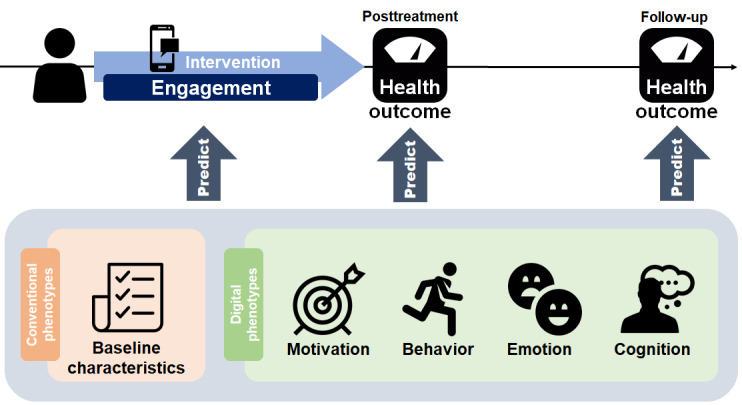
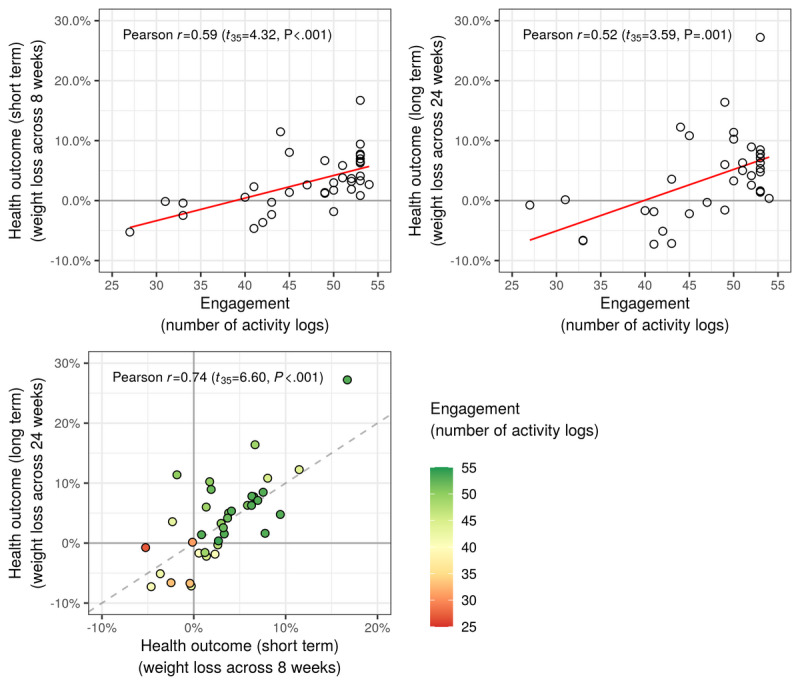
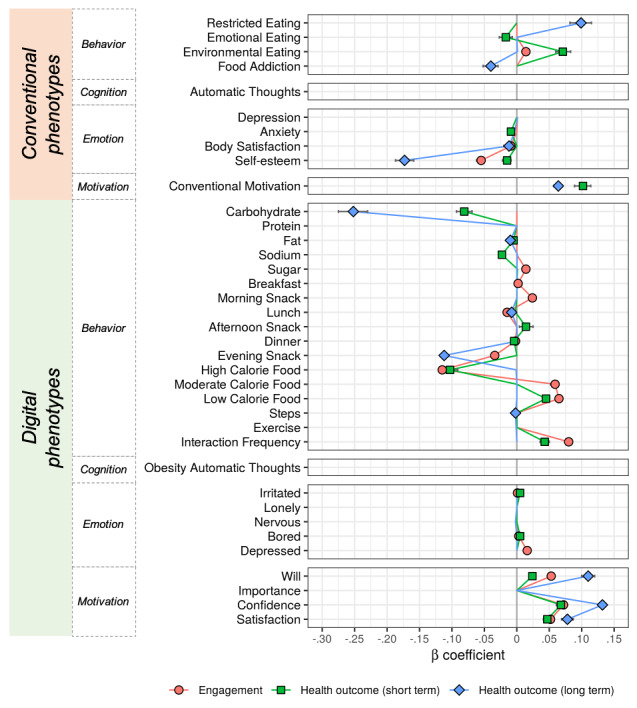
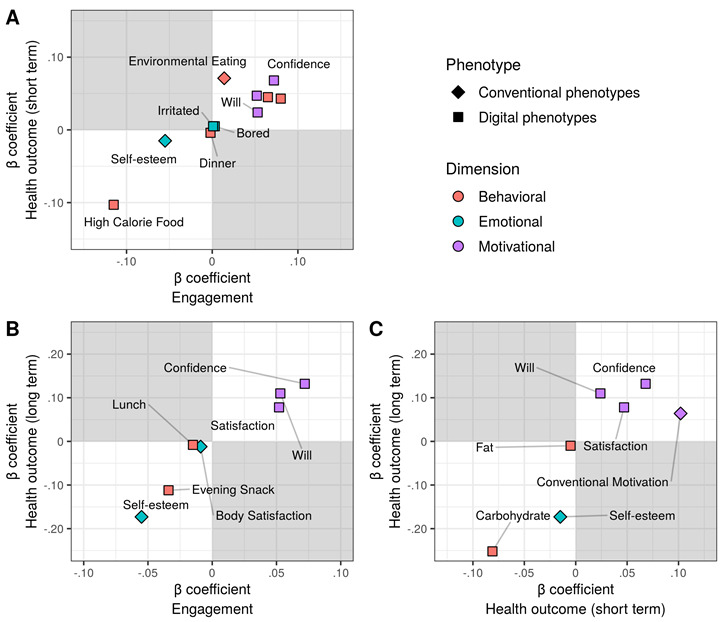
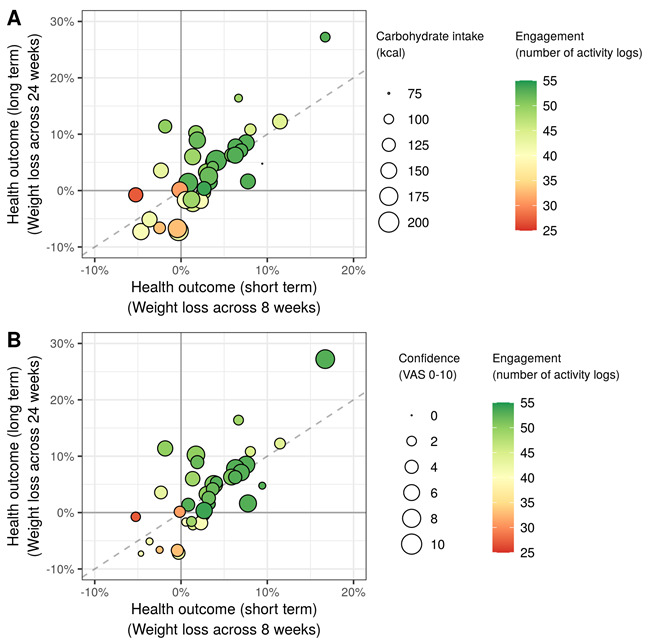
BACKGROUND The digital health care community has been urged to enhance engagement and clinical outcomes by analyzing multidimensional digital phenotypes. OBJECTIVE This study aims to use a machine learning approach to investigate the performance of multivariate phenotypes in predicting the engagement rate and health outcomes of digital cognitive behavioral therapy. METHODS We leveraged both conventional phenotypes assessed by validated psychological questionnaires and multidimensional digital phenotypes within time-series data from a mobile app of 45 participants undergoing digital cognitive behavioral therapy for 8 weeks. We conducted a machine learning analysis to discriminate the important characteristics. RESULTS A higher engagement rate was associated with higher weight loss at 8 weeks (r=−0.59; P<.001) and 24 weeks (r=−0.52; P=.001). Applying the machine learning approach, lower self-esteem on the conventional phenotype and higher in-app motivational measures on digital phenotypes commonly accounted for both engagement and health outcomes. In addition, 16 types of digital phenotypes (ie, lower intake of high-calorie food and evening snacks and higher interaction frequency with mentors) predicted engagement rates (mean R2 0.416, SD 0.006). The prediction of short-term weight change (mean R2 0.382, SD 0.015) was associated with 13 different digital phenotypes (ie, lower intake of high-calorie food and carbohydrate and higher intake of low-calorie food). Finally, 8 measures of digital phenotypes (ie, lower intake of carbohydrate and evening snacks and higher motivation) were associated with a long-term weight change (mean R2 0.590, SD 0.011). CONCLUSIONS Our findings successfully demonstrated how multiple psychological constructs, such as emotional, cognitive, behavioral, and motivational phenotypes, elucidate the mechanisms and clinical efficacy of a digital intervention using the machine learning method. Accordingly, our study designed an interpretable digital phenotype model, including multiple aspects of motivation before and during the intervention, predicting both engagement and clinical efficacy. This line of research may shed light on the development of advanced prevention and personalized digital therapeutics. CLINICALTRIAL ClinicalTrials.gov NCT03465306; https://clinicaltrials.gov/ct2/show/NCT03465306
Overview
The claims and statistics of this paper haven’t been checked yet.
Free: it reads the open-access text and checks the first 5 claims that cite a source we can check. Create a free account to check every claim.
Integrity signals
Registry
Cites
Statistics
Figures
Verification
Claims the paper makes
The claims and statistics of this paper haven’t been checked yet.
Free: it reads the open-access text and checks the first 5 claims that cite a source we can check. Create a free account to check every claim.
Claims other papers make about this one
Each is checked against this paper’s own text: does it say what the citing paper says it does?
The cited source doesn’t support the claim as written.
In the citing paper
“The studies that ranked high for selective reporting bias tended to report only user satisfaction data and treatment adherence, despite their methods considering the collection and assessment of psychiatric scale data and other effectiveness outcomes (29, 76, 79, 85–88, 92).”
From Examining the role of AI technology in online mental healthcare: opportunities, challenges, and implications, a mixed-methods review (2024) · cites this paper as [87]
Checked by a reasoning model — may be wrong.
Experimental — accuracy not yet measuredThe cited source says what the claim attributes to it.
In the citing paper
“The implemented machine learning approach identified self-esteem, in-app motivational measures, lower intake of high-calorie food, and higher interaction frequency with a healthcare mentor as predictors of higher treatment engagement.”
From Examining the role of AI technology in online mental healthcare: opportunities, challenges, and implications, a mixed-methods review (2024) · cites this paper as [87]
The cited source says what the claim attributes to it.
In the citing paper
“They reported that around 59% of outcome variance was explained by their prediction model (87).”
From Examining the role of AI technology in online mental healthcare: opportunities, challenges, and implications, a mixed-methods review (2024) · cites this paper as [87]
The cited source says what the claim attributes to it.
In the citing paper
“Kim et al. (2021) determined that higher engagement in an eCBT program for obesity was associated with higher weight loss.”
From Examining the role of AI technology in online mental healthcare: opportunities, challenges, and implications, a mixed-methods review (2024) · cites this paper as [87]
Self-check
Percentages, sums and reported differences re-computed from the paper’s own numbers.
The self-check needs the paper’s full text.
Citations
Cites
Regularization and Variable Selection Via the Elastic Net
Zou, H., & Hastie, T. (2005) · Journal of the Royal Statistical Society Series B: Statistical Methodology · doi:10.1111/j.1467-9868.2005.00503.x · Cited by 20,957
Guay, F., Vallerand, R. J., & Blanchard, C. (2000) · Motivation and Emotion · doi:10.1023/a:1005614228250 · Cited by 1,579 · cited 1×
“These categorizations among the four dimensions were proposed based on previous studies [18-21].”
MethodA Motivational Model of Video Game Engagement
Przybylski, A. K., Rigby, C. S., & Ryan, R. M. (2010) · Review of General Psychology · doi:10.1037/a0019440 · Cited by 1,422 · cited 1×
“Of special interest to this issue, it is noted that intrinsic motivation is a significant precursor for engagement [8].”
BackgroundWhat is user engagement? A conceptual framework for defining user engagement with technology
O'Brien, H. L., & Toms, E. G. (2008) · Journal of the American Society for Information Science and Technology · doi:10.1002/asi.20801 · Cited by 1,397
Masters, S. L., Dunne, A., Subramanian, S. L., Hull, R. L., Tannahill, G. M., Sharp, F. A., Becker, C., Franchi, L., Yoshihara, E., Chen, Z., et al. (2010) · Nature Immunology · doi:10.1038/ni.1935 · Cited by 1,330
Borghouts, J., Eikey, E., Mark, G., De Leon, C., Schueller, S. M., Schneider, M., Stadnick, N., Zheng, K., Mukamel, D., & Sorkin, D. H. (2021) · Journal of Medical Internet Research · doi:10.2196/24387 · Cited by 1,069 · cited 1×
“For the first time, this study evaluated the multiple dimensions of motivation at two different periods: before (conventional motivation) and during (in-app motivation) the intervention [31,32].”
BackgroundTorous, J., Nicholas, J., Larsen, M. E., Firth, J., & Christensen, H. (2018) · Evidence Based Mental Health · doi:10.1136/eb-2018-102891 · Cited by 790 · cited 2×
“Previously, pragmatic qualities, systematic flow, satisfaction, usability, and esthetics were known as the major contributors to digital therapeutic engagement [7,27,29].”
BackgroundLaranjo, L., Arguel, A., Neves, A. L., Gallagher, A. M., Kaplan, R., Mortimer, N., Mendes, G. A., & Lau, A. Y. S. (2015) · Journal of the American Medical Informatics Association · doi:10.1136/amiajnl-2014-002841 · Cited by 661 · cited 1×
“The association between intervention exposure and efficacy emphasizes the need for a detailed understanding of user engagement [3].”
BackgroundTorous, J., Lipschitz, J., Ng, M., & Firth, J. (2020) · Journal of Affective Disorders · doi:10.1016/j.jad.2019.11.167 · Cited by 546 · cited 1×
“From this perspective, a previous meta-analysis claimed that integrating a human factor into the treatment is an actionable strategy to alleviate dropout rates in the digital intervention [30].”
BackgroundMachine Learning and Decision Support in Critical Care
Johnson, A. E. W., Ghassemi, M. M., Nemati, S., Niehaus, K. E., Clifton, D., & Clifford, G. D. (2016) · Proceedings of the IEEE · doi:10.1109/jproc.2015.2501978 · Cited by 432 · cited 1×
“A recent study has shown that mortality prediction models using intensive care unit data based on a machine learning approach are superior to conventional methods [15].”
Background
Cited by
Digital therapeutics in the clinic
Phan, P., Mitragotri, S., & Zhao, Z. (2023) · Bioengineering & Translational Medicine · doi:10.1002/btm2.10536 · Cited by 104
Gutierrez, G., Stephenson, C., Eadie, J., Asadpour, K., & Alavi, N. (2024) · Frontiers in Psychiatry · doi:10.3389/fpsyt.2024.1356773 · Cited by 71
Metzendorf, M., Wieland, L. S., & Richter, B. (2024) · Cochrane Database of Systematic Reviews · doi:10.1002/14651858.cd013591.pub2 · Cited by 77
Huang, L., Huhulea, E. N., Abraham, E., Bienenstock, R., Aifuwa, E., Hirani, R., Schulhof, A., Tiwari, R. K., & Etienne, M. (2025) · Medicina · doi:10.3390/medicina61020358 · Cited by 68
“Additionally, psychological factors, such as patient trust in AI recommendations or preference for personal interaction, play a role in engagement and adherence to AI-guided weight management programs [68,110].”
Digital Phenotyping in Health Using Machine Learning Approaches: Scoping Review
Dlima, S. D., Shevade, S., Menezes, S. R., & Ganju, A. (2022) · JMIR Bioinformatics and Biotechnology · doi:10.2196/39618 · Cited by 60
“…temperature [17] Number of days activity monitor data were uploaded to the web-based app [52] Step count [18-22, 26, 27, 29, 30, 39, 43, 46, 56, 59-61] Engagement in binge eating [54] Blood pressure [19,21,43] Call logs [60] Gait parameters [44,51,58] Engagement in dietary restraint [54]…”
BackgroundMethodInfluential
Metadata
- Authors
- Kim, M., Yang, J., Ahn, W.-Y., & Choi, H. J.
- Affiliations
- Seoul National University (KR)
- Corresponding author
- Choi, Hyung Jin
- Venue
- Journal of Medical Internet Research
- Publisher
- JMIR Publications Inc.
- Published
- 2021-06-24
- Volume
- 23
- Issue
- 6
- Pages
- e27218
- ISSN
- 1438-8871 (ISSN-L)
- PMC
- PMC8277339
- OpenAlex
- W3162309386
- Cited by
- 41
- References
- 41
- Citations by year
- 2026: 8 · 2025: 9 · 2024: 9 · 2023: 10 · 2022: 4 · 2021: 1
- FWCI
- 6.74
- Type
- journal article
- Language
- en
- Open access
- gold
- doi.org
- Licence
- cc-by
- Locations
- Journal of Medical Internet Research (publishedVersion, cc-by)
- PubMed Central (publishedVersion, cc-by)
- PubMed (publishedVersion)
- DOAJ (DOAJ: Directory of Open Access Journals) (submittedVersion, cc-by-sa)
- Seoul National University Open Repository (Seoul National University) (submittedVersion)
- Funders
- National Research Foundation (BK21 FOUR)
- Seoul National University (NRF-2018R1A4A1025891)
- Topics
- Health Sciences › Health Professions › General Health Professions › Mobile Health and mHealth Applications
- Social Sciences › Psychology › Applied Psychology › Digital Mental Health Interventions
- Social Sciences › Psychology › Experimental and Cognitive Psychology › Mental Health Research Topics
- Keywords
- digital phenotypes, mobile health intervention, obesity, digital cognitive behavioral therapy, user engagement, weight loss, self-esteem, motivation, dietary intake, carbohydrate intake, mobile application, digital therapeutics, model interpretability
- MeSH terms
- Machine Learning, Humans, Obesity, Phenotype, Outcome Assessment, Health Care, Telemedicine
About these checks
Registry, retraction, Cites and statistics results are computed, not judged, with one exception: a printed reference that no index lists is read once by a model before it counts as a citation error. Claims are extracted by a model and kept only when their quote appears verbatim in the text; each cited source is then checked, with a model’s help, for whether it says what the claim relies on. Those verdicts can be wrong — read the claim’s quote and the cited source before relying on one.
Statistics and arithmetic are recomputed, not judged.
Confidence bands are shown only for fields calibrated on our annotated test set. None is calibrated yet, so no band is shown.
What counts as a claim ›How we measure confidence ›How we check this ›
Are you an author, or do you see a problem with this page? Request a review
How to cite
Cite CoChat for the checks on this page, and the paper for its own findings.
- This page
- CoChat. (2026). Citation check: Machine Learning Analysis to Identify Digital Behavioral Phenotypes for Engagement and Health Outcome Efficacy of an mHealth Intervention for Obesity: Randomized Controlled Trial. https://app.cochat.ai/papers/10.2196/27218
- The paper
- Kim, M., Yang, J., Ahn, W.-Y., & Choi, H. J. (2021). Machine Learning Analysis to Identify Digital Behavioral Phenotypes for Engagement and Health Outcome Efficacy of an mHealth Intervention for Obesity: Randomized Controlled Trial. Journal of Medical Internet Research. https://doi.org/10.2196/27218
Data sources
Bibliographic data: Semantic Scholar, OpenAlex, Crossref.
Contains information from the Semantic Scholar Academic Graph Datasets, made available under the ODC Attribution License (ODC-BY 1.0).
Semantic Scholar’s data is described in: Kinney, R., et al. (2023). The Semantic Scholar Open Data Platform. arXiv:2301.10140.
