

The DOI matches its Crossref record; 6 of the 6 references it cites were found in a registry or an index.
Anki Tagger: A Generative AI Tool for Aligning Third-Party Resources to Preclinical Curriculum
Open accessPublished version of a preprint
Abstract
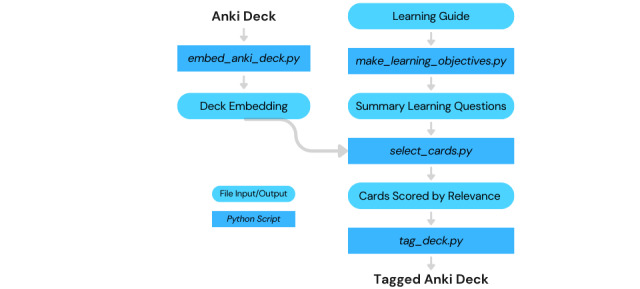
Using large language models, we developed a method to efficiently query existing flashcard libraries and select those most relevant to an individual's medical school curricula.
Overview
The claims and statistics of this paper haven’t been checked yet.
Run the check — free, no account needed. It reads the open-access text and checks the sources it cites.
Integrity signals
Registry
Cites
Statistics
Figures
Verification
Claims the paper makes
The claims and statistics of this paper haven’t been checked yet.
Run the check — free, no account needed. It reads the open-access text and checks the sources it cites.
Claims other papers make about this one
Each is checked against this paper’s own text: does it say what the citing paper says it does?
The cited source says what the claim attributes to it.
In the citing paper
“AI and LLMs can assist students in efficiently utilizing flashcards from existing libraries, such as Anki [153].”
From Artificial intelligence in undergraduate medical education: an updated scoping review (2025) · cites this paper as [153]
Self-check
Percentages, sums and reported differences re-computed from the paper’s own numbers.
The self-check needs the paper’s full text.
Citations
Cites
Gilson, A., Safranek, C. W., Huang, T., Socrates, V., Chi, L., Taylor, R. A., & Chartash, D. (2023) · JMIR Medical Education · doi:10.2196/45312 · Cited by 2,078
Comparison Between ChatGPT and Google Search as Sources of Postoperative Patient Instructions
Ayoub, N., Lee, Y.-J., Grimm, D. R., & Balakrishnan, K. (2023) · JAMA Otolaryngology–Head & Neck Surgery · doi:10.1001/jamaoto.2023.0704 · Cited by 98
Jape, D., Zhou, J., & Bullock, S. (2022) · BMC Medical Education · doi:10.1186/s12909-022-03324-8 · Cited by 74
The Self-directed Medical Student Curriculum
Wu, J. H., Gruppuso, P. A., & Adashi, E. Y. (2021) · JAMA · doi:10.1001/jama.2021.16312 · Cited by 59
Wothe, J. K., Wanberg, L. J., Hohle, R. D., et al. (2023) · Journal of Medical Education and Curricular Development · doi:10.1177/23821205231173289 · Cited by 28
Rana, T., Laoteppitaks, C., Zhang, G., et al. (2020) · The FASEB Journal · doi:10.1096/fasebj.2020.34.s1.09736 · Cited by 9
Cited by
Sorted by citations
Artificial intelligence in undergraduate medical education: an updated scoping review
Simoni, J., Urtubia-Fernandez, J., Mengual, E., Simoni, D. A., Royo, M., Egaña-Yin, D., Hertog, O. L. A., López-Ortiz, L., Muñoz-Tomás, A., Santiago-Martínez, P., et al. (2025) · BMC Medical Education · doi:10.1186/s12909-025-08188-2 · Cited by 62
Metadata
- Authors
- Pendergrast, T., & Chalmers, Z.
- Affiliations
- University of Michigan (US)
- Northwestern University (US)
- Corresponding author
- Chalmers, Zachary
- Venue
- JMIR Medical Education
- Publisher
- JMIR Publications Inc.
- Published
- 2023-09-20
- Volume
- 9
- Pages
- e48780
- ISSN
- 2369-3762 (ISSN-L)
- PMC
- PMC10551781
- OpenAlex
- W4385967155
- Cited by
- 18
- References
- 6
- Citations by year
- 2026: 4 · 2025: 9 · 2024: 5
- FWCI
- 0.72
- Type
- journal article
- Language
- en
- Open access
- gold
- doi.org
- Licence
- cc-by
- Locations
- JMIR Medical Education (publishedVersion, cc-by)
- PubMed Central (publishedVersion, cc-by)
- PubMed (publishedVersion)
- DOAJ (DOAJ: Directory of Open Access Journals) (submittedVersion, cc-by-sa)
- Topics
- Health Sciences › Medicine › Health Informatics › Artificial Intelligence in Healthcare and Education
- Social Sciences › Education › Innovations in Medical Education
- Social Sciences › Education › Artificial Intelligence in Education
- Keywords
- Anki, flashcards, large language models, preclinical curriculum, medical education, generative AI, personalized learning, spaced repetition
About these checks
Registry, retraction, Cites and statistics results are computed, not judged, with one exception: a printed reference that no index lists is read once by a model before it counts as a citation error. Claims are extracted by a model and kept only when their quote appears verbatim in the text; each cited source is then checked, with a model’s help, for whether it says what the claim relies on. Those verdicts can be wrong — read the claim’s quote and the cited source before relying on one.
Statistics and arithmetic are recomputed, not judged.
Confidence bands are shown only for fields calibrated on our annotated test set. None is calibrated yet, so no band is shown.
What counts as a claim ›How we measure confidence ›How we check this ›
Are you an author, or do you see a problem with this page? Request a review
How to cite
Cite CoChat for the checks on this page, and the paper for its own findings.
- This page
- CoChat. (2026). Citation check: Anki Tagger: A Generative AI Tool for Aligning Third-Party Resources to Preclinical Curriculum. https://app.cochat.ai/papers/10.2196/48780
- The paper
- Pendergrast, T., & Chalmers, Z. (2023). Anki Tagger: A Generative AI Tool for Aligning Third-Party Resources to Preclinical Curriculum. JMIR Medical Education. https://doi.org/10.2196/48780
