

The DOI matches its Crossref record; 3 of the 3 references it cites were found in a registry or an index.
Integrated Network Analysis of Symptom Clusters Across Monkeypox Epidemics From 1970 to 2023: Systematic Review and Meta-Analysis
Open accessPublished version of a preprint
Abstract
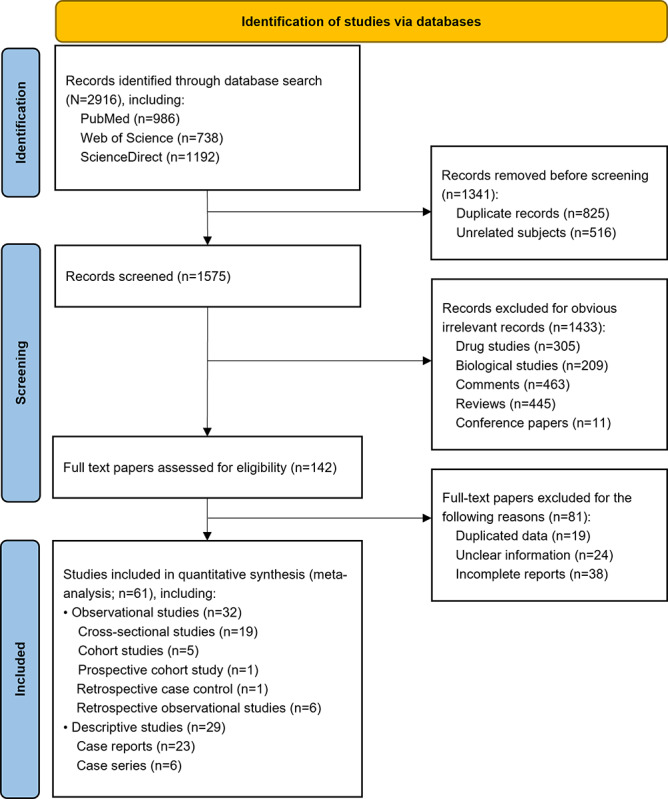
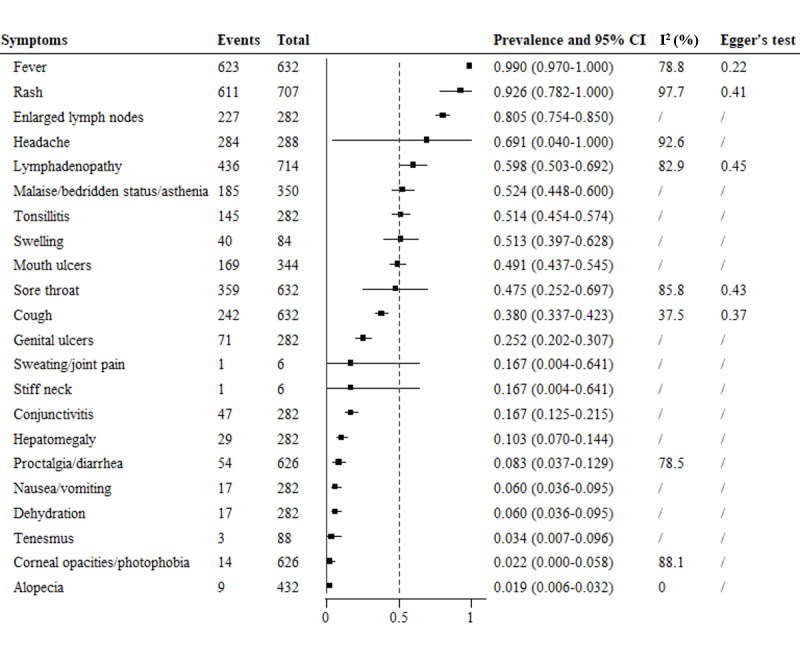
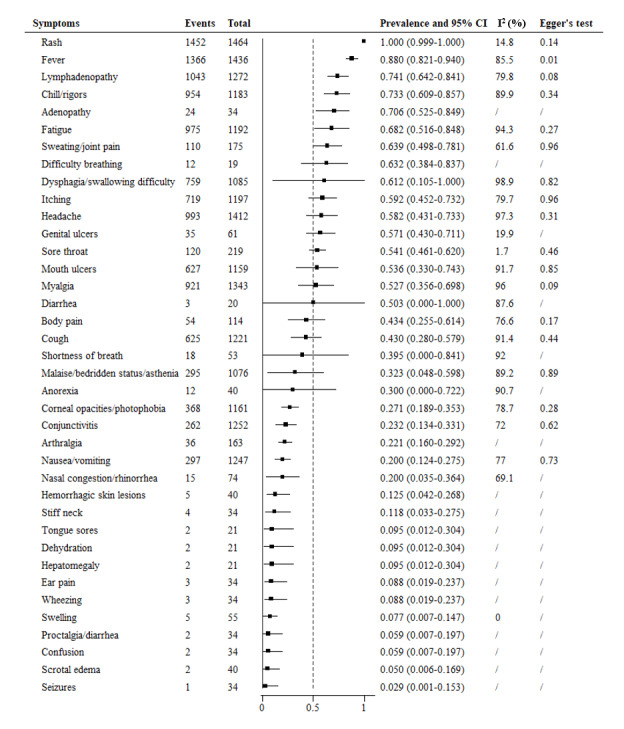
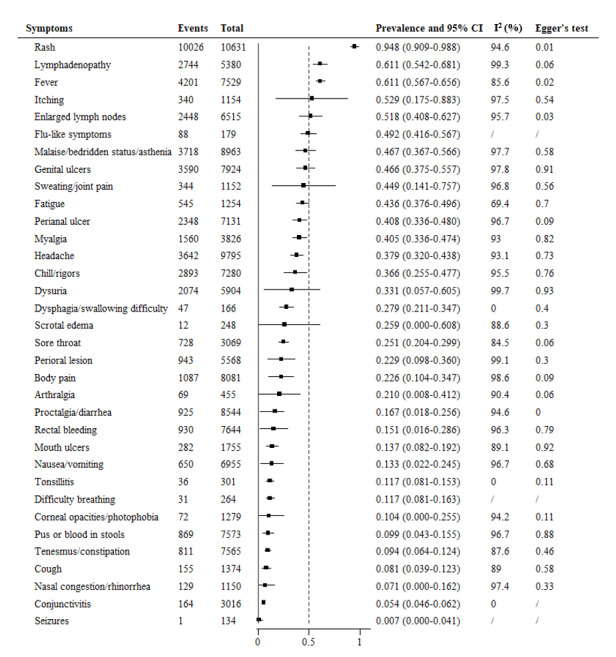
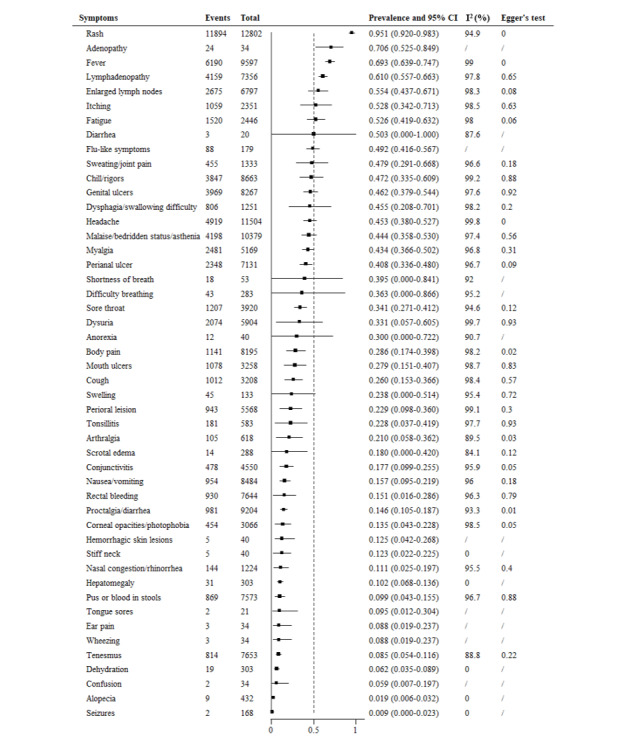
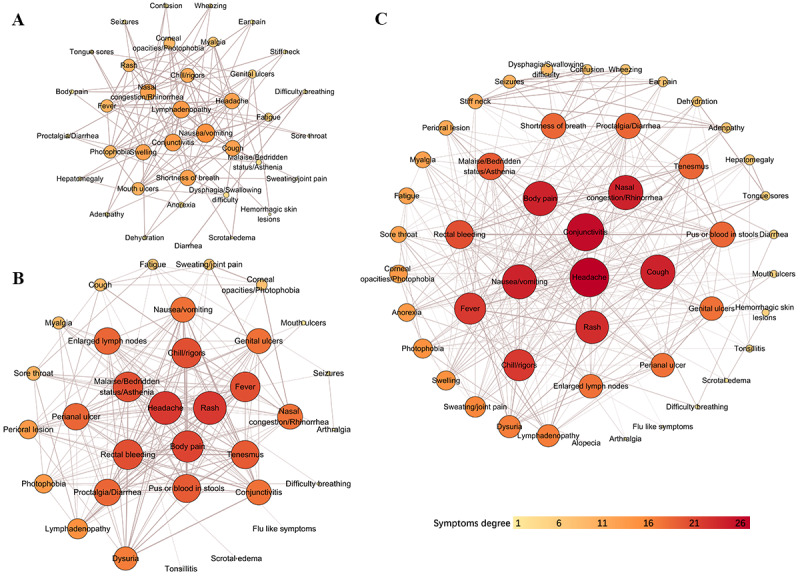
Background: The worldwide spread of monkeypox (mpox) has witnessed a significant increase, particularly in nonendemic countries. Objective: We aimed to investigate the changing clinical symptoms associated with mpox from 1970 to 2023 and explore their interrelations. Methods: In this systematic review and meta-analysis, 3 electronic databases were searched for English peer-reviewed studies conducted from January 1970 to April 2023 that reported any symptoms among confirmed mpox cases. We categorized the mpox epidemics into 3 periods: 1970-2002 (period 1, within the African region), 2003-2021(period 2, epidemics outside Africa), and 2022-2023 (period 3, worldwide outbreak). Following PRISMA guidelines, a meta-analysis was performed to estimate the pooled prevalence for each symptom. The correlation among symptoms was analyzed and visualized using network analysis. Results: The meta-analysis included 61 studies that reported 21 symptoms in 720 patients from period 1, 39 symptoms in 1756 patients from period 2, and 37 symptoms in 12,277 patients from period 3. The most common symptom among patients from all 3 periods was rash (period 1: 92.6%, 95% CI 78.2%-100%; period 2: 100%, 95% CI 99.9%-100%; and period 3: 94.8%, 95% CI 90.9%-98.8%), followed by lymphadenopathy (period 1: 59.8%, 95% CI 50.3%-69.2%; period 2: 74.1%, 95% CI 64.2%-84.1%; and period 3: 61.1%, 95% CI 54.2%-68.1%). Fever (99%, 95% CI 97%-100%), enlarged lymph nodes (80.5%, 95% CI 75.4%-85.0%), and headache (69.1%, 95% CI 4%-100%) were the main symptoms in period 1, with a significant decrease in period 3: 37.9%, 31.2%, and 28.7%, respectively. Chills/rigors (73.3%, 95% CI 60.9%-85.7%), fatigue (68.2%, 95% CI 51.6%-84.8%), and dysphagia/swallowing difficulty (61.2%, 95% CI 10.5%-100%) emerged as primary new symptoms in period 2 and decreased significantly in period 3. Most other symptoms remained unchanged or decreased in period 3 compared to the former 2 periods. Nausea/vomiting had the highest degree of correlation (with 13 symptoms) and was highly positively correlated with lymphadenopathy (r=0.908) and conjunctivitis (r=0.900) in period 2. In contrast, rash and headache were 2 symptoms with the highest degree of correlation (with 21 and 21 symptoms, respectively) in period 3 and were highly positively correlated with fever (r=0.918 and 0.789, respectively). Conclusions: The manifestation of symptoms in patients with mpox has become more diverse, leading to an increase in their correlation. Although the prevalence of rash remains steady, other symptoms have decreased. It is necessary to surveil the evolving nature of mpox and the consequential changes in clinical characteristics. Epidemic countries may shift their focus on the potential association among symptoms and the high synergy risk. Trial Registration: PROSPERO Registration: CRD42023403282; http://tinyurl.com/yruuas5n
Overview
The claims and statistics of this paper haven’t been checked yet.
Run the check — free, no account needed. It reads the open-access text and checks the sources it cites.
Integrity signals
Registry
Cites
Statistics
Figures
Verification
Claims the paper makes
The claims and statistics of this paper haven’t been checked yet.
Run the check — free, no account needed. It reads the open-access text and checks the sources it cites.
Self-check
Percentages, sums and reported differences re-computed from the paper’s own numbers.
The self-check needs the paper’s full text.
Citations
Cites
ROBINS-I: a tool for assessing risk of bias in non-randomised studies of interventions
Sterne, J. A., Hernán, M. A., Reeves, B. C., Savović, J., Berkman, N. D., Viswanathan, M., Henry, D., Altman, D. G., Ansari, M. T., Boutron, I., et al. (2016) · BMJ · doi:10.1136/bmj.i4919 · Cited by 20,329
Declaración PRISMA 2020: una guía actualizada para la publicación de revisiones sistemáticas
Page, M. J., McKenzie, J. E., Bossuyt, P. M., Boutron, I., Hoffmann, T. C., Mulrow, C. D., Shamseer, L., Tetzlaff, J. M., Akl, E. A., Brennan, S. E., et al. (2021) · Revista Española de Cardiología (English Edition) · doi:10.1016/j.rec.2021.07.010 · Cited by 1,313
Cochrane Rapid Reviews Methods Group offers evidence-informed guidance to conduct rapid reviews
Garritty, C., Gartlehner, G., Nussbaumer-Streit, B., King, V. J., Hamel, C., Kamel, C., Affengruber, L., & Stevens, A. (2021) · Journal of Clinical Epidemiology · doi:10.1016/j.jclinepi.2020.10.007 · Cited by 1,141
Research works printed but not linked: 30
- 10.1371/journal.pntd.0010141 · DOI
- 10.1086/498155 · DOI
- 10.1186/s12941-022-00527-1 · DOI
- 10.1016/s1473-3099(03)00856-9 · DOI
- 10.1136/bmjgh-2022-009838 · DOI
- 10.1128/JCM.40.8.2919-2921.2002 · DOI
- Moore, M, 2023, Mpox (Monkeypox)
- 10.1016/S0140-6736(22)02187-0 · DOI
- 10.1126/science.add4507 · DOI
- 10.1016/j.imj.2022.07.001 · DOI
- 10.3389/fpubh.2018.00241 · DOI
- 10.3390/tropicalmed1010008 · DOI
- 10.1016/j.idc.2019.03.001 · DOI
- 10.3390/pathogens12010146 · DOI
- 10.1002/rmv.2446 · DOI
- 10.1002/jmv.28709 · DOI
- 10.1016/j.eclinm.2022.101817 · DOI
- 10.1093/infdis/jiad034 · DOI
- 10.3390/biomedicines11030957 · DOI
- 10.1136/bmj.327.7414.557 · DOI · Paper page
- 10.1099/vir.0.81215-0 · DOI
- 10.1111/tmi.13785 · DOI
- 10.1126/science.add4153 · DOI
- 10.1073/pnas.2220415120 · DOI
- 10.1371/journal.pntd.0007791 · DOI
- 10.1111/all.15633 · DOI
- 10.1016/j.jinf.2022.08.013 · DOI
- 10.1093/cid/ciaa143 · DOI
- 10.1016/j.eclinm.2022.101710 · DOI
- 10.1002/rmv.2426 · DOI
Metadata
- Authors
- Su, S., Jia, M., Yu, Y., Li, H., Yin, W., Lu, Y., Huang, R., Xiang, R., Huang, H., & Hu, P.
- Affiliations
- Second Affiliated Hospital of Chongqing Medical University (CN)
- Corresponding author
- Hu, Peng
- ORCID
- Venue
- JMIR Public Health and Surveillance
- Publisher
- JMIR Publications Inc.
- Published
- 2024-02-16
- Volume
- 10
- Pages
- e49285
- ISSN
- 2369-2960 (ISSN-L)
- PMC
- PMC10907939
- OpenAlex
- W4391885025
- Cited by
- 13
- References
- 3
- Citations by year
- 2026: 5 · 2025: 6 · 2024: 2
- FWCI
- 0.88
- Type
- journal article
- Language
- en
- Open access
- gold
- doi.org
- Licence
- cc-by
- Locations
- JMIR Public Health and Surveillance (publishedVersion, cc-by)
- PubMed Central (publishedVersion, cc-by)
- PubMed (publishedVersion)
- DOAJ (DOAJ: Directory of Open Access Journals) (acceptedVersion)
- Funders
- National Natural Science Foundation of China
- Chongqing Medical University
- Natural Science Foundation of Chongqing (CSTB2023NSCQ)
- Centre Scientifique et Technique du Bâtiment
- Topics
- Life Sciences › Immunology and Microbiology › Virology › Poxvirus research and outbreaks
- Health Sciences › Medicine › Infectious Diseases › Viral Infections and Outbreaks Research
- Health Sciences › Medicine › Epidemiology › Virology and Viral Diseases
- Keywords
- monkeypox, symptom clusters, clinical symptoms, symptom prevalence, rash, lymphadenopathy, fever, headache, symptom interrelationships
- MeSH terms
- Humans, Mpox, Monkeypox, Epidemics, Symptom Assessment
About these checks
Registry, retraction, Cites and statistics results are computed, not judged, with one exception: a printed reference that no index lists is read once by a model before it counts as a citation error. Claims are extracted by a model and kept only when their quote appears verbatim in the text; each cited source is then checked, with a model’s help, for whether it says what the claim relies on. Those verdicts can be wrong — read the claim’s quote and the cited source before relying on one.
Statistics and arithmetic are recomputed, not judged.
Confidence bands are shown only for fields calibrated on our annotated test set. None is calibrated yet, so no band is shown.
What counts as a claim ›How we measure confidence ›How we check this ›
Are you an author, or do you see a problem with this page? Request a review
How to cite
Cite CoChat for the checks on this page, and the paper for its own findings.
- This page
- CoChat. (2026). Citation check: Integrated Network Analysis of Symptom Clusters Across Monkeypox Epidemics From 1970 to 2023: Systematic Review and Meta-Analysis. https://app.cochat.ai/papers/10.2196/49285
- The paper
- Su, S., Jia, M., Yu, Y., Li, H., Yin, W., Lu, Y., Huang, R., Xiang, R., Huang, H., & Hu, P. (2024). Integrated Network Analysis of Symptom Clusters Across Monkeypox Epidemics From 1970 to 2023: Systematic Review and Meta-Analysis. JMIR Public Health and Surveillance. https://doi.org/10.2196/49285
