

The DOI matches its Crossref record; 4 of the 4 references it cites were found in a registry or an index.
Emerging Trends in Information-Seeking Behavior for Alpha-Gal Syndrome: Infodemiology Study Using Time Series and Content Analysis
Published version of a preprint
Abstract
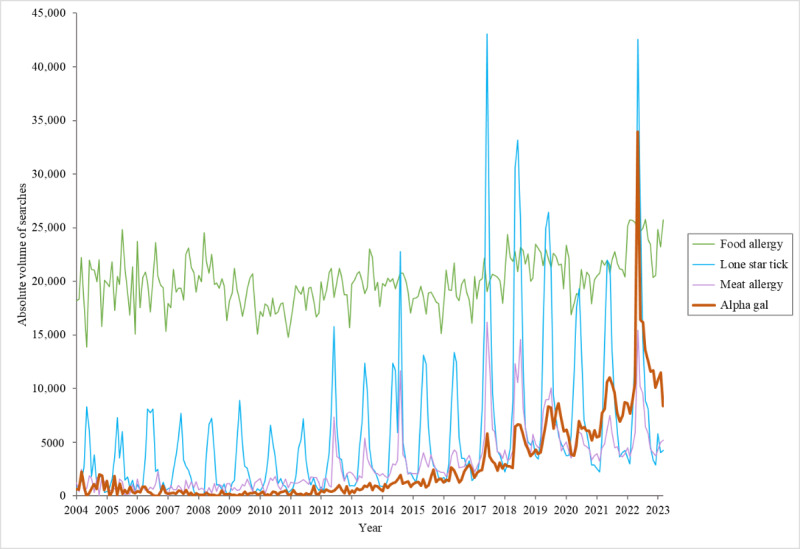
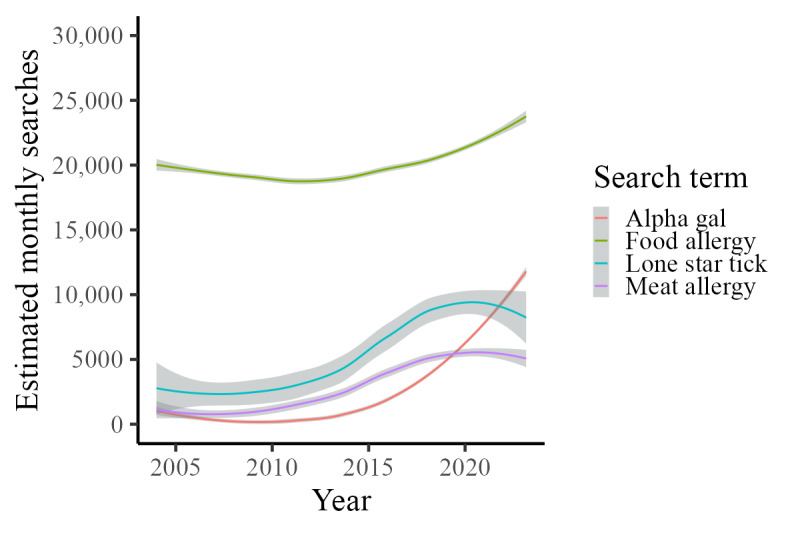
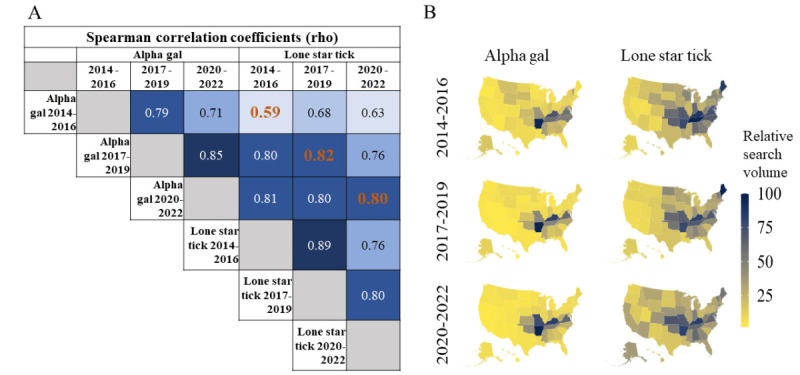
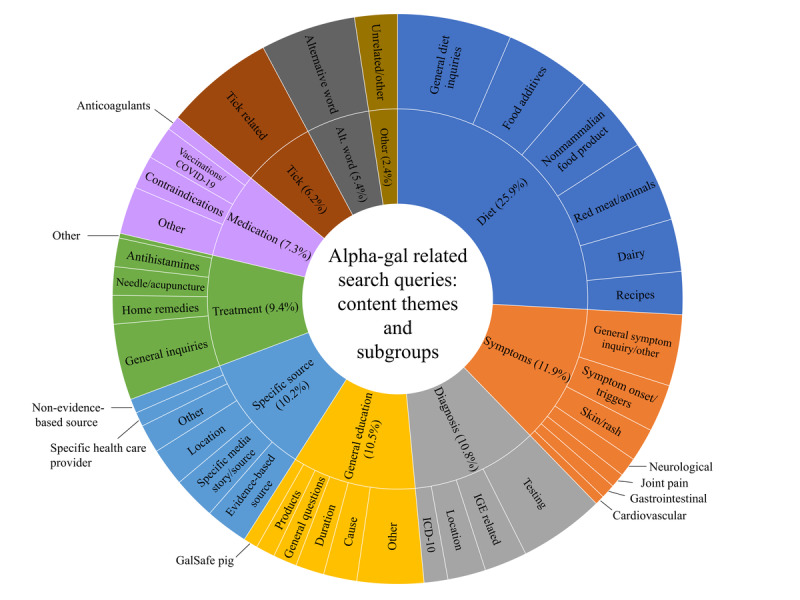
Background: Alpha-gal syndrome is an emerging allergy characterized by an immune reaction to the carbohydrate molecule alpha-gal found in red meat. This unique food allergy is likely triggered by a tick bite. Cases of the allergy are on the rise, but prevalence estimates do not currently exist. Furthermore, varying symptoms and limited awareness of the allergy among health care providers contribute to delayed diagnosis, leading individuals to seek out their own information and potentially self-diagnose. Objective: The study aimed to (1) describe the volume and patterns of information-seeking related to alpha-gal, (2) explore correlations between alpha-gal and lone star ticks, and (3) identify specific areas of interest that individuals are searching for in relation to alpha-gal. Methods: Google Trends Supercharged-Glimpse, a new extension of Google Trends, provides estimates of the absolute volume of searches and related search queries. This extension was used to assess trends in searches for alpha-gal and lone star ticks (lone star tick, alpha gal, and meat allergy, as well as food allergy for comparison) in the United States. Time series analyses were used to examine search volume trends over time, and Spearman correlation matrices and choropleth maps were used to explore geographic and temporal correlations between alpha-gal and lone star tick searches. Content analysis was performed on related search queries to identify themes and subcategories that are of interest to information seekers. Results: Time series analysis revealed a rapidly increasing trend in search volumes for alpha-gal beginning in 2015. After adjusting for long-term trends, seasonal trends, and media coverage, from 2015 to 2022, the predicted adjusted average annual percent change in search volume for alpha-gal was 33.78%. The estimated overall change in average search volume was 627%. In comparison, the average annual percent change was 9.23% for lone star tick, 7.34% for meat allergy, and 2.45% for food allergy during this time. Geographic analysis showed strong significant correlations between alpha-gal and lone star tick searches especially in recent years (ρ=0.80; P<.001), with primary overlap and highest search rates found in the southeastern region of the United States. Content analysis identified 10 themes of primary interest: diet, diagnosis or testing, treatment, medications or contraindications of medications, symptoms, tick related, specific sources of information and locations, general education information, alternative words for alpha-gal, and unrelated or other. Conclusions: The study provides insights into the changing information-seeking patterns for alpha-gal, indicating growing awareness and interest. Alpha-gal search volume is increasing at a rapid rate. Understanding specific questions and concerns can help health care providers and public health educators to tailor communication strategies. The Google Trends Supercharged-Glimpse tool offers enhanced features for analyzing information-seeking behavior and can be valuable for infodemiology research. Further research is needed to explore the evolving prevalence and impact of alpha-gal syndrome.
Overview
The claims and statistics of this paper haven’t been checked yet.
Run the check — free, no account needed. It reads the open-access text and checks the sources it cites.
Integrity signals
Registry
Cites
Statistics
Figures
Verification
Claims the paper makes
The claims and statistics of this paper haven’t been checked yet.
Run the check — free, no account needed. It reads the open-access text and checks the sources it cites.
Claims other papers make about this one
Each is checked against this paper’s own text: does it say what the citing paper says it does?
In the citing paper
“Anti-α-gal IgE antibodies can cause delayed allergic reactions after consumption of mammalian meat, offal, dairy products, or gelatin, as well as immediate reactions after exposure to certain mammalian-derived drugs or biological agents, such as cetuximab.”
From Parasites and allergies: a complex bidirectional relationship from evolutionary origins to modern therapeutics (2026) · cites this paper as Romeiser et al. 2024
In the citing paper
“Clinical manifestations include gastrointestinal symptoms, urticaria, angioedema, and anaphylaxis”
From Parasites and allergies: a complex bidirectional relationship from evolutionary origins to modern therapeutics (2026) · cites this paper as Romeiser et al. 2024
Self-check
Percentages, sums and reported differences re-computed from the paper’s own numbers.
The self-check needs the paper’s full text.
Citations
Cites
Eysenbach, G. (2009) · Journal of Medical Internet Research · doi:10.2196/jmir.1157 · Cited by 1,351
The use of google trends in health care research: a systematic review
Nuti, S. V., Wayda, B., Ranasinghe, I., Wang, S., Dreyer, R. P., Chen, S. I., & Murugiah, K. (2014) · PLoS ONE · doi:10.1371/journal.pone.0109583 · Cited by 1,086
Mavragani, A., Ochoa, G., & Tsagarakis, K. P. (2018) · Journal of Medical Internet Research · doi:10.2196/jmir.9366 · Cited by 390
The Meat of the Matter: Understanding and Managing Alpha-Gal Syndrome
Macdougall, J. D., Thomas, K. O., & Iweala, O. I. (2022) · ImmunoTargets and Therapy · doi:10.2147/itt.s276872 · Cited by 64
Research works printed but not linked: 31
- 10.1016/j.iac.2017.09.002 · DOI
- 10.3390/ijms21041474 · DOI
- 10.1016/j.waojou.2021.100598 · DOI
- Ng, AE, 2023, NCHS Data Brief, 1
- 10.1001/jamapediatrics.2013.2376 · DOI
- 10.1111/j.1398-9995.2009.02121.x · DOI
- 10.1159/000375106 · DOI
- 10.1080/1744666X.2020.1782745 · DOI
- 10.4049/jimmunol.2100712 · DOI
- 10.1016/j.jaip.2019.03.031 · DOI
- 10.3389/fimmu.2019.01056 · DOI
- 10.1186/s13071-020-04343-4 · DOI
- 10.1016/j.jaci.2011.02.019 · DOI · Paper page
- 10.1016/j.anai.2022.11.021 · DOI
- 10.3389/fcimb.2021.680264 · DOI
- 10.1016/j.ttbdis.2021.101674 · DOI
- 10.1056/NEJMp1911661 · DOI
- 10.1016/j.anai.2020.12.019 · DOI
- 10.1016/j.jaip.2019.12.003 · DOI
- 10.1016/j.onehlt.2022.100424 · DOI
- 10.1177/2150131917705714 · DOI
- 10.1177/2374373518808310 · DOI
- 10.2196/13680 · DOI
- 10.1016/j.jegh.2017.06.001 · DOI
- 10.3389/fdata.2023.1132764 · DOI
- 10.1093/aje/kwac171 · DOI
- 10.1371/journal.pone.0211778 · DOI
- 10.1016/j.jaip.2020.07.032 · DOI
- 10.1002/sim.3733 · DOI
- 10.3390/insects12030225 · DOI
- 10.14423/SMJ.0000000000001223 · DOI
Cited by
Sorted by citations
Packi, K., Świerczewski, D., Klimczak, S., Ochab, D., Gałęziewska, J., Gromek, P., Kruczkowska, W., Płuciennik, E., Kałuzińska-Kołat, Ż., & Kołat, D. (2026) · Antonie van Leeuwenhoek · doi:10.1007/s10482-026-02425-4
Metadata
- Authors
- Romeiser, J. L., Jusko, N., & Williams, A. A.
- Venue
- Journal of Medical Internet Research
- Publisher
- JMIR Publications Inc.
- Published
- 2024-05-08
- Volume
- 26
- Pages
- e49928
- ISSN
- 1438-8871
- PMC
- PMC11112475
- Cited by
- 6
- References
- 4
- Language
- en
About these checks
Registry, retraction, Cites and statistics results are computed, not judged, with one exception: a printed reference that no index lists is read once by a model before it counts as a citation error. Claims are extracted by a model and kept only when their quote appears verbatim in the text; each cited source is then checked, with a model’s help, for whether it says what the claim relies on. Those verdicts can be wrong — read the claim’s quote and the cited source before relying on one.
Statistics and arithmetic are recomputed, not judged.
Confidence bands are shown only for fields calibrated on our annotated test set. None is calibrated yet, so no band is shown.
What counts as a claim ›How we measure confidence ›How we check this ›
Are you an author, or do you see a problem with this page? Request a review
