

Family Support Protocol for Adolescent Internalizing Disorders: Protocol for a Pre-Post Quantitative Treatment Development Study
Open accessPublished version of a preprint
The DOI matches its Crossref record; 159 of the 159 references it cites were found in a registry or an index; 72 of the 174 sources its claims cite were checked for support.
Abstract
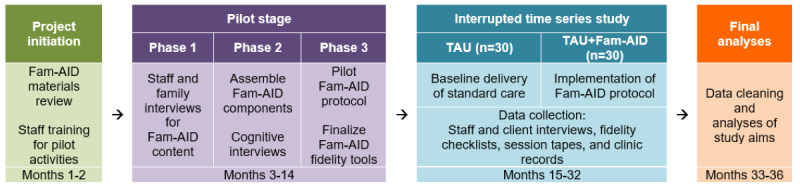
Background: Internalizing disorders (IDs), primarily depression and anxiety, are highly prevalent among adolescents receiving community-based treatment for substance use disorders (SUDs). For such clients, interventions that do not holistically address both SUDs and IDs are less effective. Objective: This pilot treatment development study aims to develop and test a modular treatment protocol for addressing cooccurring IDs among adolescents (aged 13 to 18 years) enrolled in routine care for substance use problems: Family Support Protocol for Adolescent Internalizing Disorders (Fam-AID). As an adjunctive protocol, Fam-AID will not require clinicians to markedly alter existing base practices for SUD. It will be anchored by 3 evidence-based foundations for treating cooccurring adolescent IDs: family engagement techniques, transdiagnostic individual cognitive behavioral therapy techniques, and family psychoeducation and safety planning. Methods: This quasi-experimental study will proceed in 2 stages. The pilot stage will use rapid-cycle prototyping methods in collaboration with end-user stakeholders to draft protocol delivery and fidelity guidelines adapted from existing resources, solicit provider and client input on protocol content and delivery via cognitive interviewing, and pilot prototype components on 4 to 6 cases. The second stage will be an interrupted time series study for 60 comorbid SUD+ID cases across 2 sites serving diverse adolescents: 30 will receive treatment as usual (TAU); following clinician training in the protocol, 30 new cases will receive TAU enhanced by Fam-AID. For aim 1, the focus is on evaluating the acceptability of the Fam-AID protocol through therapist and client interviews as well as assessing fidelity benchmarks using therapist- and observer-reported protocol fidelity data. For aim 2, the plan is to compare the effects of TAU only cases versus TAU+Fam-AID cases on family treatment attendance and on adolescent ID and substance use symptoms, with measurements taken at baseline and at 3-month and 6-month follow-ups. Results: Study recruitment will begin in April 2025. Conclusions: We anticipate that Fam-AID will contain 5 treatment modules that can be delivered in any sequence to meet client needs: family engagement of primary supports in treatment planning and services; relational reframing of family constraints, resiliencies, and social capital connected to the adolescent’s ID symptoms; functional analysis of the adolescent’s ID symptoms and related behaviors; cognitive behavioral therapy to address the adolescent’s ID symptoms and functional needs, featuring 3 core techniques (emotion acceptance, emotional exposure, and behavioral activation) to address negative affect and emotional dysregulation; and family psychoeducation and safety planning focused on education about comorbid SUD+ID and prevention of adolescent self-harm. If the abovementioned modules are found to be feasible and effective, Fam-AID will offer a set of pragmatic interventions to SUD clinicians for treating cooccurring IDs in adolescent clients. ©Aaron Hogue, Molly Bobek, Nicole P Porter, Alexandra MacLean, Craig E Henderson, Amanda Jensen-Doss, Gary M Diamond, Michael A Southam-Gerow, Jill Ehrenreich-May.
Overview
CoChat Summary
## TL;DR
This is a 2024 study protocol for developing Family Support Protocol for Adolescent Internalizing Disorders (Fam-AID), a modular adjunct to usual adolescent substance use disorder (SUD) care designed to address cooccurring internalizing disorders. The study will first prototype the protocol and then test feasibility and short-term impacts in 60 comorbid SUD+ID cases across 2 sites.
## Key findings
- The protocol is built around 5 modules: family engagement, relational reframing, functional analysis, CBT techniques for internalizing symptoms, and family psychoeducation/safety planning.
- The second-stage interrupted time series study will include 60 SUD+ID cases across 2 sites: 30 treatment-as-usual (TAU) cases and 30 TAU+Fam-AID cases.
- The pilot stage will test prototype components on 4 to 6 cases in phase 1 and then 2 to 3 clients in phase 3.
- The authors state power calculations for Aim 2 assuming N=60, 3 measurement occasions, moderate intercorrelation r=0.50, and effect size Cohen d=0.60 yield power = 0.80; d=0.50 yields power = 0.65.
## Methods
- Quasi-experimental, 2-stage treatment development study: a rapid-cycle pilot/prototyping stage followed by an interrupted time series comparison of TAU vs TAU+Fam-AID.
- Participants: adolescents aged 13 to 18 with at least one SUD symptom and an internalizing disorder or elevated internalizing symptoms/impairment, plus a caregiver able to attend sessions; excluded were youth requiring hospitalization, with current psychotic symptoms, severe substance use requiring detox/residential placement, or pervasive developmental disorder.
- Main analyses: qualitative thematic content analysis for acceptability; descriptive statistics, chi-square tests, ANOVA, equivalence testing, and statistical process control for fidelity; linear mixed effects models for attendance and adolescent/family outcomes over baseline, 3-month, and 6-month follow-up.
## Limitations
- The paper states that, because of the limited number of sites, clinicians, and clients, results will not be generalizable to the broader adolescent SUD treatment clinic network or workforce.
- The authors note that the quasi-experimental interrupted time series design is less preferable than randomization for causal inference, but they chose it to avoid training only half as many therapists and to reduce between-condition contamination; this is an inherent design limitation stated in the paper.
- Evident from the text: the study is a protocol with results not yet available; recruitment was to begin in April 2025, so no effectiveness findings are reported here.
Model-written summary. Check it against the paper before relying on it.
Integrity signals
Registry
Cites
Statistics
Figures

Verification
Claims the paper makes
44 Valid · 6 Not valid · 22 Not checked · 16 Own results and interpretations
At least one cited source doesn’t support this claim or points to a different paper, and none confirmed it — see the verdicts below.
In the paper
“Families are not typically centralized in SUD services for adolescents [163] despite the compelling empirical rationale that family-based treatment is a first-line option for adolescent SUD [164], is well established for adolescent depression [165], and is a useful adjunct for adolescent anxiety [166].”
§ Family Support Protocol for Adolescent Internalizing Disorders: Protocol for a Pre-Post Quantitative Treatment Development Study > Discussion > Overview
What the sources say
- Disputedcites [165] sourceExperimental — accuracy not yet measured
In “Status of Treatments > Depression in Adolescents” (page not provided), the review classifies family-based therapy as a general approach as only “possibly efficacious,” not well established. It says the specific Attachment-Based Family Therapy protocol would be “probably efficacious” if assessed separately. (LLM, conf=0.92)
Checked by a reasoning model — may be wrong.
boosted- Asserted: passes — The authors put it forward as true.
- Checkable: passes — It can be checked against evidence.
- Load-bearing: passes — The paper’s conclusions depend on it.
- Based: passes — The paper gives a reason why it holds.
- Disputed
The cited sources support only part of this claim — read each source’s verdict below.
In the paper
“Internalizing disorders (IDs), primarily depression and anxiety, are highly prevalent among adolescents receiving community-based treatment for substance use disorders (SUDs).”
- Also stated in: § Anxiety and Depression Among Adolescents With Substance Use Disorders: Highly Prevalent and Disruptive Anxiety (including trauma-related problems) and depression are highly prevalent among adolescents who misuse substances. National and community surveys report that adolescents with substance use disorders (SUDs) have comorbidity rates ranging between 17% and 30% for an anxiety disorder, major depressive disorder, or both [1]. Comorbidity is even higher in clinical samples. Adolescents enrolled in SUD treatment have cooccurrence rates ranging from 22% to 26% for anxiety disorders and 24% to 50% for depression disorders, along with an alarming range of 55% to 70% for clinically elevated symptoms of either disorder [2,3]. Anxiety and depression diagnoses themselves cooccur at such high rates in adolescents that prevailing clinical taxonomies place them within a single category of internalizing disorder (ID) whose core symptoms—anxious emotional states, depressed mood, somatization, and social withdrawal—are associated with overcontrolled behaviors and subjective distress. According to the tripartite model of comorbidity, the strong cooccurrence of anxiety and depression symptoms constitute a shared internalizing syndrome, negative affectivity, which is linked to other internalizing symptoms such as low positive affect and anxious arousal [4-6]. In this vein, developmental theories describe an internalizing pathway to SUD whereby childhood behavioral challenges marked by negative affectivity and social inhibition predispose adolescents to substance use (SU) problems [7,8]. Longitudinal outcome data suggest that adolescents with cooccurring SUD+ID are more difficult to treat effectively than those who do not have IDs. One systematic review [9] found that adolescents with comorbid SUD and depression showed higher attrition from treatment, and generally worse outcomes for both SU and depression, than those with a singular disorder. Another study [10] reported that baseline levels of elevated ID symptoms or diagnosis of an anxiety or depression disorder broadly predicted worse SU outcomes. Studies have also shown that maintenance of SUD treatment gains [11,12] and posttreatment recovery to adaptive levels of functioning [13] are harder to achieve for adolescents with IDs and related negative affect. It also appears that ID-related symptoms impact posttreatment SU behavior in multiple ways, foremost being that negative affect can induce adolescents to reinitiate use [14] or interfere with their motivation and capacity to use relapse prevention and health promotion skills learned during treatment [15]. · plain
“Anxiety (including trauma-related problems) and depression are highly prevalent among adolescents who misuse substances.”
§ Family Support Protocol for Adolescent Internalizing Disorders: Protocol for a Pre-Post Quantitative Treatment Development Study > Abstract > Background
What the sources say
- Partly supportedcites [1] sourceExperimental — accuracy not yet measured
The Results section reports co-occurring major depression and SUD among US adolescents, so the paper supports the depression–SUD association. It does not report the prevalence of depression or anxiety among adolescents receiving community-based SUD treatment; its prevalence estimate uses the broader adolescent survey population, and anxiety is not assessed. (LLM, conf=0.82)
plainstates an association- Asserted: passes — The authors put it forward as true.
- Checkable: passes — It can be checked against evidence.
- Load-bearing: passes — The paper’s conclusions depend on it.
- Based: passes — The paper gives a reason why it holds.
- Also stated in: § Anxiety and Depression Among Adolescents With Substance Use Disorders: Highly Prevalent and Disruptive Anxiety (including trauma-related problems) and depression are highly prevalent among adolescents who misuse substances. National and community surveys report that adolescents with substance use disorders (SUDs) have comorbidity rates ranging between 17% and 30% for an anxiety disorder, major depressive disorder, or both [1]. Comorbidity is even higher in clinical samples. Adolescents enrolled in SUD treatment have cooccurrence rates ranging from 22% to 26% for anxiety disorders and 24% to 50% for depression disorders, along with an alarming range of 55% to 70% for clinically elevated symptoms of either disorder [2,3]. Anxiety and depression diagnoses themselves cooccur at such high rates in adolescents that prevailing clinical taxonomies place them within a single category of internalizing disorder (ID) whose core symptoms—anxious emotional states, depressed mood, somatization, and social withdrawal—are associated with overcontrolled behaviors and subjective distress. According to the tripartite model of comorbidity, the strong cooccurrence of anxiety and depression symptoms constitute a shared internalizing syndrome, negative affectivity, which is linked to other internalizing symptoms such as low positive affect and anxious arousal [4-6]. In this vein, developmental theories describe an internalizing pathway to SUD whereby childhood behavioral challenges marked by negative affectivity and social inhibition predispose adolescents to substance use (SU) problems [7,8]. Longitudinal outcome data suggest that adolescents with cooccurring SUD+ID are more difficult to treat effectively than those who do not have IDs. One systematic review [9] found that adolescents with comorbid SUD and depression showed higher attrition from treatment, and generally worse outcomes for both SU and depression, than those with a singular disorder. Another study [10] reported that baseline levels of elevated ID symptoms or diagnosis of an anxiety or depression disorder broadly predicted worse SU outcomes. Studies have also shown that maintenance of SUD treatment gains [11,12] and posttreatment recovery to adaptive levels of functioning [13] are harder to achieve for adolescents with IDs and related negative affect. It also appears that ID-related symptoms impact posttreatment SU behavior in multiple ways, foremost being that negative affect can induce adolescents to reinitiate use [14] or interfere with their motivation and capacity to use relapse prevention and health promotion skills learned during treatment [15]. · plain
The cited sources support only part of this claim — read each source’s verdict below.
In the paper
“For such clients, interventions that do not holistically address both SUDs and IDs are less effective.”
§ Family Support Protocol for Adolescent Internalizing Disorders: Protocol for a Pre-Post Quantitative Treatment Development Study > Abstract > Background
What the sources say
- Not checked — no full text of the sourcecites [9] source
- Not matchedcites [10] Curry, JF, 2016, Youth Substance Abuse and Co-occurring Disorders
Couldn’t be matched to a paper in Crossref, so it can’t be checked.
- Not checked — no full text of the sourcecites [11] source
- Not checked — no full text of the sourcecites [12] source
- Partly supportedcites [13] sourceExperimental — accuracy not yet measured
The Discussion reports that, among adolescents with borderline personality disorder, substance use disorder, and depression, only those receiving the holistic I-BAFT intervention showed substantial improvement in substance use; the substance-use-focused IDC intervention did not improve substance use in adolescents with depression. The paper describes a holistic approach as potentially well suited to this subgroup, but does not establish that interventions addressing only substance use are less effective for adolescents with substance use and internalizing disorders generally. (LLM, conf=0.86)
- Could not verifycites [14] sourceExperimental — accuracy not yet measured
The Discussion recommends targeting multiple relapse antecedents and tailoring prevention to adolescents’ emotional states. It does not compare the effectiveness of interventions that address both substance use and internalizing disorders with those that do not; searches for integrated treatment and intervention effectiveness found no such comparison. (LLM, conf=0.75)
- Not checked — no full text of the sourcecites [15] source
plainstates a cause- Asserted: passes — The authors put it forward as true.
- Checkable: passes — It can be checked against evidence.
- Load-bearing: passes — The paper’s conclusions depend on it.
- Based: passes — The paper gives a reason why it holds.
Every source the paper cites for this claim was checked and supports it.
In the paper
“Esposito-Smythers et al [22] demonstrated the effectiveness of a protocol that included cognitive behavioral therapy (CBT) for SUD, individual CBT for depression and suicidality, and family skills training.”
§ Family Support Protocol for Adolescent Internalizing Disorders: Protocol for a Pre-Post Quantitative Treatment Development Study > Introduction > Integrated Treatment Models for Comorbid SUD+ID: Major Barriers to Implementation
What the sources say
- Supportedcites [22] source
The Method (Study Conditions; page unavailable) describes an integrated CBT protocol with individual adolescent, family, and parent-training sessions targeting substance use and suicidality. The Results (page unavailable) report fewer heavy drinking and marijuana-use days and fewer suicide attempts than enhanced treatment as usual, supporting the claim of effectiveness. The paper does not report a between-group advantage for depressed mood or suicidal ideation, but the citing sentence does not claim one. (LLM, conf=0.88)
boostedstates a cause- Asserted: passes — The authors put it forward as true.
- Checkable: passes — It can be checked against evidence.
- Load-bearing: unclear — It is unclear whether the paper’s conclusions depend on it.
- Based: passes — The paper gives a reason why it holds.
- Supported
The cited sources support only part of this claim — read each source’s verdict below.
In the paper
“However, because integrated models of this type require multidomain symptom targeting and intervention coordination, they are difficult to implement and evaluate [21].”
§ Family Support Protocol for Adolescent Internalizing Disorders: Protocol for a Pre-Post Quantitative Treatment Development Study > Introduction > Integrated Treatment Models for Comorbid SUD+ID: Major Barriers to Implementation
What the sources say
- Partly supportedcites [21] sourceExperimental — accuracy not yet measured
The Review’s “Conceptual Model” section describes multiple treatment targets, combined therapeutic modules, and an interdisciplinary approach; it also says the proposed model may require more time and resources than existing treatments. “Implications for future research” calls for more trials and studies to identify which components matter. The paper does not specifically say that intervention coordination makes these models difficult to implement and evaluate. (LLM, conf=0.83)
plainstates a cause- Asserted: passes — The authors put it forward as true.
- Checkable: passes — It can be checked against evidence.
- Load-bearing: passes — The paper’s conclusions depend on it.
- Based: passes — The paper gives a reason why it holds.
- Partly supported
27 more claims · 12 with their cited sources checked
Create a free account to see all 88 claims and every source verdict.
- Probably not a substantial claim. 31
- It may state two separate claims as one. 42
Citations
Cites
Using thematic analysis in psychology
Braun, V., & Clarke, V. (2006) · Qualitative Research in Psychology · doi:10.1191/1478088706qp063oa · Cited by 194,414
Basics of Qualitative Research (3rd ed.): Techniques and Procedures for Developing Grounded Theory
Corbin, J., & Strauss, A. (2008) · SAGE · doi:10.4135/9781452230153 · Cited by 12,136
Gratz, K. L., & Roemer, L. (2004) · Journal of Psychopathology and Behavioral Assessment · doi:10.1023/b:joba.0000007455.08539.94 · Cited by 8,942
Cognitive-Behavioral Treatment of Borderline Personality Disorder
Cary, G. L. (1994) · American Journal of Psychotherapy · doi:10.1176/appi.psychotherapy.1994.48.1.155 · Cited by 6,283
Quasi-experimentation: Design and analysis issues for field settings
Shrout, P. E. (1980) · Evaluation and Program Planning · doi:10.1016/0149-7189(80)90063-4 · Cited by 6,010
Doing Qualitative Research in Education Settings
(2002) · doi:10.1353/book4583 · Cited by 3,502
Interrupted time series regression for the evaluation of public health interventions: a tutorial
Lopez Bernal, J., Cummins, S., & Gasparrini, A. (2016) · International Journal of Epidemiology · doi:10.1093/ije/dyw098 · Cited by 3,049
A comparison of inclusive and restrictive strategies in modern missing data procedures.
Collins, L. M., Schafer, J. L., & Kam, C.-M. (2001) · Psychological Methods · doi:10.1037/1082-989x.6.4.330 · Cited by 2,389
Self-harm and suicide in adolescents
Hawton, K., Saunders, K. E., & O'Connor, R. C. (2012) · The Lancet · doi:10.1016/s0140-6736(12)60322-5 · Cited by 2,306
Chorpita, B. F., Yim, L., Moffitt, C., Umemoto, L. A., & Francis, S. E. (2000) · Behaviour Research and Therapy · doi:10.1016/s0005-7967(99)00130-8 · Cited by 1,966
Research works printed but not linked: 7
- Rubin, J, 2008, Handbook of Usability Testing: How to Plan, Design, and Conduct Effective Tests
- Albert, W, 2013, Measuring the User Experience: Collecting, Analyzing, and Presenting Usability Metrics. 2nd edition
- 2023, Understanding Mental Disorders: Your Guide to DSM-5-TR®
- Chorpita, BF, 2009, Modular Approach to Therapy for Children with Anxiety, Depression, Trauma, or Conduct Problems
- Ehrenreich-May, J, 2013, Transdiagnostic Treatments for Children and Adolescents: Principles and Practices, 3
- Achenbach, TM, 2001, Manual for the ASEBA School-age Forms & Profiles: An Integrated System of Multi-informant Assessment
- Raudenbush, S, 2002, Hierarchical Linear Models: Applications and Data Analysis Methods. 2nd edition
Cited by
Hogue, A., Porter, N., Henderson, C. E., Ozechowski, T. J., Wenzel, K., Fishman, M. J., & Becker, S. J. (2025) · Journal of Clinical Child & Adolescent Psychology · doi:10.1080/15374416.2025.2521855 · Cited by 14
Self-citationRazavi, F. E.-S., Ebrahimi, M. I., & Nazari, A. (2025) · مجله علمی دانشگاه علوم پزشکی رفسنجان · doi:10.66224/jrums.24.8.675
Metadata
- Authors
- Hogue, A., Bobek, M., Porter, N. P., MacLean, A., Henderson, C. E., Jensen-Doss, A., Diamond, G. M., Southam-Gerow, M. A., & Ehrenreich-May, J.
- Affiliations
- Sam Houston State University (US)
- Ben-Gurion University of the Negev (IL)
- University of Miami (US)
- ORCID
- Venue
- JMIR Research Protocols
- Publisher
- JMIR Publications Inc.
- Published
- 2024-09-16
- Volume
- 13
- Pages
- e64332
- ISSN
- 1929-0748 (ISSN-L)
- PMC
- PMC11443177
- OpenAlex
- W4400854765
- Cited by
- 2
- References
- 158
- Citations by year
- 2025: 2
- FWCI
- 0.52
- Type
- journal article
- Language
- en
- Open access
- gold
- doi.org
- Licence
- cc-by
- Locations
- JMIR Research Protocols (publishedVersion, cc-by)
- PubMed (publishedVersion)
- DOAJ (DOAJ: Directory of Open Access Journals) (submittedVersion)
- PubMed Central (submittedVersion, cc-by)
- Topics
- Health Sciences › Medicine › Epidemiology › Substance Abuse Treatment and Outcomes
- Social Sciences › Psychology › Clinical Psychology › Child and Adolescent Psychosocial and Emotional Development
- Social Sciences › Psychology › Applied Psychology › Digital Mental Health Interventions
- Keywords
- adolescent depression, adolescent anxiety, substance use disorders, family involvement, family psychoeducation, safety planning, cognitive behavioral therapy, treatment protocol development
- MeSH terms
- Family Support, Adolescent, Family Therapy, Female
About these checks
Registry, retraction, Cites and statistics results are computed, not judged, with one exception: a printed reference that no index lists is read once by a model before it counts as a citation error. Claims are extracted by a model and kept only when their quote appears verbatim in the text; each cited source is then checked, with a model’s help, for whether it says what the claim relies on. Those verdicts can be wrong — read the claim’s quote and the cited source before relying on one.
The claim verdicts this report counts are experimental: their accuracy is not yet measured.
A language model drew the claims from the paper on 2026-10-11, under version 3 of the claim definition (model deepseek-v4.1-flash, prompt extract-v3).
A second model labelled each claim on 2026-10-11 (model jev-1.13-20260917, definition revision gold-guideline-v0.2).
Cited sources are checked with a language model’s help (gpt-6-sol).
Statistics and arithmetic are recomputed, not judged.
Confidence bands are shown only for fields calibrated on our annotated test set. None is calibrated yet, so no band is shown.
What counts as a claim ›How we measure confidence ›How we check this ›
Are you an author, or do you see a problem with this page? Request a review
Data sources
Bibliographic data: Semantic Scholar, OpenAlex, Crossref.
Contains information from the Semantic Scholar Academic Graph Datasets, made available under the ODC Attribution License (ODC-BY 1.0).
Semantic Scholar’s data is described in: Kinney, R., et al. (2023). The Semantic Scholar Open Data Platform. arXiv:2301.10140.
