

The DOI matches its Crossref record; 206 of the 207 references it cites were found in a registry or an index.
Evaluating the Impact of Physical Activity Apps and Wearables: Interdisciplinary Review
Open accessPublished version of a preprint
Abstract
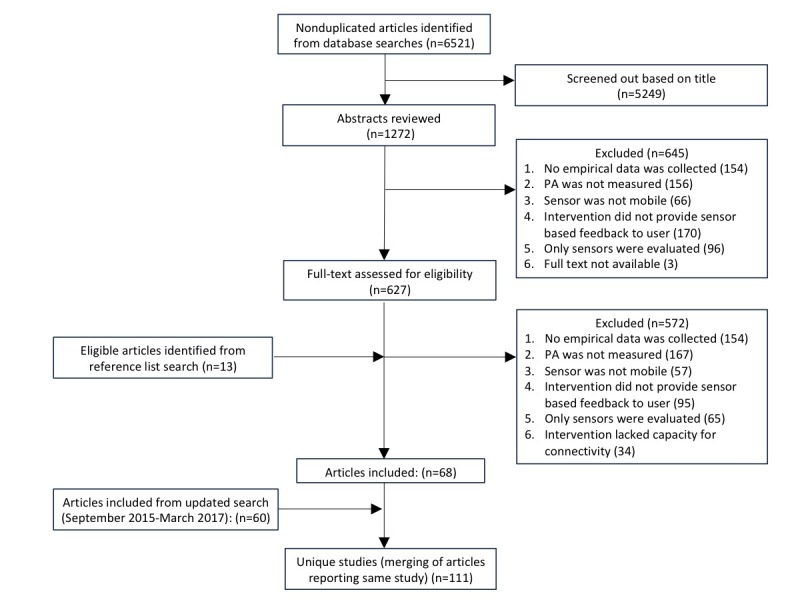
BACKGROUND: Although many smartphone apps and wearables have been designed to improve physical activity, their rapidly evolving nature and complexity present challenges for evaluating their impact. Traditional methodologies, such as randomized controlled trials (RCTs), can be slow. To keep pace with rapid technological development, evaluations of mobile health technologies must be efficient. Rapid alternative research designs have been proposed, and efficient in-app data collection methods, including in-device sensors and device-generated logs, are available. Along with effectiveness, it is important to measure engagement (ie, users' interaction and usage behavior) and acceptability (ie, users' subjective perceptions and experiences) to help explain how and why apps and wearables work. OBJECTIVES: This study aimed to (1) explore the extent to which evaluations of physical activity apps and wearables: employ rapid research designs; assess engagement, acceptability, as well as effectiveness; use efficient data collection methods; and (2) describe which dimensions of engagement and acceptability are assessed. METHOD: An interdisciplinary scoping review using 8 databases from health and computing sciences. Included studies measured physical activity, and evaluated physical activity apps or wearables that provided sensor-based feedback. Results were analyzed using descriptive numerical summaries, chi-square testing, and qualitative thematic analysis. RESULTS: A total of 1829 abstracts were screened, and 858 articles read in full. Of 111 included studies, 61 (55.0%) were published between 2015 and 2017. Most (55.0%, 61/111) were RCTs, and only 2 studies (1.8%) used rapid research designs: 1 single-case design and 1 multiphase optimization strategy. Other research designs included 23 (22.5%) repeated measures designs, 11 (9.9%) nonrandomized group designs, 10 (9.0%) case studies, and 4 (3.6%) observational studies. Less than one-third of the studies (32.0%, 35/111) investigated effectiveness, engagement, and acceptability together. To measure physical activity, most studies (90.1%, 101/111) employed sensors (either in-device [67.6%, 75/111] or external [23.4%, 26/111]). RCTs were more likely to employ external sensors (accelerometers: P=.005). Studies that assessed engagement (52.3%, 58/111) mostly used device-generated logs (91%, 53/58) to measure the frequency, depth, and length of engagement. Studies that assessed acceptability (57.7%, 64/111) most often used questionnaires (64%, 42/64) and/or qualitative methods (53%, 34/64) to explore appreciation, perceived effectiveness and usefulness, satisfaction, intention to continue use, and social acceptability. Some studies (14.4%, 16/111) assessed dimensions more closely related to usability (ie, burden of sensor wear and use, interface complexity, and perceived technical performance). CONCLUSIONS: The rapid increase of research into the impact of physical activity apps and wearables means that evaluation guidelines are urgently needed to promote efficiency through the use of rapid research designs, in-device sensors and user-logs to assess effectiveness, engagement, and acceptability. Screening articles was time-consuming because reporting across health and computing sciences lacked standardization. Reporting guidelines are therefore needed to facilitate the synthesis of evidence across disciplines.
Overview
The claims and statistics of this paper haven’t been checked yet.
Run the check — free, no account needed. It reads the open-access text and checks the sources it cites.
Integrity signals
Registry
Cites
Statistics
Figures
Verification
Claims the paper makes
The claims and statistics of this paper haven’t been checked yet.
Run the check — free, no account needed. It reads the open-access text and checks the sources it cites.
Claims other papers make about this one
Each is checked against this paper’s own text: does it say what the citing paper says it does?
The source backs part of the claim, not all of it — or backs it for a different population, condition or comparison.
In the citing paper
“However, knowledge on these apps’ potential is lacking, particularly in regard to testing apps in practical settings and using objective data, and health apps generally are not evidence-based [63].”
From Advantages and disadvantages of mobile applications for workplace health promotion: A scoping review (2024) · cites this paper as [63]
Experimental — accuracy not yet measuredThe source backs part of the claim, not all of it — or backs it for a different population, condition or comparison.
In the citing paper
“However, knowledge on these apps’ potential is lacking, particularly in regard to testing apps in practical settings and using objective data, and health apps generally are not evidence-based [63].”
From Advantages and disadvantages of mobile applications for workplace health promotion: A scoping review (2024) · cites this paper as [63]
Experimental — accuracy not yet measured
Self-check
Percentages, sums and reported differences re-computed from the paper’s own numbers.
The self-check needs the paper’s full text.
Citations
Cites
Scoping studies: towards a methodological framework
Arksey, H., & O'Malley, L. (2005) · International Journal of Social Research Methodology · doi:10.1080/1364557032000119616 · Cited by 36,742
International physical activity questionnaire: 12-country reliability and validity
CRAIG, C. L., MARSHALL, A. L., SJ??STR??M, M., BAUMAN, A. E., BOOTH, M. L., AINSWORTH, B. E., PRATT, M., EKELUND, U., YNGVE, A., SALLIS, J. F., et al. (2003) · Medicine & Science in Sports & Exercise · doi:10.1249/01.mss.0000078924.61453.fb · Cited by 21,619
Scoping studies: advancing the methodology
Levac, D., Colquhoun, H., & O'Brien, K. K. (2010) · Implementation Science · doi:10.1186/1748-5908-5-69 · Cited by 15,268
CONSORT 2010 Statement: updated guidelines for reporting parallel group randomised trials
the CONSORT Group, Schulz, K. F., Altman, D. G., & Moher, D. (2010) · BMC Medicine · doi:10.1186/1741-7015-8-18 · Cited by 13,371
Developing and evaluating complex interventions: the new Medical Research Council guidance
Craig, P., Dieppe, P., Macintyre, S., Michie, S., Nazareth, I., & Petticrew, M. (2008) · BMJ · doi:10.1136/bmj.a1655 · Cited by 10,995
CONSORT 2010 Statement: updated guidelines for reporting parallel group randomised trials
Schulz, K. F., Altman, D. G., Moher, D., & for the CONSORT Group (2010) · BMJ · doi:10.1136/bmj.c332 · Cited by 9,329
Global status report on noncommunicable diseases 2010.
Alwan, A. (2011) · Cited by 8,494
Guidance for conducting systematic scoping reviews
Peters, M. D. J., Godfrey, C. M., Khalil, H., McInerney, P., Parker, D., & Soares, C. B. (2015) · International Journal of Evidence-Based Healthcare · doi:10.1097/xeb.0000000000000050 · Cited by 7,472
Process evaluation of complex interventions: Medical Research Council guidance
Moore, G. F., Audrey, S., Barker, M., Bond, L., Bonell, C., Hardeman, W., Moore, L., O'Cathain, A., Tinati, T., Wight, D., et al. (2015) · BMJ · doi:10.1136/bmj.h1258 · Cited by 6,204
Usability Evaluation In Industry
(1996) · CRC Press eBooks · doi:10.1201/9781498710411 · Cited by 4,445
Research works printed but not linked: 6
- Blair, SN, 2009, Br J Sports Med, 43, 1
- 10.1007/978-3-642-27-2_39 · DOI
- Taylor, D, 2016, Stud Health Technol Inform, 220, 414
- Godin, G, 1985, Can J Appl Sport Sci, 10, 141
- ConnellyKOn developing a technology acceptance model for pervasive computingWorkshop of Ubiquitous System Evaluation (USE)20079th International Conference on Ubiquitous Computing (UBICOMP) 2007September 16-19Innsbruck, Austria
- Quesenbery, W, 2003, Content and complexity: Information design in technical communication, 81
Cited by
Sorted by citations
Items 101–136 of 136
Trek — A Mobile App Solution for Safe Exploration and Healthy Lifestyles
Fernando, A., Weesinghe, W. M. P. D., Wijewardhana, K. J. S., R.R.W.G.B.P.P.M., H., Kumari, S., & Jayasinghe, D. (2023) · International Conference on Advancements in Computing (ICAC) · doi:10.1109/icac60630.2023.10417650 · Cited by 1
García-Fariña, A. (2025) · Education and human development · doi:10.5772/intechopen.1009376 · Cited by 1
Phạm, Q. (2019) · TSpace (University of Toronto) · Cited by 1
Hermsen, S. (2019) · The Design Journal · doi:10.1080/14606925.2019.1595844
mHealth Acceptance and Usage Among South Asian Adults in US
Ramaswamy, P. (2019) · Digital Commons-TMC (Texas Medical Center)
Self-management support using mHealth in patients with COPD
Korpershoek, Y. (2021) · Utrecht University Repository (Utrecht University) · doi:10.33540/518
Designing Technologies to Support Patient Engagement in the Hospital
Mishra, S. R. (2019) · ResearchWorks at the University of Washington (University of Washington)
Arshad, R., Hamid, A., & Shahid, S. (2021) · Behaviour and Information Technology · doi:10.1080/0144929x.2021.2006787
John, M., & Kleppisch, M. (2019) · Springer Reference Pflege, Therapie, Gesundheit · doi:10.1007/978-3-662-55793-8_108-1
Hermsen, S. (2022) · Proceedings of DRS · doi:10.21606/drs.2022.159
Fashion and Technology: A Concern Over Wearables' Environmental and Social Implications
Morozova, D. (2023) · Emerald Group Publishing Limited eBooks · doi:10.1108/978-1-80382-345-420231018
Ambient Information Design for a Work Environment
Torpus, J., Kovacevic, T., & Navarro, J. (2023) · Lecture notes in computer science · doi:10.1007/978-3-031-34609-5_31
R.R.W.G.B.P.P.M., H. (2023) · doi:10.22541/au.169333757.77065122/v1
Governance von und durch Verhaltensdesign
Timko, C. (2023) · Springer eBooks · doi:10.1007/978-3-658-41247-0_2
Asthma and Other Respiratory Disorders Associated with Obesity
Abu‐Hasan, M., & Fedele, D. A. (2023) · American Academy of PediatricsItasca, IL eBooks · doi:10.1542/9781610026536-43
Angeloni, M. P. C., Medina, R., de Oliveira, K. M., Strugeon, E. G.-L., & Tîrnȃucȃ, C. (2024) · HAL
Exploring Student Perceptions of Smart Wearable Devices in Middle-Distance Running
Meina, Z., Osman, N. B., & Yin, T. T. (2025) · International Journal of Academic Research in Progressive Education and Development · doi:10.6007/ijarped/v14-i3/26003
Buckingham, S. A., Morrissey, K., Williams, A. J., Price, L., & Harrison, J. T. (2020) · Figshare · doi:10.6084/m9.figshare.13186034
Ridgers, N. D., Timperio, A. F., Ball, K., Lai, S. K., Brown, H. L., Macfarlane, S., & Salmon, J. (2021) · Figshare · doi:10.6084/m9.figshare.14404342
iSkate: A Digital Meet-up for Skateboarders
King, D. (2024) · Maryland Shared Open Access Repository (USMAI Consortium) · doi:10.13016/m28ufm-frli
Exploring smartphone overuse and meaningful use
Almoallim, S. (2024) · Lancaster EPrints (Lancaster University) · doi:10.17635/lancaster/thesis/2791
Ridgers, N. D., Timperio, A. F., Ball, K., Lai, S. K., Brown, H., Macfarlane, S., & Salmon, J. (2021) · Figshare · doi:10.6084/m9.figshare.14404348
Buckingham, S. A., Morrissey, K., Williams, A. J., Price, L. L., & Harrison, J. (2020) · Figshare · doi:10.6084/m9.figshare.13186040
Buckingham, S. A., Morrissey, K., Williams, A. J., Price, L. L., & Harrison, J. (2020) · Figshare · doi:10.6084/m9.figshare.13186031
Ridgers, N. D., Timperio, A. F., Ball, K., Lai, S. K., Brown, H. L., Macfarlane, S., & Salmon, J. (2021) · Figshare · doi:10.6084/m9.figshare.14404345
Buckingham, S. A., Morrissey, K., Williams, A. J., Price, L. L., & Harrison, J. T. (2020) · Figshare · doi:10.6084/m9.figshare.13186028
Buckingham, S. A., Morrissey, K., Williams, A. J., Price, L. L., & Harrison, J. (2020) · Figshare · doi:10.6084/m9.figshare.13186037
Marin-Gomez, F. X. (2019) · Tesis Doctorals en Xarxa (Consorci de Serveis Universitaris de Catalunya)
The Social Implications of Digital Health Technology
Lievevrouw, E., & Hoyweghen, I. V. (2019) · Lirias
Russanti, I., Banath, Y. A., Ramadhani, K. R., Rahmawati, S., Fadhilah, S. N., Sari, F. I., Yulistiana, Y., Prihatina, Y. I., Wahyuningsih, U., & Son, D. (2026) · SSRN Electronic Journal · doi:10.2139/ssrn.6205392
Bouchan, J. (2025) · theses.fr (ABES) · doi:10.70675/743350e8z80e5z4099z8dccz83c38dd9413a
Sherman, A. L., Fowler, J., Duffy, A., Riecke, B. E., & Moreno, S. (2026) · JMIR Research Protocols · doi:10.2196/81490
Tabacchi, G., Cottone, R., Scardina, A., Giardina, M., Amato, A., Vasto, S., Accardi, G., Liberto, V. D., Frinchi, M., Boffetta, P., et al. (2026) · Frontiers in Digital Health · doi:10.3389/fdgth.2026.1701301
The Impact of GERAK PRO on Employee Performance Through Exercise Motivation
Rofi’i, R., Nasir, M. J. A., & Arumsari, Y. K. (2026) · Jurnal Relevansi Ekonomi Manajemen dan Bisnis · doi:10.61401/relevansi.v10i1.388
Metadata
- Authors
- McCallum, C., Rooksby, J., & Gray, C. M.
- Affiliations
- University of Glasgow (GB)
- Corresponding author
- McCallum, Claire
- Venue
- JMIR mhealth and uhealth
- Publisher
- JMIR Publications Inc.
- Published
- 2018-03-23
- Volume
- 6
- Issue
- 3
- Pages
- e58
- ISSN
- 2291-5222 (ISSN-L)
- PMC
- PMC5889496
- OpenAlex
- W2789449717
- Cited by
- 126
- References
- 207
- Citations by year
- 2026: 4 · 2025: 10 · 2024: 9 · 2023: 18 · 2022: 22 · 2021: 22 · 2020: 18 · 2019: 14 · 2018: 9
- FWCI
- 2.87
- Type
- journal article
- Language
- en
- Open access
- gold
- doi.org
- Licence
- cc-by
- Locations
- JMIR mhealth and uhealth (publishedVersion, cc-by)
- Europe PMC (PubMed Central) (publishedVersion, cc-by)
- PubMed Central (publishedVersion, cc-by)
- PubMed (publishedVersion)
- ENLIGHTEN (Jurnal Bimbingan dan Konseling Islam) (acceptedVersion, cc-by-sa)
- Northumbria Research Link (Northumbria University) (submittedVersion, cc-by)
- DOAJ (DOAJ: Directory of Open Access Journals) (submittedVersion, cc-by-sa)
- Topics
- Health Sciences › Health Professions › General Health Professions › Mobile Health and mHealth Applications
- Social Sciences › Psychology › Applied Psychology › Digital Mental Health Interventions
- Health Sciences › Medicine › Public Health, Environmental and Occupational Health › Physical Activity and Health
- Keywords
- physical activity apps, wearable devices, mobile health, single-case experimental design, multiphase optimization strategy, user engagement, acceptability, effectiveness, accelerometer, research design evaluation, physical activity monitoring
About these checks
Registry, retraction, Cites and statistics results are computed, not judged, with one exception: a printed reference that no index lists is read once by a model before it counts as a citation error. Claims are extracted by a model and kept only when their quote appears verbatim in the text; each cited source is then checked, with a model’s help, for whether it says what the claim relies on. Those verdicts can be wrong — read the claim’s quote and the cited source before relying on one.
Statistics and arithmetic are recomputed, not judged.
Confidence bands are shown only for fields calibrated on our annotated test set. None is calibrated yet, so no band is shown.
What counts as a claim ›How we measure confidence ›How we check this ›
Are you an author, or do you see a problem with this page? Request a review
