

Russian-Language Mobile Apps for Reducing Alcohol Use: Systematic Search and Evaluation (Preprint)
Open accessPreprint — published as 10.2196/31058 · Paper page
The DOI matches its Crossref record; its reference list is not available.
Abstract
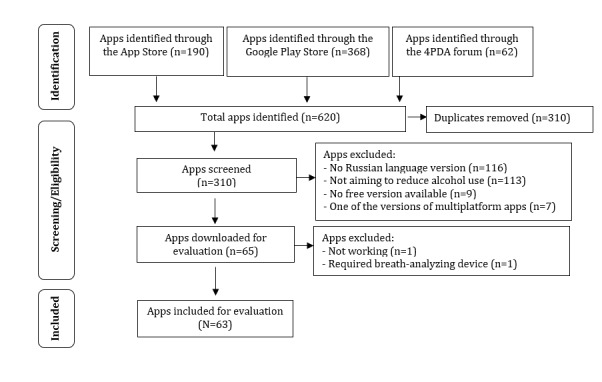
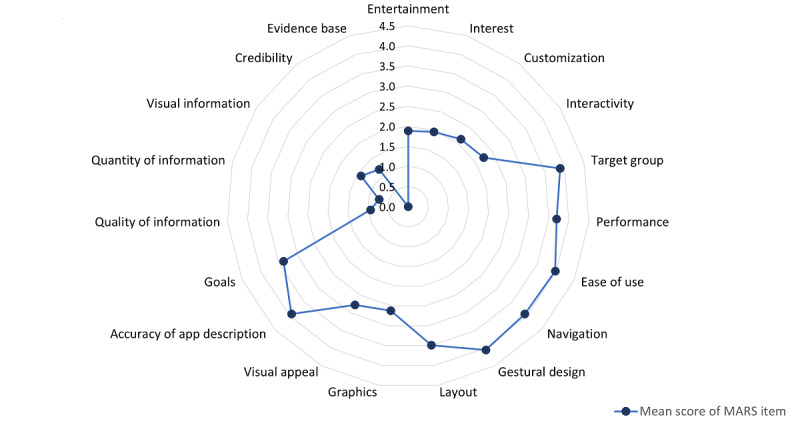
BACKGROUND: Personalized prevention tools such as mobile apps designed to reduce alcohol consumption are widespread in mobile app stores accessible in Russia. However, the quality and content of these mobile apps have not been systematically evaluated. OBJECTIVE: This study aimed to identify Russian-language mobile apps for reducing alcohol use and to evaluate their quality and potential to change alcohol-related health behavior. It further aimed to identify apps that could facilitate screening and brief interventions in primary health care in Russia. METHODS: A systematic search for mobile apps available in Russia was carried out between April 1 and 15, 2020, December 1 and 15, 2020, and in March 2021 in the iPhone App Store, Google Play Store, and the 4PDA forum. App quality was assessed using the Mobile App Rating Scale (MARS), and structured searches in electronic libraries and bibliographic databases were used to evaluate the apps’ evidence base. The number of features facilitating changes in lifestyle behavior was assessed using the App Behavior Change Scale (ABACUS). RESULTS: We identified 63 mobile apps for reducing alcohol use. The mean MARS quality ratings were high for the subscales of functionality (3.92 out of 5, SD 0.58) and aesthetics (2.96, SD 0.76) and low for engagement (2.42, SD 0.76) and information (1.65, SD 0.60). Additional searches in electronic libraries and bibliographic databases (eLibrary, CyberLeninka, Google Scholar) yielded no studies involving the identified apps. ABACUS scores ranged from 1 to 15 out of 25, with a mean of 5 (SD 3.24). Two of the identified apps might be useful for screening and brief interventions in Russian primary health care after improvements in content and scientific testing. CONCLUSIONS: Russian-language mobile apps for reducing alcohol use are accessible in the app stores. Many of them are aesthetically pleasing, functional, and easy to use. However, information about their scientific trialing or testing is lacking. Most apps contain a low number of features that facilitate changes in lifestyle behavior. Further research should examine the context of Russian-language mobile apps for reducing alcohol use. Our findings underline the need to develop evidence-based apps to mitigate alcohol consumption in Russia and elsewhere. CLINICALTRIAL: PROSPERO International Prospective Register of Systematic Reviews CRD42020167458; https://www.crd.york.ac.uk/prospero/display_record.php?RecordID=167458
Overview
The claims and statistics of this paper haven’t been checked yet.
Free: it reads the open-access text and checks the first 5 claims that cite a source we can check. Create a free account to check every claim.
Integrity signals
Registry
Cites
Statistics
Figures
Verification
Claims the paper makes
The claims and statistics of this paper haven’t been checked yet.
Free: it reads the open-access text and checks the first 5 claims that cite a source we can check. Create a free account to check every claim.
Self-check
Percentages, sums and reported differences re-computed from the paper’s own numbers.
The self-check needs the paper’s full text.
Citations
No citation lists for this paper
No citation lists for this paper yet — checked again daily.
References 39 · Cited by 6
Research works printed but not linked: 1
- 10.1037/0033-2909.86.2.420 · DOI · Paper page
Metadata
- Authors
- Bunova, A., Wiemker, V., Gornyi, B., Ferreira-Borges, C., & Neufeld, M.
- Affiliations
- Ministry of Health of the Russian Federation (RU)
- Heidelberg University (DE)
- Centre for Addiction and Mental Health (CA)
- Corresponding author
- Bunova, Anna
- Venue
- JMIR mhealth and uhealth
- Publisher
- JMIR Publications Inc.
- Published
- 2021-06-08
- Volume
- 10
- Issue
- 1
- Pages
- e31058-e31058
- ISSN
- 2291-5222 (ISSN-L)
- PMC
- PMC8787655
- OpenAlex
- W3210009245
- Cited by
- 6
- References
- 39
- Citations by year
- 2025: 1 · 2024: 2 · 2023: 1 · 2022: 2
- FWCI
- 1.40
- Type
- journal article
- Language
- en
- Open access
- gold
- doi.org
- Licence
- cc-by
- Locations
- JMIR mhealth and uhealth (publishedVersion, cc-by)
- PubMed Central (publishedVersion, cc-by)
- PubMed (publishedVersion)
- DOAJ (DOAJ: Directory of Open Access Journals) (submittedVersion)
- Topics
- Health Sciences › Health Professions › General Health Professions › Mobile Health and mHealth Applications
- Health Sciences › Medicine › Epidemiology › Substance Abuse Treatment and Outcomes
- Social Sciences › Psychology › Applied Psychology › Digital Mental Health Interventions
- Keywords
- alcohol consumption reduction, mobile health apps, app quality, Mobile App Rating Scale, screening and brief intervention, primary care, Russia, App Store, user engagement, alcohol prevention
- MeSH terms
- Systematic Reviews as Topic, Alcohol Drinking, Delivery of Health Care, Humans, Language, Mobile Applications
About these checks
Registry, retraction, Cites and statistics results are computed, not judged, with one exception: a printed reference that no index lists is read once by a model before it counts as a citation error. Claims are extracted by a model and kept only when their quote appears verbatim in the text; each cited source is then checked, with a model’s help, for whether it says what the claim relies on. Those verdicts can be wrong — read the claim’s quote and the cited source before relying on one.
Statistics and arithmetic are recomputed, not judged.
Confidence bands are shown only for fields calibrated on our annotated test set. None is calibrated yet, so no band is shown.
What counts as a claim ›How we measure confidence ›How we check this ›
Are you an author, or do you see a problem with this page? Request a review
How to cite
Cite CoChat for the checks on this page, and the paper for its own findings.
- This page
- CoChat. (2026). Citation check: Russian-Language Mobile Apps for Reducing Alcohol Use: Systematic Search and Evaluation (Preprint). https://app.cochat.ai/papers/10.2196/preprints.31058
- The paper
- Bunova, A., Wiemker, V., Gornyi, B., Ferreira-Borges, C., & Neufeld, M. (2021). Russian-Language Mobile Apps for Reducing Alcohol Use: Systematic Search and Evaluation (Preprint). JMIR mhealth and uhealth. https://doi.org/10.2196/preprints.31058
Data sources
Bibliographic data: Semantic Scholar, OpenAlex, Crossref.
Contains information from the Semantic Scholar Academic Graph Datasets, made available under the ODC Attribution License (ODC-BY 1.0).
Semantic Scholar’s data is described in: Kinney, R., et al. (2023). The Semantic Scholar Open Data Platform. arXiv:2301.10140.
