

Anticoncentration theorems for schemes showing a quantum speedup
Open accessThe DOI matches its Crossref record; 73 of the 73 references it cites were found in a registry or an index.
Abstract
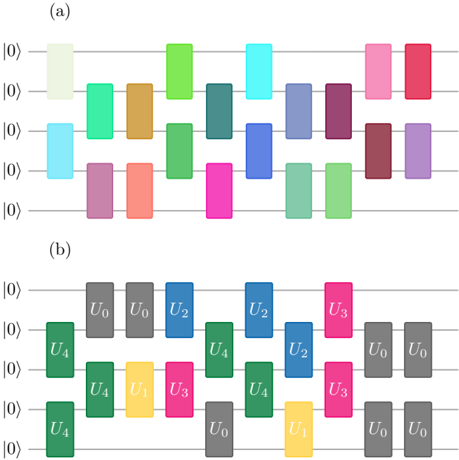
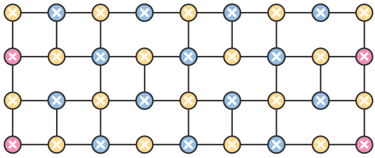
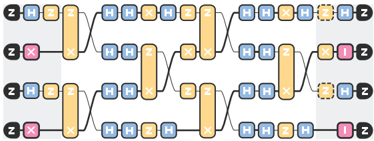
One of the main milestones in quantum information science is to realise quantum devices that exhibit an exponential computational advantage over classical ones without being universal quantum computers, a state of affairs dubbed quantum speedup, or sometimes "quantum computational supremacy". The known schemes heavily rely on mathematical assumptions that are plausible but unproven, prominently results on anticoncentration of random prescriptions. In this work, we aim at closing the gap by proving two anticoncentration theorems and accompanying hardness results, one for circuit-based schemes, the other for quantum quench-type schemes for quantum simulations. Compared to the few other known such results, these results give rise to a number of comparably simple, physically meaningful and resource-economical schemes showing a quantum speedup in one and two spatial dimensions. At the heart of the analysis are tools of unitary designs and random circuits that allow us to conclude that universal random circuits anticoncentrate as well as an embedding of known circuit-based schemes in a 2D translation-invariant architecture.
Overview
The claims and statistics of this paper haven’t been checked yet.
Free: it reads the open-access text and checks the first 5 claims that cite a source we can check. Create a free account to check every claim.
Integrity signals
Registry
Cites
Statistics
Figures

Verification
Claims the paper makes
The claims and statistics of this paper haven’t been checked yet.
Free: it reads the open-access text and checks the first 5 claims that cite a source we can check. Create a free account to check every claim.
Claims other papers make about this one
Each is checked against this paper’s own text: does it say what the citing paper says it does?
The cited source says what the claim attributes to it.
In the citing paper
“for which we also provide numerical evidence of so-called anticoncentration99,100.”
From Logical quantum processor based on reconfigurable atom arrays (2024) · cites this paper as [99]
Self-check
Percentages, sums and reported differences re-computed from the paper’s own numbers.
The self-check needs the paper’s full text.
Citations
Cites
Colloquium: Nonequilibrium dynamics of closed interacting quantum systems
Polkovnikov, A., Sengupta, K., Silva, A., & Vengalattore, M. (2011) · Reviews of Modern Physics · doi:10.1103/revmodphys.83.863 · Cited by 2,562
Haake, F. (2010) · Springer Series in Synergetics · doi:10.1007/978-3-642-05428-0 · Cited by 2,006
Gottesman, D., & Chuang, I. L. (1999) · Nature · doi:10.1038/46503 · Cited by 1,860
Measurement-based quantum computation on cluster states
Raussendorf, R., Browne, D. E., & Briegel, H. J. (2003) · Physical Review A · doi:10.1103/physreva.68.022312 · Cited by 1,655
Strengths and Weaknesses of Quantum Computing
Bennett, C. H., Bernstein, E., Brassard, G., & Vazirani, U. (1997) · SIAM Journal on Computing · doi:10.1137/s0097539796300933 · Cited by 1,470
Quantum computations: algorithms and error correction
Kitaev, A. Y. (1997) · Russian Mathematical Surveys · doi:10.1070/rm1997v052n06abeh002155 · Cited by 1,424
Classical and Quantum Computation
Kitaev, A., Shen, A., & Vyalyi, M. (2002) · Graduate Studies in Mathematics · doi:10.1090/gsm/047 · Cited by 1,387
Quantum many-body systems out of equilibrium
Eisert, J., Friesdorf, M., & Gogolin, C. (2015) · Nature Physics · doi:10.1038/nphys3215 · Cited by 1,255
Self-citationCharacterizing quantum supremacy in near-term devices
Boixo, S., Isakov, S. V., Smelyanskiy, V. N., Babbush, R., Ding, N., Jiang, Z., Bremner, M. J., Martinis, J. M., & Neven, H. (2018) · Nature Physics · doi:10.1038/s41567-018-0124-x · Cited by 1,175
Trotzky, S., Chen, Y.-A., Flesch, A., McCulloch, I. P., Schollwöck, U., Eisert, J., & Bloch, I. (2012) · Nature Physics · doi:10.1038/nphys2232 · Cited by 1,058
Self-citation
Research works printed but not linked: 5
- 16. T. Kapourniotis and A. Datta, (2017), arXiv:1703.09568 . · arXiv
- 26. G. Kuperberg, Theory of Computing 11, 183 (2015). · doi:10.4086/toc.2015.v011a006
- 28. A. Bouland, B. Fefferman, C. Nirkhe, and U. Vazirani, (2018), arXiv:1803.04402 . · arXiv
- 51. M. A. Nielsen and I. L. Chuang, Quantum com- putation and quantum information, Cambridge Series on Information and the Natural Sciences (Cambridge University Press, 2000).
- 59. J. Eisert, M. Friesdorf, and C. Gogolin, Nature Phys 11, 124 (2015), arXiv:1408.5148 . · arXiv
Cited by
Logical quantum processor based on reconfigurable atom arrays
Bluvstein, D., Evered, S. J., Geim, A. A., Li, S. H., Zhou, H., Manovitz, T., Ebadi, S., Cain, M., Kalinowski, M., Hangleiter, D., et al. (2024) · Nature · doi:10.1038/s41586-023-06927-3 · Cited by 1,119
“Our implemented circuits are equivalent to IQP circuits 98 , which gives a theoretical basis for understanding why our circuits could be classically hard to simulate, for which we also provide numerical evidence of so-called anticoncentration 99,100 .”
MethodSelf-citationOn the complexity and verification of quantum random circuit sampling
Bouland, A., Fefferman, B., Nirkhe, C., & Vazirani, U. (2019) · Nature Physics · doi:10.1038/s41567-018-0318-2 · Cited by 287
Introduction to Haar Measure Tools in Quantum Information: A Beginner's Tutorial
Mele, A. A. (2024) · Quantum · doi:10.22331/q-2024-05-08-1340 · Cited by 472
“However, for many applications in quantum information, only low-order moments of the Haar measure are needed [1, 9, 12–14, 20, 37].”
BackgroundHarrow, A. W., & Mehraban, S. (2023) · Communications in Mathematical Physics · doi:10.1007/s00220-023-04675-z · Cited by 126
Theory of Quantum System Certification
Kliesch, M., & Roth, I. (2021) · PRX Quantum · doi:10.1103/prxquantum.2.010201 · Cited by 139
“[138] D.”
Computational advantage of quantum random sampling
Hangleiter, D., & Eisert, J. (2023) · Reviews of Modern Physics · doi:10.1103/revmodphys.95.035001 · Cited by 145
Self-citation"Quantum Supremacy" and the Complexity of Random Circuit Sampling
Bouland, A., Fefferman, B., Nirkhe, C., & Vazirani, U. V. (2018) · arXiv (Cornell University) · doi:10.4230/lipics.itcs.2019.15 · Cited by 57
Subsystem symmetries, quantum cellular automata, and computational phases of quantum matter
Stephen, D. T., Nautrup, H. P., Bermejo-Vega, J., Eisert, J., & Raussendorf, R. (2019) · Quantum · doi:10.22331/q-2019-05-20-142 · Cited by 131
Self-citationRandom Quantum Circuits Anticoncentrate in Log Depth
Dalzell, A. M., Hunter-Jones, N., & Brandão, F. G. S. L. (2022) · PRX Quantum · doi:10.1103/prxquantum.3.010333 · Cited by 161
Quantum computational advantage via high-dimensional Gaussian boson sampling
Deshpande, A., Mehta, A., Vincent, T., Quesada, N., Hinsche, M., Ioannou, M., Madsen, L., Lavoie, J., Qi, H., Eisert, J., et al. (2022) · Science Advances · doi:10.1126/sciadv.abi7894 · Cited by 106
Self-citationEfficient classical simulation of noisy quantum computationPreprint
Gao, X., & Duan, L. (2018) · arXiv (Cornell University) · doi:10.48550/arxiv.1810.03176 · Cited by 108
“1 is replaced by Anti-concentration condition The precise statement of anti-concentration condition is as follows [5, 19, 21, 24–26]: where D denotes a uniform distribution for each blue box chosen from the corresponding gate set, m is the number of blue boxes, D m denotes a joint distribution of m…”
BackgroundA Polynomial-Time Classical Algorithm for Noisy Quantum Circuits
Schuster, T., Yin, C., Gao, X., & Yao, N. Y. (2025) · Physical Review X · doi:10.1103/xct1-7kf2 · Cited by 152
Verification of Many-Qubit States
Takeuchi, Y., & Morimae, T. (2018) · Physical Review X · doi:10.1103/physrevx.8.021060 · Cited by 83
How many qubits are needed for quantum computational supremacy?
Dalzell, A. M., Harrow, A. W., Koh, D. E., & La Placa, R. L. (2020) · Quantum · doi:10.22331/q-2020-05-11-264 · Cited by 88
“Under this assumption, it has been shown that there cannot exist an efficient classical algorithm to produce samples from the output distribution of certain families of quantum circuits [3, 5, 11, 13, 14, 16, 24, 28, 31, 38, 39, 46, 47, 58], up to constant multiplicative error.”
MethodBoundaries of quantum supremacy via random circuit sampling
Zlokapa, A., Villalonga, B., Boixo, S., & Lidar, D. A. (2023) · npj Quantum Information · doi:10.1038/s41534-023-00703-x · Cited by 50
“It is a strongly held conjecture that most partition functions are hard to approximate, which would imply (with Stockmeyer’s theorem and anticoncentration, which has been proven for RCS [39]) that most circuits are hard to sample.”
BackgroundImpossibility of Classically Simulating One-Clean-Qubit Model with Multiplicative Error
Fujii, K., Kobayashi, H., Morimae, T., Nishimura, H., Tamate, S., & Tani, S. (2018) · Physical Review Letters · doi:10.1103/physrevlett.120.200502 · Cited by 59
Oszmaniec, M., Dangniam, N., Morales, M. E. S., & Zimborás, Z. (2022) · PRX Quantum · doi:10.1103/prxquantum.3.020328 · Cited by 113
“One such line of works [19, 47, 62] is based on the idea of fidelity witness of output states.”
BackgroundTight Bounds on the Convergence of Noisy Random Circuits to the Uniform Distribution
Deshpande, A., Niroula, P., Shtanko, O., Gorshkov, A. V., Fefferman, B., & Gullans, M. J. (2022) · PRX Quantum · doi:10.1103/prxquantum.3.040329 · Cited by 89
“Prior work on anticoncentration has mostly been via second-moment bounds on the output probabilities [26,28, 32,34,59], which can be proved via the design property of random circuits [26,60,61].”
Quantum advantage of unitary Clifford circuits with magic state inputs
Yoganathan, M., Jozsa, R., & Strelchuk, S. (2019) · Proceedings of the Royal Society A Mathematical Physical and Engineering Sciences · doi:10.1098/rspa.2018.0427 · Cited by 75
“That is because a common strategy for proving that a class of circuits anticoncentrates is to show that it is an -approximate 2 design and then use the result [16, 19], that such 2-designs have the anticoncentration property.”
BackgroundInfluentialEfficient Classical Simulation of Clifford Circuits with Nonstabilizer Input States
Bu, K., & Koh, D. E. (2019) · Physical Review Letters · doi:10.1103/physrevlett.123.170502 · Cited by 68
Tangpanitanon, J., Thanasilp, S., Dangniam, N., Lemonde, M.-A., & Angelakis, D. G. (2020) · Physical Review Research · doi:10.1103/physrevresearch.2.043364 · Cited by 62
“[58] Dominik Hangleiter, Juan Bermejo-Vega, Martin Schwarz, and Jens Eisert.”
BackgroundSample Complexity of Device-Independently Certified “Quantum Supremacy”
Hangleiter, D., Kliesch, M., Eisert, J., & Gogolin, C. (2019) · Physical Review Letters · doi:10.1103/physrevlett.122.210502 · Cited by 45
“However, most known proofs of anti-concentration [11, 16, 20, 25] (with the notable exception of Morimae’s hardness result [44]4) rely on the Paley-Zygmund inequality”
BackgroundMethodSelf-citationClosing Gaps of a Quantum Advantage with Short-Time Hamiltonian Dynamics
Haferkamp, J., Hangleiter, D., Bouland, A., Fefferman, B., Eisert, J., & Bermejo-Vega, J. (2020) · Physical Review Letters · doi:10.1103/physrevlett.125.250501 · Cited by 63
Self-citationComplexity Classification of Conjugated Clifford Circuits
Bouland, A., Fitzsimons, J. F., & Koh, D. E. (2017) · DROPS (Schloss Dagstuhl – Leibniz Center for Informatics) · doi:10.4230/lipics.ccc.2018.21 · Cited by 54
Quantum Computational Advantage with Constant-Temperature Gibbs Sampling
Bergamaschi, T., Chen, C.-F., & Liu, Y. (2024) · Annual Symposium on Foundations of Computer Science · doi:10.1109/focs61266.2024.00071 · Cited by 63
“…circuits suffices for our purpose, in this paper we use the concrete example of cluster states on regular lattices composed with random Z -rotations 15 , which have become the basis for various proposals of sampling-based quantum supremacy using low-depth circuits [32], [20], [4], [5], [33], [34].”
Epsilon-Nets, Unitary Designs, and Random Quantum Circuits
Oszmaniec, M., Sawicki, A., & Horodecki, M. (2021) · IEEE Transactions on Information Theory · doi:10.1109/tit.2021.3128110 · Cited by 50
Anticoncentration in Clifford Circuits and Beyond: From Random Tensor Networks to Pseudomagic States
Magni, B., Christopoulos, A., Luca, A. D., & Turkeshi, X. (2025) · Physical Review X · doi:10.1103/p8dn-glcw · Cited by 65
“Already an approximate 2-design ensures that the overlap with any state cannot be too small [6].”
Gibbs Sampling gives Quantum Advantage at Constant Temperatures with O(1)-Local Hamiltonians
Rajakumar, J., & Watson, J. D. (2026) · Quantum · doi:10.22331/q-2026-01-22-1981 · Cited by 35
The hardness of random quantum circuits
Movassagh, R. (2023) · Nature Physics · doi:10.1038/s41567-023-02131-2 · Cited by 61
“Moreover, rigorous anti-concentration bounds have been proved for RCS 20,21 , which show that most probabilities are large and spread out.”
BackgroundComplexity Phase Diagram for Interacting and Long-Range Bosonic Hamiltonians
Maskara, N., Deshpande, A., Ehrenberg, A., Tran, M. C., Fefferman, B., & Gorshkov, A. V. (2022) · Physical Review Letters · doi:10.1103/physrevlett.129.150604 · Cited by 33
Krovi, H. (2022) · arXiv (Cornell University) · doi:10.48550/arxiv.2206.05642 · Cited by 28
“For Haar random circuits, it was shown in [45]–[47].”
MethodComputing exact moments of local random quantum circuits via tensor networks
Braccia, P., Bermejo, P., Cincio, Ł., & Cerezo, M. (2024) · Quantum Machine Intelligence · doi:10.1007/s42484-024-00187-8 · Cited by 33
“In what follows, we present a joint proof for Theorem 1 and Proposition 1.”
Verifiable measurement-based quantum random sampling with trapped ions
Ringbauer, M., Hinsche, M., Feldker, T., Faehrmann, P. K., Bermejo-Vega, J., Edmunds, C., Postler, L., Stricker, R., Marciniak, C. D., Meth, M., et al. (2025) · Nature Communications · doi:10.1038/s41467-024-55342-3 · Cited by 34
Self-citationUnconditional measurement-based quantum computation with optomechanical continuous variables
Houhou, O., Moore, D. W., Bose, S., & Ferraro, A. (2022) · Physical Review A · doi:10.1103/physreva.105.012610 · Cited by 25
Designs from Local Random Quantum Circuits with SU ( d ) Symmetry
Li, Z., Zheng, H., Liu, J., Jiang, L., & Liu, Z.-W. (2024) · PRX Quantum · doi:10.1103/prxquantum.5.040349 · Cited by 30
Universal distributions of overlaps from generic dynamics in quantum many-body systems
Christopoulos, A., Chan, A., & Luca, A. D. (2025) · Physical Review Research · doi:10.1103/kl64-xnsz · Cited by 28
Can Chaotic Quantum Circuits Maintain Quantum Supremacy under Noise?Preprint
Yung, M., & Gao, X. (2017) · arXiv (Cornell University) · doi:10.48550/arxiv.1706.08913 · Cited by 20
On the Complexity of Random Quantum Computations and the Jones PolynomialPreprint
Mann, R. L., & Bremner, M. J. (2017) · arXiv (Cornell University) · doi:10.48550/arxiv.1711.00686 · Cited by 22
Anti-Concentration for the Unitary Haar Measure and Applications to Random Quantum Circuits
Fefferman, B., Ghosh, S., & Zhan, W. (2024) · DROPS (Schloss Dagstuhl – Leibniz Center for Informatics) · doi:10.4230/lipics.itcs.2026.57 · Cited by 21
Protocols for classically training quantum generative models on probability distributions
Kasture, S., Kyriienko, O., & Elfving, V. E. (2023) · Physical Review A · doi:10.1103/physreva.108.042406 · Cited by 25
Anticoncentration and state design of doped real Clifford circuits and tensor networks
Magni, B., Heinrich, M., Leone, L., & Turkeshi, X. (2026) · Physical Review A · doi:10.1103/w6l4-mh6k · Cited by 23
Quantum advantage from energy measurements of many-body quantum systems
Novo, L., Bermejo-Vega, J., & García−Patrón, R. (2021) · Quantum · doi:10.22331/q-2021-06-02-465 · Cited by 25
“The results in [22, 76] are analogous to approximate worst-case hardness results in [18–20]; proofs of anti-concentration of the output distribution in [19, 70]; and exact average-case hardness results in [29, 77].”
BackgroundMethodResultInfluentialSelf-citationMeasurement-Driven Quantum Advantages in Shallow Circuits
Cao, C., & Eisert, J. (2026) · Physical Review Letters · doi:10.1103/4b99-xmqn · Cited by 36
“[58] are realizable in our model via measurement-mediated routing without added unitary depth, our scheme therefore realizes a subset of instances from this known hard circuit family at constant depth.”
Self-citationMore global randomness from less-random local gates
Anonymous, Katsura, H., Mitsuhashi, Y., Soejima, T., Eisert, J., & Yoshioka, N. (2026) · Physical Review A · doi:10.1103/9tnv-2559 · Cited by 18
“Uni-tary 2 -designs have a range of applications, such as computational advantage [79, 80], quantum channel fidelity estimation [58], random coding [81, 82], and randomized measurement [14, 83].”
Self-citationArchitectures and random properties of symplectic quantum circuits
García-Martín, D., Braccia, P., & Cerezo, M. (2025) · Quantum Science and Technology · doi:10.1088/2058-9565/ae20b5 · Cited by 22
“Anti-concentration roughly refers to the property that the output probabilities after measuring in the computational basis are not concentrated in a small subset of bit-strings [66, 67].”
Efficient Construction of Quantum Physical Unclonable Functions with Unitary t-designsPreprint
Kumar, N., Mezher, R., & Kashefi, E. (2021) · arXiv (Cornell University) · doi:10.48550/arxiv.2101.05692 · Cited by 16
“σ(Y ) = 1 π2 (log d+ 1 + γ + log ∣∣∣∣2 sin( − 2 ) ∣∣∣∣) + o(1) ≈ 1 π2 (log d+ 1 + γ + log 2) + o(1) (20)”
Anticoncentration Is (Almost) All You Need
Heinrich, M., Haferkamp, J., Roth, I., & Helsen, J. (2026) · Physical Review Letters · doi:10.1103/z3mp-5gml · Cited by 16
“This implies that the outcome distributions of such circuits anticon-centrate in the original sense, i.e. a concentration of probability cannot happen for at least a constant fraction of instances [28].”
Quantum supremacy and quantum phase transitions
Thanasilp, S., Tangpanitanon, J., Lemonde, M.-A., Dangniam, N., & Angelakis, D. G. (2021) · Physical review. B./Physical review. B · doi:10.1103/physrevb.103.165132 · Cited by 12
“[51] Dominik Hangleiter, Juan Bermejo-Vega, Martin Schwarz, and Jens Eisert.”
BackgroundUniversality in the Anticoncentration of Noisy Quantum Circuits at Finite Depths
Sauliere, A., Lami, G., Boyer, C., Nardis, J. D., & Luca, A. D. (2026) · PRX Quantum · doi:10.1103/xl16-cdy9 · Cited by 16
Signatures of a sampling quantum advantage in driven quantum many-body systems
Tangpanitanon, J., Thanasilp, S., Lemonde, M.-A., Dangniam, N., & Angelakis, D. G. (2023) · Quantum Science and Technology · doi:10.1088/2058-9565/acbd69 · Cited by 12
“[33] Dominik Hangleiter, Juan Bermejo-Vega, Martin Schwarz, and Jens Eisert.”
BackgroundExploring shallow-depth boson sampling: Toward a scalable quantum advantage
Go, B., Oh, C., Jiang, L., & Jeong, H. (2024) · Physical Review A · doi:10.1103/physreva.109.052613 · Cited by 17
“[41] Dominik Hangleiter, Juan Bermejo-Vega, Martin Schwarz, and Jens Eisert.”
BackgroundSampling and the complexity of nature
Hangleiter, D. (2020) · arXiv (Cornell University) · doi:10.17169/refubium-28790 · Cited by 10
Self-citationNon-Haar Random Circuits form Unitary Designs as Fast as Haar Random Circuits
Yada, T., Suzuki, R., Mitsuhashi, Y., & Yoshioka, N. (2025) · Physical Review Letters · doi:10.1103/q172-8cmt · Cited by 14
“Our result for patchwork circuits demonstrates that non-Haar random circuits can also exhibit anticoncentration at O (log N ) depth, based on the fact that approximate unitary 2-designs are known to imply anticoncentration [42].”
A game of quantum advantage: linking verification and simulation
França, D. S., & García−Patrón, R. (2022) · Quantum · doi:10.22331/q-2022-06-30-753 · Cited by 10
“The key technical assumption behind various state-of-the-art classical hardness proofs for quantum advantage proposals is the property that the underlying ensemble is an approximate two design [28].”
BackgroundFault-tolerant quantum speedup from constant depth quantum circuits
Mezher, R., Ghalbouni, J., Dgheim, J., & Markham, D. (2020) · Physical Review Research · doi:10.1103/physrevresearch.2.033444 · Cited by 8
Stationary Phase Method in Discrete Wigner Functions and Classical Simulation of Quantum Circuits
Kocia, L., & Love, P. J. (2021) · Quantum · doi:10.22331/q-2021-07-05-494 · Cited by 8
“Strong simulation of quantum universal circuits is #P -hard [1–3]; the cost of classical strong simulation is expected to not only scale exponentially but to also be harder than tasks that can be performed efficiently on a quantum computer.”
BackgroundPolynomial-Time Classical Simulation of Noisy IQP Circuits with Constant Depth
Rajakumar, J., Watson, J. D., & Liu, Y.-K. (2025) · Proceedings of the 2025 Annual ACM-SIAM Symposium on Discrete Algorithms (SODA) · doi:10.1137/1.9781611978322.30 · Cited by 7
Estimation of mutual information via quantum kernel methods
Maeda, Y., Kawaguchi, H., & Tezuka, H. (2025) · Quantum Machine Intelligence · doi:10.1007/s42484-025-00263-7 · Cited by 6
“This phenomenon, anti-concentration, has been established as a theorem concerning fundamental aspects of quantum circuit design [43, 46], in addition to quantum random walks.”
Random Regular Graph States Are Complex at Almost Any Depth
Ghosh, S., Hangleiter, D., & Helsen, J. (2025) · PRX Quantum · doi:10.1103/52xz-3hpc · Cited by 12
Self-citationOn computational complexity and average-case hardness of shallow-depth boson sampling
Go, B., Oh, C., & Jeong, H. (2026) · Quantum · doi:10.22331/q-2026-03-13-2026 · Cited by 10
Random projection using random quantum circuits
Kumaran, K., Sajjan, M., Oh, S., & Kais, S. (2024) · Physical Review Research · doi:10.1103/physrevresearch.6.013010 · Cited by 8
“The main essence of the applicability of the local random circuits in this task is their ability to anticoncentrate rapidly at linear or sublinear depths [52,53].”
BackgroundStatistical learning on randomized data to verify quantum state approximate k -designs
Mukherjee, K., Chehade, S., Versini, L., El-Din, K. K. A., Mintert, F., & Mukherjee, R. (2026) · Physical Review Research · doi:10.1103/16yg-xqtd · Cited by 5
Rewindable Quantum Computation and Its Equivalence to Cloning and Adaptive Postselection
Hiromasa, R., Mizutani, A., Takeuchi, Y., & Tani, S. (2025) · Theory of Computing Systems · doi:10.1007/s00224-024-10208-5 · Cited by 6
“…probability distribution obtained from some classes of quantum circuits (e.g., instantaneous quantum polynomial time (IQP) circuits [4]) can be efficiently simulated with classical computers, then PH collapses to its second [5, 6] or third level [4, 7–18], or BQP is in the second level of PH [19].”
Noisy Random Quantum Circuit Sampling and its Classical Simulation
Zhang, M., Wang, C., & Han, Y. (2023) · Advanced Quantum Technologies · doi:10.1002/qute.202300030 · Cited by 8
Quantum tug of war between randomness and symmetries on homogeneous spaces
Arvind, R., Bharti, K., Khoo, J. Y., Koh, D. E., & Kong, J. F. (2025) · Physical Review Research · doi:10.1103/physrevresearch.7.013105 · Cited by 4
Mezher, R., Ghalbouni, J., Dgheim, J., & Markham, D. (2019) · arXiv (Cornell University) · Cited by 5
Probes of chaos over the Clifford group and approach to Haar valuesPreprint
Cusumano, S., Esposito, G., & Hamma, A. (2026) · arXiv (Cornell University) · doi:10.48550/arxiv.2603.29695 · Cited by 4
Słowik, O., Reardon-Smith, O., & Sawicki, A. (2025) · Journal of Physics A Mathematical and Theoretical · doi:10.1088/1751-8121/ae0edc · Cited by 2
“They have also been applied to the study of quantum speed-ups [21–23], due to their anti-concentration property [24, 25].”
Mixed symmetries of S n : immanants in the sampling of U ( d ) submatrices
Daigle, J., de Guise, H., & Welsh, T. A. (2025) · Journal of Physics Conference Series · doi:10.1088/1742-6596/3152/1/012020 · Cited by 2
Generalized cross-entropy benchmarking for random circuits with ergodicity
Cheng, B., Meng, F., Zhang, Z.-J., & Yung, M. (2025) · Chip · doi:10.1016/j.chip.2025.100127 · Cited by 2
Quantum Computing’s Path to Supremacy: Progress in the NISQ Epoch
Puthussery, E. S., & Poonia, R. C. (2024) · Lecture notes in networks and systems · doi:10.1007/978-981-97-3591-4_25 · Cited by 3
Low overhead universality and quantum supremacy using only Z control
Barch, B., Mohseninia, R., & Lidar, D. A. (2021) · Physical Review Research · doi:10.1103/physrevresearch.3.033207 · Cited by 1
The power of restricted quantum computational models
Yoganathan, M. (2021) · Apollo (University of Cambridge) · doi:10.17863/cam.63085 · Cited by 1
Hardness of efficiently generating ground states in postselected quantum computation
Takeuchi, Y., Takahashi, Y., & Tani, S. (2021) · Physical Review Research · doi:10.1103/physrevresearch.3.013213 · Cited by 1
Gaussian Boson Sampling Complexity
Tanggara, A. (2021) · ANU Open Research (Australian National University) · doi:10.25911/j9r5-e059
Quantum computation and combinatorial structures
Mann, R. L. (2019) · OPUS - Open Publications of UTS Scholars (University of Technology Sydney) · Cited by 2
Classical simulation of restricted cluster state quantum circuits
Garn, M. (2023) · Brunel University Research Archive (BURA) (Brunel University London)
Shallow Quantum Circuits: Algorithms, Complexity, and Fault Tolerance
Liu, Y. (2024) · eScholarship (California Digital Library) · Cited by 3
Yada, T., Yoshioka, N., & Sagawa, T. (2026) · Physical Review Letters · doi:10.1103/zsb1-gx7f
Randomness for quantum information processing
Mezher, R. (2019) · theses.fr (ABES) · doi:10.70675/20d8dd52zead4z4afcz8e10z9e2c54fd7654
Toward Quantum Proof-of-Knowledge from Anticoncentration in Deep Quantum Circuits
Young, D. L., & Thornton, M. A. (2026) · IEEE Dallas Circuits and Systems Conference (DCAS) · doi:10.1109/dcas69364.2026.11545107
“…circuits with nearest-neighbor gates form ϵ -approximate 2-designs in depth O ( n log(1 /ϵ )) , which implies anticoncentration via the following cited result from Hangleiter et al. [1] which connects approximate unitary 2-designs to anticoncentration: Theorem 2 (2-Designs Anticoncentrate [1]) .”
Metadata
- Authors
- Hangleiter, D., Bermejo-Vega, J., Schwarz, M., & Eisert, J.
- Affiliations
- Freie Universität Berlin (DE)
- Venue
- Quantum
- Published
- 2018-05-22
- Volume
- 2
- Pages
- 65
- ISSN
- 2521-327X (ISSN-L)
- OpenAlex
- W2756364467
- Cited by
- 58
- References
- 49
- Citations by year
- 2026: 8 · 2025: 12 · 2024: 7 · 2023: 7 · 2022: 7 · 2021: 7 · 2020: 4 · 2019: 5 · 2018: 1
- FWCI
- 2.39
- Type
- journal article
- Language
- en
- Open access
- gold
- doi.org
- Locations
- Quantum (publishedVersion, cc-by)
- arXiv (Cornell University) (submittedVersion)
- DOAJ (DOAJ: Directory of Open Access Journals) (submittedVersion)
- arXiv (Cornell University) (cc-by)
- Topics
- Physical Sciences › Computer Science › Artificial Intelligence › Quantum Computing Algorithms and Architecture
- Physical Sciences › Physics and Astronomy › Atomic and Molecular Physics, and Optics › Quantum many-body systems
- Physical Sciences › Physics and Astronomy › Atomic and Molecular Physics, and Optics › Quantum Information and Cryptography
- Keywords
- anti-concentration, quantum advantage, random circuits, unitary designs, quantum quench, quantum simulation, hardness results, two-dimensional quantum systems
About these checks
Registry, retraction, Cites and statistics results are computed, not judged, with one exception: a printed reference that no index lists is read once by a model before it counts as a citation error. Claims are extracted by a model and kept only when their quote appears verbatim in the text; each cited source is then checked, with a model’s help, for whether it says what the claim relies on. Those verdicts can be wrong — read the claim’s quote and the cited source before relying on one.
Statistics and arithmetic are recomputed, not judged.
Confidence bands are shown only for fields calibrated on our annotated test set. None is calibrated yet, so no band is shown.
What counts as a claim ›How we measure confidence ›How we check this ›
Are you an author, or do you see a problem with this page? Request a review
Data sources
Bibliographic data: Semantic Scholar, OpenAlex, Crossref.
Contains information from the Semantic Scholar Academic Graph Datasets, made available under the ODC Attribution License (ODC-BY 1.0).
Semantic Scholar’s data is described in: Kinney, R., et al. (2023). The Semantic Scholar Open Data Platform. arXiv:2301.10140.
