

Community assembly, functional traits and phylogeny in Himalayan river birds
Open accessPreprint — published as 10.1002/ece3.9012 · Paper page
The DOI matches its Crossref record; its reference list is not available.
Abstract
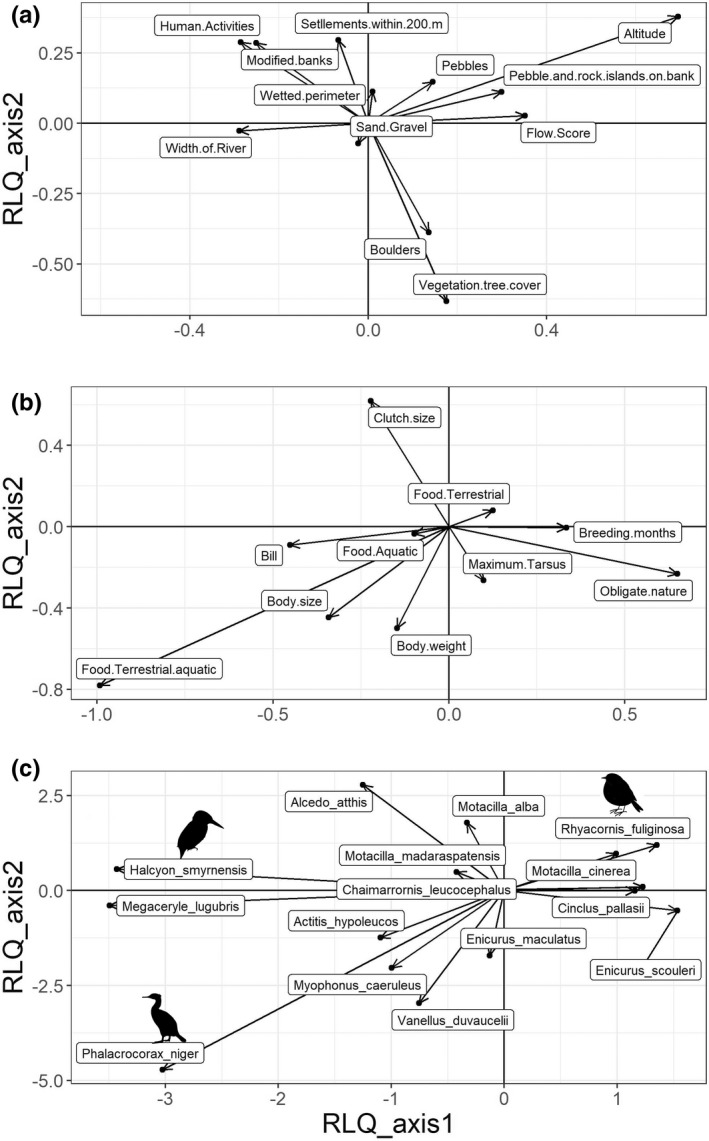
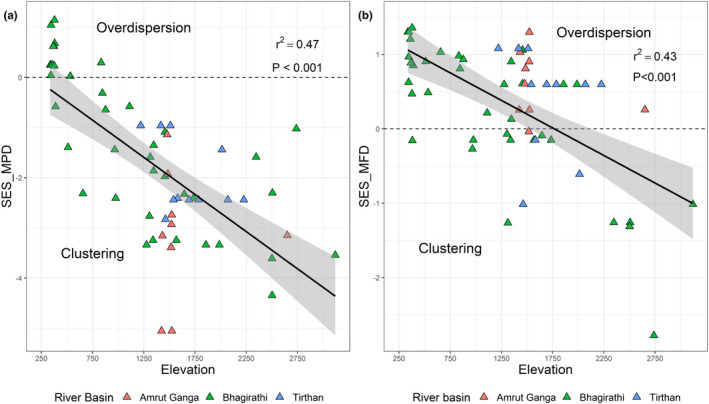
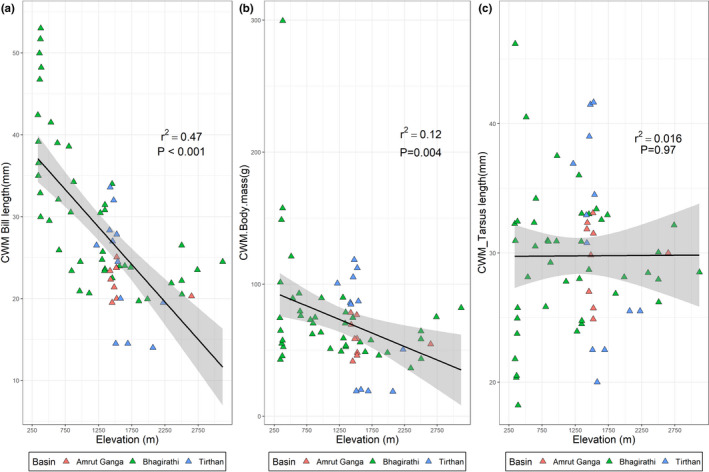
Heterogeneity in riverine habitats acts as a template for species evolution that influences river communities at different spatio-temporal scales. Although birds are conspicuous elements of these communities, the roles of phylogeny, functional traits and habitat character in their niche-use or species’ assembly have seldom been investigated. We explored these themes by surveying multiple headwaters over 3000 m of elevation in the Himalayan Mountains of India where specialist river birds reach their greatest diversity on Earth. After ordinating community composition, species traits and habitat character, we investigated whether river-bird traits varied with elevation in ways that were constrained or independent of phylogeny, hypothesising that trait patterns reflect environmental filtering. Community composition and trait representation varied strongly with elevation and river naturalness as species that foraged in the river/riparian ecotone gave way to small insectivores with obligate links to the river channel. These trends were influenced strongly by phylogeny as communities became more clustered by functional traits at higher elevation. Phylogenetic signals varied among traits, however, and were reflected in body mass, bill size and tarsus length more than in body size, tail length and breeding strategy. These variations imply that community assembly in high altitude river birds reflects a blend of phylogenetic constraint and habitat filtering coupled with some proximate niche-based moulding of trait character. We suggest that the regional co-existence of river birds in the Himalaya is facilitated by the same array of factors that together reflect the highly heterogeneous template of river habitats provided by these mountain headwaters.
Overview
The claims and statistics of this paper haven’t been checked yet.
Free: it reads the open-access text and checks the first 5 claims that cite a source we can check. Create a free account to check every claim.
Integrity signals
Registry
Cites
Statistics
Figures
Verification
Claims the paper makes
The claims and statistics of this paper haven’t been checked yet.
Free: it reads the open-access text and checks the first 5 claims that cite a source we can check. Create a free account to check every claim.
Self-check
Percentages, sums and reported differences re-computed from the paper’s own numbers.
The self-check needs the paper’s full text.
Citations
No citation lists for this paper
No citation lists for this paper yet — checked again daily.
References 90 · Cited by 22
Metadata
- Authors
- Sinha, A., Chatterjee, N., Krishnamurthy, R., & Ormerod, S.
- Affiliations
- Wildlife Institute of India (IN)
- University of British Columbia (CA)
- Cardiff University
- Venue
- Ecology and Evolution
- Publisher
- Wiley
- Published
- 2022-02-03
- Volume
- 12
- Issue
- 6
- Pages
- e9012-e9012
- ISSN
- 2045-7758 (ISSN-L)
- PMC
- PMC9204853
- OpenAlex
- W4283017490
- Cited by
- 22
- References
- 90
- Citations by year
- 2026: 3 · 2025: 2 · 2024: 2 · 2023: 13 · 2022: 2
- FWCI
- 2.53
- Type
- journal article
- Language
- en
- Open access
- gold
- doi.org
- Licence
- cc-by
- Locations
- Ecology and Evolution (publishedVersion, cc-by)
- PubMed Central (publishedVersion, cc-by)
- PubMed (publishedVersion)
- ORCA Online Research @Cardiff (Cardiff University) (acceptedVersion)
- DOAJ (DOAJ: Directory of Open Access Journals) (submittedVersion)
- Funders
- Ministry of Environment
- Ministry of Environment, Forest and Climate Change
- Topics
- Physical Sciences › Environmental Science › Ecology › Avian ecology and behavior
- Physical Sciences › Environmental Science › Nature and Landscape Conservation › Ecology and Vegetation Dynamics Studies
- Physical Sciences › Environmental Science › Ecology › Freshwater macroinvertebrate diversity and ecology
- Keywords
- community assembly, functional traits, phylogeny, elevation gradient, environmental filtering, phylogenetic signal, headwater streams, insectivorous birds, body size, bill size, tarsus length, species coexistence, habitat heterogeneity
About these checks
Registry, retraction, Cites and statistics results are computed, not judged, with one exception: a printed reference that no index lists is read once by a model before it counts as a citation error. Claims are extracted by a model and kept only when their quote appears verbatim in the text; each cited source is then checked, with a model’s help, for whether it says what the claim relies on. Those verdicts can be wrong — read the claim’s quote and the cited source before relying on one.
Statistics and arithmetic are recomputed, not judged.
Confidence bands are shown only for fields calibrated on our annotated test set. None is calibrated yet, so no band is shown.
What counts as a claim ›How we measure confidence ›How we check this ›
Are you an author, or do you see a problem with this page? Request a review
How to cite
Cite CoChat for the checks on this page, and the paper for its own findings.
- This page
- CoChat. (2026). Citation check: Community assembly, functional traits and phylogeny in Himalayan river birds. https://app.cochat.ai/papers/10.22541/au.164390436.66192037/v1
- The paper
- Sinha, A., Chatterjee, N., Krishnamurthy, R., & Ormerod, S. (2022). Community assembly, functional traits and phylogeny in Himalayan river birds. Ecology and Evolution. https://doi.org/10.22541/au.164390436.66192037/v1
Data sources
Bibliographic data: Semantic Scholar, OpenAlex, Crossref.
Contains information from the Semantic Scholar Academic Graph Datasets, made available under the ODC Attribution License (ODC-BY 1.0).
Semantic Scholar’s data is described in: Kinney, R., et al. (2023). The Semantic Scholar Open Data Platform. arXiv:2301.10140.
