

Evaluation of a multisite telehealth group model for persistent pain management for rural/remote participants
Open accessThe DOI matches its Crossref record; 62 of the 62 references it cites were found in a registry or an index.
Abstract
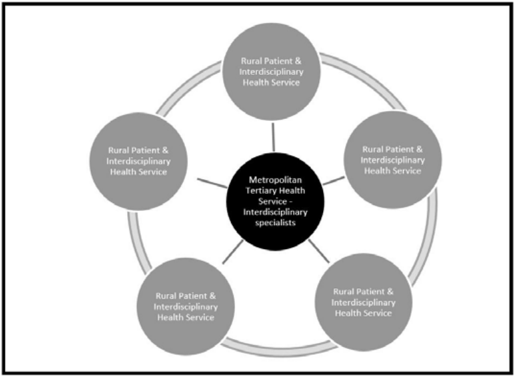
INTRODUCTION: Individuals living in rural/remote areas have recognised barriers to specialist services for persistent pain management. Although there is current evidence to support the use of telehealth to deliver individual pain management support, there is minimal evidence to support the use of pain management programs delivered within a group model, using telehealth. The aim of the present research was to perform a formative evaluation of a persistent pain management program implemented using a multisite telehealth group model, and to examine consumer perceptions. METHODS: The Manage Your Pain multisite telehealth group program was developed as a modified hub-and-spoke model. The model allowed participants from multiple rural/remote 'spoke' sites in Queensland, Australia to access four 2-hour specialist persistent pain management sessions from a metropolitan interdisciplinary persistent pain management centre ('hub' site, 491-1009 km from spoke sites), and simultaneously enable real-time access/interactions between participants at each of the spoke sites. Twenty-one individuals living with persistent pain participated in one of five multisite telehealth groups over the 10-month period. All participants completed standard pain scales before and after the pain management program, including Chronic Pain Acceptance Questionnaire 20 (CPAQ20), Brief Pain Inventory (BPI), Depression Anxiety Stress Scale (DASS 21), Pain Self Efficacy Questionnaire (PSEQ) and the Participant Reported Outcomes Measurement Information System (PROMIS). The Patient Impression of Change Scale (PICS), a telehealth perceptions survey, and a semi-structured telephone interview were completed post-program. RESULTS: Results revealed significant (p<0.05) improvements in the activity subscale and total score of the CPAQ, with 6 (30%) showing reliable improvement (90% confidence interval), indicating higher levels of activity engagement and pain acceptance after the program. Four (19%) participants made reliable improvement on the BPI interference. Post-program, the PICS revealed 65% of participants reported improvements in overall function, 61% indicated improved mood, 57% reported improved physical activity and 50% had some improvement in pain. Post-program, less than 10% of participants reported having technical (audio, visual) issues that had impacted on their sessions, and more than 90% found telehealth to be comfortable, convenient and would consider using it for their healthcare in the future. Post-program, most participants felt they had connected and were in a shared health experience with other group members through the multisite telehealth model. The interviews revealed three main themes: 'group experiences', which involved comments relating to the dynamics of the group and the shared experience; 'telehealth accessibility', which pertained to perceptions of the telehealth model for accessing specialist services; and 'limitations and concerns', where participants spoke of possible improvements to the program delivery model. CONCLUSIONS: Results confirmed that participants received benefit from the pain management program and that they had positive perceptions of receiving the service using a telehealth model. The present findings provide positive data to support using telehealth to deliver specialist persistent pain management for individuals who face accessibility issues in rural and remote communities. The model also demonstrated that positive elements of group treatment can be achieved through telehealth group models.
Overview
The claims and statistics of this paper haven’t been checked yet.
Free: it reads the open-access text and checks the first 5 claims that cite a source we can check. Create a free account to check every claim.
Integrity signals
Registry
Cites
Statistics
Figures


Verification
Claims the paper makes
The claims and statistics of this paper haven’t been checked yet.
Free: it reads the open-access text and checks the first 5 claims that cite a source we can check. Create a free account to check every claim.
Claims other papers make about this one
Each is checked against this paper’s own text: does it say what the citing paper says it does?
The cited source says what the claim attributes to it.
In the citing paper
“A recent multisite study found that a virtual group intervention was helpful for adults with persistent pain. 37”
From Virtual psychoeducation for improvement of pain catastrophizing in pediatric presurgical patients and caregivers: a proof-of-concept study (2023) · cites this paper as [37]
The cited source says what the claim attributes to it.
In the citing paper
“Two recent feasibility studies have, however, demonstrated that online-delivered group-based PMPs are feasible in a tertiary pain service setting33 and can be delivered successfully for people living in rural and remote areas.34”
Self-check
Percentages, sums and reported differences re-computed from the paper’s own numbers.
The self-check needs the paper’s full text.
Citations
Cites
Tong, A., Sainsbury, P., & Craig, J. (2007) · International Journal for Quality in Health Care · doi:10.1093/intqhc/mzm042 · Cited by 42,509
Qualitative research and evaluation methods
Patton, M. Q. (1980) · Cited by 35,743
von Elm, E., Altman, D. G., Egger, M., Pocock, S. J., Gøtzsche, P. C., & Vandenbroucke, J. P. (2008) · Journal of Clinical Epidemiology · doi:10.1016/j.jclinepi.2007.11.008 · Cited by 17,893
Cohen, J. (1992) · Psychological Bulletin · doi:10.1037//0033-2909.112.1.155 · Cited by 8,771
Jacobson, N. S., & Truax, P. (1991) · Journal of Consulting and Clinical Psychology · doi:10.1037/0022-006x.59.1.12 · Cited by 7,770
Core outcome domains for chronic pain clinical trials: IMMPACT recommendations
Turk, D. C., Dworkin, R. H., Allen, R. R., Bellamy, N., Brandenburg, N., Carr, D. B., Cleeland, C., Dionne, R., Farrar, J. T., Galer, B. S., et al. (2003) · Pain · doi:10.1016/j.pain.2003.08.001 · Cited by 3,510
Dworkin, R. H., Turk, D. C., Wyrwich, K. W., Beaton, D., Cleeland, C. S., Farrar, J. T., Haythornthwaite, J. A., Jensen, M. P., Kerns, R. D., Ader, D. N., et al. (2008) · The Journal of Pain · doi:10.1016/j.jpain.2007.09.005 · Cited by 3,471
Cella, D., Yount, S., Rothrock, N., Gershon, R., Cook, K., Reeve, B., Ader, D., Fries, J. F., Bruce, B., & Rose, M. (2007) · Medical Care · doi:10.1097/01.mlr.0000258615.42478.55 · Cited by 3,118
The cost of dichotomising continuous variables
Altman, D. G., & Royston, P. (2006) · BMJ · doi:10.1136/bmj.332.7549.1080 · Cited by 2,688
RELIEVING PAIN IN AMERICA: A BLUEPRINT FOR TRANSFORMING PREVENTION, CARE, EDUCATION, AND RESEARCH
Simon, L. S. (2012) · Journal of Pain & Palliative Care Pharmacotherapy · doi:10.3109/15360288.2012.678473 · Cited by 2,183
Research works printed but not linked: 4
- Lynch ME, Campbell FA, Clark AJ, Dunbar MJ, Goldstein D, Peng P, et al. Waiting for treatment for chronic pain -a survey of existing benchmarks: toward establishing evidence-based benchmarks for medically acceptable waiting times. Pain Research & Management 2007; 12(4): 245-248.
- Volwes KE, Wetherell JL, Sorrell JT. Targeting acceptance, mindfulness, and values based action in chronic pain: findings of two preliminary trials of an outpatient groups-based intervention. Cognitive and Behavioural Practice 2009; 16(1): 49-58. https://doi.org/10.1016/j.cbpra.2008.08.001 · DOI · Paper page
- McCracken LM, Vowles KE, Eccleston C. Acceptance-based treatment for persons with complex, long standing chronic pain: a preliminary analysis of treatment outcome in comparison to a waiting phase. Behaviour Research and Therapy 2005; 43(10): 1335-1346. https://doi.org/10.1016/j.brat.2004.10.003 · DOI · Paper page
- Baranoff JA, Hanrahan SJ, Burke ALJ. Changes in acceptance in a low-intensity, group-based acceptance and commitment therapy (ACT) chronic pain intervention. International Journal of Behavioural Medicine 2016; 23(1): 30-38. https://doi.org/10.1007 /s12529-015-9496-9 57 · doi:10.1007/s12529-015-9496-957
Cited by
Current Implementation of Digital Health in Chronic Disease Management: Scoping Review
Pong, C. Y., Tseng, R. M. W. W., Tham, Y. C., & Lum, E. (2024) · Journal of Medical Internet Research · doi:10.2196/53576 · Cited by 126
Telemedicine and current clinical practice trends in the COVID-19 pandemic
Wahezi, S. E., Kohan, L. R., Spektor, B., Brancolini, S., Emerick, T., Fronterhouse, J. M., Luedi, M. M., Colon, M. A., Kitei, P. M., Anitescu, M., et al. (2021) · Best Practice & Research Clinical Anaesthesiology · doi:10.1016/j.bpa.2020.11.005 · Cited by 56
“While benefits of telemedicine are substantial and include increased patient access to specialist pain care in rural areas, increased convenience with reduced driving, reduced wait times, greater flexibility in provider scheduling, and potential cost savings, barriers for telemedicine implementation continue to exist…”
Mental health professionals and telehealth in a rural setting: a cross sectional survey
Nelson, D., Inghels, M., Kenny, A. J., Skinner, S., McCranor, T., Wyatt, S., Phull, J. S., Nanyonjo, A., Yusuff, O., & Gussy, M. G. (2023) · BMC Health Services Research · doi:10.1186/s12913-023-09083-6 · Cited by 56
Development of a Telemedicine Neurological Examination for Spine Surgery: A Pilot Trial
Goyal, D. K. C., Divi, S. N., Schroeder, G. D., Pfeifer, R., Canseco, J. A., Bowles, D. R., Nicholson, K. J., Patel, P. D., Reyes, A. A., Radcliff, K. E., et al. (2020) · Clinical Spine Surgery A Spine Publication · doi:10.1097/bsd.0000000000001066 · Cited by 36
Telepractice and Dysphagia Management: The Era of COVID-19 and Beyond
Ward, E. C., Raatz, M., Marshall, J., Wishart, L. R., & Burns, C. L. (2022) · Dysphagia · doi:10.1007/s00455-022-10444-2 · Cited by 28
Self-citation
Metadata
- Authors
- Scriven, H., Doherty, D., & Ward, E.
- Affiliations
- Gold Coast Hospital (AU)
- Corresponding author
- Doherty, Darren
- Venue
- Rural and Remote Health
- Publisher
- Rural and Remote Health
- Published
- 2019-03-19
- Volume
- 19
- Issue
- 1
- Pages
- 4710-4710
- ISSN
- 1445-6354 (ISSN-L)
- OpenAlex
- W2923081234
- Cited by
- 41
- References
- 57
- Citations by year
- 2026: 2 · 2025: 5 · 2024: 5 · 2023: 8 · 2022: 6 · 2021: 7 · 2020: 7 · 2019: 1
- FWCI
- 4.86
- Type
- journal article
- Language
- en
- Open access
- diamond
- doi.org
- Licence
- cc-by
- Locations
- Rural and Remote Health (publishedVersion, cc-by)
- PubMed (publishedVersion)
- Topics
- Health Sciences › Medicine › Public Health, Environmental and Occupational Health › Telemedicine and Telehealth Implementation
- Health Sciences › Health Professions › Physical Therapy, Sports Therapy and Rehabilitation › Musculoskeletal pain and rehabilitation
- Health Sciences › Medicine › Anesthesiology and Pain Medicine › Pain Management and Treatment
- Keywords
- telemedicine, hub and spoke model, pain acceptance, pain self-efficacy, patient perspectives, chronic pain, activity engagement, anxiety and depression, physical activity, patient-reported outcomes
- MeSH terms
- Adult, Affect, Aged, Aged, 80 and over, Complementary Therapies, Analgesics, Female, Humans, Male, Middle Aged, Occupational Therapy, User-Computer Interface, Exercise, Telemedicine, Rural Health Services, Physical Therapy Modalities, Videoconferencing, Chronic Pain, Pain Management
About these checks
Registry, retraction, Cites and statistics results are computed, not judged, with one exception: a printed reference that no index lists is read once by a model before it counts as a citation error. Claims are extracted by a model and kept only when their quote appears verbatim in the text; each cited source is then checked, with a model’s help, for whether it says what the claim relies on. Those verdicts can be wrong — read the claim’s quote and the cited source before relying on one.
Statistics and arithmetic are recomputed, not judged.
Confidence bands are shown only for fields calibrated on our annotated test set. None is calibrated yet, so no band is shown.
What counts as a claim ›How we measure confidence ›How we check this ›
Are you an author, or do you see a problem with this page? Request a review
Data sources
Bibliographic data: Semantic Scholar, OpenAlex, Crossref.
Contains information from the Semantic Scholar Academic Graph Datasets, made available under the ODC Attribution License (ODC-BY 1.0).
Semantic Scholar’s data is described in: Kinney, R., et al. (2023). The Semantic Scholar Open Data Platform. arXiv:2301.10140.
